How to Use Base Chain: Bridge, Swap and Lend (2026)
— By Tony Rabbit in Tutorials

Learn how to use Base chain in 2026: bridging, swapping, lending, passkeys and Base App flows, plus the key risks every user should watch for.
Using Base Chain involves bridging assets to this Ethereum Layer 2 network, then swapping and lending within its DeFi ecosystem. Base, Coinbase's L2, offers sub-cent gas fees and native USDC, providing an accessible on-ramp for mainstream users into Ethereum DeFi, secured by Ethereum and built on the OP Stack.
Intent check: This page owns the Base ecosystem and dApp-usage angle. If you only need the beginner setup steps first, read How to Use Base Chain in 2026.
Base is Coinbase's Layer 2 network and, by mid 2026, the most accessible on-ramp into Ethereum DeFi for mainstream users. Built on the OP Stack, secured by Ethereum, and wired directly into a 110 million user exchange, Base has gone from launch novelty in August 2023 to a 20 billion dollar TVL ecosystem that quietly hosts more daily active addresses than any other L2.
If you have used Ethereum mainnet and recoiled at a 12 dollar swap, Base is the version of Ethereum you actually want. Sub-cent gas fees, native USDC, the Coinbase Smart Wallet with passkeys, sponsored gas, and a flagship DEX (Aerodrome) that has cleared more than 600 billion dollars in lifetime volume.
This 2026 guide walks through what Base is, how it works under the hood, how to bridge to it, how to add it to MetaMask, how to swap on Aerodrome step by step, how to lend on Morpho, the top memecoins (BRETT, DEGEN, TOSHI), the new Base App consumer pivot, and the centralization risks every user should understand before parking real money.
What Is Base Chain?
Base is an Ethereum Layer 2 optimistic rollup built by Coinbase on the OP Stack, launched on mainnet on August 9, 2023, by Jesse Pollak and his team. It batches thousands of transactions off-chain, posts the data to Ethereum mainnet for settlement, and uses fault proofs to inherit Ethereum's security guarantees. There is no native BASE token, gas is paid in ETH, and the canonical bridge is run by Coinbase.
In one sentence: Base is the cheapest, easiest way to use Ethereum if you already have a Coinbase account.
The network uses ETH for gas, settles to Ethereum mainnet, and is fully EVM-equivalent. Any Solidity contract that runs on Ethereum runs on Base unchanged. That is what lets Uniswap, Aave, Compound, Morpho, and Curve all deploy on Base with minimal effort, and what gave the chain a credible DeFi stack within weeks of launch.
A Short History: From Side Project to Top L2
Coinbase teased Base in February 2023. Internally it had been a side project led by Jesse Pollak, who runs Coinbase's wallet division. The thesis was simple: Coinbase had distribution, Ethereum had developers, and L2s had the room to actually scale. Plug all three together and you get the consumer crypto onramp the industry had been promising for years.
Base launched on mainnet on August 9, 2023, alongside the "Onchain Summer" campaign that drove millions of low-fee transactions in its first weeks. By the end of 2023 it had 400 million dollars in TVL. By the end of 2024 it crossed 4 billion. By the end of 2025 it was the second largest L2 by TVL, and through Q1 2026 it climbed past 20 billion thanks to Coinbase listings, native USDC, the Base App launch, and the Aerodrome flywheel.
Key milestones to remember:
- Aug 2023: Mainnet launch, Onchain Summer, friend.tech viral wave.
- Mar 2024: EIP-4844 (Dencun) ships blobs, Base fees drop 90 percent overnight.
- Sep 2024: Circle deploys native USDC on Base, retiring bridged USDbC.
- 2025: Coinbase Smart Wallet with passkeys + sponsored gas hits 10M wallets.
- Q4 2025: Base introduces fault proofs, completing Stage 1 rollup criteria.
- 2026: Coinbase rebrands its consumer app as Base App, putting Base in front of every retail user.
Worth contextualising next to the rest of the ecosystem. If you are new to L2s, our broader piece on Ethereum and its scaling roadmap explains why rollups exist in the first place.
How Base Works Under the Hood
Base is an optimistic rollup. That phrase does a lot of heavy lifting, so let us unpack it. A rollup is a separate chain that "rolls up" thousands of transactions, computes the result off Ethereum, and posts a compressed summary plus the raw transaction data back to Ethereum mainnet. Optimistic means the rollup assumes its results are correct and gives anyone a window to challenge them with a fault proof if they are not.
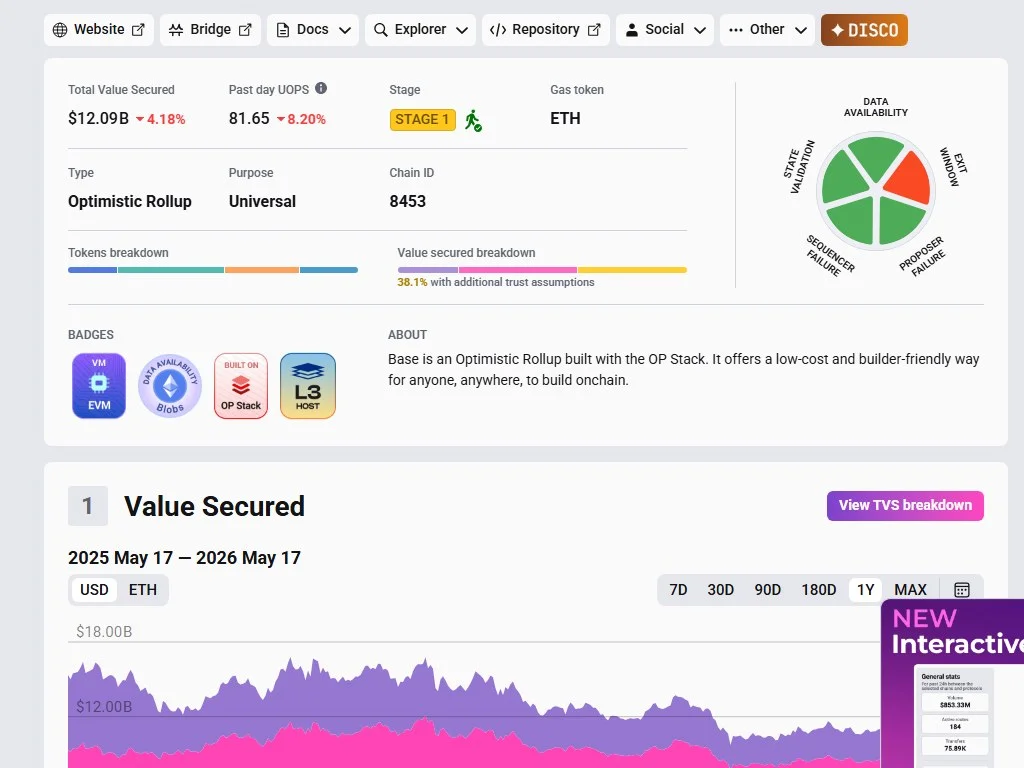
The OP Stack, maintained by Optimism, is the open source codebase that powers Base, Optimism, Mode, Zora, World Chain, and dozens of other rollups. Sharing a stack means upgrades, security research, and tooling improvements compound across every chain in the "Superchain" ecosystem. Base settles to Ethereum, posts blob data via EIP-4844, and is now in Stage 1 with permissionless fault proofs as of late 2025.
Why does this matter? Because the security claim of Base is "as good as Ethereum, minus the sequencer trust assumption." The sequencer can censor or reorder your transactions, but it cannot steal funds. Anyone watching can prove a bad state with a fault proof and slash a malicious actor. If the sequencer goes down (Base has had two notable outages in 2024 and one in 2025), users can force-include transactions directly through Ethereum L1, although the UX is rough.
How to Add Base to MetaMask
If you do not use Coinbase Wallet or the Coinbase Smart Wallet, MetaMask is the universal default. Adding Base takes 20 seconds. You can either go to chainlist.org and click "Add Base" or paste these RPC details manually.
To use a faster public endpoint, swap the RPC for one of https://base.llamarpc.com, https://base.publicnode.com or a personal Alchemy / Infura endpoint. Always use HTTPS, never paste an RPC from a random Telegram link, and double-check the chain ID 8453 to avoid getting fed a fake network by a phishing site.
Once Base is added, switch to it in the MetaMask network dropdown, send a tiny amount of ETH to your wallet, and you are live. For best practices on safer wallet management, see our piece on crypto wallet security and the explainer on using burner wallets for airdrops and memecoins.
How to Bridge to Base (5 Routes Compared)
Getting ETH or USDC onto Base is the one step most beginners overthink. You have five solid options, each with a different tradeoff between speed, cost, and trust.
The cleanest beginner path is Coinbase direct withdrawal: log in, send to a Base address, pick the Base network in the dropdown, confirm. Funds arrive in seconds with zero network fees because Coinbase eats the cost internally. If you do not use Coinbase, Across is the next best choice, with the lowest fees among trustless bridges and a 30-second average finality. For deeper context on cross-chain UX, our guide on how cryptocurrencies work across chains covers the messaging primitives underneath.
Avoid: bridges that ask you to approve unlimited token allowances for unknown contracts. Use Permit2-aware tools and review approvals in revoke.cash.
Coinbase Smart Wallet, Passkeys, and Sponsored Gas
The most underrated thing on Base is not a DEX or a memecoin. It is the Coinbase Smart Wallet. Launched in mid-2024 and matured through 2025, it is a smart-contract wallet (ERC-4337 account abstraction) where the "key" is a passkey stored in your phone or laptop. There is no seed phrase to memorise, no MetaMask popup to ignore, and no need to bridge ETH first because dApps can sponsor your gas.
How it works in practice:
- You visit a dApp that supports Smart Wallet (Aerodrome, Uniswap, OpenSea on Base, Farcaster, etc.).
- You click "Sign in" and Face ID or Touch ID authenticates you.
- A smart-contract wallet is provisioned at your address.
- The dApp uses a Paymaster (Coinbase Developer Platform) to pay your gas in USDC, or for free as a promo.
For new users, this is the closest crypto has come to feeling like a normal app. You do not need to understand gas, networks, or seed phrases on day one. The tradeoff: Smart Wallet is partially custodial in the sense that Coinbase manages the passkey recovery path. Power users still hold a hardware wallet for cold storage. But for daily DeFi and onchain consumer apps on Base, Smart Wallet is the new default.
Base vs Optimism vs Arbitrum vs zkSync vs Linea
Base does not exist in a vacuum. Here is how it stacks against the other big L2s in 2026.
Practical takeaway: Arbitrum still wins on raw DeFi sophistication (perps, structured products, RWAs). Base wins on retail onboarding, consumer apps, and memecoin culture. Optimism wins on Superchain alignment if you care about the broader OP collective. ZK rollups (zkSync, Linea, Scroll) win on cryptographic security and faster withdrawals but lag in liquidity. Most active users have wallets on Arbitrum and Base, and bridge between them as opportunities arise.
Gas Fees on Base: How Cheap Is Cheap?
Base gas got radically cheaper after Ethereum's Dencun upgrade in March 2024 introduced EIP-4844 blobs. Before Dencun, L2s posted calldata to Ethereum's execution layer, paying full gas prices. After Dencun, L2s post blob data, which lives on the consensus layer for 18 days at a fraction of the cost. Base passed the savings to users immediately, dropping median swap fees from 25 cents to under 1 cent.
Typical 2026 fees on Base:
- ETH transfer: ~$0.001
- USDC transfer: ~$0.002
- Uniswap swap: ~$0.01
- Aerodrome swap: ~$0.005
- NFT mint: ~$0.02
- Complex DeFi (lending + swap + deposit): ~$0.05
These numbers fluctuate with Ethereum blob demand. If many L2s post blobs in the same block, blob gas spikes and L2 fees rise temporarily. But the floor is structurally low, and Base is one of the cheaper L2s because Coinbase subsidises sequencer profits and contributes to the OP Collective. For a deeper explainer on the unit being priced, see what is gas price in gwei.
How to Swap on Aerodrome: Step by Step
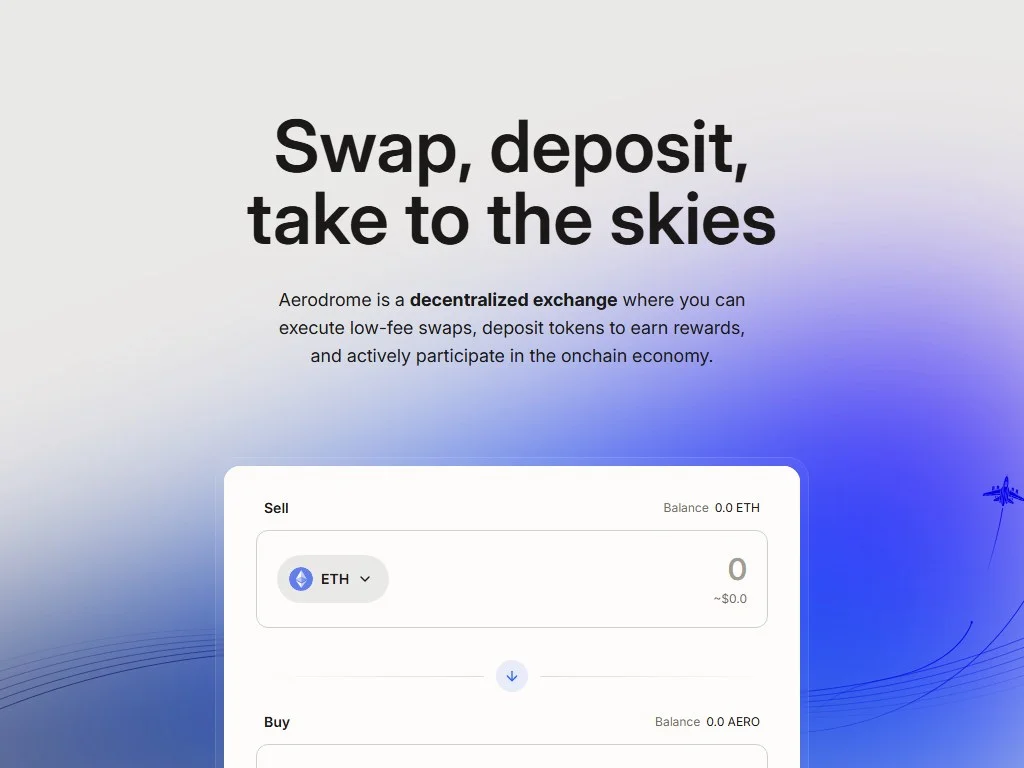
Aerodrome is the dominant Base DEX, a fork of Velodrome with the ve(3,3) model that aligns liquidity provider rewards with voting power. It routinely sees 1 to 2 billion dollars in weekly volume, more than every other Base DEX combined. Here is the exact walkthrough for swapping USDC for ETH on Aerodrome.
For aggregated routing across all Base DEXs (Aerodrome + Uniswap V3 + Sushi + Maverick), use 1inch or Matcha. They will sometimes find better routes for large trades that split across multiple venues.
Aerodrome veAERO Model Deep Dive
Aerodrome runs the ve(3,3) model pioneered by Curve and refined by Velodrome. It is the reason Base liquidity is so deep. Mechanics in plain English:
1. Lock AERO for veAERO. You buy AERO and lock it for 1 to 4 years. Longer locks = more voting power (veAERO). veAERO is non-transferable and decays linearly to zero at expiry.
2. Vote weekly for pools. Each Thursday (epoch flip) your veAERO votes for which liquidity pools should receive AERO emissions in the next epoch. You vote for pools you want to incentivise.
3. Earn bribes + fees. Protocols pay bribes (in their own tokens) to attract your votes. Voters earn 100% of the trading fees and bribes of the pool they vote on. Liquidity providers earn AERO emissions.
4. Flywheel: More AERO emissions to a pool attracts more liquidity, which makes it cheaper to trade, which generates more fees, which attracts more bribes, which makes veAERO more valuable, which raises AERO price, which attracts more locking. This is the ve(3,3) flywheel.
Practical advice: if you are a passive USDC holder, providing liquidity in the USDC/USDbC stable pool earns ~6 to 12% APR in AERO emissions with minimal impermanent loss. If you are bullish on AERO, lock for 4 years and vote weekly for the highest-bribe pool. Concept of impermanent loss applies on volatile pairs.
How to Lend on Morpho
Morpho is the leading lending market on Base, having overtaken Aave on the chain through 2025 thanks to its isolated-market design and curated vaults. Where Aave bundles all assets into one pool, Morpho lets curators (Steakhouse, Gauntlet, MEV Capital) build isolated markets with custom risk parameters.
The simplest play: deposit USDC into a curated vault, earn 5 to 12% APR depending on the vault's strategy. Steps:
- Go to app.morpho.org, connect wallet on Base.
- Pick the Earn tab, sort by USDC.
- Pick a vault. Steakhouse USDC and Gauntlet USDC Core are battle-tested.
- Deposit USDC, click "Approve" then "Deposit". Two transactions, total cost under 5 cents.
- Yields accrue continuously. Withdraw anytime (subject to vault liquidity).
For borrowing, you can deposit cbETH or wstETH as collateral and borrow USDC at sub-7% rates, useful for leveraged staking strategies. Watch the loan-to-value ratio carefully and avoid the liquidation zone.
Top dApps on Base in 2026
Base's ecosystem has matured into a credible top-3 DeFi destination. Below are the apps that move real volume and TVL.
If you want exposure to the broader DeFi stack including DeFi fundamentals, oracles like Pyth, and real-world assets like Ondo Finance tokenized treasuries, almost everything is now deployed on Base.
Top Base Memecoins: BRETT, DEGEN, TOSHI
Base became the memecoin chain of 2024 to 2026 because fees are low enough for retail to round-trip $50 trades without losing it all in gas. Three names dominate the ecosystem and have built durable communities.
BRETT (Based Brett): Pepe's friend in the original Matt Furie comics. Peaked at $1.8B market cap. Cult community, mostly community-driven, no team token. The Base memecoin that broke into top-100 by market cap.
DEGEN: Started as a Farcaster tipping token in early 2024. Now has its own L3 (Degen Chain) settling to Base. Used as a social tipping currency and as the unit of account for socialfi apps. Peaked north of $700M cap.
TOSHI: Named after Brian Armstrong's cat. The first memecoin to launch on Base (literally block 1). Cult-following, community-driven, semi-official Coinbase mascot energy. Top-3 Base memecoin by cap.
If you trade memes, set tight slippage (0.5 to 2%), use a fresh wallet, and always check the contract on basescan + DEXTools before buying. Honeypots and copy-token scams are rampant. Our piece on avoiding address poisoning covers the most common Base wallet attack vector.
The Base App Consumer Pivot
In Q1 2026, Coinbase rebranded its consumer mobile app into "Base App", merging the centralised exchange, the self-custody wallet, and onchain social into a single product. The pitch is simple: open the app, see your portfolio (CEX + onchain), tap to swap, tap to pay, tap to message a friend onchain, all within a passkey-secured Smart Wallet.
This is the biggest distribution event in L2 history. 110 million Coinbase users now have a one-tap door into Base DeFi. Onchain transactions inside the app are subsidised, swaps route through Aerodrome and Uniswap, USDC payments are gasless, and Farcaster is integrated as the native social layer.
The product implications are huge: Base is no longer competing with other L2s for crypto-native users. It is competing with Robinhood, Cash App, and Venmo for mainstream users. The bet is that onchain UX, subsidised gas, and seamless onboarding will eventually pull "normal" users into using DeFi without realising they are using DeFi.
Risks: Coinbase Centralization and Sequencer Downtime
Base is great, but it is not Ethereum mainnet. Honest tradeoffs every user should weigh:
The bull case: Coinbase has more skin in the game than any other rollup operator. A meaningful exploit on Base would tank Coinbase's regulatory standing and stock price, so incentives are well-aligned with security. The progressive decentralization roadmap (Stage 1 in 2025, Stage 2 in 2026 to 2027) brings Base closer to Ethereum-level trust assumptions over time.
Base Builder Rewards and Grants
Base has spent meaningfully on ecosystem development. Three programs are worth knowing:
Base Ecosystem Fund: Direct equity and token investment from Coinbase Ventures into Base-native startups. Cheque sizes from $100k to $5M. Apply via coinbase.com/ventures. The fund has backed Farcaster, Aerodrome, Virtuals Protocol, Talent Protocol, and dozens of consumer-facing apps that drive daily active users on Base.
Builder Rewards: Weekly distribution of ETH and merchandise to top-contributing builders on Base, measured by GitHub activity, deployed contracts, and Farcaster engagement. Tracked via Talent Protocol. Top builders earn 1 to 5 ETH per week and the program has paid out more than 10,000 ETH cumulatively since launch.
Onchain Summer hackathons: Annual flagship event in August (anniversary of Base launch). Prize pools regularly exceed $1M in ETH, USDC, and partner credits. The 2025 edition surfaced more than 600 new Base apps, several of which have grown to millions in TVL. Worth tracking even as a user, since winners often launch with airdrop campaigns.
If you are a developer, these programs are real money. If you are a user, they matter because they keep new apps shipping on Base at a faster pace than competitor L2s. The combination of Coinbase distribution and ongoing builder funding is what made Base catch up to (and in some metrics surpass) Arbitrum despite a two-year head start.
Onchain Summer and Base Culture Cycles
Beyond the technical stack, the thing that made Base feel different from day one was the marketing and community execution. "Onchain Summer" is an annual campaign Coinbase has run every August since 2023 to drive low-fee transactions, NFT mints, and consumer apps. The 2023 edition produced 5 million transactions in one month, mostly micro-mints under 50 cents each. The 2024 edition added Farcaster Frames and pulled in a wave of socialfi experiments. The 2025 edition added AI agents and tokenized media. Each cycle has compounded the daily active user base.
This cultural cadence matters because L2 economics depend on volume. A chain that processes 10 million transactions a month at sub-cent fees can still be a real business once you stack sequencer profits, MEV capture, and partner integrations. Base now processes more daily transactions than any other L2 and its sequencer is among the most profitable rollup operations in the industry, on track to deliver hundreds of millions in annualised revenue back to Coinbase.
For users, this matters in two practical ways. First, the cyclical hype means there are always new launches to participate in, often with airdrops or rewards. Second, the sequencer revenue means Coinbase has strong incentives to keep the chain stable and growing, not abandon it. Compare that to L2s where the operator has no consumer distribution and limited revenue: those are the ones most at risk of stagnation.
Pros and Cons of Base
- Cheapest reliable L2 fees (sub-cent swaps)
- Frictionless Coinbase onramp and offramp
- Native USDC, no bridged-wrapper risk
- Coinbase Smart Wallet + passkeys + sponsored gas
- Aerodrome flywheel and deep DEX liquidity
- Inherits Ethereum security via fault proofs
- Vibrant memecoin and socialfi culture
- Centralised sequencer run by Coinbase
- Regulatory exposure tied to Coinbase
- No native token (no governance, no airdrop)
- 7-day withdrawal window via canonical bridge
- Sequencer outage history (3 incidents 2023-25)
- Memecoin scam density is high
- Less mature derivatives stack than Arbitrum
Yield Strategies on Base in 2026
Past the basic swap and lend flows, Base hosts a credible stack of yield strategies that mirror what mainnet DeFi offered in 2021-22, but at one hundredth the gas cost. A few categories worth knowing.
Stablecoin yield: Park USDC in Morpho's Steakhouse or Gauntlet vaults for 5 to 12% APR. Park it in Aerodrome's USDC/USDbC stable pool for 6 to 14% APR mostly paid in AERO emissions. Use Compound on Base for a more conservative 3 to 5% APR with no emission risk. Stack with looping (borrow USDC against cbETH, redeposit) for leveraged 10 to 20% APR if you accept liquidation risk.
ETH yield: Convert ETH to cbETH (Coinbase's liquid staking token) or wstETH (Lido's) and earn 3 to 4% native staking yield. Deposit into Aerodrome's ETH/cbETH pool for additional emissions. Use as collateral on Morpho to borrow USDC and recycle into more cbETH for leveraged staking yields of 8 to 15%. Concept similar to Rocket Pool rETH on mainnet, adapted to Base.
RWA yield: Tokenized treasuries from Ondo Finance, Securitize, and Backed all settle on Base. Yields track 4 to 5.5% short-term US treasury rates with cryptographic settlement. See tokenized treasuries overview and RWA tokenization explained for the broader thesis.
LP and bribe farming: Lock AERO for 4-year veAERO and vote weekly for the highest-bribe pool. Active voters report 30 to 60% APR on their veAERO position. Requires weekly active management and willingness to handle volatile pool composition. Concept relies on the market maker incentives ve(3,3) coordinates.
Whatever strategy you pick, size it to a position you can monitor. Base is cheap enough to rebalance weekly without paying meaningful gas, but the protocols still carry smart contract risk. Diversify across at least two protocols and avoid keeping more than 30% of your DeFi capital in any single vault.
Trading on Base: Tools and Analytics
If you trade on Base, a small toolkit goes a long way. DEXTools is the most-used real-time terminal for spotting new pairs, tracking volume, and reading liquidity depth on Aerodrome, Uniswap V3, and the long tail of Base DEXs. DefiLlama tracks TVL by protocol, GeckoTerminal mirrors DEXTools with a different UI, and Dune dashboards let you slice on-chain activity by wallet or smart contract.
For active traders, key data points to monitor: 24h volume vs liquidity ratio (real demand vs farmed wash trades, covered in our fake volume detection guide), holder distribution on basescan, top-10 holder concentration, contract verification status, ownership renouncement, and dev wallet activity. Memecoin trading on Base is especially competitive because gas is so cheap that bots front-run every juicy launch. Set tight slippage, use private RPCs (Flashbots Protect equivalent on Base) when available, and never chase a candle that already 10x'd.
For systematic strategies, concepts like backtesting, VWAP, and long vs short positioning all apply to Base markets the same way they do to centralized exchanges. The difference is that on Base, you can build and run a strategy without permission, settle in seconds, and pay micropennies per transaction.
Best Practices for Using Base Safely
A few habits that separate experienced Base users from beginners burned in a memecoin rug:
- Use a hardware wallet for any position above $1,000. Ledger and Trezor work natively with MetaMask on Base.
- Use a burner wallet for memecoin sniping and risky dApps. Never connect your main wallet to a fresh contract.
- Set finite token approvals not infinite. Review and revoke approvals monthly via revoke.cash.
- Simulate transactions using transaction simulation tools like Tenderly or Blowfish before signing.
- Double check contract addresses on basescan + DEXTools before buying any token. Copy-token scams use lookalike addresses.
- Avoid signing blind transactions. If MetaMask shows a raw hex blob and no human-readable summary, do not sign.
- Use 1inch or Matcha for large swaps to get aggregated routing across all DEXs.
- Bridge small amounts first when trying a new bridge. Confirm receipt before sending real money.
For more wallet hygiene, see understanding nonce errors and stablecoin fundamentals.
Frequently Asked Questions
Q Is Base safe to use?
Q Does Base have a token?
Q How do I get ETH onto Base?
Q Base vs Arbitrum, which should I pick?
Q What is the chain ID for Base?
Q How long does it take to withdraw from Base to Ethereum?
Q Why are Base gas fees so cheap?
Q What wallet should I use on Base?
Q Is USDC on Base the real USDC?
Q What is the Base App?
Q Can I run a node on Base?
Q What are the best Base memecoins?
Conclusion: Why Base Wins in 2026
Base is the L2 that finally made onchain feel like a consumer product. Sub-cent fees, native USDC, Coinbase Smart Wallet, sponsored gas, Aerodrome liquidity, and the Base App putting an L2 in front of 110 million retail users. None of these features in isolation is revolutionary. Stacked together, they make Base the easiest way for a non-developer to actually use DeFi, mint NFTs, tip on Farcaster, or trade BRETT.
The honest tradeoff is centralisation. The sequencer is Coinbase, the canonical bridge is Coinbase, and the regulatory exposure flows back to a US-listed exchange. For mainstream users, this is a feature (familiar brand, KYC compliance, recovery paths). For maximalist permissionless users, it is a reason to keep most exposure on Ethereum L1 or on more decentralised L2s. Most of us land somewhere in the middle: hold long-term in cold storage on L1, transact daily on Base.
If you are starting from zero today, the workflow is: open Coinbase, buy some ETH or USDC, withdraw to your wallet on Base (free, instant), add Base to MetaMask (chain ID 8453), and try a 10 dollar swap on Aerodrome. The whole onboarding takes 10 minutes and costs pennies. From there, the entire Base ecosystem (Morpho, Uniswap V4, Farcaster, BRETT, Zora) opens up.
For deeper related reading, browse our coverage on DeFi fundamentals, Ethereum basics, the Uniswap V4 hooks guide, and the Pyth oracle network. Track Base TVL, top tokens, and trending pairs in real time on DEXTools, the trader's terminal for every Base swap.
Related Guides
- How to Use Base Chain in 2026: Wallet Setup, Bridge and First Transaction Guide
- Base Chain Ecosystem Guide: Architecture, Fees, dApps and Coinbase's L2 (2026)
- How to Use Coinbase Wallet: Self-Custody and dApp Guide (2026)
- Coinbase App vs Advanced Trade vs Wallet: Which One Should You Use in 2026?
- Coinbase Advanced Trade vs Coinbase App: Wallet and Fee Guide (2026)
- What Is Abstract Chain? The Pudgy Penguins Consumer Layer 2