What Is Tether (USDT): Complete Stablecoin Guide (2026)
— By Tony Rabbit in Tutorials

What is Tether USDT? Complete 2026 guide: $200B+ stablecoin pegged 1:1 to USD, multi-chain (Ethereum, Tron, Solana), reserve attestations, USDT vs USDC vs DAI, mint/redeem flow.
Tether (USDT) is the largest stablecoin in the world and arguably the most important asset in all of crypto outside of Bitcoin itself. With a market capitalization that has surged past $140 billion in 2026, USDT now settles more daily volume than Bitcoin, Ethereum, and every other crypto asset combined. If you have ever moved money across a centralized exchange, sent value across borders without a bank, or hedged a volatile stablecoin position, you almost certainly used USDT.
But what exactly is Tether? How does a private company in the British Virgin Islands maintain a $140 billion peg to the US dollar? Why does USDT exist on more than a dozen blockchains, and why does the TRC-20 version dominate trading volume while the ERC-20 version dominates DeFi? Is Tether actually safe in 2026, after years of regulatory pressure, a record-breaking CFTC settlement, and the rollout of MiCA in Europe? This complete guide answers every one of those questions.
In this evergreen tutorial you will learn what USDT is, how its reserves are structured today, the differences between USDT on TRC-20, ERC-20, Solana SPL, BSC, and TON, how USDT compares head to head with USDC, DAI, and FDUSD, what MiCA and the FATF Travel Rule mean for everyday holders, and where Tether is heading next with its expansion into Bitcoin mining, AI, and Latin American banking. By the end you will understand exactly why USDT is the silent backbone of crypto and how to use it safely.
What Is Tether (USDT) in Simple Terms?
Tether, ticker USDT, is a stablecoin issued by Tether Limited, a private company that pegs each token one to one to the US dollar. For every USDT in circulation, Tether claims to hold an equivalent dollar of reserves in cash, US Treasury bills, Bitcoin, gold, secured loans, and other instruments. When you buy USDT for one dollar, you can in theory redeem it later for one dollar. That simple promise is what makes USDT useful as a unit of account, a medium of exchange, and a store of value in the crypto economy.
The reason USDT exists at all is that the legacy banking system and the crypto economy do not talk to each other natively. Sending a wire transfer between two banks can take days and cost dozens of dollars in fees. Sending USDT between two crypto wallets takes seconds and costs cents. By tokenizing the US dollar on public blockchains, Tether bridged the gap between fiat money and on-chain liquidity, and that bridge has now become the most heavily trafficked road in all of crypto.
It is critical to understand that USDT is not the US dollar. It is a tokenized claim against Tether Limited that the market trusts to be worth one dollar. The peg is maintained through a combination of redemptions (large institutions can mint or redeem USDT directly with Tether at a one-to-one rate), arbitrage (when the price drifts on secondary markets, traders profit by closing the gap), and reserve transparency (Tether publishes quarterly attestations from BDO Italia showing the composition of its reserves). For more on how the broader stablecoin model works, see our complete stablecoin guide.
A Brief History of Tether (2014 to 2026)
Tether was originally launched in July 2014 under the name Realcoin by Brock Pierce, Reeve Collins, and Craig Sellars. The project was built on top of the Omni Layer, a protocol that lives on the Bitcoin blockchain. A few months later it was rebranded to Tether, and in early 2015 Bitfinex listed it for trading. From day one Tether and Bitfinex shared overlapping ownership and management, a fact that would later become the centerpiece of years of regulatory scrutiny.
For its first three years, USDT remained a niche product used mostly by traders on Bitfinex and Poloniex to park funds between trades. The first major inflection point came in 2017 when Tether migrated USDT to the Ethereum blockchain as an ERC-20 token. Suddenly USDT was programmable, composable with the emerging DeFi ecosystem, and easily transferable across hundreds of exchanges. By the end of 2017, USDT supply exceeded $1 billion for the first time.
The second inflection point came in 2019 when Tether issued USDT on the Tron blockchain as a TRC-20 token. Tron offered transaction fees that were a tiny fraction of Ethereum gas costs, and within 18 months TRC-20 USDT became the most heavily traded version of the token. By 2022, TRC-20 USDT alone accounted for more on-chain transfer volume than the entire Ethereum network. Today, in 2026, more than 50% of all USDT transfer volume happens on Tron.
Tether has also faced major regulatory storms. In 2021 the New York Attorney General reached an $18.5 million settlement with Tether and Bitfinex over claims about reserve backing, and the CFTC settled for an additional $41 million the same year. Each settlement pushed Tether toward greater transparency. By 2023 the company was publishing quarterly attestations, and by 2026 those attestations are produced by BDO Italia, one of the top global accounting firms, and include line-by-line breakdowns of every reserve asset.
USDT Reserve Composition in 2026
The most important question anyone can ask about a stablecoin is what backs it. In 2026, Tether publishes a detailed quarterly attestation that breaks down the composition of its reserves. The latest figures show that the overwhelming majority of USDT is backed by short-duration US Treasury bills, making Tether one of the largest non-sovereign holders of US debt in the world, ranked alongside countries like Germany and South Korea.
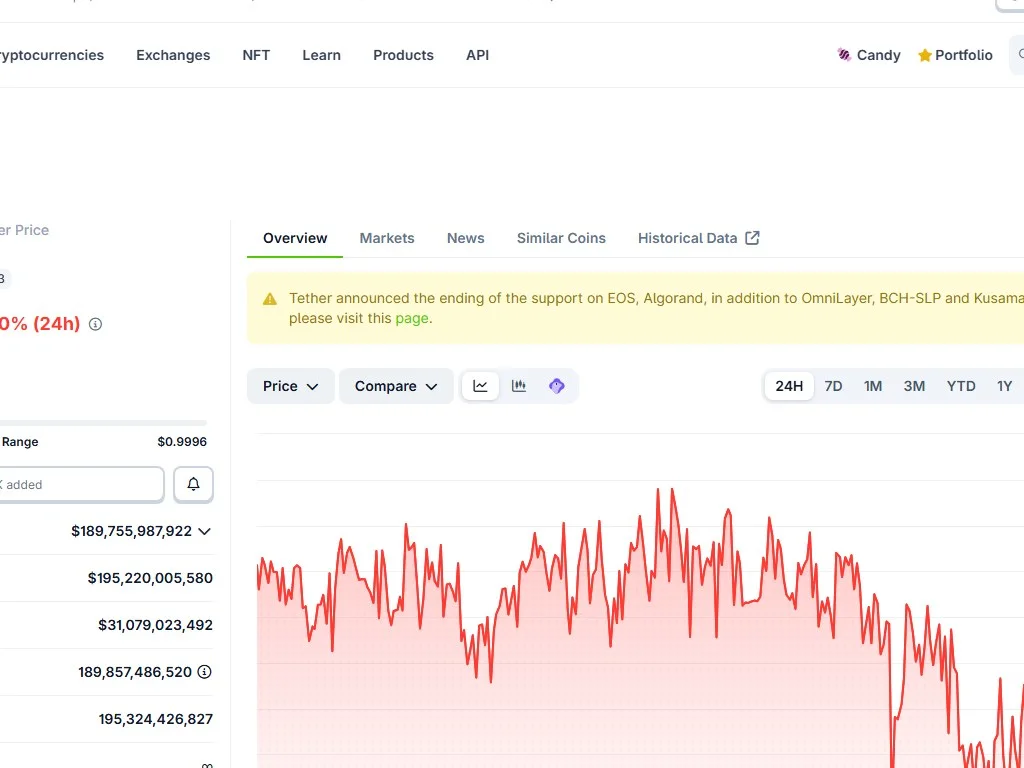
This composition is dramatically different from where Tether was in 2018. Back then, only about 30% of reserves were in direct cash or Treasury equivalents, and a large portion was made up of commercial paper, secured loans, and intercompany receivables. The shift to Treasury bills was driven by both regulatory pressure and pure economics: short-duration T-bills are paying around 5% in 2026, which generates billions of dollars in annual interest income for Tether. That interest is what funds Tether's aggressive expansion into Bitcoin mining, AI infrastructure, and Latin American banking, which we cover later in this guide.
One important caveat: an attestation is not a full audit. An attestation confirms that on a specific date the reserves existed and were valued correctly, but it does not provide the same level of assurance as a full audit by a Big Four firm. Tether has stated repeatedly that it is working toward a full audit, and in 2026 it has hired additional staff to prepare for that step, but as of this writing no Big Four firm has signed off on a Tether audit.
USDT on TRC-20 vs ERC-20 vs Solana vs BSC vs TON
Tether is unique among stablecoins because it is issued natively on more than a dozen different blockchains. Each version is a separate token, with different supply, fees, transaction speed, and user base. The version you choose matters a lot, and choosing wrong can cost you money or in some cases cause you to lose funds entirely if you send to the wrong network.
USDT on Tron (TRC-20): The Volume King
Tron USDT is the version most exchanges default to and the version that has quietly become the most-used dollar instrument in the world for cross-border remittance corridors. The reason is brutally simple: transactions cost around one dollar and confirm in three seconds. If you are sending $200 from Dubai to Lagos or from Manila to Mexico City, paying 50 cents to a dollar in fees is acceptable. Paying $20 in Ethereum gas fees is not. Read more about how the two standards differ in our TRC-20 vs ERC-20 comparison.
TRC-20 USDT also dominates exchange-to-exchange settlement. When market makers move billions of dollars between Binance, OKX, Bybit, and Coinbase, they overwhelmingly use TRC-20 because the cost difference at scale is enormous. Moving $100 million in TRC-20 might cost $5 in fees. Moving the same amount in ERC-20 could cost $400.
The trade-off is that the Tron network is more centralized than Ethereum. There are around 27 super representatives that produce blocks, and the network has been associated with various controversies tied to its founder Justin Sun. For everyday users moving stablecoins, this rarely matters. For institutions concerned about decentralization and censorship resistance, it can be a deal-breaker.
USDT on Ethereum (ERC-20): The DeFi Standard
Ethereum USDT remains the standard for everything related to decentralized finance. If you are providing liquidity on Curve, using Aave for lending, or running flash loan arbitrage, you almost certainly need ERC-20 USDT. Ethereum is also the version most heavily used by traditional institutional desks because of its battle-tested security and the deep integrations with custody providers like Fireblocks and BitGo.
The downside is gas fees. During peak network congestion, sending ERC-20 USDT can cost $20 to $50. Even during normal periods, fees of $2 to $5 are common. For small transfers, this makes ERC-20 USDT impractical. For DeFi power users and large institutional flows, the cost is irrelevant compared to the value of the strategies being executed.
USDT on Solana (SPL): The Speed Specialist
Tether on Solana lives as an SPL token. Solana offers sub-second confirmations and fees that round to fractions of a cent. For high-frequency trading on decentralized exchanges like Jupiter and Raydium, Solana USDT is unbeatable. The supply on Solana has been growing rapidly through 2025 and 2026 as institutional flows have followed retail traders onto the network.
One important note: Solana has experienced multiple network outages over its history. While stability has improved significantly with the Firedancer client rollout, traders who need bulletproof uptime for settlement still prefer Ethereum or Tron for large transfers.
USDT on TON: The Telegram Native
The newest important deployment of USDT is on The Open Network (TON), the blockchain originally developed by Telegram. TON USDT is integrated directly into the Telegram wallet, which means hundreds of millions of Telegram users can send dollars to each other inside the messenger with the same experience as sending a text. This is potentially the largest distribution channel any stablecoin has ever had. Read our dedicated guide on USDT on TON and the Telegram wallet to learn more.
USDT vs USDC vs DAI vs FDUSD: Head to Head
USDT is the largest stablecoin, but it is not the only one. The two closest competitors are Circle's USDC and MakerDAO's DAI, with Binance-affiliated FDUSD rounding out the top four. Each has a fundamentally different design philosophy, regulatory posture, and risk profile.
The simplest way to think about the trade-offs: USDT is the most liquid and most widely accepted but has the weakest regulatory posture. USDC is fully transparent and US-regulated but lost ground after its temporary depeg during the Silicon Valley Bank collapse in March 2023. DAI is the only major decentralized stablecoin and cannot be frozen by any single entity, but its supply is smaller and partly backed by USDC itself. FDUSD is a newcomer that has captured Binance flow but lacks the breadth of integrations of USDT or USDC.
For trading on centralized exchanges and moving money across borders, USDT is the default choice. For DeFi where you want regulatory clarity and US-based banking exposure, USDC is preferred by many institutional players. For users who specifically want censorship resistance, only MakerDAO's DAI meets that requirement.
The Regulatory Landscape in 2026
The regulatory environment for stablecoins has changed dramatically in the past two years. Three major frameworks now shape how Tether operates: the EU's Markets in Crypto-Assets regulation (MiCA), the FATF Travel Rule, and what crypto industry insiders refer to as Operation Choke Point 2.0 in the United States.

MiCA in the European Union
The Markets in Crypto-Assets regulation came into full force across the EU at the end of 2024. Under MiCA, any issuer of an asset-referenced or e-money token who wants to offer it to EU residents must be authorized by an EU regulator and must hold reserves in EU-licensed credit institutions. Tether has so far declined to seek a MiCA license, and as a result several European exchanges, including Crypto.com, Bitstamp, and Coinbase Europe, have delisted USDT for EU residents.
This is one of the most consequential regulatory shifts in stablecoin history. It does not mean USDT cannot be used in Europe at all (peer-to-peer transfers, self-custody, and trading on non-EU venues are still possible) but it does mean USDT is functionally absent from regulated EU exchanges. USDC, by contrast, obtained an electronic money institution license in France and is fully MiCA compliant. As a result, USDC has gained significant ground in the European market.
The FATF Travel Rule
The Travel Rule, enforced by the Financial Action Task Force, requires that financial institutions transmitting funds above a certain threshold (typically $1,000 or 1,000 euros) share information about the sender and receiver. As crypto exchanges and stablecoin issuers are increasingly classified as Virtual Asset Service Providers, they must implement Travel Rule compliance.
For USDT, this manifests in two ways. First, exchanges that handle USDT must collect and share KYC information for transfers above the threshold, even between exchanges. Second, Tether itself maintains the ability to freeze USDT held in wallets that have been flagged by law enforcement. As of 2026, Tether has frozen well over $2 billion in USDT across thousands of addresses linked to sanctions violations, ransomware payments, and stolen funds. This freeze capability is a fundamental feature of how Tether interacts with the global financial system.
Operation Choke Point 2.0 and the Tether US Push
In the United States, the regulatory environment has been hostile to offshore stablecoins for several years. The unofficial campaign that crypto industry commentators call Operation Choke Point 2.0 refers to a coordinated effort by US banking regulators, the SEC, and the CFTC to limit the ability of crypto companies to access traditional banking. Tether responded in 2025 by announcing the development of a US-domestic stablecoin, Tether USA (sometimes referred to as USA-T), which is intended to be fully compliant with the federal stablecoin framework that emerged from the GENIUS Act and similar US legislation.
Tether USA is not the same as USDT. It is a separate token, issued by a US-domiciled subsidiary, with reserves held entirely in US Treasury bills and cash in US banks. The strategy is to keep USDT as the global, offshore, high-utility stablecoin while Tether USA serves the US institutional and consumer market in compliance with US law.
How to Buy USDT Safely
Buying USDT is straightforward but you need to choose the right venue and network. Here are the most common options ranked by ease of use and security.
Whichever method you use, two safety rules apply. First, always double-check the network before withdrawing. Sending TRC-20 USDT to an ERC-20 deposit address will result in lost funds because the receiving exchange does not monitor that network for that address. Second, never store large balances on a centralized exchange long-term. Withdraw to a self-custody wallet such as MetaMask (for ERC-20), Phantom (for SPL), or Tonkeeper (for TON Jetton).
The Most Common Use Cases for USDT
USDT is the Swiss Army knife of crypto. Here are the five most common ways people actually use it in 2026.
Send dollars from anywhere to anywhere in seconds for cents. TRC-20 USDT now moves more value across emerging-market corridors than Western Union and MoneyGram combined.
USDT is the dominant quote currency on every major exchange. The BTC/USDT pair alone settles tens of billions of dollars per day across spot and perpetuals markets.
When the market turns, traders rotate from BTC, ETH, and altcoins into USDT to preserve dollar value. No fiat off-ramp needed, no taxable event in many jurisdictions.
In Argentina, Turkey, Nigeria, Venezuela, and Lebanon, USDT functions as a synthetic dollar savings account. Millions of people now hold their savings in stablecoins.
Supply USDT to Aave, Compound, or Curve to earn yield. Provide it as liquidity in stable pools to capture trading fees with minimal impermanent loss.
Remote workers in 100+ countries receive their salaries in USDT. Platforms like Deel, Request, and Liquify settle millions in stablecoin payroll every month.
Tether's Strategic Expansion: Mining, AI, and Latin America
One of the most underappreciated stories in crypto is what Tether is doing with the billions of dollars in interest income its Treasury bill holdings generate. Rather than paying out profits to shareholders, Tether has been reinvesting aggressively into adjacent industries that strengthen the long-term position of the company and the broader Bitcoin ecosystem.
Bitcoin Mining
Tether has become one of the largest Bitcoin mining operators in the world, with operations in Uruguay, Paraguay, and El Salvador. The strategy is twofold. First, mining converts Tether's surplus profits into Bitcoin, which is held as part of the reserve buffer. Second, owning mining capacity gives Tether a direct stake in Bitcoin's network security, which Tether's stability ultimately depends on. By 2026, Tether's mining operations are estimated to control around 3% of total Bitcoin hash rate.
AI Infrastructure
Tether has invested hundreds of millions into AI infrastructure, including Northern Data Group, a German operator of AI compute centers. The thesis is that AI compute and crypto mining share similar infrastructure (power-hungry data centers in remote locations) and that the same operational expertise translates across both industries. Tether has also acquired stakes in several AI startups, including some focused on open-source language models.
Latin American Banking
Tether has invested in or acquired stakes in a growing list of fintech and banking companies across Latin America, where USDT has effectively become the de facto dollar in countries with capital controls and high inflation. Strategic investments include payment processors in Argentina, neobanks in Mexico, and education-focused platforms across the region. The goal is to deepen USDT's distribution and utility in the markets where it has the strongest organic adoption.
Risks: Depeg History and Regulatory Threats
No serious guide to USDT is complete without an honest discussion of the risks. Tether has been at the center of multiple controversies and at least three significant depeg events in its history. Understanding these helps you size positions appropriately.
Historical Depeg Events
USDT has briefly traded below its dollar peg several times. In October 2018, during the Bitfinex banking crisis, USDT dropped to around $0.85 on some exchanges before recovering. In May 2022, in the wake of the Terra/LUNA collapse, USDT briefly dipped to about $0.95 as panicked traders rotated into competitors. In each case, Tether processed billions of dollars in redemptions at the official 1:1 rate, and arbitrageurs eventually restored the peg. A depeg in a stablecoin can be a buying opportunity, but only if you have a clear thesis about why the peg will be restored.
Regulatory Threats
The most plausible long-term threat to Tether is regulatory rather than economic. If a major jurisdiction were to declare USDT an unregistered security or ban its use entirely, the immediate impact on liquidity could be severe. Even in 2026, after Tether has dramatically improved its transparency and reserve composition, the company has not solved the structural issue of being an unregulated dollar-equivalent that competes with US bank deposits.
Counterparty Risk
USDT is a centralized stablecoin. Tether Limited can freeze your USDT if you are flagged by law enforcement, sanctions authorities, or in some cases by Tether's own compliance team. This is not theoretical: thousands of addresses have been frozen, and individual holders have at times found themselves locked out of their funds without warning. For users in compliant jurisdictions, this risk is minimal. For users in sanctioned countries or operating in gray-market activities, it is a serious consideration.
USDT in DeFi: Bridges and Wrapped Versions
One important nuance: not all USDT is native USDT. When USDT moves across chains via bridges, the resulting token on the destination chain is often a bridged version rather than a Tether-issued one. Bridged USDT carries additional risk because it depends on the security of the underlying bridge, and history is full of cross-chain bridge hacks. When possible, always use native USDT minted directly by Tether on the chain you are using.
Tether has been moving aggressively to deploy native USDT on more chains rather than relying on third-party bridges. By 2026, native Tether-issued USDT is available on Ethereum, Tron, Solana, BSC, TON, Polygon, Avalanche, Cosmos, Arbitrum, Optimism, Base, NEAR, Algorand, Tezos, and several more. Always check whether the version on the chain you are using is native or bridged before holding large balances.
Video: Tether USDT Explained in 10 Minutes
A complete visual breakdown of how USDT works, who controls it, and why it matters.

Pros and Cons of Using USDT
- Deepest liquidity of any digital asset in the world
- Available on 14+ blockchains with cheap fees on TRC-20, SPL, TON
- Accepted on virtually every exchange and DeFi protocol
- Reserves dominated by US Treasury bills since 2023
- Battle-tested through multiple market crises
- Excellent for cross-border payments and remittances
- No full Big Four audit, only quarterly attestations
- Not MiCA compliant, delisted from many EU exchanges
- Centralized issuer that can freeze tokens
- History of brief depegs during market crises
- Offshore registration creates legal uncertainty in some jurisdictions
- Complex multi-chain landscape increases user error risk
The Future of USDT
Looking forward from 2026, the trajectory of USDT depends on three big questions. First, will Tether successfully launch a US-domestic stablecoin while keeping USDT dominant offshore? Second, will the FATF Travel Rule and MiCA expand into more jurisdictions, potentially eroding USDT's market share to compliant competitors like USDC and FDUSD? Third, can central bank digital currencies (CBDCs) replace stablecoins, and if so, on what timeline?
Our view is that USDT will remain dominant in emerging markets and offshore finance for the foreseeable future, while compliant alternatives gain share in regulated Western markets. The dollar-equivalent token market is large enough to support multiple winners, and Tether's first-mover advantage, distribution, and Bitcoin reserves give it a structural moat. The most likely future is one where USDT keeps growing in absolute terms while losing market share in regulated markets and gaining it in unbanked and high-inflation economies.
What is certain is that stablecoins as a category are now too large and too useful to disappear. With a combined market cap above $250 billion in 2026, stablecoins have become a fundamental piece of global financial plumbing. USDT is the largest and most important of them, and understanding it is essential for anyone serious about crypto.
Frequently Asked Questions
Q What is USDT in simple terms?
Q Is Tether (USDT) safe to use in 2026?
Q What is the difference between USDT on TRC-20 and ERC-20?
Q USDT vs USDC: which is better?
Q Can Tether freeze my USDT?
Q Has USDT ever depegged from the dollar?
Q Is USDT legal in the European Union?
Q How does Tether make money?
Q What is the cheapest way to send USDT?
Q Can I earn yield on USDT?
Conclusion: Why USDT Still Dominates
Tether is one of the most consequential financial innovations of the past decade. From a Bitcoin-Omni experiment in 2014 to a $140 billion settlement layer that moves more daily volume than every other crypto asset combined, USDT has quietly become the silent backbone of the digital economy. It is the most-used dollar instrument in emerging markets, the dominant quote currency on every major exchange, and the de facto settlement asset for global crypto liquidity.
None of this means USDT is without risk. The lack of a full audit, the regulatory uncertainty in Europe and the United States, and the centralized freeze capability are all real considerations that should inform how you use it. But for the vast majority of users, USDT remains the most practical and liquid stablecoin in the world, and its reserve composition in 2026 is the strongest it has ever been.
Understanding USDT is no longer optional for anyone serious about crypto. Whether you are a trader rotating between assets, a remittance sender moving value across borders, a saver in a high-inflation economy, or a DeFi user farming yield, USDT is part of the infrastructure you depend on. Bookmark this guide, share it with anyone who still asks "what is USDT?", and check back as we update it through every major regulatory and reserve milestone in the years ahead.