How to Use Base Chain in 2026: Beginner Setup Guide

— By Tony Rabbit in Tutorials

How to Use Base Chain in 2026: Beginner Setup Guide

Learn how to use Base chain in 2026 with a beginner setup guide covering wallets, bridging, gas, swaps, approvals, and your safest first steps on Coinbase L2.

Base is a Layer 2 blockchain built on the OP Stack and incubated by Coinbase, one of the largest cryptocurrency exchanges in the world. Since its mainnet launch in August 2023, Base has quickly become one of the most active L2 networks, attracting billions in TVL and millions of users drawn by its low fees, fast transactions, and the credibility of the Coinbase brand behind it.

This tutorial covers everything you need to know about using Base - from adding the network to your wallet and bridging ETH, to trading on Base DEXs, exploring the ecosystem, and minting NFTs. Whether you are new to Layer 2 networks or migrating from another chain, this guide will get you up and running.

Intent split

Base Chain - Key Metrics 2026

$8B+
Total Value Locked
~$0.01
Average Gas Fee
2M+
Daily Transactions
500+
dApps Deployed

What is Base?

Base is an Ethereum Layer 2 (L2) network that processes transactions off of the main Ethereum chain (Layer 1) while inheriting its security guarantees. It uses optimistic rollup technology through the OP Stack - the same framework that powers Optimism, another major L2 network.

The core idea behind Base (and L2s in general) is simple: execute transactions on a faster, cheaper chain while periodically posting compressed transaction data back to Ethereum mainnet for security and finality. This allows Base to offer transaction fees that are a fraction of a cent while maintaining the trustless security model of Ethereum.

Key Characteristics

Built by Coinbase: Base is incubated and backed by Coinbase, bringing institutional credibility and a massive potential user base. Coinbase has committed to decentralizing Base over time through the Superchain ecosystem.

OP Stack: Built on the same technology as Optimism, Base is part of the Superchain vision - a network of interoperable L2 chains sharing security and infrastructure.

EVM Compatible: Base is fully compatible with the Ethereum Virtual Machine. Any Solidity smart contract that runs on Ethereum can run on Base with minimal or no modifications. This means all your favorite Ethereum tools, wallets, and developer frameworks work on Base.

No Native Token: Base does not have its own native token. ETH is used for gas fees. This simplifies the user experience and avoids the speculative dynamics that can distort new chain ecosystems.

Adding Base to Your Wallet

MetaMask Setup

Adding Base to MetaMask is straightforward. You can do it manually or automatically through a chain listing site.

Base Network Details

Network Name: Base

RPC URL: https://mainnet.base.org

Chain ID: 8453

Currency Symbol: ETH

Block Explorer: https://basescan.org

Manual Method: Open MetaMask, click the network selector at the top, then Add Network, then Add a network manually. Enter the Base network details shown above and click Save. Base will now appear in your network dropdown.

Automatic Method: Visit chainlist.org, search for "Base", and click Add to MetaMask. This auto-populates all the network details and adds Base to your wallet in one click.

Coinbase Wallet

If you use Coinbase Wallet, Base is supported natively - no manual configuration needed. Coinbase Wallet automatically detects and supports Base transactions. Simply select Base from the network picker when sending transactions or interacting with dApps.

Other Wallets

Most major Ethereum wallets support Base, including Rabby, Rainbow, Trust Wallet, and hardware wallets like Trezor and Ledger (when connected through MetaMask or Rabby). The setup process is similar - add the Base network using the RPC details above.

Bridging ETH to Base

To use Base, you need ETH on the Base network for gas fees and transactions. Bridging moves your ETH from Ethereum mainnet (or another chain) to Base.

Official Base Bridge

The official bridge at bridge.base.org is the most trusted method. Connect your wallet, select the amount of ETH to bridge from Ethereum to Base, and confirm the transaction. The official bridge uses the native OP Stack bridge mechanism.

Bridging time: Deposits from Ethereum to Base take approximately 1-5 minutes. Withdrawals from Base back to Ethereum take approximately 7 days due to the optimistic rollup challenge period - this is a security feature, not a bug.

Third-Party Bridges

For faster bridging or cross-chain transfers from other L2s, several third-party bridges offer excellent service:

Across Protocol: Fast bridging between Ethereum, Base, Arbitrum, Optimism, and other chains. Transfers typically complete in under 2 minutes. Minimal fees.

Stargate (LayerZero): Supports bridging from a wide range of chains including Polygon, Avalanche, and BNB Chain to Base.

Orbiter Finance: Specialized in L2-to-L2 transfers. Very fast and affordable for moving funds between Arbitrum, Optimism, and Base.

Coinbase: If you have ETH on Coinbase exchange, you can withdraw directly to your Base address - no bridging needed. This is often the cheapest and simplest on-ramp to Base for Coinbase users.

Bridge Safety Tips

  • Always use official or well-established bridge protocols
  • Double-check the URL - phishing sites mimicking bridges are common
  • Start with a small test transaction before bridging large amounts
  • Be aware of the 7-day withdrawal period when using the official bridge to move back to Ethereum

Top Base DEXs

Base has developed a thriving DeFi ecosystem with several prominent decentralized exchanges.

Aerodrome Finance

Aerodrome is the dominant DEX on Base, consistently accounting for the majority of on-chain trading volume. Built as a fork of Velodrome (Optimism's leading DEX), Aerodrome uses a ve(3,3) tokenomics model that incentivizes deep liquidity through its AERO governance token.

Aerodrome supports both volatile (uncorrelated) and stable (correlated) trading pairs, concentrated liquidity positions, and a comprehensive gauge voting system for liquidity providers. To trade on Aerodrome, visit aerodrome.finance, connect your wallet (ensure you are on the Base network), select your token pair, enter the amount, and confirm the swap.

BaseSwap

BaseSwap is a popular AMM DEX built natively on Base, offering token swaps, liquidity provision, yield farming, and a launchpad for new projects. Its interface is similar to Uniswap and PancakeSwap, making it familiar for users coming from other chains. BaseSwap supports a wide range of Base-native tokens and established cross-chain assets.

Uniswap on Base

Uniswap V3, the largest DEX by brand recognition, is fully deployed on Base. If you already know how to use Uniswap on Ethereum, the experience is identical - just switch your wallet to the Base network. Uniswap on Base offers concentrated liquidity, limit-order-like range orders, and deep liquidity for major pairs.

Other Notable DEXs

SushiSwap: Multi-chain DEX with Base support, offering swaps and concentrated liquidity pools.

Odos: A DEX aggregator that routes your swap through multiple DEXs to find the best price. Recommended for larger trades to minimize slippage.

1inch: Another major aggregator supporting Base, comparing prices across all Base DEXs in real-time.

Gas Fees - Base vs Ethereum vs Arbitrum

One of the primary reasons to use Base (or any L2) is the dramatic reduction in gas fees compared to Ethereum mainnet.

Gas Fee Comparison (Typical Swap Transaction)

Ethereum L1

$3-15+
Per swap transaction

Base

$0.001-0.01
Per swap transaction

Arbitrum

$0.01-0.10
Per swap transaction

Gas fees fluctuate based on network congestion. Base fees dropped significantly after EIP-4844 (Proto-Danksharding) reduced L2 data posting costs. Fees shown are approximate averages for standard token swaps.

Base consistently offers some of the lowest gas fees among major L2 networks. A typical token swap costs less than a penny, and even complex DeFi interactions like providing liquidity or claiming rewards rarely exceed a few cents. This makes Base particularly attractive for smaller portfolios where Ethereum mainnet gas fees would eat into profits.

Popular Base dApps and Ecosystem

Base's ecosystem has grown rapidly, with hundreds of applications spanning DeFi, social, gaming, and tooling.

DeFi

Aerodrome: The leading DEX and liquidity layer (covered above).

Aave V3: The blue-chip lending protocol is live on Base, allowing you to lend and borrow assets with competitive rates.

Compound V3: Another major lending protocol on Base, offering USDC and ETH lending markets.

Extra Finance: Leveraged yield farming on Base, allowing users to amplify their LP positions.

Morpho: A peer-to-peer lending optimizer that enhances rates on top of existing lending pools.

Social and Identity

Farcaster: A decentralized social protocol built on Base, often described as a crypto-native Twitter alternative. Farcaster has become a hub for the crypto community, with Base serving as its settlement layer for on-chain actions.

Friend.tech: A social trading platform where users can buy and sell "keys" tied to individual profiles, enabling gated communities and direct access.

Gaming and Entertainment

Base hosts a growing number of on-chain games and entertainment apps. The low gas fees make Base ideal for gaming applications that require frequent small transactions.

Developer Tools

Base provides robust developer infrastructure including thorough documentation, the Base Builder Grants program, and compatibility with all standard Ethereum development tools (Hardhat, Foundry, Remix, etc.).

NFTs on Base

Base has become a significant NFT ecosystem, particularly for affordable minting and onboarding new users to NFTs.

Minting and Trading

The low gas fees on Base make NFT minting extremely affordable - typically less than a cent per mint. This has led to an explosion of free and low-cost mint collections, art experiments, and community NFT projects.

OpenSea: The largest NFT marketplace fully supports Base. You can browse, buy, sell, and list Base NFTs on opensea.io by selecting the Base chain filter.

Zora: A creator-focused NFT platform with strong Base integration. Zora specializes in open editions and has become a go-to platform for Base NFT drops.

mint.fun: An NFT minting aggregator that tracks trending mints across Base and other chains.

Coinbase Onchain Summer

Coinbase has run multiple "Onchain Summer" campaigns featuring exclusive NFT drops on Base from major brands and artists. These events have been instrumental in onboarding mainstream users to on-chain activity and demonstrating the accessibility of L2 technology.

Security Considerations on Base

While Base inherits Ethereum's security at the settlement layer, there are some considerations unique to L2 usage:

Smart Contract Risk: dApps on Base carry the same smart contract risks as on any chain. Stick to audited protocols and avoid aping into unverified contracts.

Bridge Risk: When bridging to and from Base, you are interacting with bridge smart contracts. Use only reputable bridges and understand the trust assumptions of each.

Sequencer Centralization: Currently, Coinbase operates the Base sequencer (the entity that orders transactions). While plans for decentralization are underway, this means Coinbase technically has the ability to censor or reorder transactions. In practice, this has not been an issue, but it is worth understanding the trust assumption.

Token Verification: Base's low fees attract scam tokens. Always verify token contract addresses through BaseScan (basescan.org) before trading. Use DEX aggregators that flag verified tokens.

Getting Started Checklist

Ready to start using Base? Here is your quick-start checklist:

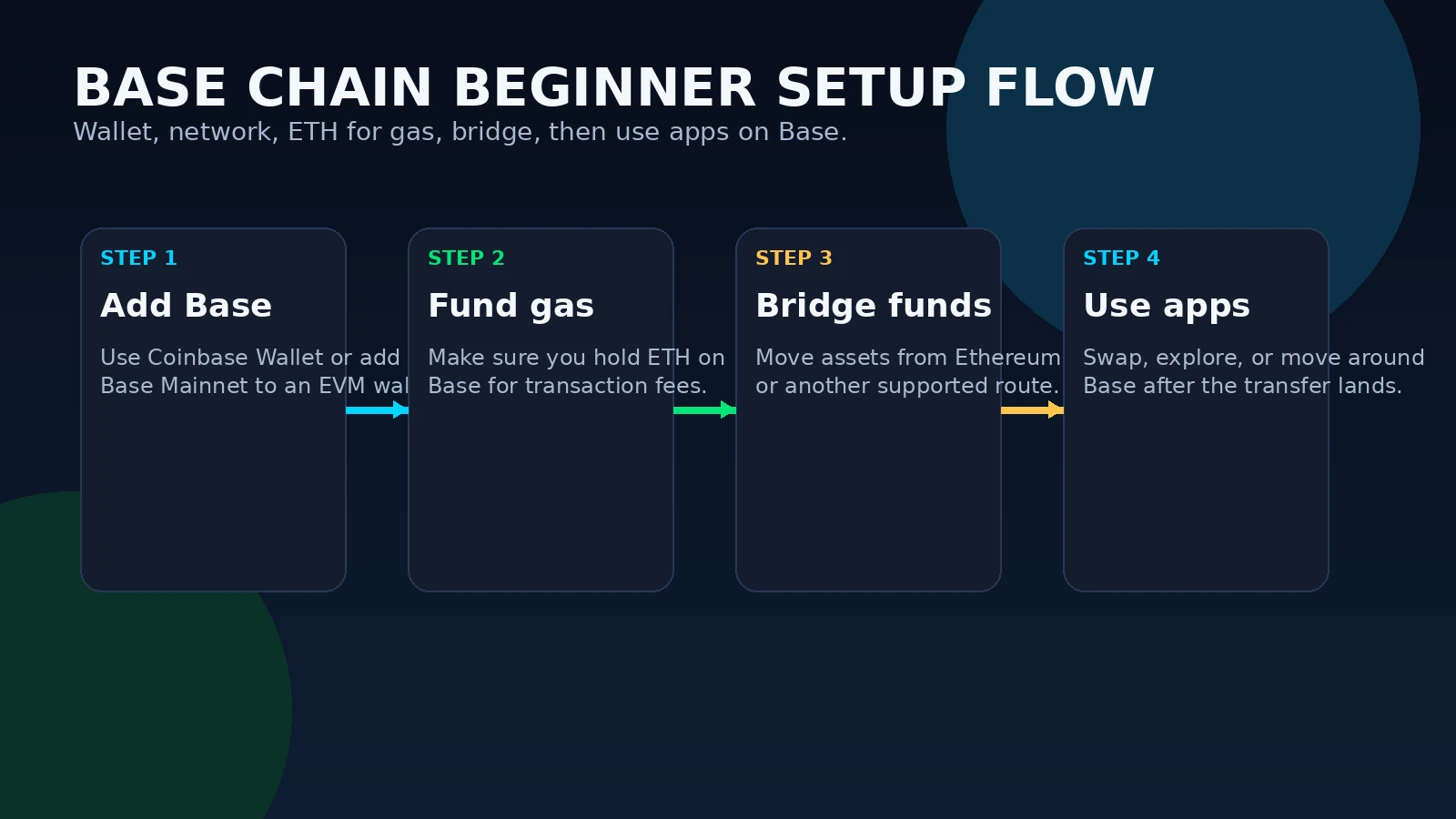
1. Add Base network to your wallet (MetaMask, Rabby, or Coinbase Wallet)

2. Bridge ETH to Base using the official bridge or a third-party bridge like Across

3. Explore Aerodrome or Uniswap for your first swap

4. Check out Farcaster for the Base social experience

5. Browse Base NFTs on OpenSea or Zora

6. Monitor your activity on BaseScan (basescan.org)

7. Bookmark DefiLlama's Base page for ecosystem tracking

Best First Moves on Base for New Users

Most Base tutorials stop after wallet setup and bridging, but that is only the starting point. The real beginner question is what to do first once funds actually arrive on Base. A clean starting workflow is to begin with a small amount of ETH or USDC, make one test swap on a blue-chip DEX, check your approvals, and only then start exploring higher-risk apps.

If you are brand new to Layer 2s, your first Base session should look like this: fund your wallet, bridge a small amount, confirm the transaction onchain, do one swap, and keep a gas buffer. After that, you can branch out into lending, perps, social apps, or NFTs. This keeps mistakes small while you learn the rhythm of the chain. If you need a broader bridging primer first, use our cross-chain bridge guide. If you still need wallet setup, start with MetaMask.

Good first action
Bridge a small amount of ETH, then make one simple swap on a major DEX like Aerodrome or Uniswap on Base.
Good first habit
Review token approvals after every new app. Approvals are one of the easiest ways beginners accumulate silent risk.

Base Safety Checklist Before You Approve Anything

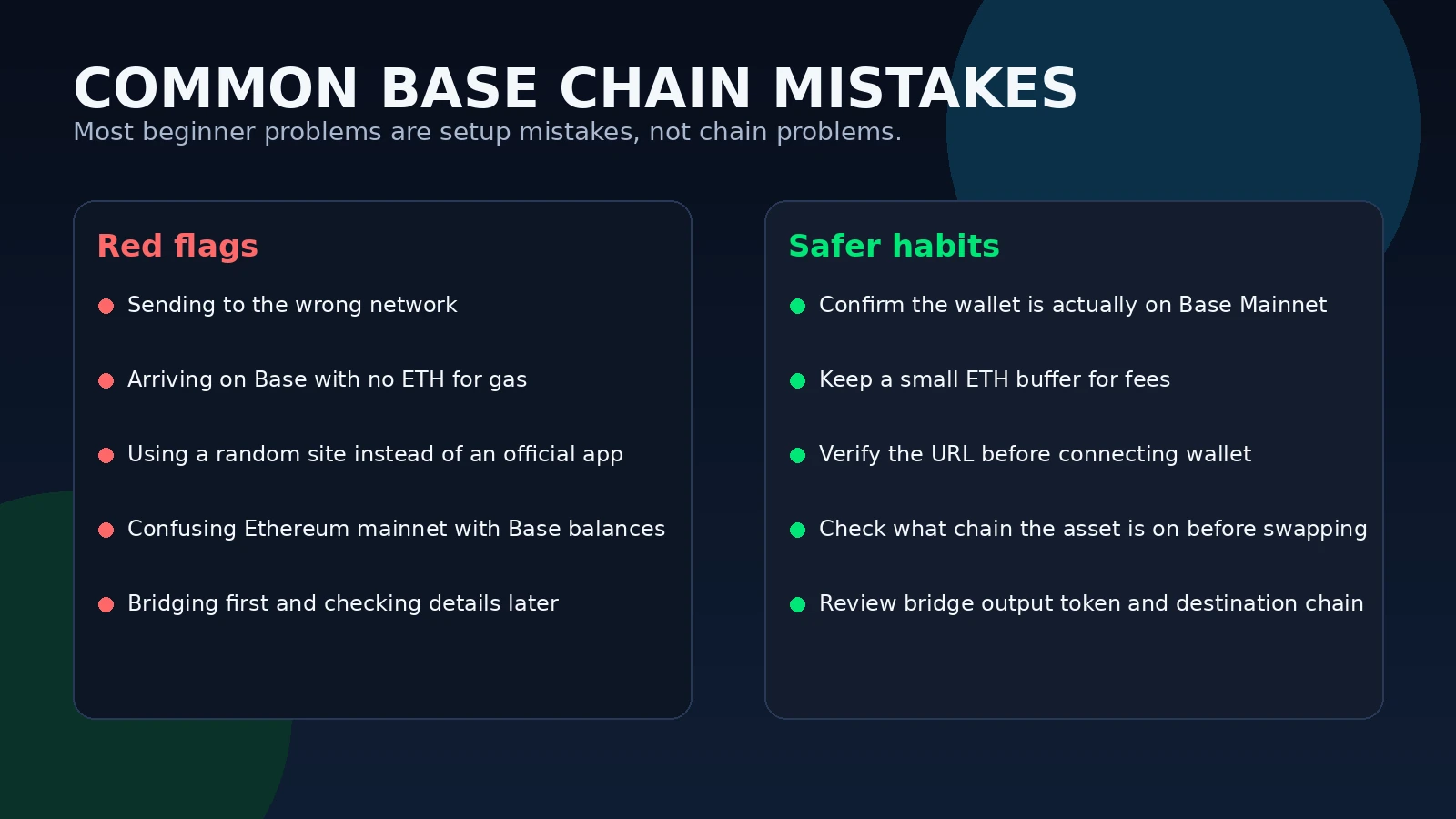
Base is cheap and fast, which is exactly why beginners can click too quickly. Low gas fees make it feel harmless to experiment, but approvals, fake tokens, and clone interfaces can still cause permanent losses. Before you confirm any Base transaction, check the domain, the token contract, the spender address, and the estimated output. If a token only exists on a random interface and not on major trackers, slow down.

On Base, approval management matters more than people think. A failed trade is annoying. A broad unlimited approval to the wrong contract is worse. This is why the best ranking pages tend to win by being more specific on workflow risk, not by repeating generic Layer 2 theory. Keep a separate wallet for experimentation, start with smaller size, and revoke approvals you no longer need. If you want a broader conceptual view of why Base exists, pair this guide with our Layer 2 explainer.

  • Use the official bridge or a proven bridge route, not a random aggregator result
  • Keep a bit of ETH on Base for future gas before you make your first trade
  • Double-check token tickers against contract addresses
  • Be careful with experimental memecoins and low-liquidity pairs
  • Review approvals after using new apps
  • Make one small test transaction before moving size

When Base Is the Right Chain and When It Is Not

Base is usually the right choice when you want low fees, Ethereum compatibility, easy onboarding from the Coinbase ecosystem, and access to a fast-growing app layer. It is especially strong for users who want a simple EVM environment without mainnet gas pain. It is also a practical chain for people who want to explore onchain social, consumer apps, and lower-cost DeFi without jumping into a completely different wallet standard.

Base is not automatically the best chain for every job. If your liquidity, favorite apps, or counterparties are deeper elsewhere, another network may still be better for that specific trade or workflow. The right way to think about Base is not as a universal replacement for Ethereum mainnet, but as a lower-friction execution layer. That is why it works well as a first stop for swaps, smaller DeFi positions, and experimentation, while larger long term holdings may still sit on mainnet or in self-custody cold storage.

Frequently Asked Questions

FAQ

Does Base have its own token?

No. Base does not have a native governance or utility token. ETH is used for gas fees on Base. Coinbase has stated there are no plans to launch a Base token. Be wary of any token claiming to be the "official Base token" - it is a scam.

Is Base safe to use?

Base inherits the security of Ethereum through its optimistic rollup architecture. Transaction data is posted to Ethereum mainnet, meaning even if the Base sequencer goes down, your funds can be recovered through L1. The main risk factors are smart contract bugs in dApps (same as any chain) and the current centralization of the sequencer operated by Coinbase. Overall, Base is considered one of the safer L2 options due to Coinbase's regulatory standing and resources.

How do I withdraw from Base back to Ethereum?

You have two options. The official bridge (bridge.base.org) takes approximately 7 days due to the optimistic rollup challenge period. Third-party bridges like Across, Stargate, or Orbiter offer near-instant withdrawals for a small fee. For most users, a third-party bridge is the practical choice for speed, while the official bridge is the most trustless option.

How does Base compare to Arbitrum and Optimism?

All three are Ethereum L2 rollups offering low fees and fast transactions. Base and Optimism share the OP Stack architecture, while Arbitrum uses its own Nitro technology. Base typically offers the lowest gas fees. Arbitrum has the largest DeFi ecosystem by TVL. Optimism is the most decentralized of the three. Many active DeFi users operate across all three chains to access different opportunities and liquidity pools.

Related Tutorials