What Is Rocket Pool (rETH): Complete Liquid Staking Guide (2026)
— By Tony Rabbit in Tutorials

What is Rocket Pool? Complete 2026 rETH liquid staking guide: decentralized Ethereum staking, 8 ETH minipools, RPL collateral, rETH vs stETH, Oracle DAO and node operator economics.
If you want to stake Ethereum but you do not have 32 ETH to spin up your own validator, you have two realistic paths. The first is to deposit into a centralized exchange like Coinbase or Binance. The second is to use a decentralized liquid staking protocol. Among the decentralized options, Rocket Pool is the most ideologically pure and the most technically interesting in the entire DeFi ecosystem.
Rocket Pool is a permissionless, decentralized liquid staking protocol on Ethereum. It lets anyone stake any amount of ETH (starting from 0.01 ETH) and receive rETH, a token that automatically accrues staking rewards. At the same time, it lets node operators run Ethereum validators with as little as 4 ETH of their own capital instead of the usual 32 ETH. This dual structure is what makes Rocket Pool unique among the dozens of staking platforms that have emerged since The Merge in 2022.
In this guide we will go deep. You will learn the full history of Rocket Pool from its 2017 founding, the architecture of minipools (including the legacy 16 ETH model, the LEB16 transition, and the 8 ETH and 4 ETH bonded models), the role of the RPL token as both collateral and governance, how the Oracle DAO works, how the rETH price mechanic guarantees no peg risk, the Saturn and Houston upgrades that reshaped the protocol in 2024 to 2026, and how Rocket Pool integrates with EigenLayer for restaking yield. We will also walk through exactly how to stake ETH for rETH and how to run your own minipool if you want to become a node operator.
What Is Rocket Pool?
Rocket Pool is a smart contract based staking pool for Ethereum. It exists to solve two specific problems that vanilla Ethereum staking creates. The first problem is the 32 ETH minimum. To run an Ethereum validator, you historically needed exactly 32 ETH locked up, which is well over $100,000 at most ETH prices. That is prohibitive for the average user. The second problem is liquidity. Once your ETH is staked it is locked, and even after the Shapella upgrade enabled withdrawals, exiting takes time and forfeits future yield.
Rocket Pool fixes both problems simultaneously. On the staker side, you can deposit any amount of ETH from 0.01 ETH up to millions, and you receive rETH in return. rETH is a freely transferable ERC-20 token that represents your share of all the staking rewards across the Rocket Pool network. You can swap it on Uniswap, use it as collateral on Aave, supply it as liquidity on Curve, or just hold it. On the node operator side, you can run a validator with as little as 4 ETH of your own capital. The rest comes from the protocol's deposit pool, which is funded by stakers who minted rETH.
What makes Rocket Pool different from Lido, the largest liquid staking protocol, is decentralization. Lido has a permissioned set of around 40 professional node operators who collectively run all of its validators. Rocket Pool has more than 3,800 independent node operators as of 2026, each running their own minipools from their own machines, with no central operator selection process. Anyone with 4 ETH and a reasonably stable internet connection can become a Rocket Pool node operator. This is the trade-off Rocket Pool deliberately makes: slightly more complex tokenomics and slightly lower TVL in exchange for radical permissionlessness.
History: From 2017 Concept to 2026 Powerhouse
Rocket Pool is one of the oldest projects in the Ethereum staking space. It was conceived in late 2016 by David Rugendyke, an Australian developer who realized that Ethereum staking was going to be inaccessible to most users when proof of stake eventually launched. The first whitepaper was published in 2017, and the project ran on Ethereum testnets for years while Ethereum itself worked toward the Beacon Chain genesis.
Rocket Pool launched its public mainnet on November 6, 2021. At launch, the minimum bond for node operators was 16 ETH, half of the 32 ETH a vanilla solo validator required, with the other 16 ETH provided by stakers in the deposit pool. The RPL token, which had existed since 2017 as an ERC-20, was upgraded in 2021 to a new contract with inflationary tokenomics that distributes rewards to node operators who post RPL as collateral.
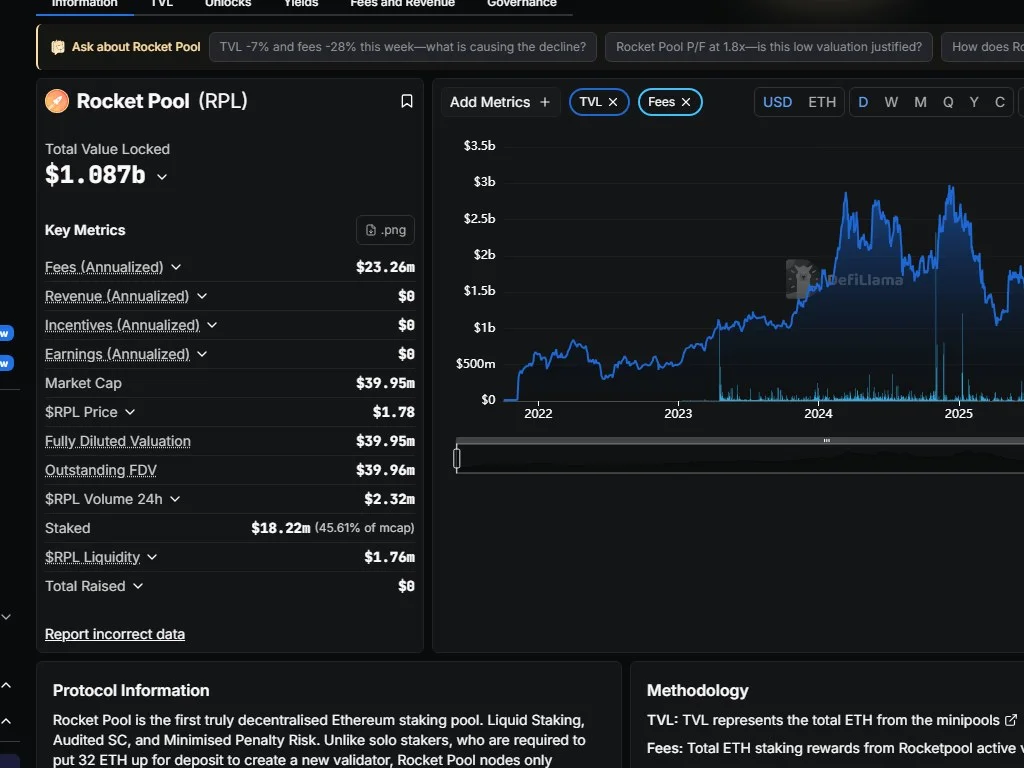
From 2022 through 2026, the protocol went through several major upgrades. The Atlas upgrade in 2023 introduced the LEB8 minipool type, which lowered the node operator bond from 16 ETH to 8 ETH, doubling capital efficiency for operators. The Houston upgrade in 2024 added on-chain protocol DAO governance and the ability to vote with rETH. The Saturn upgrade, which rolled out in phases through 2025 and 2026, introduced LEB4 minipools (4 ETH bonded), the megapool architecture that consolidates multiple validators under a single contract, native EigenLayer restaking integration, and a redesigned RPL collateral system. By 2026 Rocket Pool has more than 1.2 million ETH staked across roughly 130,000 minipools, making it the second largest liquid staking protocol after Lido.
The Minipool Architecture Explained
To really understand Rocket Pool, you have to understand the minipool. A minipool is a smart contract that owns a single Ethereum validator. Each minipool is funded partly by the node operator and partly by the protocol's deposit pool. The deposit pool is filled by users who stake ETH in exchange for rETH. When the deposit pool has enough ETH to match a node operator's bond, a new minipool is created, the combined 32 ETH is deposited to the Beacon Chain, and a validator goes live.
The genius of this design is that the smart contract enforces fair distribution. When the validator earns rewards on the Beacon Chain, those rewards eventually flow back into the minipool contract. The contract automatically calculates the split: the node operator gets their own staked ETH back plus their share of the rewards, plus a commission on the pool's share for running the infrastructure. The pool's share, including the rewards, flows to the rETH token, increasing its underlying value. There is no central party that can take a different cut, freeze withdrawals, or change the terms.
The same design protects against operator misbehavior. If a node operator gets slashed, the slashing penalty comes out of their bonded ETH first. Stakers who hold rETH are not exposed to operator-level slashing until the node operator's entire bond is wiped out, which only happens in extreme cases of correlated malicious behavior. This is fundamentally different from a centralized staking service where one operator's mistake socializes losses across all users.
The RPL Token: Collateral, Governance, and Rewards
The RPL token is the protocol's native asset and it does three things at once. First, it serves as supplementary collateral for node operators. To run a minipool, a node operator must stake a minimum amount of RPL equal to 10% of the protocol-supplied ETH. So for an LEB8 minipool with 24 ETH from the pool, the operator must stake at least 2.4 ETH worth of RPL. This is on top of their 8 ETH bond. The RPL collateral acts as an additional buffer for stakers: if anything goes wrong and the operator's ETH bond is not enough to cover the loss, the RPL is also slashed.
Second, RPL is a reward token. Approximately 5% of the total RPL supply is minted each year as inflation. Of that inflation, 70% goes to node operators who hold RPL as collateral, 15% goes to the Oracle DAO, and 15% goes to the protocol treasury to fund development. Node operators earn RPL rewards proportional to their staked RPL, with diminishing returns above 10% collateral and a hard cap that was historically 150% but has been adjusted in the Saturn upgrade. This creates a direct economic incentive for operators to hold and stake RPL.
Third, RPL is the governance token of the Rocket Pool Protocol DAO (pDAO). RPL holders can vote on protocol-level changes such as inflation rate adjustments, treasury allocations, smart contract upgrades, and new minipool types. The Houston upgrade in 2024 introduced on-chain governance for the pDAO, replacing the previous off-chain Snapshot voting. Saturn extended governance rights to include rETH holders, who can delegate their voting power to a node operator or vote directly on certain matters.
The Oracle DAO: How Rocket Pool Stays Trustless
One of the trickiest problems in liquid staking is the oracle problem. Validator balances live on the Beacon Chain, which is a separate consensus layer that smart contracts on the execution layer cannot directly read. So how does the Rocket Pool smart contract know how much ETH each minipool has on the Beacon Chain? The answer is the Oracle DAO.
The Oracle DAO (oDAO) is a small group of trusted entities (around 15 members in 2026) who are responsible for reporting Beacon Chain data to the Rocket Pool smart contracts. They report total network ETH balance, individual minipool balances, and exchange rates between rETH and ETH. The oDAO uses a consensus mechanism: a supermajority must agree on a value before it is committed on-chain. Each member runs an open source oracle node software that automatically computes and signs these reports.
The oDAO is intentionally small and curated because the protocol needs honest, reliable reporters. Members are vetted by the community and elected by RPL holders. They include established Ethereum infrastructure providers, audit firms, and long-time Rocket Pool contributors. While this is the most centralized part of the protocol, the oDAO cannot steal funds. It can only report data. If it reported false data, the rETH exchange rate would be wrong, but the underlying ETH would still be safely held by the minipool contracts and the Beacon Chain validators. The Saturn upgrade introduced additional cryptographic safeguards using the EIP-4788 Beacon Block Root, which makes parts of the oDAO's role increasingly trust-minimized over time.
How the rETH Price Mechanic Works
One of the most important things to understand about rETH is that it does not maintain a 1:1 peg with ETH. It is not designed to. The rETH price relative to ETH is supposed to go up over time, reflecting the accrued staking rewards. This is called a reward-bearing or accruing token, as opposed to a rebasing token like stETH.
Initial parity. Each rETH represents exactly 1 ETH staked in the protocol.
Compounded staking rewards have increased the underlying ETH per rETH by ~12%.
rETH continues to compound. Holders pay no transaction to claim rewards.
The exchange rate is calculated by a simple formula: total ETH backing the rETH supply, divided by the total rETH supply. As validators earn rewards, the numerator grows while the denominator stays fixed. Each rETH token therefore represents an ever-increasing share of ETH. This design has two huge advantages. It is tax efficient in many jurisdictions because no rebasing event creates a taxable income realization. And it is DeFi friendly because the token balance never changes, which means DEX liquidity pools, lending markets, and other protocols can integrate rETH without worrying about supply changes mid-block.
There is a real arbitrage mechanism that keeps the secondary market price of rETH close to its smart contract redemption value. If rETH trades below its true exchange rate on Uniswap, arbitrageurs buy rETH there and (when the deposit pool has space) redeem it through the protocol for the higher ETH amount. If rETH trades above, arbitrageurs deposit ETH into the protocol to mint new rETH and sell it on Uniswap. The protocol charges a 0.05% deposit fee that goes to node operators, which provides a small structural premium on secondary markets but keeps the peg tight.
Minipool Types: LEB16, LEB8, LEB4 and the Megapool Era
The minipool types have evolved significantly. Understanding the differences matters because they affect node operator economics and the level of capital efficiency you can get out of your ETH.
The original 16 ETH minipool was the launch configuration in 2021. Node operator deposits 16 ETH, deposit pool supplies 16 ETH, total 32 ETH funds one validator. The operator earns 15% commission on the pool's half of the rewards, plus 100% of their own half. This model is being retired and almost no new 16 ETH minipools are created in 2026.
The LEB8 minipool, introduced in the Atlas upgrade, is the most common type today. Operator bonds 8 ETH, deposit pool supplies 24 ETH, total 32 ETH. The 8 ETH bond means an operator can run four LEB8 minipools with the same capital they previously needed for two 16 ETH minipools, doubling capital efficiency. The commission rate is 14%, slightly lower than the legacy 16 ETH type, but the doubled capital efficiency makes total returns significantly better.
The LEB4 minipool, introduced in Saturn 1 in 2025, lowers the operator bond to just 4 ETH with 28 ETH from the deposit pool. To compensate stakers for the lower operator bond, LEB4 minipools require higher RPL collateral (a minimum of 15% of the borrowed ETH, vs 10% for LEB8). They also carry a lower commission of around 10%. LEB4 dramatically increases capital efficiency for node operators willing to lock up additional RPL.
The most recent innovation, megapools, was introduced in Saturn 2 in early 2026. Instead of each validator being its own minipool contract, a megapool is a single contract that holds many validators for the same node operator. Megapools reduce gas costs for protocol operations, simplify rewards distribution, and unlock partial withdrawals via EIP-7002. They are now the default architecture for new node operators.
The Saturn and Houston Upgrades
Houston was the 2024 upgrade and Saturn was the 2025 to 2026 series. Together they redefined what Rocket Pool is capable of.
Houston shipped on-chain governance for the Protocol DAO. Before Houston, protocol decisions were made through off-chain Snapshot votes that the Oracle DAO would then execute. Houston brought a formal on-chain pDAO governance contract, security council with veto power on emergency issues, and the ability for rETH holders to delegate voting power to node operators or trusted community delegates. This made Rocket Pool one of the few staking protocols with credible decentralized governance, comparable to MakerDAO or Compound.
Saturn is a phased upgrade with three planned phases. Saturn 1 in 2025 delivered LEB4 minipools, a redesigned RPL collateral curve with no upper cap, validator entry queue optimizations, and the first integration points for native restaking. Saturn 2 in early 2026 launched megapools, native EigenLayer integration that lets operators opt their validators into restaking and route the additional yield through Rocket Pool, and a revamped commission mechanism. Saturn 3, planned for late 2026, will introduce sub-1 ETH bonded minipools for very small operators backed by a new insurance fund, and full integration with Ethereum's Maximum Effective Balance changes from the Pectra upgrade.
rETH vs stETH: Detailed Comparison
The most common question about Rocket Pool is how rETH compares to Lido's stETH. Both are liquid staking tokens, both wrap ETH, both pay staking rewards. But the differences are significant.
The headline numbers favor Lido on scale and TVL. But Rocket Pool wins on the dimensions that matter most for the long-term health of Ethereum: decentralization, censorship resistance, and the diversity of node operators. If you care about the protocol's neutrality and you do not mind a slightly lower yield, rETH is the more aligned choice. If you only care about maximum liquidity and depth in DeFi markets, stETH still has more options, though the gap is narrowing every year.
How to Stake ETH on Rocket Pool
Staking ETH on Rocket Pool to get rETH is straightforward and takes about three minutes. You do not need to run any infrastructure, set up a node, or buy RPL. The process is identical to swapping one token for another on a DEX.
First, set up an Ethereum wallet such as MetaMask, Rabby, or any wallet you trust. Make sure it is funded with the ETH you want to stake plus a small amount of additional ETH (about 0.005 ETH) to cover the deposit gas fee. Visit the official Rocket Pool staking site at stake.rocketpool.net and double check the URL, since phishing clones exist. Connect your wallet by clicking the connect button in the top right and approving the connection prompt.
Next, choose how much ETH you want to stake. The minimum is 0.01 ETH and the maximum is whatever is available in the deposit pool capacity at that moment. The interface will show you exactly how much rETH you will receive based on the current exchange rate, including the 0.05% deposit fee. Click stake, then confirm the transaction in your wallet. After one block confirmation, your rETH will appear in the same wallet address you used to deposit.
You can also acquire rETH on secondary markets if the protocol's deposit pool is full. Uniswap, Balancer, and Curve all have deep rETH/ETH liquidity pools. Sometimes the secondary market price is slightly cheaper than minting directly because of the deposit fee or short-term liquidity imbalances, so it is worth checking both before transacting. Tools like CowSwap and 1inch will automatically route through whichever venue is cheapest.
How to Run a Rocket Pool Minipool
Running a minipool is more involved. You become a node operator, which means you take on the responsibility of keeping a validator online and well-behaved. The reward is higher yield than staking rETH, plus RPL inflation rewards, plus full MEV exposure. The work is real but manageable.
The hardware requirements are modest by 2026 standards. You need a machine with at least 32 GB of RAM, a 4 TB NVMe SSD, a reliable wired internet connection, and ideally a UPS for power continuity. A Raspberry Pi can no longer keep up with the demands of running an Ethereum node, so most operators use a small NUC, a Dell OptiPlex, or a self-built mini ITX rig. Cloud servers work but defeat the decentralization purpose; if you want truly decentralized staking, run it at home.
The software is the Rocket Pool Smartnode, an open source CLI and stack that handles the entire setup. Install Docker, install the Smartnode CLI from the official release, run rocketpool service install, then rocketpool service config. The configuration wizard walks you through selecting an execution client (Geth, Nethermind, Besu, or Reth), a consensus client (Lighthouse, Prysm, Nimbus, Teku, or Lodestar), and a validator client. The Smartnode strongly encourages client diversity to support Ethereum's overall network health.
Once your node is fully synced (which takes 1 to 3 days on a fresh install), you fund your node wallet with at least 4 ETH for an LEB4 minipool or 8 ETH for LEB8, plus enough RPL to meet the collateral requirement (you can buy RPL on Uniswap and bridge or transfer it to the node wallet). Then run rocketpool node deposit, select your minipool type, and confirm. The Smartnode CLI handles every step including ETH deposit to the protocol, validator key generation, deposit data submission, and registration of the minipool contract.
From that point your validator is in the activation queue, and once active it starts earning rewards. The Smartnode shows you your performance, your RPL balance, your accumulated rewards, and any actions you need to take. Most operators check in once a week and take action once a month at most. The smoothing pool is an optional feature where you contribute your MEV and execution rewards to a shared pool that distributes them evenly across all participants; this smooths out the lottery-like nature of MEV and is recommended for most solo operators.
EigenLayer Restaking Integration
One of the biggest changes in 2026 is Rocket Pool's native integration with EigenLayer. Restaking lets validators reuse their staked ETH as security for additional services called Actively Validated Services (AVSs), earning extra yield in exchange for additional slashing risk. Before Saturn 2, Rocket Pool operators could not natively restake because their validators belonged to a smart contract, not directly to them.
With Saturn 2, node operators can opt their megapool into EigenLayer. The protocol handles the EigenPod creation, AVS opt-in, and reward routing transparently. Additional restaking yield is split between the operator and the rETH stakers according to the same commission structure as base ETH yield. Stakers who hold rETH get exposure to restaking rewards without needing to choose AVSs themselves, and they can opt out by choosing a non-restaked version of rETH called rETH-base.
The trade-off is risk. AVS slashing conditions are separate from Ethereum consensus slashing. A poorly designed AVS could slash your operator's stake even if Ethereum itself is performing fine. Rocket Pool has implemented a curated list of approved AVSs that operators can join, vetted by the oDAO and pDAO, to limit downside risk. As of 2026 this list includes EigenDA, AltLayer, Lagrange, and a few others, all of which have undergone extensive security review.
Liquid Staking Landscape: Rocket Pool vs Lido vs Frax vs Coinbase
Each protocol makes different trade-offs. Rocket Pool prioritizes decentralization above all. Lido prioritizes scale and DeFi integrations. Frax adds an interesting two-token system where frxETH is the liquid token and sfrxETH is the yield-bearing version, which lets users decide whether to seek yield or maximum liquidity. Coinbase offers the simplest user experience but at the cost of centralization and a hefty 25% fee. Stader is a younger competitor that mimics Rocket Pool's permissionless model with slightly different economics. For most users who want a real decentralized option, Rocket Pool remains the gold standard.
Ecosystem Integrations and Use Cases for rETH
rETH is one of the most integrated assets in DeFi. Once you hold it you have far more options than just letting it sit in your wallet.
Supply rETH as collateral on Aave V3, Compound, Spark, or Morpho. Borrow stablecoins against it while still earning staking yield.
Provide rETH/ETH liquidity on Curve, Balancer, or Uniswap V3 concentrated pools. Earn swap fees on top of staking rewards.
Bridge rETH to Arbitrum, Optimism, Base, or zkSync to use it in L2 DeFi with much lower gas costs.
Deposit rETH into Yearn, Pendle, or Convex vaults that automate complex strategies for additional yield.
Use rETH to mint stablecoins via MakerDAO, Liquity V2, or Lybra Finance. Earn staking yield on collateral.
Restake rETH via EigenLayer-integrated wrappers or Symbiotic for extra AVS rewards on top of base yield.
The most important thing to know about using rETH in DeFi is that it does not rebase, so contracts that integrate with it do not need special handling. This is why rETH was the first liquid staking token approved as collateral on Aave V3 alongside wstETH, and why it has remained the favored LST among DeFi protocols building new products.
Risks of Rocket Pool
Rocket Pool is one of the more conservative DeFi protocols, but no system is risk-free. The first risk is smart contract risk. The Rocket Pool contracts have been audited multiple times (by Sigma Prime, ConsenSys Diligence, Trail of Bits, and others) and have run on mainnet for over four years without exploit. But any complex smart contract system carries residual bug risk, and the Saturn changes are still relatively new.
The second risk is slashing risk. If Rocket Pool node operators collectively misbehave or experience correlated failures, the combined slashing could exceed operator bonds and start to eat into rETH backing. The protocol has mitigation mechanisms including RPL collateral, the smoothing pool, and oDAO insurance, but a catastrophic correlated slashing event remains a theoretical tail risk.
The third risk is regulatory. Liquid staking has come under increasing regulatory scrutiny in some jurisdictions, particularly the US, where the SEC has questioned whether liquid staking tokens are securities. Rocket Pool is structured to be as decentralized as possible to reduce this risk, but no DeFi protocol can guarantee future regulatory treatment.
The fourth risk is the rETH peg. Because rETH cannot always be redeemed directly through the protocol (only when the deposit pool has excess capacity or when minipools exit), the secondary market price can deviate from the smart contract exchange rate during stress periods. During the FTX collapse in late 2022, rETH briefly traded at a 5% discount to its underlying ETH value. This kind of discount typically resolves within days but can affect users who need to exit immediately.
The fifth risk is RPL token volatility for node operators. Since RPL is used as collateral and its value is denominated in ETH for collateral calculations, a sharp drop in RPL relative to ETH could push operators below the minimum collateral ratio, triggering a slow forced rebalancing. The Saturn upgrade smoothed these mechanics, but operators should still monitor their collateral position.
Frequently Asked Questions
Q What is rETH and how does it work?
Q Is Rocket Pool better than Lido?
Q What is the minimum ETH to stake on Rocket Pool?
Q What is the RPL token used for?
Q What is the difference between rETH and stETH?
Q How much can I earn staking with Rocket Pool?
Q Is rETH safe?
Q Can I unstake rETH for ETH directly?
Q What hardware do I need to run a Rocket Pool minipool?
Q Does Rocket Pool support restaking?
Q What is the smoothing pool?
Q Can I lose money holding rETH?
Conclusion
Rocket Pool represents a particular vision of what Ethereum staking should be. It is messier than a centralized exchange offering one-click staking. It is more capital-intensive than Lido for node operators. The token economics are more complicated than most DeFi protocols. But every one of those trade-offs exists to preserve a single property: anyone, anywhere, can participate in securing Ethereum without permission.
That ideological commitment shapes everything about Rocket Pool. The 8 ETH and 4 ETH bonded minipool models exist because the team kept asking how to lower the barrier to running a validator without compromising security. The RPL collateral system exists to align node operator incentives with the rETH stakers who trust them. The Oracle DAO exists because Ethereum oracles for cross-layer data are still a hard problem, and Rocket Pool would rather solve it with a small trusted set than with a half-baked trustless solution that exposes user funds to risk.
If you are an ETH holder who wants liquid staking with the strongest possible decentralization guarantees, rETH is the most aligned choice. If you have spare ETH and the hardware skills to run a node, becoming a Rocket Pool node operator is one of the most direct ways to contribute to Ethereum while earning yield. If you are a DeFi power user, rETH is one of the most composable and integrated liquid staking tokens in the entire ecosystem. As Ethereum matures and the importance of decentralized infrastructure becomes more obvious, Rocket Pool's role in the staking landscape is likely to keep growing through Saturn 3 and beyond.
Related Guides
- Lido vs Rocket Pool: Ethereum Liquid Staking Compared (2026)
- Liquid Staking Explained: stETH, rETH, jitoSOL and More
- Best ETH Staking Platforms in 2026: Coinbase vs Kraken vs Lido vs Rocket Pool
- What Is a Staking Pool in Crypto? Complete Guide (2026)
- What Is Lombard Finance? LBTC Bitcoin Liquid Staking Guide 2026