Base Chain Ecosystem Guide: Architecture, Fees, dApps and Coinbase's L2 (2026)
— By Tony Rabbit in Tutorials
Go beyond the beginner definition of Base and explore its OP Stack architecture, gas model, top dApps, Superchain role, and ecosystem in 2026.
Intent check: This page covers Base's architecture, gas model, and ecosystem depth. If you only need the beginner definition first, read What Is Base? Coinbase L2 Guide for Beginners (2026).
Base is the Ethereum Layer 2 network built by Coinbase, and over the past two years it has quietly become one of the most important pieces of crypto infrastructure on the planet. Launched in August 2023 as a public mainnet, Base has grown from a curious experiment into a top-three L2 by total value locked, hosting hundreds of dApps, billions of dollars in liquidity, and tens of millions of users coming directly from the Coinbase exchange. If you have heard people talking about Arbitrum and Optimism for years and wondered where Base fits in, this guide is for you.
The pitch is simple: Base offers near-instant transactions for under ten cents, full Ethereum security, the same Solidity tooling developers already know, and a direct on-ramp from the largest regulated exchange in the United States. The execution has been remarkable. While Ethereum mainnet gas fees still routinely spike above twenty dollars during congestion, a swap on Base typically costs between one and ten cents. That difference of two or three orders of magnitude is what makes Base usable for everyday people doing everyday onchain things, from sending stablecoins to trading memecoins to minting NFTs.
In this complete 2026 guide, you will learn exactly what Base is, the architecture that makes it work, how it compares to other major L2s, how to bridge funds onto it, how to add it to MetaMask in under a minute, which dApps are worth your time, the honest truth about Coinbase's centralization, and whether Base will ever have its own token. By the end you will know enough to use Base confidently, deploy contracts on it as a developer, and explain it intelligently to anyone who asks. Let us dive in.
What Is Base Chain?
Base is an Ethereum Layer 2 network built on the OP Stack, the open-source rollup framework developed by Optimism. It is incubated and operated by Coinbase, the publicly traded US cryptocurrency exchange, and it inherits its security from Ethereum mainnet by posting transaction data and state roots back to L1. In practical terms, Base is a separate blockchain that processes transactions cheaply and quickly, then periodically commits the results of those transactions to Ethereum, where they become final and tamper-proof.
The defining design choice of Base, and one that separates it from almost every other L2, is that it has no native token by design. There is no BASE coin to buy, no governance token, no airdrop. The gas token on Base is ETH, exactly the same Ether you use on Ethereum mainnet. When you bridge ETH from L1 to Base, you can spend it directly to pay for transactions. Coinbase has publicly stated multiple times that they have no current plans to issue a Base token, and they have backed that up through years of operation without one. We will explore why later in this guide, and what that means for users.
Base is an optimistic rollup, meaning it assumes transactions are valid by default and provides a challenge window during which fraud proofs can be submitted to dispute invalid state transitions. This is the same security model used by Optimism and Arbitrum, and it stands in contrast to zero-knowledge rollups which use cryptographic proofs instead. The trade-off is that withdrawals from optimistic rollups back to L1 take seven days under normal conditions, while ZK rollups can be near-instant. For most users this rarely matters because third-party bridges offer fast withdrawals for a small fee.
The Architecture of Base
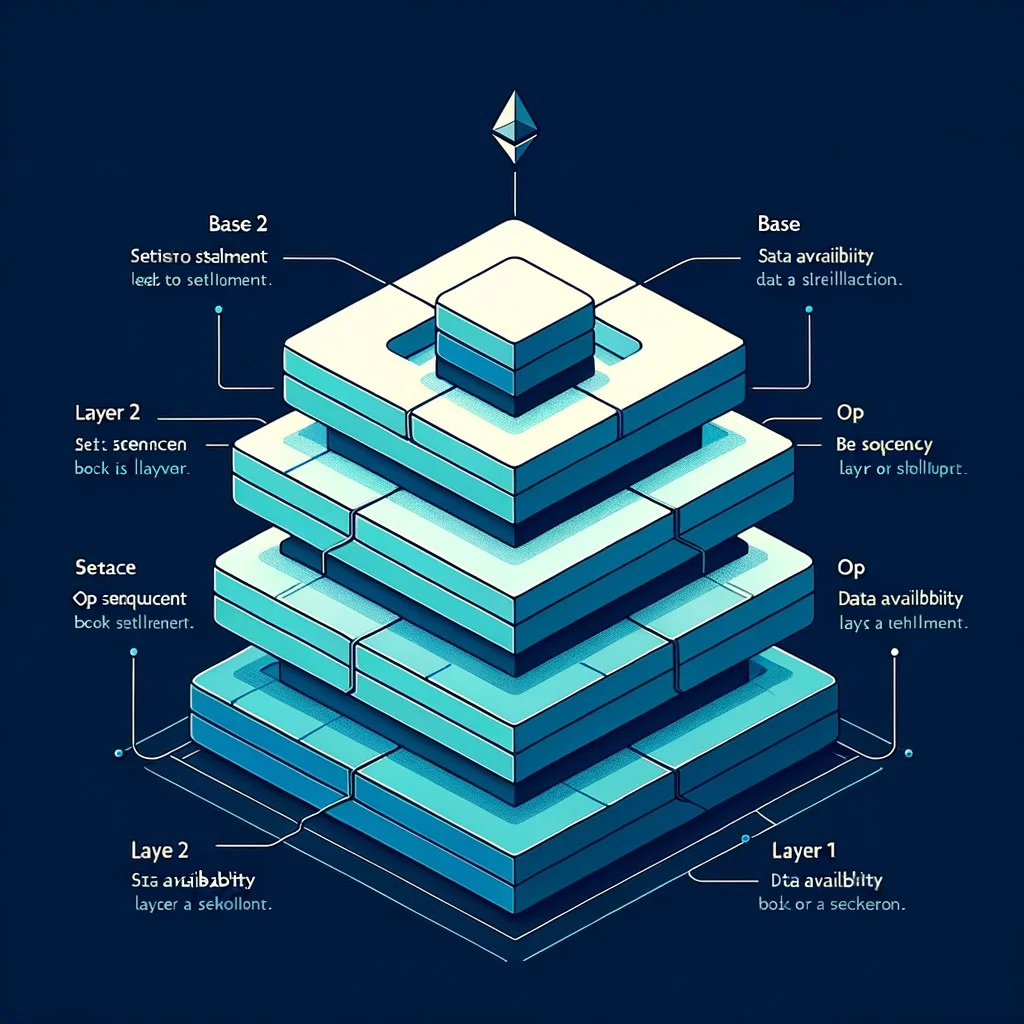
To understand how Base achieves its combination of speed, low fees, and Ethereum-grade security, you need to understand how an optimistic rollup actually works under the hood. Base operates as two stacked layers working together. The top layer, which is Base itself, handles execution. The bottom layer, Ethereum mainnet, handles settlement and data availability. Everything Base does ultimately gets anchored back to Ethereum.
EVM, 2s blocks
Run by Coinbase
Optimism codebase
Final source of truth
EIP-4844 blobs
Validators + economic
The execution layer is where your transaction first lands. You sign a message in MetaMask saying you want to swap 1 ETH for USDC. That signed message is sent to the Base sequencer, which is the centralized service operated by Coinbase responsible for ordering transactions and producing blocks. The sequencer assembles your transaction along with thousands of others into a Base block, executes them through the EVM (Ethereum Virtual Machine), and produces a new state. Base block times are around two seconds, so this happens almost instantly.
What the sequencer does next is the magic of being a rollup. It batches together a large number of executed transactions, compresses them aggressively, and posts them back to Ethereum L1 as data. Since the Dencun upgrade in March 2024, this data is posted as blobs using the EIP-4844 standard, which reduced L2 data costs by roughly an order of magnitude. The sequencer also posts state roots, which are cryptographic commitments to the new Base state. Anyone watching L1 can reconstruct the entire Base chain from these published batches, which means Base inherits Ethereum's censorship resistance and data availability guarantees.
A separate component called the proposer submits state roots to the L1 contract that governs Base. These state roots are subject to a seven-day challenge window during which anyone can submit a fraud proof if they believe the sequencer cheated. If a fraud proof succeeds, the disputed state is rolled back. In practice this almost never happens because the economic incentives align everyone toward producing valid blocks. The seven-day window does mean, however, that direct withdrawals from Base to Ethereum take seven days to finalize.
Why Coinbase Built Base
The strategic logic behind Base is one of the cleanest stories in crypto. Coinbase is the largest regulated cryptocurrency exchange in the United States with over one hundred million verified users. For years, those users could buy ETH and other tokens on Coinbase, but the moment they tried to do anything onchain, they ran into the brutal reality of Ethereum mainnet gas fees. Sending an ERC-20 token might cost twenty dollars. Swapping on Uniswap could cost forty. Minting an NFT during a busy mint could cost over one hundred. For users buying fifty or one hundred dollars worth of crypto, those fees made onchain activity completely irrational.
Base solves that. By operating its own L2 with one to ten cent fees, Coinbase can funnel its massive existing user base directly into the onchain economy. From the Coinbase app, a user can deposit USDC onto Base for free, swap it on Aerodrome, mint an NFT, lend on Compound, or send it to a friend, all for pennies. The friction that kept ninety-nine percent of Coinbase users away from DeFi simply evaporates. Coinbase's revenue model expands from trading fees on the exchange to also include sequencer revenue on Base, which has consistently been one of the highest-revenue rollups in crypto.
There is also a regulatory dimension. By running their own L2 with their own sequencer, Coinbase maintains a level of operational visibility and control that pure-play decentralized chains do not offer. They can enforce sanctions screening at the sequencer level if regulators ever demand it. They can produce audit trails. They can sit comfortably as a public US company in a way that operating an anarchic L1 would never permit. Critics see this as a feature for Coinbase but a bug for crypto values. Defenders argue that bringing one hundred million users onchain, even on a partially centralized L2, is a net win for the whole ecosystem.
Base vs Other Major L2s in 2026
The L2 landscape in 2026 is mature and competitive. Base, Arbitrum, Optimism, and Blast are the four largest by total value locked, with several other contenders like zkSync, Scroll, and Linea fighting for share. Each takes a different approach to the same problem: making Ethereum cheaper and faster while preserving its security. Here is how the major optimistic rollups compare.
The biggest practical differentiator for Base is the Coinbase on-ramp. If you already have a Coinbase account, getting funds onto Base is a one-click free deposit. For Arbitrum or Optimism, you typically need to bridge from Ethereum L1, which involves a separate bridging transaction and L1 gas. This sounds like a small thing but it has shaped user behavior dramatically. A huge portion of Base's user base came directly through Coinbase Wallet without ever touching a third-party bridge tool.
Arbitrum still leads in pure DeFi total value locked because it had a multi-year head start and onboarded the bulk of degen DeFi protocols. Optimism has a slightly smaller TVL but is the philosophical center of the Superchain vision, and its governance token model has been more aggressive than Base's. Blast carved out a niche by offering native yield on bridged ETH and stablecoins, although that model has faced criticism for the way it custodies funds during the pre-mainnet period. For mainstream consumer apps, Farcaster mini-apps, social tokens, and creator monetization, Base has become the default.
Bridging to Base
There are three main ways to get funds onto Base, and the right one depends on where your funds currently live and how fast you need them to arrive. Understanding all three is worth doing once because you will use whichever is cheapest for your situation.
The first and simplest method, if you already have a Coinbase account, is a direct Coinbase deposit. From within the Coinbase app or coinbase.com, you can send ETH, USDC, or several other supported tokens directly to the Base network for free. Coinbase essentially does an internal credit transfer rather than an onchain bridge, so there are no gas fees. This is by far the cheapest and fastest path for the average user. If you do not already have funds on Coinbase, you can buy ETH or USDC with a debit card or bank transfer and then withdraw directly to Base.
The second method is the official Base bridge at bridge.base.org. This is the canonical, trust-minimized way to move funds between Ethereum L1 and Base. Deposits from L1 to Base typically arrive in around ten minutes and cost an Ethereum L1 transaction fee, which can be anywhere from one dollar to forty dollars depending on network congestion. Withdrawals from Base back to L1 using the official bridge take seven days due to the optimistic rollup challenge window. This is fine if you have time, but for faster withdrawals, see the third method.
The third method is third-party bridges such as Across, Hop Protocol, Stargate, Orbiter, and Synapse. These services aggregate liquidity across multiple chains and offer near-instant bridging in both directions, including fast withdrawals from Base to L1 in under ten minutes. They work by having liquidity providers front you the funds on the destination chain and then collect the bridged amount on the source side over the standard seven-day window. The fee is typically 0.05 to 0.3 percent of the amount, which for most users is far cheaper than waiting a week. For a deeper look at how these protocols work, our guide to bridged tokens explains the mechanics in detail.
How to Add Base to MetaMask
If you use MetaMask, adding Base takes about thirty seconds. The newer versions of MetaMask actually have Base preconfigured in their network picker, so you can search for it directly in the network dropdown and click Add. If for some reason it does not appear, or if you want to add it manually with custom RPC settings, here is everything you need.
To add Base manually in MetaMask, open the extension and click the network dropdown at the top, then click Add a Network. Choose Add a network manually. Paste in each field above exactly as shown. Click Save. MetaMask will switch to Base, and if you bridge ETH over, you will see it appear in your balance just like any other network. The Chain ID 8453 is the identifier that uniquely distinguishes Base from every other EVM chain, and signing transactions for the wrong chain ID is one of the most common security mistakes in crypto.
For better performance during high-traffic periods, you can swap the default RPC URL for one from a provider like Alchemy, QuickNode, or Infura. These offer free tiers that work well for personal use and tend to be more reliable than the public RPC when many people are using it simultaneously. To do this, sign up for a free account, create a Base mainnet endpoint, copy the URL, and paste it into MetaMask in place of mainnet.base.org. Your transactions and reads will route through their infrastructure instead.
Gas Fees on Base
Gas fees on Base are dramatically cheaper than on Ethereum mainnet, which is the entire point. A simple ETH transfer typically costs between $0.01 and $0.05. An ERC-20 token transfer is usually $0.02 to $0.08. A swap on Aerodrome or Uniswap might be $0.05 to $0.20 depending on complexity. NFT mints can run from $0.10 to $0.50 for popular collections. Compare this to Ethereum L1 where the same operations can cost twenty to one hundred dollars during peak congestion, and you understand why so many users have moved their daily activity to Base.
The breakthrough that pushed Base fees down to their current levels was EIP-4844, also called Proto-Danksharding, which activated as part of Ethereum's Dencun upgrade in March 2024. Before EIP-4844, L2s like Base had to post their batched transaction data to Ethereum as standard calldata, which competed for blockspace with regular L1 transactions and was extremely expensive. EIP-4844 introduced a new transaction type that carries blob data, which is cheap, ephemeral data designed specifically for L2 rollups.
The impact was immediate and enormous. Base fees dropped by roughly ten times overnight when blobs went live. What used to be a fifteen cent swap became a one cent swap. This is the single biggest reason why 2024 and 2025 saw the explosion of mainstream consumer activity on L2s. Base in particular benefited because its low-fee design made it perfectly positioned to absorb the wave of users that suddenly found onchain activity affordable. If you want a deeper dive into gas fees and how they work, our dedicated guide covers the full picture.
Top dApps on Base in 2026
Base in 2026 is no longer just a place to do cheap transfers. It hosts a full DeFi stack, a leading consumer social network, NFT marketplaces, gaming infrastructure, and an enormous memecoin ecosystem. Here are the dApps you should know.
The dominant DEX on Base. Forked from Velodrome, uses a ve(3,3) model. Highest TVL and trading volume on the chain.
Uniswap V3 and V4 deployed on Base. Deep liquidity for major pairs, integrated with Coinbase Wallet swaps.
The largest decentralized social network. Frames and mini-apps run natively on Base. Crypto's main social layer.
Dynamic-distribution AMM with concentrated liquidity that moves automatically. Strong for stable pairs.
Lending and borrowing markets for ETH, USDC, and WBTC. The blue-chip money market of Base.
SocialFi keys and creator coins. After the original wave, projects like Phaver and Bracket continue the model.
Aerodrome deserves special attention because it has effectively become the central liquidity hub of Base. It uses a vote-escrow model where AERO holders lock their tokens to direct emissions toward specific pools, which in turn attracts more liquidity to those pools, which generates more trading volume. The result is a self-reinforcing flywheel that has put Aerodrome's TVL ahead of many chains' entire ecosystems. If you want to trade on Base, Aerodrome should usually be your first check for liquidity.
Farcaster is the dApp that pushed Base into mainstream consumer relevance. Built on top of its own protocol, Farcaster operates as a Twitter-like social network where users own their identities and posts cryptographically. The killer feature is Frames, which let developers embed interactive applications directly inside Farcaster posts. These Frames run transactions on Base by default, meaning a user can mint an NFT, vote in a governance proposal, or play a game inside the social feed without ever leaving the app. This integration has produced novel use cases that simply do not exist on any other chain.
The Coinbase Centralization Question
It is impossible to write an honest guide to Base without addressing the centralization question directly. Today, the Base sequencer is run entirely by Coinbase. That means Coinbase decides which transactions get included in each block, in what order. They could in theory censor specific addresses, front-run transactions, or experience downtime that halts the entire chain. This is a real concern, not a hypothetical one. Coinbase is a publicly traded US company subject to US regulators, and if a regulator one day demanded that they freeze certain addresses on Base, the technical capability exists.
The mitigation is that users always have an escape hatch. Because Base posts all transaction data to Ethereum L1, anyone can reconstruct the chain independently. The L1 contracts also include a mechanism for users to force-include transactions if the sequencer ever censors them, although this path requires technical knowledge and incurs L1 gas costs. In a worst-case scenario where Coinbase went offline or rogue, users could withdraw their funds back to L1 through the protocol-level mechanism without needing Coinbase's cooperation.
Base, in line with the broader Superchain roadmap, has committed to progressively decentralizing the sequencer over time. The plan involves moving from a single Coinbase-run sequencer to a multi-party sequencer set, and eventually to a fully permissionless sequencer market where anyone can participate. As of 2026, this transition is in progress but not complete. Realistically, you should use Base understanding that today it carries Coinbase counterparty risk in addition to standard smart contract and Ethereum risk. For most users that trade-off is acceptable. For high-conviction decentralization maximalists, it is not.
Superchain Integration
Base is a founding member of the Superchain, the network of OP Stack chains envisioned by Optimism. The idea behind the Superchain is that multiple L2s can share security, governance, communication standards, and eventually liquidity, while each maintaining their own sovereign sequencers and revenue. Think of it as a federated network of rollups that all speak the same protocol and can interoperate seamlessly.
In practice this means that as the Superchain matures, moving funds and messages between Base, Optimism, and other Superchain chains becomes near-instant and free. The cross-chain communication protocol baked into the OP Stack allows smart contracts on one chain to natively call contracts on another, opening up new design patterns that are not possible across unaffiliated chains. By 2026, several major DeFi protocols have started deploying as Superchain-native applications, treating Base and Optimism as essentially a single computational fabric.
The economic model of the Superchain involves a portion of sequencer revenue flowing back into a collective pool that funds public goods, security upgrades, and ecosystem grants. Base contributes a percentage of its sequencer revenue to this pool as part of its Superchain participation. This alignment of economic interests across chains is one of the key reasons why the OP Stack has been so successful as a rollup framework, and why so many new L2s including Worldcoin, Mode, and Zora have chosen to launch on it.
Base for Memecoins
Base has become one of the dominant memecoin chains, alongside Solana and the ever-active Ethereum L1. In 2024 and 2025, Base went through multiple memecoin seasons that produced tokens like BRETT, DEGEN, TOSHI, MIGGLES, and dozens of others that achieved hundred-million-dollar market caps from nothing. The combination of low fees, deep liquidity on Aerodrome, and direct Coinbase integration meant that memecoins on Base could go from launch to global virality in a matter of hours.
The mechanics are straightforward. A developer or anonymous team deploys an ERC-20 contract on Base. They seed a liquidity pool on Aerodrome or Uniswap with a small amount of ETH and the new token. They tweet, post on Farcaster, and try to attract attention. If the token catches on, more buyers pile in, the price goes up, and the cycle either continues into a major run or collapses as everyone exits at once. Base's low fees make this game accessible because participants can buy and sell with pennies in gas rather than tens of dollars on Ethereum L1.
The dark side is the same as on every memecoin chain. The vast majority of Base memecoin launches are scams, rug pulls, or honeypots designed to extract value from naive buyers. Tokens with disabled sell functions, hidden mint authority, or concentrated team holdings are everywhere. The DexTools terminal and tools like Bubblemaps make it possible to screen tokens for red flags before you buy, but the floor of due diligence required is constant vigilance. If you want to play in this part of Base, do it with money you can afford to lose, and always check liquidity locks, contract verification, and holder distribution before clicking buy.
Base for Developers
If you are a Solidity developer, Base is one of the smoothest L2s to deploy on because it is fully EVM-equivalent. Anything that runs on Ethereum mainnet runs on Base without modification. You do not need to learn a new language, refactor your contracts, or use a special compiler. You can take a Foundry or Hardhat project that targets Ethereum, change the RPC URL to mainnet.base.org, and deploy. The bytecode is identical, gas semantics are nearly identical, and the developer tooling is the same.
For local development, Base provides a testnet called Base Sepolia which uses Sepolia ETH from the standard Ethereum testnet faucets. To configure Foundry for Base, you add Base mainnet and Base Sepolia entries to your foundry.toml with the appropriate RPC URLs and chain IDs. For Hardhat, you add the networks to your hardhat.config.js. Verification on basescan.org works the same way as Etherscan verification, using an API key from Basescan. The OnchainKit and Coinbase Wallet SDK provide additional libraries for building consumer-facing apps with smart wallet support, gasless transactions through paymasters, and easy social login.
One small but important detail for developers is that Base inherits the L1 cost component of all transactions. When you call a contract on Base, your user pays a tiny execution fee on L2 plus a share of the cost of posting the transaction data to L1. For data-heavy operations like large storage writes or many event emissions, the L1 component can dominate. Optimizing contracts for L2 generally means minimizing calldata size, packing storage variables, and being thoughtful about event payloads. The savings compared to mainnet are still enormous, but understanding the cost structure helps you build apps that feel free to your users.
Base Tokenomics: Why There Is No BASE Token
The question that comes up constantly is whether Base will ever have a token, and if so, when. Coinbase's stated position has been consistent and clear: they have no current plans to issue a Base network token. Their reasoning has several layers. Coinbase is a publicly traded US company that already has a token in the form of COIN stock. Issuing an additional network token would create regulatory complexity, particularly around securities classification, that they have decided not to take on while their core business is going so well.
There is also a philosophical argument that L2 tokens are often unnecessary. Optimism and Arbitrum issued tokens primarily for governance and to incentivize early users through airdrops. Coinbase already has its user base, does not need to bootstrap activity through a token incentive program, and can use ETH as the gas token without any user confusion. From a pure user-experience standpoint, having one token (ETH) that works the same on L1 and on Base is simpler than maintaining a separate gas token.
That said, the market continues to speculate. There are persistent rumors every six months that Base is preparing to launch a token. Some traders accumulate Base-native projects on the theory that any future BASE token airdrop would distribute based on onchain activity, similar to how the Optimism airdrop worked. As of this guide, no such token exists and no official roadmap has been announced. Anyone selling you a presale of BASE tokens is running a scam. The only way to participate in Base today is by being onchain, using its dApps, and waiting to see what Coinbase decides over the long term.
Risks of Using Base
No chain is risk-free, and an honest assessment of Base requires looking at the failure modes. The first major risk is sequencer downtime. Because Coinbase runs the only sequencer, if their infrastructure has an outage, Base transactions stop being processed. This has happened a small number of times in Base's history, usually resolved within an hour or two, but it is a known operational risk. During downtime, funds are not at risk of theft, but you cannot transact until the sequencer comes back online.
The second risk is regulatory and counterparty exposure to Coinbase itself. If Coinbase faced an extreme regulatory action, lawsuit, or corporate failure, the operation of Base could be affected. The L1 bridge contracts and the chain data on Ethereum would still exist, but the experience of using Base depends on Coinbase running the sequencer. The mitigation here is that the protocol allows users to recover funds through L1 even without Coinbase's cooperation, but that recovery path is technical and slow.
The third risk is the same set of smart contract risks that affect every chain. The dApps you use on Base could have bugs, get exploited, or rugpull. The official bridge contracts have been audited and battle-tested, but third-party bridges, lesser-known DEXs, and yield protocols carry varying degrees of audit and security maturity. The general rule applies: stick to blue-chip protocols for serious money, use small amounts to test new protocols, and never put more on any single platform than you are willing to lose. Understanding the rollup security model from our Layer 2 rollups guide will help you reason about these risks more precisely.
Frequently Asked Questions
What is Base coin?
There is no Base coin or BASE token. Base is the name of the Ethereum Layer 2 network operated by Coinbase, and its gas token is ETH (the same Ether used on Ethereum mainnet). When you transact on Base, you pay fees in ETH. Coinbase has stated they have no current plans to launch a network token. Anyone claiming to sell BASE tokens is running a scam.
Is Base a Layer 2?
Yes. Base is an Ethereum Layer 2 network built on the OP Stack. Specifically, it is an optimistic rollup that processes transactions offchain on its own chain, then periodically posts batched transaction data and state commitments back to Ethereum mainnet. This gives Base the speed and low fees of an independent chain while inheriting Ethereum's security guarantees.
How do I add Base to MetaMask?
Open MetaMask, click the network selector at the top, choose Add a network manually, and enter the following: Network Name as Base Mainnet, Chain ID as 8453, RPC URL as https://mainnet.base.org, Currency Symbol as ETH, and Block Explorer as https://basescan.org. Click Save and switch to Base. Newer versions of MetaMask also have Base preconfigured so you can add it with a single click from the network picker.
What are the cheapest fees on Base?
Typical fees on Base range from about $0.01 to $0.10 for most operations. Simple ETH transfers are usually around one to three cents. Token swaps on Aerodrome or Uniswap typically cost five to twenty cents. Complex DeFi operations like opening a leveraged position might run thirty to fifty cents. These are roughly ten times cheaper than equivalent transactions on Ethereum L1, especially since EIP-4844 blobs were activated.
Will Base have a token?
Coinbase has publicly and repeatedly stated they have no current plans to issue a Base network token. Their position is that ETH works fine as a gas token and that issuing an additional token would create regulatory complexity for a publicly traded US company. That said, the market continues to speculate, and the situation could change in the future. As of 2026, no token exists, no official roadmap to issue one has been announced, and any presale or claim of an imminent BASE airdrop is fraudulent.
Is Base safe?
Base is generally considered safe within the trust model of an optimistic rollup with a centralized sequencer. The underlying smart contracts have been audited and proven in production for over two years. Funds bridged onto Base are secured by the same Ethereum security that protects ETH and ERC-20 tokens on mainnet. The main risks are sequencer downtime due to Coinbase operating it as a single operator, dApp-level smart contract bugs that affect specific protocols, and regulatory or operational risk to Coinbase itself. For most users, these risks are acceptable in exchange for the cost and speed benefits. For ultra-cautious users, waiting for sequencer decentralization may be preferable.
Conclusion
Base has become one of the most important pieces of Ethereum infrastructure in 2026, and the data backs it up. It consistently ranks in the top three L2s by total value locked, processes millions of transactions per day, hosts a thriving DeFi and social ecosystem, and serves as the primary onchain destination for the largest pool of regulated crypto users in the world. The combination of OP Stack technical maturity, EIP-4844 cost reduction, Coinbase distribution, and Superchain interoperability has produced a chain that is both technically credible and commercially dominant.
The trade-offs are real. The sequencer is centralized today, run by a publicly traded US company that faces ongoing regulatory scrutiny. There is no native token to align community ownership in the way that Optimism's OP or Arbitrum's ARB do. The path to sequencer decentralization is a work in progress rather than a finished product. For the maximalist crypto purist, these are dealbreakers. For the pragmatic builder, trader, or everyday user, they are acceptable trade-offs for a chain that simply works, every day, at the lowest fees in the L2 ecosystem.
If you are coming to Base for the first time, the path is short. Add it to MetaMask using the config above, bridge a small amount of ETH or USDC over from Coinbase or via a third-party bridge, and start using a dApp like Aerodrome or Uniswap to get a feel for the chain. Within ten minutes you will understand why so many people have moved their daily onchain activity to Base. The future of Ethereum is multi-chain, and Base is one of the chains that has earned a place in that future. Welcome to the onchain economy.
Frequently Asked Questions
What is the Base Chain?
Base is an Ethereum Layer 2 (L2) blockchain developed by Coinbase. It aims to provide a secure, low cost, and developer friendly environment for building decentralized applications.
How does Base Chain interact with Coinbase?
Base is incubated by Coinbase and leverages its expertise and resources. While developed by Coinbase, Base is designed to be decentralized and open to the broader crypto ecosystem.
What are the typical fees on Base Chain?
Transaction fees on Base Chain are generally lower than on the Ethereum mainnet. This is a key advantage of L2 solutions, making microtransactions and dApp interactions more affordable.
What kind of dApps can be found in the Base ecosystem?
The Base ecosystem is growing and includes a variety of dApps such as decentralized exchanges (DEXs), lending protocols, NFT marketplaces, and gaming applications. Developers are actively building new projects on the chain.
What is the long term vision for Base Chain by 2026?
By 2026, Base aims to be a prominent L2 solution, fostering a vibrant developer community and a diverse range of user friendly dApps. It seeks to contribute to the broader adoption of blockchain technology.
Related Guides
- Base Chain dApp Guide: Bridge, Swap, Lend and Use Base App (2026)
- How to Use Base Chain in 2026: Wallet Setup, Bridge and First Transaction Guide
- dYdX V4 Explained: Appchain Architecture, Validators and Market Structure (2026)
- What Is Toshi (TOSHI)? Base Memecoin from Coinbase CEO's Cat Explained in 2026
- Coinbase Smart Wallet: Passkey & Base Account Guide 2026