What Is Base? Coinbase L2 Guide for 2026

What is Base? Learn how Coinbase's Layer 2 works, what changed with the unified stack, and how the Base ecosystem fits into Ethereum scaling in 2026.
This guide explains what Base is as Coinbase's Layer 2 network. If you want the broader shared-stack context, also read our Optimism Superchain guide.
The "Unified Stack" Era and the $BASE Token Transition
What is Base?
Base is a Layer 2 blockchain built on Ethereum and developed by Coinbase.
- It is designed to make transactions faster, cheaper, and more scalable while maintaining the security of the Ethereum network. Base supports decentralized applications (dApps), smart contracts, and crypto payments, helping developers create blockchain-based services for a wider audience.
- Base has become one of the leading Ethereum Layer 2 networks by user activity and transaction volume. In February 2026, the network announced a transition toward a unified Base-operated stack built with technologies such as Reth, reducing its dependence on the Optimism OP Stack while remaining secured by Ethereum as an Optimistic Rollup. The move aims to improve scalability, speed up protocol upgrades, and give Base greater control over its technical roadmap.
- While it remains an Optimistic Rollup settled on Ethereum, Base is now a distinct economic and technical sovereign. With the May 2026 $BASE token distribution currently underway, the network is transitioning from a corporate experiment into a community-owned digital economy.
1. The Technical Pivot: The Unified Base Stack
In early 2026, Base moved away from a direct reliance on the OP Stack to consolidate its codebase.
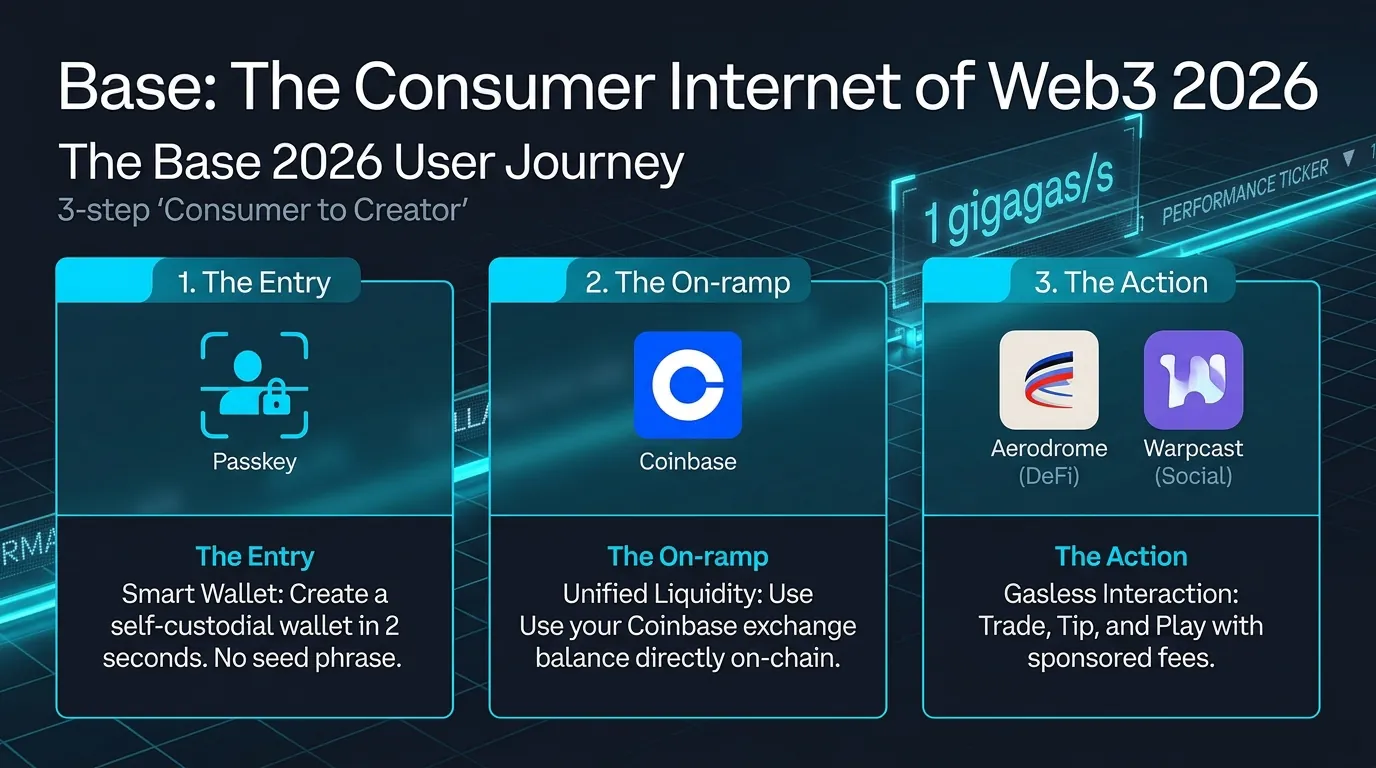
Reth-Based Execution: By utilizing Reth (Rust Ethereum), Base has optimized its node software to handle high-concurrency workloads, targeting a sustained 1 gigagas per second throughput.
Faster Upgrade Cycles: By managing its own unified repository, Base can now deploy hard forks and performance patches twice as fast as it could within the Superchain coordination model.
Security Stage 1+: Despite its independence, Base remains a Stage 1 decentralized rollup, maintaining a robust "Security Council" with independent signers and the ability for users to force-withdraw via Ethereum L1.
2. The UX Revolution: Coinbase Smart Wallets & Passkeys
The primary driver of Base's dominance in 2026 is its "invisible" onboarding. The Coinbase Smart Wallet has effectively removed the traditional barriers to entry for mainstream users.
No Seed Phrases: Using Passkey technology (biometrics via Apple/Google), users can create a self-custodial wallet in seconds without memorizing 12 words.
Gasless Transactions: Through the Paymaster infrastructure, dApps on Base frequently sponsor user gas fees, making the experience feel as frictionless as using a standard web app.
Asset Portability: The Smart Wallet allows users to use their Coinbase exchange balances directly on-chain without a manual "transfer" step, bridging the gap between centralized and decentralized finance.
3. The 2026 Ecosystem: Beyond DeFi
Base has become the home of the "Social Web3" and "Agentic Economy."
Aerodrome Finance: The network's liquidity engine, holding over $1.2 billion in TVL and processing the majority of the chain’s trading volume.
Farcaster (Warpcast): The decentralized social layer where millions of users interact, tip, and launch "frames" that act as mini-apps directly in their social feed.
Virtuals Protocol: A booming sector in 2026 where AI agents operate their own wallets on Base, trading assets and managing social accounts autonomously.
Onchain Summer 2026: The annual ecosystem festival is currently featuring "Global Rewards" for users interacting with the newly launched $BASE token distribution.
Technical Trade-offs and Market Realities
Strengths and Opportunities
Massive Distribution: Direct integration with Coinbase's 100M+ users provides a structural advantage no other L2 can match.
Developer Velocity: The new Unified Stack allows Base to innovate on performance faster than chains tied to a shared roadmap.
Ecosystem Depth: From AI agents to decentralized social media, Base has the most diverse application layer in Web3.
Limitations and Challenges
Ecosystem Fragmentation: The "breakup" with the Optimism Superchain has raised concerns about fragmented liquidity between Base and other OP-stack chains.
Token Inflation Risk: With the launch of the $BASE token in May 2026, the network must now manage a complex circulating supply and the expectations of airdrop participants.
Centralization Perception: While technically decentralized (Stage 1), the heavy influence of Coinbase on the core development and sequencing still presents a "centralization risk" for purists.
Verification and Security via DEXTools
- Thousands of new tokens (ranging from AI agents to social memecoins) are launched daily. Verifying liquidity depth and contract safety is mandatory. DEXTools is the optimal tool for analyzing the market and avoiding scams within the Base ecosystem.
Disclaimer: This article is for informational purposes only and does not constitute investment advice, financial advice, trading advice, or any other kind of advice. DEXTools does not recommend buying, selling, or holding any cryptocurrency or token. Users should conduct their own research and consult with a qualified financial advisor before making any investment decisions. Cryptocurrency investments are volatile and high-risk. DEXTools is not responsible for any losses incurred.
Related Guides
- What Is Toshi (TOSHI)? Base Memecoin from Coinbase CEO's Cat Explained in 2026
- Coinbase Smart Wallet: Passkey & Base Account Guide 2026
- Base Chain Ecosystem Guide: Architecture, Fees, dApps and Coinbase's L2 (2026)
- Base Chain dApp Guide: Bridge, Swap, Lend and Use Base App (2026)
- How to Use Base Chain in 2026: Wallet Setup, Bridge and First Transaction Guide
Frequently Asked Questions
What is the Unified Base Stack in Base?
The Unified Base Stack is a new infrastructure that Base adopted to optimize its performance, allowing for high throughput and faster upgrade cycles. It marks a significant shift from relying on the OP Stack to a more independent codebase.
How does the Coinbase Smart Wallet work?
The Coinbase Smart Wallet simplifies the onboarding process by allowing users to create a self-custodial wallet without needing to memorize seed phrases, using biometrics instead.
What are the main features of the $BASE token?
The $BASE token is part of Base's transition to a community-owned digital economy, with its distribution currently underway as of May 2026. It aims to enhance user engagement within the Base ecosystem and facilitate various transactions.
What challenges does Base face after its transition from the Optimism Superchain?
Base faces challenges such as potential ecosystem fragmentation due to its separation from the Optimism Superchain and the risk of token inflation with the introduction of the $BASE token.
How can traders verify tokens in the Base ecosystem?
Traders can use DEXTools to verify the liquidity and safety of new tokens launched on Base, ensuring they meet compatibility standards and checking for any vulnerabilities. This tool helps avoid scams and provides essential market analysis.