dYdX V4 Explained: Appchain Architecture, Validators and Market Structure (2026)

A protocol-level guide to dYdX v4 covering its Cosmos appchain design, validator incentives, off-chain order book model, and market structure for perps.
Intent check: This page is the protocol explainer for dYdX v4 architecture and market structure. If you want the trading walkthrough, read How to Use dYdX.
The Decentralized Inversion: Transitioning to Absolute Sovereign Infrastructure
- The global digital asset derivatives market handles significantly larger notional volumes than spot trading. For decentralized protocols, scaling a perpetual futures exchange requires balancing execution throughput with strict cryptographic self-custody. While early iterations of dYdX successfully operated as a smart-contract layer and subsequent Layer 2 rollup on top of the Ethereum mainnet, they encountered rigid architectural restrictions regarding order execution speeds and structural decentralization.
- To bypass these scaling limitations, the protocol underwent a major structural migration with the launch of its V4 architecture. Moving away from Ethereum-dependent systems, dYdX re-implemented its entire exchange as a standalone, sovereign Layer 1 blockchain within the Cosmos ecosystem. This guide provides a detailed analysis of dYdX Chain’s infrastructure, validator economics, and cross-margin framework.
1. The Cosmos Migration: Solving the Decentralized Order Book Problem
High-throughput trading platforms require specialized execution frameworks. Traditional order matching engines rely on high-frequency databases to update order books instantly. In legacy decentralized models (including dYdX v3), this required a hybrid setup: the matching engine was hosted on centralized cloud servers, while only the final trade settlements were committed to the blockchain.
The In-Memory Order Book Architecture
By migrating to a dedicated app-chain built using the Cosmos SDK framework and CometBFT consensus, dYdX eliminated the centralized matching server completely.
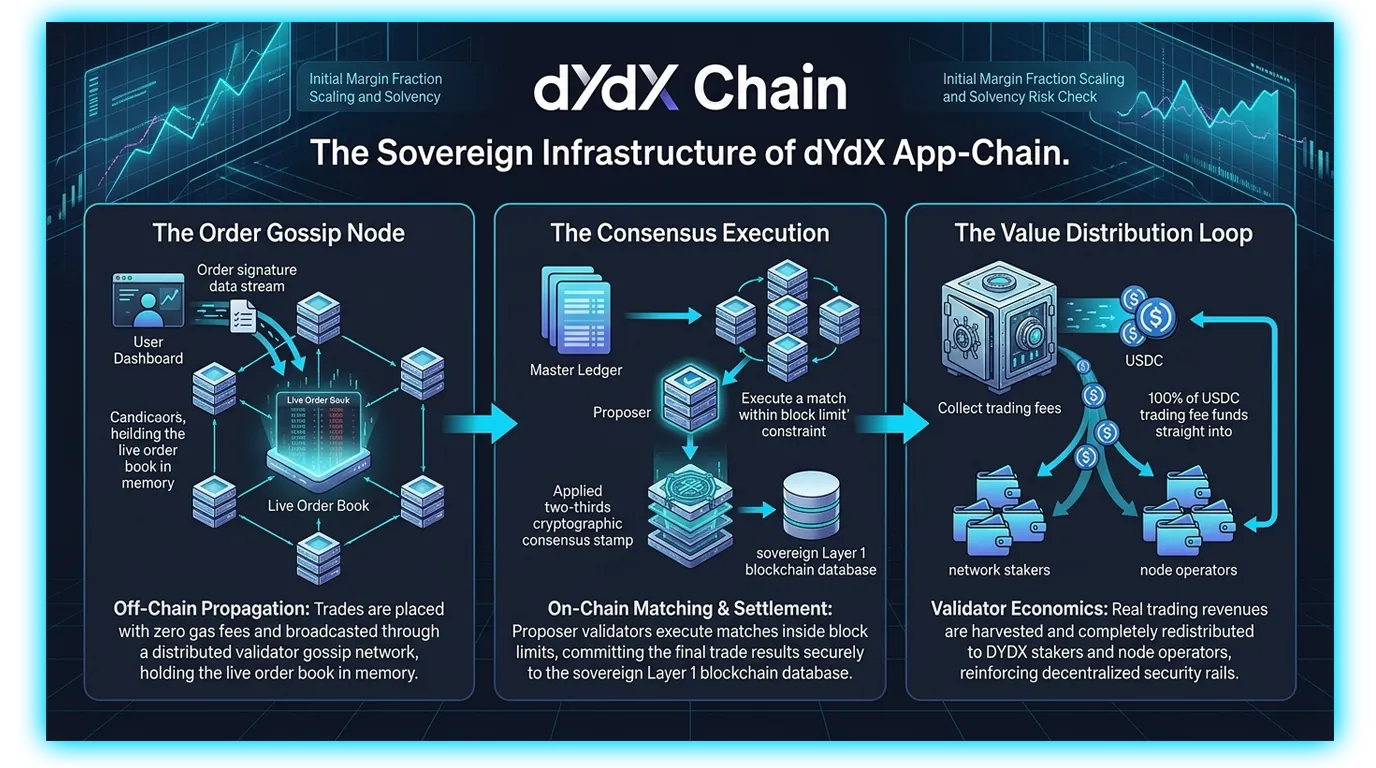
Distributed Matching: Every independent validator within the dYdX Chain network maintains an identical, live copy of the exchange's limit order book directly inside their server's memory.
Off-Chain Gossip, On-Chain Settlement: Order submissions, adjustments, and cancellations are broadcasted off-chain through a high-speed peer-to-peer network.
Consensus Matching: When a validator is selected to propose the next block, it runs the matching logic against its in-memory order book. If a match is found, the transaction is bundled into the proposed block. Once a two-thirds supermajority of validators vote to confirm, the trade results are permanently saved to the on-chain database.
The Zero-Gas Fee Model
Because order submissions and cancellations occur off-chain via the validator gossip network, dYdX Chain does not charge network gas fees for placing or canceling orders. This design preserves the smooth user experience of a centralized exchange. The protocol only applies transaction fees when a trade match successfully executes on-chain, eliminating the spam costs that degrade user margins on standard smart-contract networks.
2. Validator Economics and 100% USDC Value Distribution
Transitioning into a sovereign Layer 1 chain requires a native validator set to secure the ledger. In standard proof-of-stake blockchains, validators and stakers are compensated through continuous token inflation, which dilutes the circulating asset supply over multi-year horizons. dYdX Chain discards this inflationary model, replacing it with a direct protocol-revenue distribution loop.
Real-Yield Allocation: The protocol collects all trading fees and network transaction costs, and 100% of these revenues are distributed directly to DYDX token stakers and validators.
USDC Denomination: To shield node operators from market volatility, the vast majority of protocol fees are collected and distributed natively in USDC. Stakers can claim these rewards manually on a per-block basis.
Validator Commissions: Individual validators set custom commission rates (averaging roughly 5% to 6%). This fee is automatically deducted from their stakers' rewards to fund specialized validator hardware, server maintenance, and uptime service level agreements.
This economic shift updates the DYDX token from a passive governance asset into a direct network-security vehicle that captures utility fees directly from global exchange volume.
3. USDC Cross-Margin and Advanced Risk Parameters
Financial stability inside a perpetual exchange depends heavily on real-time margin evaluation and fast liquidation execution. dYdX Chain uses USDC as its universal collateral and cross-margin engine, integrated through native issuance rails across the Cosmos network via Noble.
The Initial Margin Fraction (IMF) Scaling Model
- To insulate the exchange from large-scale cascading insolvencies, dYdX classifies asset markets into explicit liquidity tiers. The protocol dynamically calculates the required Initial Margin Fraction (IMF) for an account based on its open interest notional value.
When a position grows beyond a market's lower volume cap, the required initial collateral increases linearly using the following scaling formula:
- This scaling mechanism ensures that as a trader accumulates an exceptionally large position, they must back it with higher collateral ratios, up to a 1:1 margin requirement (1.0). This dampens system-wide exposure before market volatility can cause localized pool strain.
Maintenance Margin and the Liquidation Protocol
If an account's total equity falls below its designated Maintenance Margin Fraction, the system identifies the subaccount as insolvent. The automated liquidation engine steps in to automatically close the positions directly on the order book.
A liquidation fee is applied to the transaction and routed straight into the protocol's Insurance Fund, which acts as a capital cushion to absorb bankruptcy deficits before they can trigger contract deleveraging events across healthy accounts.
Technical Design Matrix: Evolution of the dYdX Engine
| Architecture Attribute | Legacy dYdX v3 Model | Contemporary dYdX v4 Chain |
| Blockchain Layer | Ethereum Layer 2 Rollup (StarkEx) | Sovereign Layer 1 App-Chain (Cosmos SDK) |
| Matching Engine | Centralized Cloud Server Infrastructure | Distributed In-Memory Validator Engine |
| Gas Fee Allocation | Network Gas Required per Settled Batch | Zero Gas for Placement/Cancellation; Trading Fees at Execution |
| Protocol Revenue | Retained by Centralized Operating Entity | 100% Distributed to DYDX Stakers/Validators |
| Primary Collateral | Bridged ERC-20 USDC | Native Interchain USDC (Noble Rails) |
| Governance Scope | Restricted Protocol Parameter Changes | Sovereign On-Chain Voting over All Modules |
Disclaimer: This article is for informational purposes only and does not constitute investment advice, financial advice, trading advice, or any other kind of advice. DEXTools does not recommend buying, selling, or holding any cryptocurrency or token. Users should conduct their own research and consult with a qualified financial advisor before making any investment decisions. Cryptocurrency investments are volatile and high-risk. DEXTools is not responsible for any losses incurred.
Related Guides
- TON Validators and Nominator Pools: Complete Architecture Guide (2026)
- Base Chain Ecosystem Guide: Architecture, Fees, dApps and Coinbase's L2 (2026)
- Hyperliquid L1 Explained: HyperBFT, On-Chain Order Book and Market Design (2026)
- Stablecoin Market Cap vs On-Chain Liquidity Guide
- Solana Chain Price Prediction 2026: Market outlook
Frequently Asked Questions
What is an appchain?
An appchain is a blockchain built and tuned for a single application rather than hosting many different apps. This gives the application more control over performance, fees, and how transactions are ordered.
What is an off-chain order book?
An off-chain order book keeps the matching of buy and sell orders outside the blockchain for speed, while final trades are settled on-chain. This design aims to combine fast trading with on-chain settlement guarantees.
How do validators secure a Cosmos appchain?
Validators run nodes that propose and confirm blocks and are typically required to stake tokens, which can be slashed for misbehavior. In return they earn rewards for keeping the network secure and producing blocks.
What are perpetual futures?
Perpetual futures, or perps, are derivatives that track an asset's price without an expiry date. They commonly use a funding rate mechanism to keep their price aligned with the underlying spot market.