What Is a Layer 2? Rollups and Validiums (2026)
Layer 2 explained: learn how rollups and validiums work and why optimistic and zero-knowledge models matter for Ethereum scaling in 2026.
This guide answers what a Layer 2 is and compares the main scaling models. For chain-specific examples, pair it with our Base and Optimism guides.
The 2026 Scaling Architecture
- The Ethereum ecosystem has successfully transitioned from a monolithic blockchain into a modular, multi-layered stack. While the Layer 1 (L1) remains the definitive source of truth and settlement, it is no longer where the average user transacts.
- Following the structural upgrades of Dencun (2024), Pectra (2025), and the recent Fusaka (early 2026), Layer 2 (L2) networks now process approximately 95% of all Ethereum transaction throughput.
- However, the 2026 landscape is no longer driven by the "L2 Wars" of the past. Instead, the focus has shifted toward
1. The Layer 2 Core Logic: Why Scale Off-Chain?
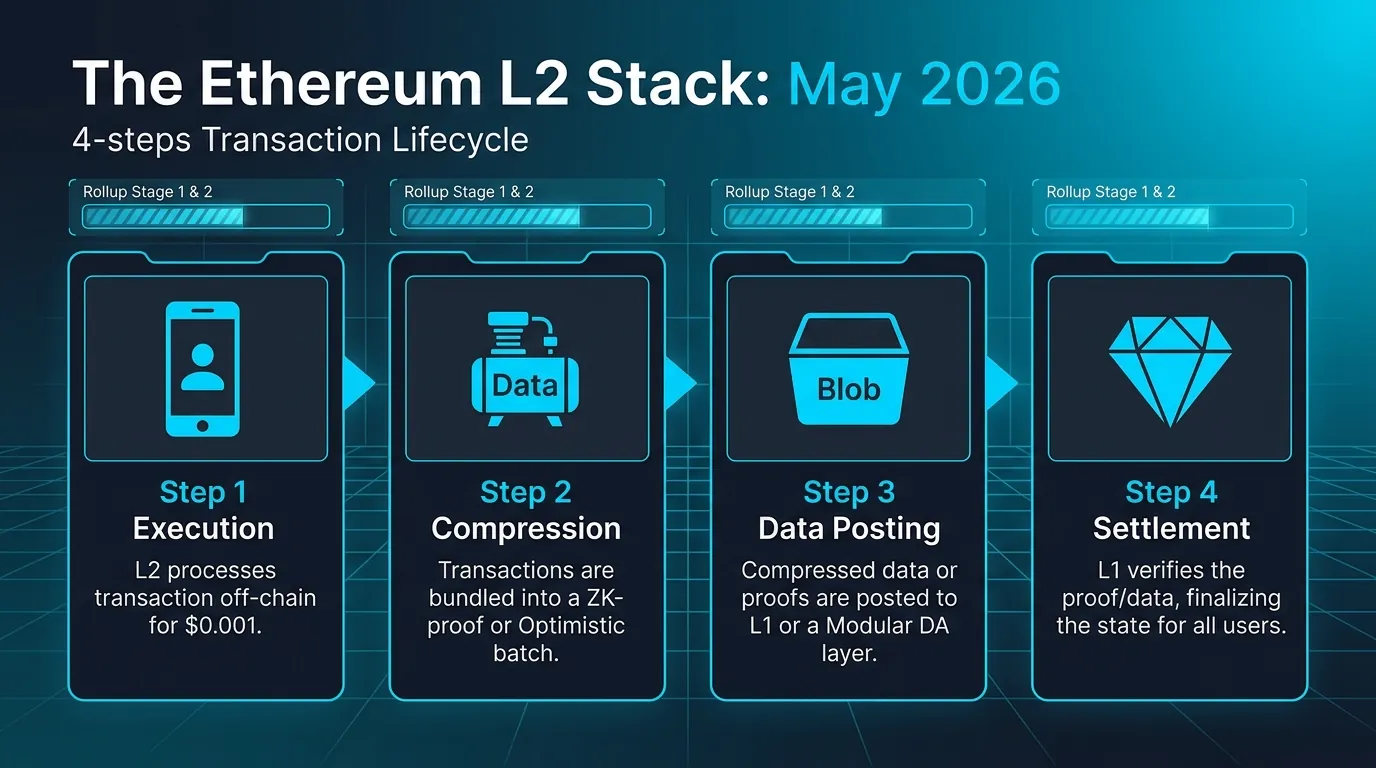
- The primary purpose of a Layer 2 is to handle transaction execution away from the Ethereum mainnet while inheriting its underlying security.
- In 2026, the cost of transacting on an L2 has reached an all-time low due to PeerDAS (EIP-7892), which expanded "blob" capacity. The relationship between L1 and L2 can be simplified as a compression ratio:

By bundling thousands of transactions into a single cryptographic summary (or "blob"), L2s reduce the congestion on the L1, allowing for fees that consistently range between $0.001 and $0.05 for most users.
2. Rollups: Optimistic vs. Zero-Knowledge (ZK)
Rollups are the most popular form of L2 because they post all transaction data back to the L1, ensuring that anyone can reconstruct the state of the chain. However, they differ in how they prove that the transactions are correct.
Optimistic Rollups (Fraud Proofs)
Optimistic rollups (like Arbitrum One and Base) operate on the principle of "innocent until proven guilty." They assume transactions are valid and post them to the L1 immediately.
The Challenge Period: There is a 7-day window during which any network participant can submit a Fraud Proof to challenge a suspicious transaction.
The Trade-off: While they offer high compatibility with existing Ethereum tools, the 7-day challenge period results in delayed native withdrawals back to the L1.
Zero-Knowledge Rollups (Validity Proofs)
ZK-rollups (like ZKsync Era and Starknet) use "Validity Proofs." Every batch of transactions includes a mathematical proof (SNARK or STARK) that proves the final state is correct.
Instant Finality: Since the math proves the transactions are right the moment they are posted, there is no need for a challenge period.
The Trade-off: These are mathematically complex and require significant computational power ("prover costs"), though these costs have decreased significantly by mid-2026.
3. Validiums and Modular Data Availability
As the demand for blockspace grew, "Validiums" emerged as a lower-cost alternative for non-financial applications like high-frequency gaming or social media.
Validium Logic: Like a ZK-rollup, a Validium uses validity proofs. However, it stores the actual transaction data off-chain (e.g., on Celestia, Avail, or a private committee).
The Risk: If the off-chain data holders disappear or withhold data, users may be unable to withdraw their funds, even if the state is proven correct. This makes Validiums a performance-first choice rather than a security-first one.
Technical Trade-offs and Market Realities
| Feature | Optimistic Rollups | ZK-Rollups | Validiums |
| Security Assumption | Economic (Incentives) | Mathematical (Proofs) | Trust (Data Committee) |
| Withdrawal Time | ~7 Days (Native) | Minutes (Instant) | Minutes (Instant) |
| Data Cost | Moderate (L1 Blobs) | Low (Compressed Proofs) | Very Low (Off-chain) |
| Best Use Case | General DeFi & Liquidity | Institutional Settlement | Gaming & Social Media |
The Decentralization Reality (May 2026)
Despite technical maturity, a critical analysis of the 2026 market shows that sequencer decentralization remains a work in progress. While "Stage 1" (active fraud/validity proofs) is now standard for major L2s, many still rely on centralized sequencers or "training wheels" (multisig overrides). This creates a persistent, albeit narrowing, gap between the theoretical security of L2s and their operational reality.
4. Data Availability (DA): The New Battlefield
The "L2 Wars" have evolved into the "DA Wars." Rollups must decide where to post their data:
Ethereum Blobs (L1): The most secure and expensive option.
Modular DA (Celestia/Avail/EigenDA): Cheaper alternatives that provide "Data Availability Sampling," ensuring that data is accessible without needing a full node to store it.
By mid-2026, PeerDAS has made Ethereum blobs much more competitive, but modular DA layers still capture a significant portion of the "AppChain" and gaming market.
Verification and Security via DEXTools
In the 2026 fragmented L2 landscape, users are often interacting with dozens of different chains through "Invisible UX" bridges. This complexity increases the risk of interacting with malicious contracts or unverified "L3" tokens. DEXTools is the optimal tool for analyzing the market and avoiding scams.
To monitor the DeFi market in an agile and secure way in real-time and trade Layer 2 assets with the help of the best crypto tools, you can access DEXTools here.
Disclaimer: This article is for informational purposes only and does not constitute investment advice, financial advice, trading advice, or any other kind of advice. DEXTools does not recommend buying, selling, or holding any cryptocurrency or token. Users should conduct their own research and consult with a qualified financial advisor before making any investment decisions. Cryptocurrency investments are volatile and high-risk. DEXTools is not responsible for any losses incurred.
Related Guides
- Optimistic Rollups vs ZK Rollups: Which One to Use
- What Is the Lightning Network? How Bitcoin Layer 2 Works
- Exploring Rollup Sequencers in Layer 2
- What is Unichain? Uniswap's L2 Rollup Complete Guide 2026
- What is Starknet? Cairo and ZK Rollup Explained (2026)
Frequently Asked Questions
What are Layer 2 networks in Ethereum?
Layer 2 networks are solutions designed to handle transaction execution off the Ethereum mainnet while maintaining its security. By doing so, they significantly reduce congestion and transaction costs.
How do Optimistic Rollups work?
Optimistic Rollups operate on the assumption that transactions are valid and immediately post them to the Layer 1, allowing a challenge period for any suspicious transactions.
What is the difference between ZK-rollups and Validiums?
ZK-rollups use validity proofs to confirm transactions and store data on-chain, while Validiums also use validity proofs but keep transaction data off-chain for lower costs.