What Are Gas Fees in Crypto? Complete Guide (2026)
— By Tony Rabbit in Tutorials

Gas fees are the transaction costs on blockchain networks, compensating validators for processing transactions. Learn how they work, how to check them, and
Gas fees in crypto are the mandatory transaction costs paid to network validators for processing and securing your activities on a blockchain. Every action, from sending tokens and swapping cryptocurrencies to interacting with smart contracts or minting NFTs, requires a gas fee. These fees compensate the decentralized network participants for their computational effort, preventing spam, and ensuring the blockchain's integrity and security.
What Exactly Are Gas Fees in Crypto?
Gas fees are the operational costs of interacting with a blockchain. Think of them as the fuel required to run a decentralized application or execute a transaction. Just as a car needs gasoline to move, a blockchain transaction needs 'gas' to be processed.
These fees are paid in the blockchain's native cryptocurrency (e.g., ETH for Ethereum, SOL for Solana). They incentivize validators or miners to include your transaction in the next block, ensuring the network remains secure, decentralized, and functional.
How Gas Fees Work: The Core Mechanics
The fundamental principle behind gas fees is resource allocation. Blockchains have limited capacity, and gas acts as a pricing mechanism to manage demand. When you initiate a transaction, you propose a 'gas price' (how much you're willing to pay per unit of computation) and a 'gas limit' (the maximum amount of computation units your transaction might consume).
Validators prioritize transactions that offer higher gas prices. This creates a dynamic marketplace where fees fluctuate based on network congestion. The more users trying to transact simultaneously, the higher the demand for block space, and consequently, the higher the gas fees.
Ethereum Gas: Gwei, Base Fees, and Priority Fees
Ethereum's gas mechanism is the most widely discussed due to its dynamic nature and historical volatility. Ethereum gas is measured in "gwei," a denomination of ETH (1 gwei = 0.000000001 ETH). Every transaction requires a certain amount of 'gas units' to execute.
Since the EIP-1559 upgrade, Ethereum gas fees are structured into two main components:
- Base Fee: This is the mandatory portion of the gas fee, dynamically adjusted by the network based on congestion. It is burned (removed from circulation) rather than paid to validators, making ETH a deflationary asset over time.
- Priority Fee (Tip): This is an optional fee you pay directly to validators to incentivize them to include your transaction faster. A higher priority fee can help your transaction get confirmed sooner during periods of high network activity.
The total gas fee for an Ethereum transaction is calculated as: (Base Fee + Priority Fee) x Gas Units Consumed.
Understanding Gas Units and Transaction Complexity
The 'gas units' required for a transaction depend entirely on its computational complexity. A simple ETH transfer requires a fixed 21,000 gas units because it's a straightforward operation.
However, interacting with complex smart contracts, like swapping tokens on a decentralized exchange (DEX), providing liquidity, or minting an NFT, can consume hundreds of thousands or even millions of gas units. This is because these actions involve multiple internal operations and state changes on the blockchain.
Gas Fees Across Different Blockchains: A Comparative Look
While the concept of gas fees is universal, their implementation and cost vary dramatically across different blockchain networks. This is due to differences in their consensus mechanisms, scalability solutions, and overall network architecture.
Why Are Ethereum Gas Fees So High (Sometimes)?
Ethereum's gas fees can spike dramatically due to high demand for its limited block space. The Ethereum mainnet can only process approximately 15-30 transactions per second (TPS). When popular DeFi protocols, NFT mints, or memecoin frenzies drive transaction volume above this capacity, users enter a bidding war.
Validators naturally pick transactions offering higher priority fees, pushing up the overall gas price. This demand-supply dynamic is the primary reason for Ethereum's often prohibitive transaction costs, which Layer 2 solutions aim to alleviate.
The Role of Layer 2 Solutions in Reducing Gas Fees
Layer 2s (L2s) are separate blockchains built on top of a Layer 1 (like Ethereum) that process transactions off the main chain, then periodically post a summary of these transactions back to the L1. This 'batching' significantly reduces the data written to the main chain, drastically cutting down gas costs.
Popular L2s like Arbitrum, Optimism, and Base offer transaction costs that are 10x to 100x cheaper than Ethereum's mainnet, while still inheriting the robust security of the underlying Ethereum blockchain. They are a cornerstone of Ethereum's scalability roadmap.
How to Check Current Gas Fees (Step-by-Step)
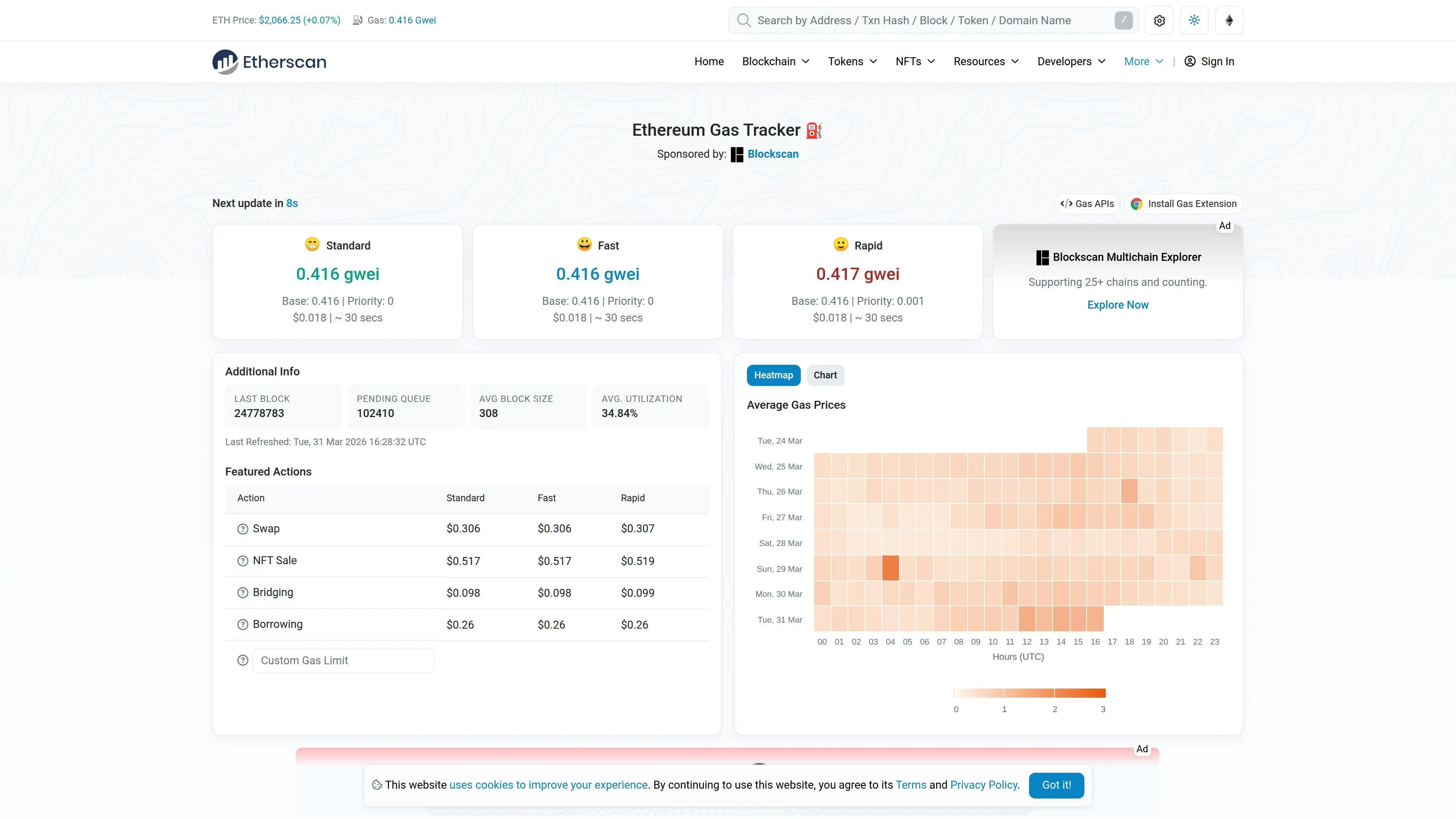
Staying informed about current gas prices is crucial for optimizing your transaction costs. Here's how to do it:
- Visit a Gas Tracker: For Ethereum, the most reliable source is etherscan.io/gastracker. This site provides real-time information on current base fees, priority fees, and estimated transaction times for different speed settings (slow, standard, fast).
- Check Your Wallet: Wallets like MetaMask often integrate gas price estimates directly into the transaction confirmation screen. While convenient, these are sometimes slightly delayed or less granular than dedicated trackers.
- Consult DEXTools: DEXTools provides integrated chain information and often includes gas fee indicators for various networks, helping you make informed decisions when interacting with different tokens and protocols.
- Monitor L2 Block Explorers: For Layer 2 networks like Arbitrum or Optimism, you can check their respective block explorers (e.g., arbiscan.io/gastracker) for specific L2 gas prices.
Strategies for Minimizing Your Crypto Gas Fees
Being strategic about your transactions can save you significant money on gas fees. Here are the top strategies:
- Time Your Transactions: Ethereum gas fees are often lowest during off-peak hours, typically weekends and early morning UTC (e.g., 2-8 AM UTC), when network congestion is lower.
- Utilize Layer 2 Networks: For most DeFi and NFT activities, consider using L2s like Arbitrum, Optimism, or Base. Bridge your assets to these networks for vastly cheaper and faster transactions.
- Batch Transactions: If a protocol supports it, batch multiple actions into a single transaction. This can be more gas-efficient than executing several individual transactions, especially for complex DeFi operations.
- Set Custom Gas (with caution): In wallets like MetaMask, you can manually set a lower 'max priority fee' or 'max base fee' than the suggested amount. This means your transaction will wait longer for confirmation, potentially hours, but you avoid overpaying. Only do this if you are not time-sensitive.
- Choose Alternative Blockchains: For activities where Ethereum's security isn't strictly necessary or its fees are prohibitive, consider blockchains with inherently lower transaction costs, such as Solana or BNB Chain.
- Simulate Transactions: Tools like Rabby Wallet or Tenderly offer transaction simulation, allowing you to preview the outcome and estimated gas cost before committing. This is especially useful for complex smart contract interactions to avoid failed transactions.
What Happens if a Transaction Fails? Do You Still Pay Gas?
Yes, on Ethereum and many other EVM-compatible chains, you still pay gas even if your transaction fails. This is a common point of frustration for users.
The reason is that the network validators still had to process and execute the computation required for your transaction, even if it ultimately reverted due to an error (e.g., insufficient liquidity, incorrect input, contract logic failure). The computational resources were consumed, and thus, the gas fee is charged.
The Future of Gas Fees: Ethereum's Continued Evolution
Ethereum's roadmap is heavily focused on scalability, which directly impacts gas fees. Beyond the success of Layer 2s, future upgrades like 'proto-danksharding' (EIP-4844) and full 'danksharding' aim to further reduce L2 transaction costs by making data availability much cheaper.
These advancements will create dedicated 'data blobs' for L2s to post their transaction summaries, drastically lowering the cost of L2 transactions and making Ethereum's ecosystem more accessible and affordable for everyday users.
How DEXTools Helps You Navigate Gas Fees
DEXTools provides essential insights that can indirectly help you manage gas fees. By offering real-time data on token prices, trading volume, and liquidity across various chains, DEXTools helps you identify optimal trading opportunities. While DEXTools doesn't directly set gas fees, its comprehensive platform allows users to:
- Monitor Multi-Chain Activity: See which chains are active and potentially more congested, helping you decide where to trade.
- Identify Opportunities on L2s: Discover new tokens and trading pairs on cheaper Layer 2 networks supported by DEXTools.
- Make Informed Decisions: Combine DEXTools' market data with real-time gas fee trackers to execute trades at the most opportune moments, minimizing costs.
Conclusion: Mastering Gas Fees for Efficient Crypto Interactions
Understanding gas fees is no longer optional in the crypto space; it's a critical skill for managing costs and optimizing your blockchain interactions. Whether you're a DeFi power user, an NFT collector, or simply sending tokens, being aware of how gas works, how to check current prices, and how to apply cost-saving strategies can make a significant difference to your overall experience and profitability.
As the blockchain ecosystem continues to evolve, with Layer 2s and other scalability solutions becoming increasingly prevalent, the landscape of gas fees will also change. Staying informed and adapting your strategies will ensure you remain efficient and effective in the decentralized world.
Frequently Asked Questions
Why are Ethereum gas fees so high?
Ethereum gas fees can be high due to high demand for limited block space. The network processes a limited number of transactions per second, and when demand exceeds this capacity, users bid higher gas prices to get their transactions prioritized by validators.
Do I pay gas even for failed transactions?
Yes, on Ethereum and many other EVM-compatible chains, you pay gas for failed transactions. This is because the network still expended computational resources to process the transaction, even if it ultimately reverted due to an error.
What is a Layer 2 (L2) in crypto?
A Layer 2 is a scaling solution built on top of a Layer 1 blockchain (like Ethereum). L2s process transactions off the main chain and then bundle them into a single summary posted back to the L1, significantly reducing transaction costs and increasing throughput while inheriting the L1's security.
Does Solana have gas fees?
Yes, Solana has gas fees, but they are typically very low, averaging around $0.00025 per transaction. This is due to Solana's high throughput architecture, which allows it to process many more transactions per second than Ethereum's mainnet.
What is 'gwei'?
Gwei is a unit of measurement for Ethereum gas. It stands for 'giga-wei,' where 1 gwei equals 0.000000001 ETH. Gas prices on Ethereum are typically quoted in gwei.
How can I check current gas fees?
You can check current gas fees using dedicated gas trackers like etherscan.io/gastracker for Ethereum, or the block explorers of specific Layer 2 networks. Many crypto wallets also provide real-time gas estimates.
What is the difference between Base Fee and Priority Fee on Ethereum?
The Base Fee is the mandatory, dynamically adjusted portion of the gas fee that gets burned. The Priority Fee (or tip) is an optional additional amount paid directly to validators to incentivize faster transaction inclusion, especially during network congestion.
Can I set a custom gas price to save money?
Yes, in many wallets like MetaMask, you can manually set a lower custom gas price (specifically the 'max priority fee' or 'max base fee'). However, this means your transaction may take significantly longer to confirm or might even fail if the network's minimum acceptable gas price rises above your set limit.
What are the best strategies to save on gas fees?
Key strategies include timing your transactions for off-peak hours, utilizing Layer 2 networks (Arbitrum, Optimism, Base), batching multiple transactions into one, and considering alternative low-fee blockchains like Solana for certain activities.