What Is Toshi (TOSHI)? Base Memecoin from Coinbase CEO's Cat Explained in 2026
— By Whatsertrade in Tutorials
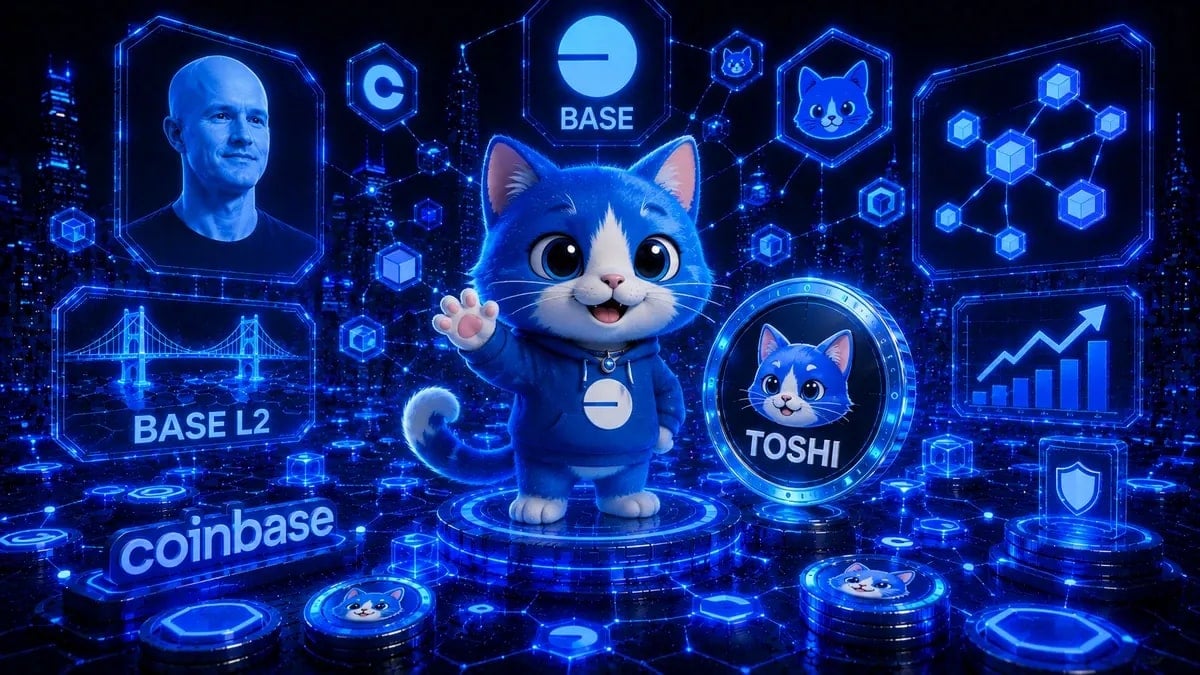
Toshi (TOSHI) is the cat-face of Coinbase's Base L2, a fan-launched memecoin named after Brian Armstrong's Chartreux that hit a $250M market cap, rallied 216% on the January 2025 Coinbase listing roadmap news, and anchors the $1.3B Base memecoin tribe. Full 2026 guide: origin story, MEOW DAO governance, tokenomics, BRETT and KEYCAT comparison, where to buy, risks.
What Is Toshi (TOSHI)? Base Memecoin from Coinbase CEO's Cat Explained in 2026
Every memecoin cycle generates one or two tokens whose origin stories sound made up even when they are true. Dogecoin came from a Comic Sans Shiba Inu joke. Bonk dropped out of a Christmas airdrop on a sleepy Solana week. And then there is Toshi, the Chartreux cat that lives in Brian Armstrong's apartment, who somehow ended up with his face on a token that crossed a quarter of a billion dollars on the blockchain his owner literally launched.
Toshi is the kind of memecoin you cannot invent without sounding like a parody of crypto culture. The asset is an ERC-20 token deployed on the Coinbase Base Layer 2 in August 2023, less than a week after Base mainnet went live. It is named after the house cat of the Coinbase CEO, who has posted pictures of the animal on Twitter for nearly a decade. The name itself is a double reference: it nods to Satoshi Nakamoto, Bitcoin's pseudonymous creator, and it is the literal name of the cat. No team allocation, no roadmap, no whitepaper, no use case beyond cultural ownership of the Base ecosystem's unofficial first pet. And it works.
This guide covers Toshi in 2026: why the cat exists, why anonymous deployers picked his name when Base launched, how the MEOW DAO formed and what it governs, what the 216 percent surge on the January 2025 Coinbase listing roadmap news looked like, and how Toshi stacks against BRETT, KEYCAT, MOCHI and DEGEN in the Base memecoin tribe. By the end you will understand both the joke and the math.
FEATURED SNIPPET
Toshi (TOSHI) is an ERC-20 memecoin on Coinbase's Base Layer 2, launched in August 2023 and named after Brian Armstrong's pet Chartreux cat. The name is also a play on Satoshi Nakamoto, Bitcoin's pseudonymous creator. Toshi is governed by the community-run MEOW DAO, sits at roughly $250 million market capitalization, is the second-largest Base memecoin after BRETT, and surged 216 percent on January 2025 news that Coinbase had added it to its listing roadmap. Holders treat it as the unofficial mascot of the Base ecosystem with a "just buy it and forget it" philosophy.
What Is Toshi in Plain English
Strip away the lore and Toshi is a memecoin built on top of Coinbase's Layer 2 network. Base is a Layer 2 rollup launched by Coinbase in August 2023 that processes transactions off-chain on its own sequencer and posts compressed proofs back to Ethereum, which means transaction fees are a fraction of a cent and confirmations feel nearly instant compared to mainnet. Toshi is a standard ERC-20 token deployed on that Base network, meaning it follows the same fungible token specification as USDC, LINK or PEPE, just on a different execution environment.
There is no whitepaper, no roadmap. There is a decentralized autonomous organization (the MEOW DAO) that governs community treasury and brand assets, but it does not control the token contract or its supply. Toshi is, by intentional design, the cultural face of an ecosystem rather than a piece of software. The thesis from holders is simple. Base needs a mascot the way Ethereum has Pepe and Solana has Dogwifhat. The mascot has to be fan-launched, no-team, no-roadmap to feel authentically memecoin. And what could be more authentically Base than naming the token after the actual cat that lives with the CEO of the company that built the chain.
That logic sounds circular until you watch it work in the market. Toshi has held the second-largest Base memecoin slot by market capitalization for most of its existence, behind only BRETT, the blue frog from Matt Furie's Boys Club webcomic. Together with DEGEN, KEYCAT and smaller cat- and frog-themed tokens, Toshi anchors the Base memecoin tribe. The total tribe market capitalization sits at roughly $1.3 billion in 2026, and Toshi commands about a quarter of that.
The Real Cat: Meet Toshi, Brian Armstrong's Chartreux
To understand the token you have to understand the animal. Toshi is a real cat that lives with Brian Armstrong, the cofounder and chief executive of Coinbase. Armstrong has posted pictures and short videos of Toshi on his personal Twitter account since at least 2014, well before Coinbase went public and well before Base was a glimmer of a Layer 2 idea. By the time Base launched, Toshi had been a recurring character in Armstrong's social media for nearly a decade.
The breed matters for the brand. Toshi is a Chartreux, a French shorthair characterized by a dense blue-gray coat, gold or copper eyes, and a famously quiet, sweet-tempered disposition. Chartreux cats have a soft half-smile that gives them a permanent look of mild amusement. Online communities seized on that expression as the visual identity of the token. Every official Toshi avatar and sticker pack leans into that quiet, knowing, almost zen look, which is part of why the "just buy it and forget it" sentiment crystallized around the token.
The naming is itself a layered joke. Toshi is a common Japanese name and a perfectly normal thing to call a cat. But it is also impossible to ignore the obvious reference to Satoshi Nakamoto, the pseudonymous creator of Bitcoin whose identity remains unknown more than fifteen years after the white paper went live. Armstrong picked a name for his cat that doubles as the most loaded reference in the cryptocurrency canon. When anonymous devs deployed the TOSHI contract on Base in August 2023, they were not just memeing the cat. They were memeing the entire founder mythology of Bitcoin through a sleepy French shorthair.

The August 2023 Launch: First Memecoin on Base
Base mainnet went live on August 9, 2023. The TOSHI contract was deployed within days. That timing is part of the lore: Toshi was effectively the first major memecoin to ship on Base, beating BRETT, DEGEN and the rest of the tribe to the chain by months. The deployers were anonymous community members, not Coinbase, not Armstrong, not any associated entity. They minted the full supply at launch, seeded liquidity on the early Base DEXes that existed at the time (mostly an early Uniswap V3 Base deployment and BaseSwap), and released the contract into the wild.
The early weeks were quiet. Base itself had almost no users at launch, the bridge from Ethereum mainnet had bottlenecks, and most retail traders had not figured out how to get assets onto Base. Toshi traded thinly into September 2023. There were no centralized exchange listings, no Coinbase support, no DexTools fanfare. The token was a curiosity held by a few hundred wallets that had bothered to bridge ETH to the new Coinbase L2 and swap into an obscure cat-named contract.
What changed everything was the broader Base ecosystem catching fire in early 2024. As BRETT exploded onto the scene in February and DEGEN became the de facto Farcaster tipping currency, Toshi got pulled along by association. By mid-2024 the cat was the senior memecoin of the chain by date of birth, with the cleanest possible "we were here first" claim any Base meme could make. That seniority matters in memecoin culture. Holders who got Toshi early kept their bags out of pride as much as conviction, and the wallet distribution gradually broadened.
Toshi Timeline: From Pet Photo to $250M Memecoin
Mapping out the Toshi story makes the price action feel less like random noise and more like a series of narrative ignitions that each took the cat one step further into Base canon. Here is the sequence that matters.
Brian Armstrong first posts pictures of his Chartreux cat Toshi on Twitter. Coinbase is a comparatively small US exchange. The cat is a personal pet, not a brand asset of any kind.
Base mainnet goes live on August 9. Within days the TOSHI contract is deployed by anonymous community devs, making it one of the first memecoins ever to live on the Coinbase L2.
Toshi trades thinly in its first months. Base usage is still minimal. The early holder cohort is a few hundred wallets willing to bridge ETH and explore the new chain.
BRETT launches and ignites Base memecoin season. The entire Base meme tribe (Toshi, DEGEN, MOCHI, KEYCAT) is pulled along as capital rotates into the chain looking for the next billion-dollar frog or cat.
MEOW DAO crystallizes from the loose Toshi community. The DAO begins coordinating treasury, brand, social and listing efforts. Toshi establishes itself as the senior cat memecoin on Base.
Toshi crosses $200M market cap for the first time. Listings appear on Bybit and a wave of mid-tier centralized exchanges. The "just buy it and forget it" mantra emerges from Crypto Twitter.
Coinbase publicly adds Toshi to its asset listing roadmap. The token surges roughly 216 percent inside 48 hours as traders front-run the eventual spot pair, with volume spiking across every Base DEX.
Toshi settles into its role as the canonical second-largest Base memecoin behind BRETT. Market capitalization stabilizes in the $200M to $300M range across the year.
Toshi remains the cat face of the Base memecoin tribe with a market cap around $250M, a roughly $1.3B tribe-wide cap, and a holder base that has weathered multiple memecoin rotation cycles. The cat keeps sleeping.
How the TOSHI Contract Was Launched on Base
The technical launch was clean by memecoin standards. The TOSHI contract is a standard ERC-20 deployed on the Base mainnet using widely audited token templates. The full supply was minted at deployment, liquidity was seeded on early Base DEXes, and the original deployer wallet eventually moved to a posture where the community could verify the absence of mint, blacklist or pause functions. There was no presale, no investor round, no team treasury that received a percentage of supply.
This matters from a security perspective. The most common rug pull pattern is a contract where the deployer retains the ability to mint unlimited new tokens, freeze transfers, or apply discretionary taxes. None of those vectors are live on the canonical TOSHI contract. You can verify this yourself on Basescan by inspecting the contract source and the owner field. The simplicity of the contract is part of why Toshi survived where countless Base cat copycats did not. Most of the copycats that appeared in 2024 had owner-controlled mint functions, suspicious admin keys, or honeypot transfer logic.
The lack of admin control also means there is no team behind Toshi in the conventional venture-backed sense. There is no formal company, no foundation grant program, no roadmap of upcoming features. Everything that exists around the token has been built by the community: the MEOW DAO, the social media accounts, the merchandise drops, the partnerships with other Base projects. The contract is the entire protocol, and the community is the entire team.
MEOW DAO: How Toshi's Community Actually Governs Itself
MEOW DAO is the community governance layer that formed around Toshi during 2024. Unlike DeFi DAOs that vote on protocol parameters or fee switches, MEOW DAO governs the soft surface of the token: brand assets, social accounts, partnerships, marketing campaigns, listing requests, and community treasury allocations. It does not, and cannot, modify the TOSHI token contract itself. The contract is immutable. But everything around it that requires coordination, from a partnership banner to a Base summit booth, runs through some form of MEOW DAO process.
The DAO structure evolved organically rather than being designed top-down. Voting power is informally weighted by participation, holdings, and demonstrated long-term commitment to the brand. Treasury funds come from community donations, partner sponsorships, and a small slice of MEOW-branded product activity. Decisions like exchange listing campaigns and merchandise releases are coordinated through public Discord and Farcaster channels.

It is worth being honest about what this kind of governance is and is not. MEOW DAO is not a Compound or Uniswap DAO with billions of dollars in protocol revenue routing through formal on-chain governance. It is closer to what crypto researchers have started calling a "social DAO" or "brand DAO," a coordination layer that maintains the cultural meaning of a memecoin without controlling its underlying contract. That distinction is important for new buyers. If you want to understand the general concept, our complete guide to decentralized autonomous organizations walks through how on-chain governance actually works.
The MEOW DAO model is what gives Toshi its surprisingly durable brand. Because no central team owns the trademark or the visual style, the community enforces its own standards collectively. Fake Toshi accounts get surfaced quickly. Copycat tokens get publicly named. That distributed quality control is part of why Toshi has survived multiple memecoin rotation cycles where smaller, less-organized Base cat memes have quietly bled out.
Why Toshi Lives on Base: The Coinbase Ecosystem Connection
Toshi could in theory have launched on Ethereum mainnet, Solana, Arbitrum or any other smart contract chain. The decision to deploy on Base in August 2023 was strategic for three reasons that compound on each other and explain why the cat became culturally inseparable from the Coinbase L2.
First, the on-the-nose joke. The whole point of Toshi is that it is named after the actual cat of the CEO of Coinbase. Launching on any chain other than Coinbase's own Layer 2 would have undercut the premise. Deploying TOSHI on Solana or Arbitrum would have made it just another generic cat coin. Deploying it on Base made it the unofficial mascot of an ecosystem run by the cat's actual owner.
Second, gas economics. Because Base is an optimistic rollup built on the OP Stack, a typical Uniswap V3 swap on Base costs cents rather than the several dollars a comparable Ethereum mainnet trade would burn. That is critical for memecoin trading culture, where users routinely make small speculative buys and need the trade to be economical after fees. For more on Base architecture, our complete guide to Base, Coinbase's L2 walks through the details, and the Ethereum complete beginner guide covers the L1 settlement layer Base inherits security from.
Third, distribution. Coinbase has more than a hundred million verified users globally, every one with the easiest possible on-ramp to Base through the Coinbase app and Coinbase Wallet. When Coinbase added Toshi to its listing roadmap in January 2025, the token gained instant access to that funnel. The 216 percent surge that followed was not random. It was the market pricing in years of cheap distribution that had not yet been activated.
The January 2025 Coinbase Roadmap Surge: 216% in 48 Hours
The single most important price event in Toshi's history happened in mid-January 2025, when Coinbase publicly added the token to its asset listing roadmap. That roadmap is the staging area for assets that Coinbase intends to support on its main spot exchange but has not yet listed. Inclusion does not guarantee a listing, but it is a strong signal that one is coming. For a Base-native token whose entire thesis depends on Coinbase distribution, the announcement was a transformational catalyst.
The market response was immediate. Within 48 hours of the listing roadmap announcement, Toshi printed a roughly 216 percent rally from its pre-announcement baseline. On-chain volume across the main Base DEXes spiked to multi-month highs, the top Toshi pools on Uniswap V3 Base saw aggressive inflows from new wallets, and CEX perpetual open interest in TOSHI more than doubled.
The reason that rally felt different from typical memecoin spikes is that it was tied to a structural distribution catalyst rather than pure narrative fuel. Coinbase listings expose tokens to a US retail audience the rest of the memecoin sector struggles to reach. Most US-based traders cannot easily access Solana memecoins or lower-tier Ethereum memecoins without bridging through unfamiliar custody. A Coinbase spot pair removes all of that friction in a single product change, and the 216 percent move reflected the step-function expansion of Toshi's addressable buyer base.
Sentiment in the weeks that followed crystallized into what is now the most quoted Toshi line on Crypto Twitter: "just buy it and forget it." The phrase has been deployed thousands of times across Farcaster, Twitter and Telegram in 2025 and 2026, almost always with a picture of the sleepy Chartreux cat. It captures both the chill brand of Toshi as an asset and a specific trading posture: long-duration, small-position, low-attention exposure that does not require active management. The mantra is not a guarantee, obviously. But it has become the most durable cultural artifact to come out of Toshi's market history.
Toshi vs BRETT vs KEYCAT vs MOCHI vs DEGEN: The Base Tribe Compared
Toshi does not exist in a vacuum. The Base ecosystem has produced an entire tribe of memecoins, each with a different narrative angle. Understanding the tribe matters because the tokens correlate heavily during ecosystem-wide rotations but diverge on individual catalysts. Here is how the five major Base memes stack up in 2026.
BRETT is the senior memecoin of Base by market cap, the blue frog from Matt Furie's Boys Club webcomic and the closest thing to a Pepe-style mascot the chain has. BRETT crossed $1 billion inside four months of its February 2024 launch and remains the top Base meme by valuation. Its moat is the pre-existing Furie universe connection. Our complete guide to Brett coin on Base covers the full history.
Toshi is second-largest, around $250 million in 2026, with a holder base that prizes seniority (Toshi was first to deploy) and cultural alignment with Coinbase. The narrative is "Brian Armstrong's cat" and the trader behavior is "buy it and forget it." Toshi is the cat mascot to BRETT's frog mascot.
DEGEN is the utility-flavored Base memecoin. It started as the native tipping currency for Farcaster, the decentralized social network that became a primary cultural venue for Base users. DEGEN is genuinely used to tip creators, which gives it different positioning than pure cultural memes. The trade-off is that DEGEN's price tracks Farcaster activity more than meme energy.
KEYCAT is a smaller cat-themed memecoin that captures a slice of the cat narrative below Toshi. Where Toshi leans into the calm sleepy Chartreux brand, KEYCAT leans into a more chaotic, internet-native cat aesthetic. It trades at a fraction of Toshi's cap but with a more aggressive volatility profile.
MOCHI rounds out the tribe with another cat-themed memecoin built through community-driven marketing. MOCHI's narrative is less tied to Coinbase or Armstrong and more to its own holder culture.

Sophisticated memecoin traders typically anchor a Base meme basket on BRETT and Toshi as the two largest and most liquid names, then add satellite exposure to DEGEN, KEYCAT or MOCHI. The basket approach captures the ecosystem-level move while diversifying away individual-token narrative risk. Our memecoin trading guide covers the broader framework for narrative-driven baskets.
How to Buy Toshi on Base: Step by Step
There are two clean paths to TOSHI: a centralized exchange route through Coinbase or a mid-tier CEX, or a decentralized route through Uniswap V3 and other DEXes on Base. Most beginners should start with the centralized route because it skips the bridging and wallet setup overhead. Power users prefer the DEX route because it gives them access to deeper Base liquidity and the ability to participate in MEOW DAO governance from self-custody.
STEP 1
Fund your exchange or wallet
If using Coinbase or another CEX that lists TOSHI, deposit USD, EUR or stablecoins. If going the DEX route, fund a self-custody wallet like MetaMask, Rabby or Coinbase Wallet with ETH on Base. You can bridge ETH from mainnet using the official Base bridge or buy directly into Base through Coinbase.
STEP 2
Locate the canonical TOSHI pair
On CEX, search TOSHI and confirm the network shows as Base before depositing. On Uniswap, navigate to app.uniswap.org, switch network to Base, and search TOSHI using the verified contract address from CoinMarketCap, CoinGecko or DexTools rather than just the ticker.
STEP 3
Execute the trade and self-custody
Set a reasonable slippage tolerance (typically 1 to 3 percent for TOSHI given current liquidity), execute the swap, and consider withdrawing from CEX to your own wallet on Base. Self-custody removes counterparty risk and keeps you eligible for any future MEOW DAO airdrops or community drops.
One critical detail: always verify the contract address before transacting. There are multiple Toshi-named copycats deployed on Base and other chains, some of which have been used in address poisoning campaigns. The canonical TOSHI contract on Base is listed at the top of the CoinMarketCap, CoinGecko and DexTools pages for the token. Copy the contract address from there, paste it into your wallet or DEX, and double-check the first six and last six characters match. For more on this specific scam pattern, our guide to avoiding crypto address poisoning scams walks through the full attack flow.
If you are new to Base wallets, the ERC-20 token standard guide is a useful primer on how TOSHI actually moves between addresses, since the token is a standard ERC-20 deployed on Base rather than anything custom. For on-chain charting and pool analysis as you trade, the DexTools complete guide walks through how to read TOSHI liquidity, holder distribution, and unusual transaction patterns in real time.
"Just Buy It and Forget It": Understanding Toshi Trader Sentiment
If you spend any time in Base trading channels, you will hear the phrase "just buy it and forget it" applied to Toshi more than any other Base memecoin. The line is half joke, half trading philosophy. Unlike high-velocity memecoins where traders flip in and out hourly, Toshi developed a culture of long-duration holding that treats short-term price action as background noise. The cat sleeps. The bag sleeps. The holder sleeps.
There are structural reasons this sentiment took root. Toshi's senior status as the first major Base memecoin gives early holders a meaningful average cost basis that survives most drawdowns intact. The renounced contract and clean tokenomics mean there is no scheduled unlock or team dump to fear, which removes one of the most common reasons memecoin holders sell defensively. And the MEOW DAO has consistently coordinated brand-positive activity that reinforces long-term holding rather than churn.
It is worth being honest about what "just buy it and forget it" does not mean. It is not a guarantee that Toshi will appreciate over any specific horizon. It is a sentiment, and sentiments shift. The phrase only works when the position is sized small enough that you can in fact ignore it during a brutal correction. A 5 percent position you can ignore is a different asset than a 50 percent position you check obsessively.
Risks and Honest Tradeoffs
Toshi is a memecoin. That means the upside is real, and the downside is also real. Anyone telling you otherwise is selling something. Here are the risks that matter, in roughly the order they should affect your sizing decisions.
First, narrative decay. Memecoins live and die on attention. Toshi has held the second-largest Base meme slot for more than two years, but there is no guarantee that position survives forever. If the Base ecosystem itself loses share to a new Layer 2 narrative, or if a new cat-themed mascot captures more cultural energy, Toshi could quietly bleed out. There is no cash flow to support the price during a narrative drought. The "just buy it and forget it" culture is a strength during ranging markets but can mask underlying weakness during prolonged narrative shifts.
Second, liquidity concentration. The deepest TOSHI pools live on Uniswap V3 Base and on a handful of centralized exchange spot pairs. In stress events, you should expect spreads to widen sharply and slippage on large orders to be material. The Coinbase listing has improved this materially compared to 2023-2024, but Toshi still has thinner liquidity than the largest memecoins on Ethereum and Solana, which matters for size.
Third, copycat and impersonation risk. Because Toshi is fan-launched and unaffiliated with Coinbase or Brian Armstrong personally, the cultural moat depends on holders continuing to recognize the canonical contract as the canonical one. Scammers regularly deploy lookalike tokens with similar names and tickers across Base, Ethereum, BSC and other chains. Some run address poisoning campaigns to trick holders into sending funds to fake addresses. Always verify contract addresses against multiple data aggregators before transacting. Our rug pull spotting guide walks through the broader patterns to watch for.
Fourth, regulatory ambiguity. Memecoins in the US sit in a gray zone. The SEC has historically taken a softer line on pure memes without identifiable promoter teams or yield promises, which is exactly why Toshi's renounced, team-less structure is also a regulatory hedge. The Coinbase listing itself is a meaningful endorsement of the token's regulatory profile, because Coinbase's compliance team would not have added TOSHI to the roadmap without significant internal review. But the broader legal landscape can change, and a sufficiently aggressive enforcement posture could pressure listings.
Fifth, association risk. Toshi is named after Brian Armstrong's cat, and Armstrong runs a public company. The token has no formal connection to him or to Coinbase, but any reputational event affecting either could create headline risk. This is mostly a tail risk.
Sixth, your own behavior. Memecoin volatility is severe. A 30 to 50 percent drawdown in a single week is normal for Toshi. The most common way to lose money in memes is panic-selling at the bottom of a normal drawdown, not the token rugging.
Toshi: Pros and Cons at a Glance
PROS
First major memecoin on Base (Aug 2023 deployment)
Renounced contract with no admin mint or pause
MEOW DAO active community governance for brand
Coinbase listing roadmap inclusion (Jan 2025)
Named after Brian Armstrong's actual cat
Second-largest Base meme by market cap
Low gas fees on Base make small trades economical
CONS
Zero utility beyond cultural ownership
Not officially endorsed by Coinbase or Armstrong
High volatility, 30 to 50 percent drawdowns common
Narrative depends on Base remaining culturally relevant
Copycat and address poisoning risk is real
Liquidity thinner than top Ethereum or Solana memes
Smaller cap than BRETT inside the Base tribe
Best Practices for Trading Toshi and Base Memes
Toshi is the kind of memecoin that rewards discipline and punishes impulse. If you are using it as your entry point into the Base ecosystem, the habits you build around this position will save you money on every memecoin you ever buy after it. Here is the playbook that experienced Base meme traders actually follow.
Start with a position size you would not regret losing entirely. The single highest-conviction risk in memecoins is not the contract or the team, it is permanent loss from a token that simply does not recover. Treat every memecoin position as binary. Either it works and you book the upside, or it does not and the loss is sized appropriately. A reasonable starting heuristic is to size memecoin exposure at one to five percent of your liquid crypto net worth in total, split across no more than three or four names. Toshi can comfortably be one of those names if you want Base mascot exposure.
Use a dedicated wallet for memecoins. Do not connect your main savings wallet to random DEX interfaces or sign blind transactions from social media links. Keep your meme wallet small, replenish it from a cold wallet on a schedule, and never sign a transaction you do not understand. For wider DeFi safety context, our DeFi guide covers the general principles.
Track liquidity, not just price. Price is downstream of liquidity. If the TOSHI pool on Uniswap V3 Base sees liquidity drain from one of the top LPs, that is a much more important signal than a single green or red daily candle. On-chain analytics tools like DexTools and DexScreener show pool depth, transaction flow and large holder movements in real time. The DexTools complete guide shows exactly how to read these signals for a token like Toshi, including how to inspect MEOW DAO treasury wallets if you want to monitor governance movements.
Take partial profits on rallies. Memecoin holders who never sell at any price tend to ride round trips back to entry. A simple rule like trimming 10 to 20 percent of your position on every doubling locks in something to show for the trade even if the long-term thesis breaks. The "just buy it and forget it" sentiment is a useful counterweight to overtrading, but it should not become an excuse to never take any profit.
Diversify across narratives, not just tickers. Holding Toshi, BRETT and KEYCAT is not real diversification because all three depend on the Base ecosystem remaining narratively strong. True memecoin diversification means spreading across chains and themes, mixing Toshi on Base with PEPE on Ethereum or a Solana cat name. Different narratives breathe at different times.
Finally, participate in MEOW DAO if you actually care about the project. The DAO is one of the rare social-DAO structures that has produced sustained brand value rather than dissolving after launch hype. Joining the community channels and voting on partnership proposals is the closest thing memecoin governance has to active management.
Frequently Asked Questions About Toshi
What is Toshi coin in one sentence?
Toshi (TOSHI) is a community-launched ERC-20 memecoin on Coinbase's Base Layer 2, named after Brian Armstrong's pet Chartreux cat and inspired in part by Bitcoin creator Satoshi Nakamoto's pseudonym.
Is Toshi really named after Brian Armstrong's cat?
Yes. Toshi is the real name of Brian Armstrong's Chartreux cat, a French shorthair breed with a blue-gray coat. Armstrong has posted pictures of the cat on his personal Twitter account since at least 2014. The token name plays on both the cat's name and Satoshi Nakamoto, Bitcoin's pseudonymous creator. The token itself is fan-launched and not affiliated with Armstrong or Coinbase officially.
When was Toshi launched on Base?
Toshi was deployed on the Base mainnet in August 2023, within days of Base going live. That timing makes Toshi effectively the first major memecoin to ship on Coinbase's Layer 2, several months before BRETT and the broader Base meme tribe arrived.
What is MEOW DAO?
MEOW DAO is the community governance organization that coordinates Toshi brand, treasury and partnership activity. It does not control the TOSHI token contract, which is immutable. Instead it governs the soft surface of the project: social media, merchandise, conference sponsorships, listing campaigns and community treasury allocations. It is what crypto researchers call a social DAO or brand DAO rather than a protocol DAO.
Is Toshi affiliated with Coinbase or Brian Armstrong?
No. TOSHI is a fan-launched token with no official endorsement, license or commercial relationship with Coinbase or Brian Armstrong personally. The token uses the cat's name and likeness as a community tribute. Coinbase did add Toshi to its asset listing roadmap in January 2025, but that is a standard listing process, not an endorsement of the token's narrative.
What happened in January 2025 with Toshi?
In mid-January 2025 Coinbase publicly added Toshi to its asset listing roadmap, signaling intent to list the token on its main spot exchange. Toshi rallied roughly 216 percent over the following 48 hours as traders priced in the structural distribution catalyst. The event is widely cited as the most important price moment in Toshi's history.
What is Toshi's market capitalization in 2026?
Toshi's market capitalization sits at approximately $250 million in 2026, making it the second-largest memecoin on the Base network behind BRETT. The total Base memecoin tribe (Toshi, BRETT, DEGEN, KEYCAT, MOCHI and smaller names combined) commands roughly $1.3 billion in aggregate market cap.
How is Toshi different from BRETT?
BRETT is the larger Base memecoin, a blue frog tribute to Matt Furie's Boys Club character launched in February 2024. Toshi is the second-largest Base meme, a cat tribute to Brian Armstrong's pet launched six months earlier in August 2023. BRETT has cultural lineage to Pepe and the broader Furie universe; Toshi has cultural lineage to Coinbase and the Bitcoin founder myth. Both anchor the Base meme tribe but represent different narrative angles.
What does "just buy it and forget it" mean for Toshi?
It is the dominant trader sentiment around Toshi: a long-duration, low-attention holding posture that treats short-term drawdowns as background noise rather than reasons to sell. The phrase captures both Toshi's calm Chartreux cat brand and a specific trading philosophy. It is not a guarantee of returns. It only works when the position is sized small enough that the holder can in fact ignore it during sharp corrections.
Where can I buy Toshi?
TOSHI is available on Coinbase following its 2025 listing, on several mid-tier centralized exchanges including Bybit, and on decentralized exchanges like Uniswap V3 deployed on the Base network. Always verify the contract address against CoinMarketCap, CoinGecko or DexTools before transacting on a DEX to avoid copycat tokens and address poisoning scams.
Is Toshi a good investment in 2026?
Toshi is a memecoin, which means there is no traditional valuation framework to apply. Whether it is a good investment depends on continued cultural relevance, the strength of the Base ecosystem, and MEOW DAO's ability to maintain brand momentum. The Coinbase listing, renounced contract and clean tokenomics make Toshi structurally cleaner than most memecoins. But volatility is high and price can fall sharply if the narrative cools. This is not financial advice, only education.
What are the main risks of holding Toshi?
Main risks include narrative decay (loss of cultural relevance), liquidity concentration in a few venues, copycat and impersonation scams targeting the TOSHI name, regulatory ambiguity around US memecoin listings, association risk with Coinbase or Brian Armstrong, and the high natural volatility of memecoins with 30 to 50 percent drawdowns being normal. Position sizing should reflect these risks.
Final Word: Why Toshi Still Matters in 2026
Toshi is one of those memecoins that should not work and does. A pet cat owned by a public-company CEO becomes the unofficial mascot of his company's Layer 2, gets tokenized by anonymous community members, accumulates a $250 million market cap, holds the second slot in the Base meme tribe for two years, and rallies 216 percent the moment its owner's exchange adds it to a listing roadmap. None of that is the product of a venture round. It is culture finding an absurd rail and a community willing to hold long enough to let the joke compound into capital.
Whether Toshi belongs in your portfolio in 2026 depends on the same things that drive any memecoin allocation. How confident are you in Base as an ecosystem. How sized is the exposure. How disciplined is your risk management when the chart gives back 40 percent in a week. The token has done its part: stayed liquid, stayed listed, stayed culturally relevant, organized into the MEOW DAO, and given its holders two full years of meme economy participation. The cat sleeps. The chain compounds. The rest is up to you.
Related Guides
- What Is Smurf Cat? Solana Viral Memecoin from TikTok Trend Explained in 2026
- What Is POPCAT? The Solana Cat Memecoin That Hit $2 Billion Explained in 2026
- Coinbase Smart Wallet: Passkey & Base Account Guide 2026
- What Is Base? Coinbase L2 Guide for 2026
- Base Chain Ecosystem Guide: Architecture, Fees, dApps and Coinbase's L2 (2026)
- What Is Brett Coin (BRETT)? The Base Memecoin Mascot Explain