Optimistic Rollups vs ZK Rollups: Which One to Use
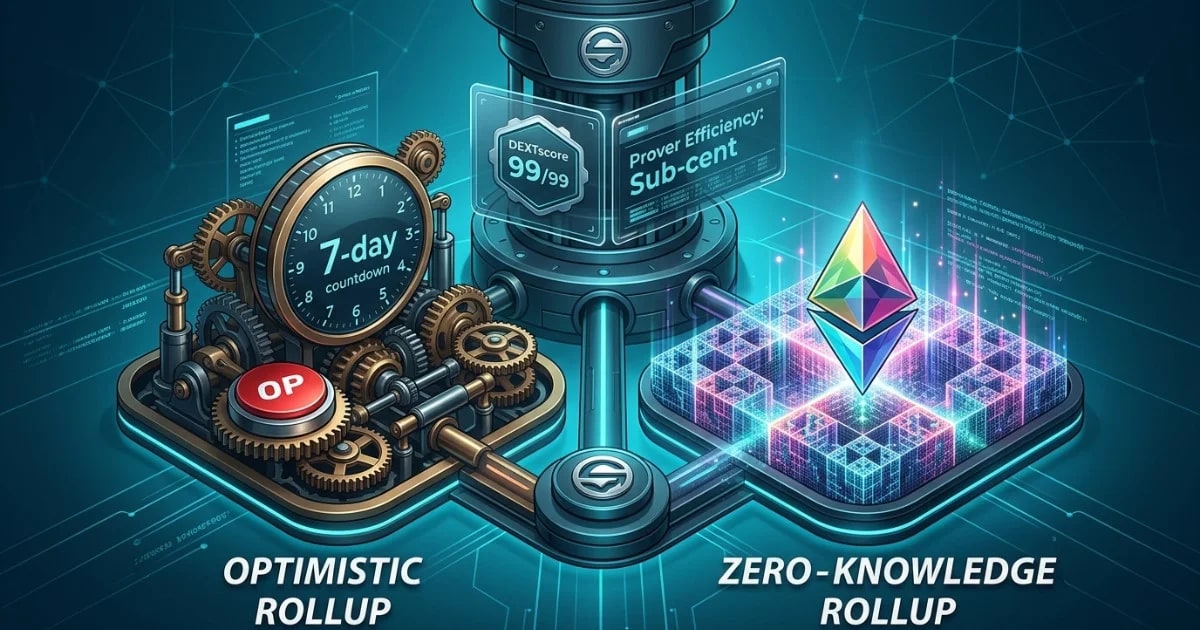
Scaling is closer to being resolved in 2026, but the choice between Optimistic and ZK Rollups remains. We analyze the 90% drop in prover costs and the 2026 decision tree.
A 2026 Technical Choice Guide
- As of May 8, 2026, the debate between Optimistic and Zero-Knowledge (ZK) Rollups has shifted from theoretical "whitepaper wars" to concrete infrastructure choices. Scaling Ethereum is no longer a goal; it is the default state. With over 95% of on-chain activity occurring on Layer 2 (L2), developers and institutions are now choosing their "execution environment" based on specific trade-offs in finality, capital efficiency, and computational overhead.
- While the "Blobs" of 2024 and the PeerDAS upgrades of 2025 have leveled the playing field for data costs, the internal mechanics of how a rollup handles state transitions remain fundamentally different. This guide provides a sober, 2026-centric analysis of which architecture best serves your specific needs.
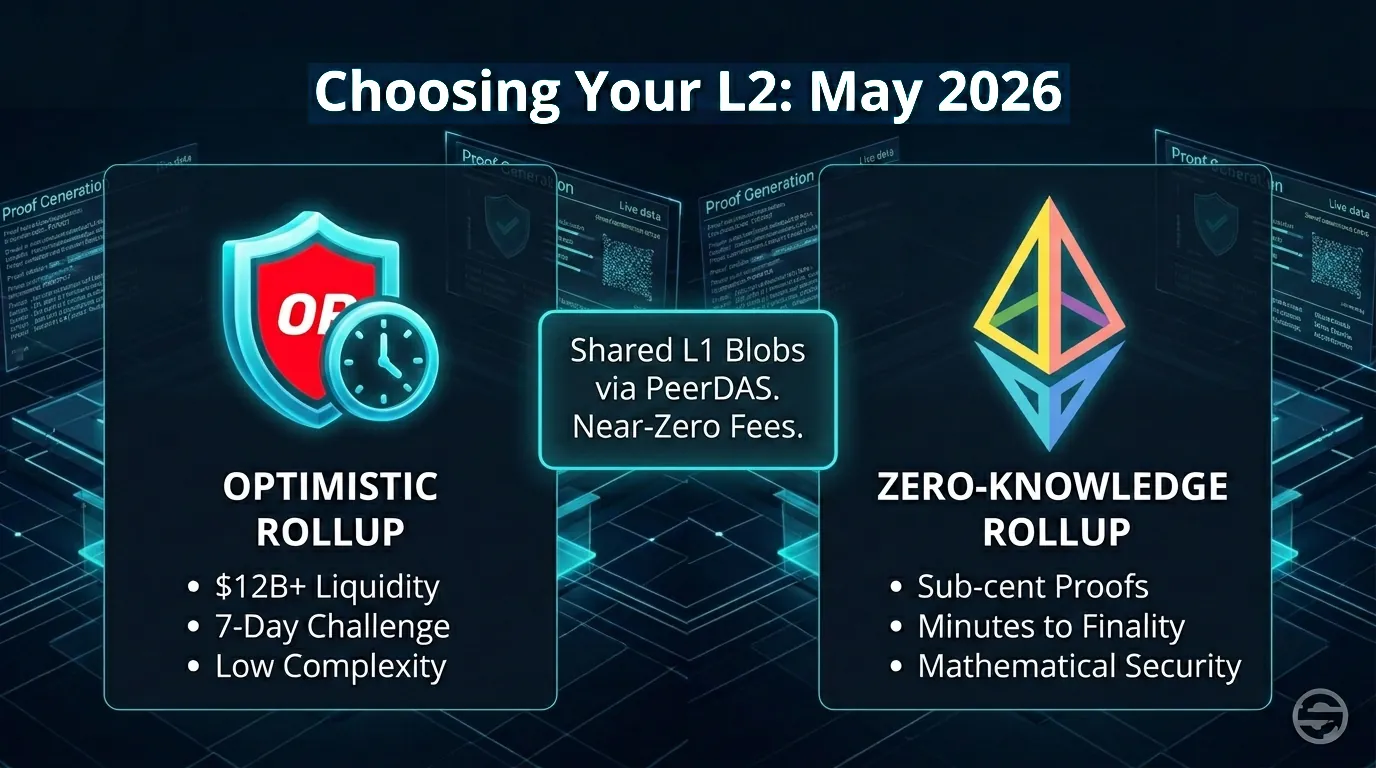
1. Optimistic vs ZK: The Core Comparison (2026 Metrics)
The distinction between these two architectures lies in their approach to trust. Optimistic rollups rely on economic game theory, while ZK rollups rely on cryptographic math.
Withdraw Times and Finality
Optimistic Rollups: In May 2026, networks like Arbitrum and Base still maintain the standard 7-day challenge period for native withdrawals. While third-party "fast bridges" exist to provide liquidity for a fee, the fundamental protocol finality remains slow.
ZK Rollups: Validity proofs allow for "instant" finality. In current 2026 production, systems like zkSync Era and Polygon zkEVM typically process a full withdrawal in 15 to 45 minutes, depending on proof batching frequency.
Prover Cost: The Sub-Cent Revolution
In 2024, the high cost of generating proofs was a major barrier for ZK networks. In 2026, the "Hardware Singularity" (driven by specialized ZK-ASICs and optimized GPU clusters (RTX 4090/5090) has dropped proving costs by over 90%.
Optimistic Overhead: Near-zero proving costs (only execution and calldata).
ZK Overhead: Now consistently under $0.01 per transaction for high-volume chains, making ZK-rollups competitive for even micro-transactions.
2. EVM Equivalence and Ecosystem Maturity
The Equivalence Gap Closed
By mid-2026, the term "EVM Equivalence" is no longer a selling point; it is a prerequisite.
Type-1 zkEVMs: Projects like Taiko offer perfect "Type-1" equivalence, meaning their code is identical to Ethereum L1.
Optimistic Maturity: Arbitrum and Optimism (OP Stack) remain the most "developer-friendly" environments due to years of stable tooling and the massive liquidity moats they have built since 2021.
Liquidity Concentration
As of May 2026, Arbitrum One leads with approximately $12.4 billion in TVL, followed by Base and Optimism. While ZK-rollups have superior capital efficiency, the "Lindy Effect" of established optimistic networks continues to attract the majority of DeFi liquidity.
Technical Trade-offs and Market Realities
Strengths and Limitations
| Feature | Optimistic Rollups (e.g., Base) | ZK Rollups (e.g., zkSync) |
| User Experience | Instant "soft" confirmations; slow native exits. | Instant soft confirmations; fast native exits. |
| Capital Efficiency | Low (funds locked for 7 days during exit). | High (funds available immediately after proof). |
| Complexity | Simple logic; easier for new chains to deploy. | High math complexity; requires expensive proving infra. |
| Security Hub | Relies on active "fraud proof" monitors. | Relies on mathematical "validity proofs." |
The "State of Proving" Risk
A critical analysis of 2026 shows that while ZK proving is cheap, it is still largely centralized. Most ZK rollups use a single "Prover" operated by the foundation. While the math ensures they cannot steal funds, they can still experience downtime or censor transactions. Optimistic rollups face a similar "sequencer centralization" risk, but their "Stage 2" decentralization efforts are currently further along in the governance cycle.
3. The 2026 Decision Tree: Which to Use?
If you are a developer or an institution deciding where to build or deploy capital, follow this logic flow:
Is Capital Efficiency the Priority? (e.g., institutional settlement, high-frequency trading)
Use ZK Rollup. The ability to move millions in capital in minutes rather than days outweighs the slight computational premium.
Is Ecosystem Liquidity/Composability the Priority? (e.g., consumer DeFi, memecoin launches, social apps)
Use Optimistic Rollup. Being where the money and the users already are (Arbitrum/Base) is more valuable than fast native exits.
Is it a Private Enterprise Application?
Use ZK-Validium. ZK technology allows for "Private DeFi" where transaction details are hidden from the public while proof of validity is still posted to Ethereum.
Is it a Mass-Market Game?
Use specialized ZK-Rollups (e.g., Immutable). These offer gasless environments optimized specifically for high-asset-volume gaming.
Verification and Security via DEXTools
In the 2026 multi-rollup era, assets are constantly being bridged across the L1/L2 divide. The risk of interacting with a "ghost" asset or a malicious bridge remains the #1 threat to user security. DEXTools is the optimal tool for analyzing the market and avoiding scams.
Professional traders in 2026 verify:
The DEXTscore: High scores (90+) are mandatory to ensure that the liquidity for an L2 asset is verified and not just a "bridge-wrapper" with no underlying value.
Bridge Forensics: Verifying that the contract address on the L2 matches the official deployment, preventing users from falling for "fake" versions of stablecoins or L1 assets.
To monitor the DeFi market in an agile and secure way in real-time and trade Layer 2 rollup assets with the help of the best crypto tools, you can access DEXTools here.
Disclaimer: This article is for informational purposes only and does not constitute investment advice, financial advice, trading advice, or any other kind of advice. DEXTools does not recommend buying, selling, or holding any cryptocurrency or token. Users should conduct their own research and consult with a qualified financial advisor before making any investment decisions. Cryptocurrency investments are volatile and high-risk. DEXTools is not responsible for any losses incurred.
Related Guides
- What Is a Layer 2? Rollups and Validiums (2026)
- Based Rollups Explained: Ethereum Scaling Guide
- Appchains vs Rollups: Which Gives Projects Control?
- What Is a TON Memo Tag and When Do You Need One? Guide (2026)
- What Is a Blockchain Explorer? How to Use One (2026)
Frequently Asked Questions
What are the main differences between Optimistic Rollups and ZK Rollups?
The primary distinction lies in their trust models; Optimistic Rollups use economic game theory, while ZK Rollups depend on cryptographic proofs.
How long does it take to withdraw from Optimistic Rollups compared to ZK Rollups?
In May 2026, Optimistic Rollups typically have a 7-day challenge period for withdrawals, whereas ZK Rollups can process withdrawals in about 15 to 45 minutes.
Which rollup should I choose for capital efficiency?
If capital efficiency is your main concern, ZK Rollups are the better option as they allow for immediate access to funds after proof validation.
What is the current state of liquidity in Optimistic Rollups versus ZK Rollups?
As of May 2026, Optimistic Rollups like Arbitrum One lead in total value locked (TVL), attracting more liquidity despite ZK Rollups having superior capital efficiency.
How can I ensure the security of assets when using rollups?
To enhance security, users should utilize tools like DEXTools to verify the integrity of assets and ensure that they are interacting with legitimate contracts.