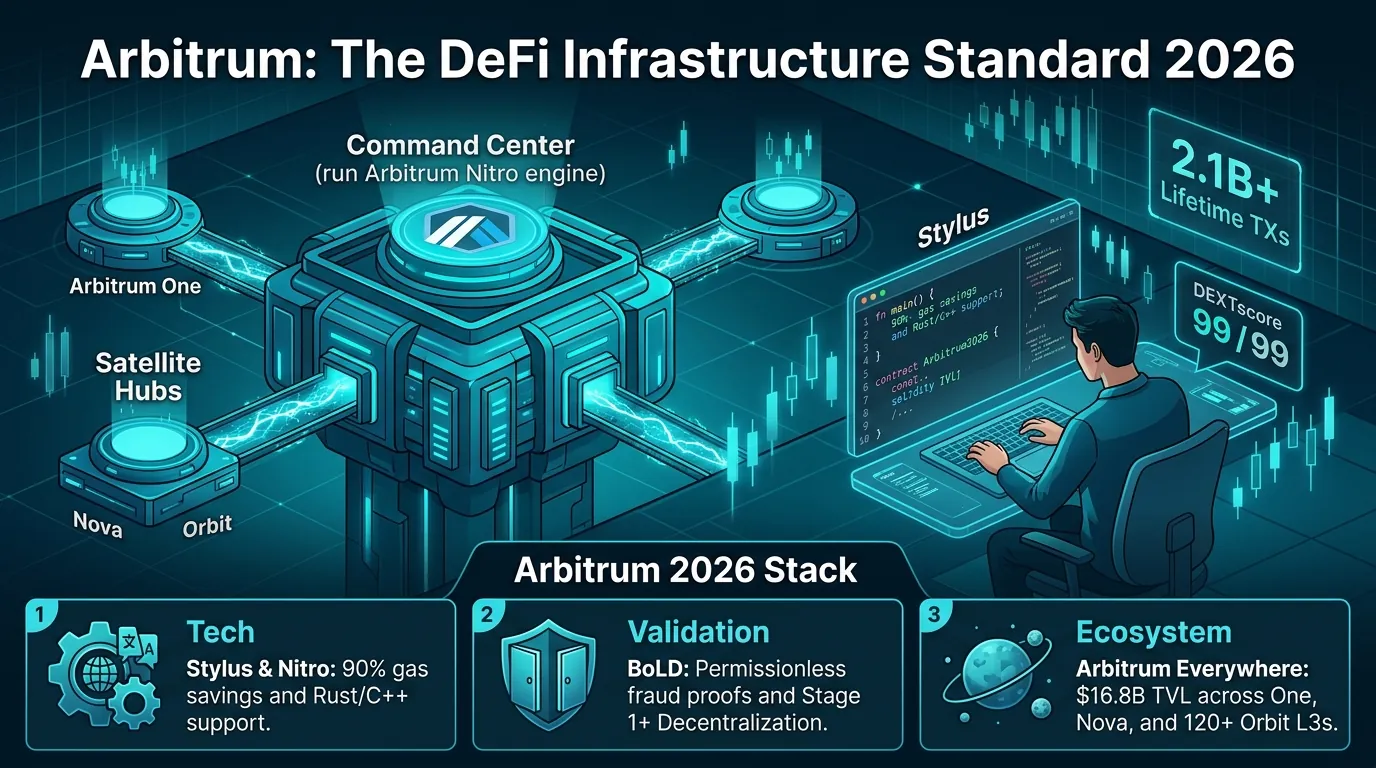
Learn what Arbitrum is, how Nitro, Stylus, and BoLD work, and why ARB stays central to Ethereum Layer 2 scaling and ecosystem growth in 2026.
Intent note
This page answers what Arbitrum is and how its Layer 2 stack works. If you want the general L2 overview first, read What Is a Layer 2?.
Arbitrum in 2026: The Institutional Layer 2 Powerhouse
What is Arbitrum?
Arbitrum is an Optimistic Rollup-based Layer 2 (L2) scaling infrastructure designed to expand Ethereum's throughput by processing transactions off-chain and posting periodic data batches to the mainnet. In the 2026 landscape, it operates as a modular stack powered by the Nitro execution engine, which ensures high compatibility with Ethereum's standards while significantly reducing gas costs.
Unlike independent sidechains, Arbitrum's security is mathematically anchored to the Ethereum L1; however, this architecture necessitates a structural "challenge period," which is the primary reason for the network's characteristic withdrawal delays. With the recent maturity of Stylus, Arbitrum has moved toward a "multi-language" model, allowing developers to deploy high-efficiency code in Rust or C++ alongside standard Solidity smart contracts.
As of May 8, 2026, Arbitrum remains the dominant force in the Ethereum Layer 2 landscape by Total Value Locked (TVL), securing approximately $16.8 billionin assets. While newer "consumer-centric" chains have captured the retail spotlight, Arbitrum has successfully pivoted toward becoming the "institutional rail" of Web3.
Following the landmark ArbOS Dia upgrade in early 2026 and the recent implementation of BoLD (Bounded Liquidity Delay), Arbitrum has moved closer to the "Holy Grail" of Stage 2 decentralization. This guide explores the technical depth, ecosystem diversity, and market realities of Arbitrum for the current year.
1. The Core Technology: Nitro, Stylus, and BoLD
Arbitrum's technical stack is built on Optimistic Rollup technology, but it has evolved significantly beyond the basic models of 2021.
Nitro Engine: The underlying tech that powers Arbitrum, designed to be highly compatible with the Ethereum Virtual Machine (EVM) while significantly reducing gas costs via advanced data compression.
Stylus (The Multi-Language VM): Released in early 2026, Stylus is a "game-changer" for developers.It allows them to write smart contracts in Rust, C, and C++ alongside Solidity. This has reduced gas costs for computationally heavy logic (like AI agents or complex gaming physics) by up to 90%.
BoLD (Permissionless Validation): Before 2026, challenging a "fraudulent" transaction on Arbitrum was limited to a whitelist of validators. With BoLD, anyone can now participate in the challenge process. This move to permissionless validation is the primary driver behind Arbitrum's "Stage 1+" status, ensuring that even a single honest participant can protect the entire network.
2. The Ecosystem: One, Nova, and Orbit
In 2026, Arbitrum is not just one chain. There are several "arbitrums," but they all share the same sophisticated infrastructure, which is divided into practical variants and specialized environments.
Gaming, Social Media (Reddit), and Micro-payments.
Arbitrum Orbit
Custom Layer 3s (L3)
Private enterprise chains and app-specific blockchains.
As of May 2026, over 120 "Orbit" chains are active, including infrastructure from traditional finance entities like Robinhood, which uses the Arbitrum stack for its tokenized equities platform.
3. The Tokenomics Reality: The ARB Overhang
While the network utility is at an all-time high (processing over 2.1 billion lifetime transactions) the ARB token continues to face a complex market reality.
Governance Power: ARB remains a pure governance token.It grants holders power over the Arbitrum DAO, which currently manages a multi-billion dollar treasury and recently voted on a $71 million ETH liquidity backstop for DeFi users.
Supply Inflation: A significant headwind in 2026 is the monthly unlock schedule.Approximately 90-100 million ARB tokens enter the market every month, creating a persistent supply overhang that requires sustained demand to maintain price stability.
The Yield Gap: Unlike other infrastructure assets, ARB does not currently offer native protocol-level yield or fee-sharing, though the DAO is actively debating "Infrastructure Equity" proposals for late 2026.
Technical Trade-offs and Market Realities
Strengths and Opportunities
Developer Flexibility: Stylus makes Arbitrum the most accessible L2 for traditional software engineers (Rust/C++).
Deep Liquidity: Arbitrum One holds the deepest "DeFi stack" in the industry, making it the safest place for institutional capital.
Decentralization Lead: With BoLD, Arbitrum is technically more decentralized than many of its competitors that still rely on centralized "Security Councils."
Limitations and Challenges
Token Dilution: The heavy unlock schedule through 2027 remains a primary concern for long-term holders.
Withdrawal Delay: As an optimistic rollup, native withdrawals still take 7 days, requiring users to use "Fast Bridges" (like Across) and pay a small premium for instant liquidity.
ZK Competition: Newer Zero-Knowledge (ZK) rollups offer faster finality and a "mathematical" security narrative that competes with Arbitrum's "economic" fraud-proof model.
Verification and Security via DEXTools
In the 2026 era of "Arbitrum Everywhere," with hundreds of Orbit L3 chains and thousands of Stylus-native tokens, verifying asset legitimacy is more critical than ever. DEXTools is the essential standard for real-time audit and verification.
Professional traders in 2026 use DEXTools to verify:
The DEXTscore: High scores (90+) are mandatory to ensure that the liquidity for an Orbit-based token is not a "honeypot."
Audits and liquidity: DEXTools provides detailed information on a token's liquidity and also offers useful external audits to assess the token's quality and help avoid scams and honeypots.
You can access Arbitrum on DEXTools here and start trading Arbitrum tokens efficiently and securely.
Disclaimer: This article is for informational purposes only and does not constitute investment advice, financial advice, trading advice, or any other kind of advice. DEXTools does not recommend buying, selling, or holding any cryptocurrency or token. Users should conduct their own research and consult with a qualified financial advisor before making any investment decisions. Cryptocurrency investments are volatile and high-risk. DEXTools is not responsible for any losses incurred.
Arbitrum is a Layer 2 scaling solution for Ethereum that uses Optimistic Rollup technology to process transactions off-chain, which helps increase Ethereum's transaction capacity while lowering gas fees.
What are the main features of Arbitrum's technology?
Arbitrum's technology includes the Nitro execution engine for compatibility and reduced gas costs, the Stylus multi-language VM allowing developers to use languages like Rust and C++, and the BoLD system that enables anyone to challenge fraudulent.
How does Arbitrum compare to other Layer 2 solutions?
Arbitrum stands out as the leading Layer 2 solution by Total Value Locked, with a focus on institutional use and a diverse ecosystem that includes various specialized chains for different applications.
What challenges does Arbitrum face in the market?
Arbitrum faces challenges such as a significant token supply inflation due to monthly unlocks, which can impact price stability, and withdrawal delays that require users to wait seven days for transactions unless they use Fast Bridges.
How can users verify the legitimacy of assets on Arbitrum?
Users can utilize DEXTools to verify asset legitimacy on Arbitrum by checking the DEXTscore for liquidity safety, identifying Stylus contracts, and ensuring that token liquidity matches the official Layer 1 bridge address.