What Is a dApp? Decentralized Apps Guide 2026
— By Tony Rabbit in Tutorials
dApps explained: learn the architecture of decentralized applications, top dApps by category, gas fees, how to use them safely, and how to build one.
A decentralized application (dApp) is a software application that runs on a blockchain network instead of a centralized server. Unlike traditional apps controlled by a single company, dApps operate through smart contracts that execute automatically on a distributed network of computers. No single entity can shut them down, alter their rules, or censor users.
The dApp ecosystem has exploded in recent years. According to DappRadar, there are now thousands of active decentralized applications across dozens of blockchains, handling billions of dollars in daily transaction volume. From swapping tokens on Uniswap to borrowing assets on Aave, dApps are reshaping how people interact with financial services, gaming, social media, and digital ownership.
This guide covers everything you need to know about dApps in 2026: how they work under the hood, what makes them different from regular apps, the major categories you should know, how to connect your wallet and start using them, and how to evaluate whether a dApp is safe before you put any funds into it.
What Exactly Is a dApp?
A dApp is any application where the core logic lives on a blockchain through smart contracts. The frontend (what you see and click) can be a normal website or mobile app, but the backend that processes transactions and stores critical data runs on a decentralized network like Ethereum, Solana, or Arbitrum. This means no single company controls the application once it is deployed.
Three characteristics define a true dApp. First, it is open source, so anyone can inspect the code and verify what the application actually does. Second, it runs on a blockchain, meaning its operations are transparent and verifiable by anyone. Third, it typically uses a cryptographic token or the blockchain's native currency to facilitate transactions, reward participants, or govern the protocol through a DAO.
Can be censored or shut down
Single point of failure
Terms can change anytime
Censorship resistant
Distributed across nodes
Rules enforced by code
Think of it this way: when you use Instagram, Meta controls every aspect of the experience. They store your data, decide what content you see, and can ban your account at will. A decentralized social app like Lens Protocol or Farcaster operates differently. Your posts live on a blockchain or decentralized storage layer, you own your social graph, and no central authority can remove your content or delete your profile.
dApp Architecture: How Decentralized Applications Work
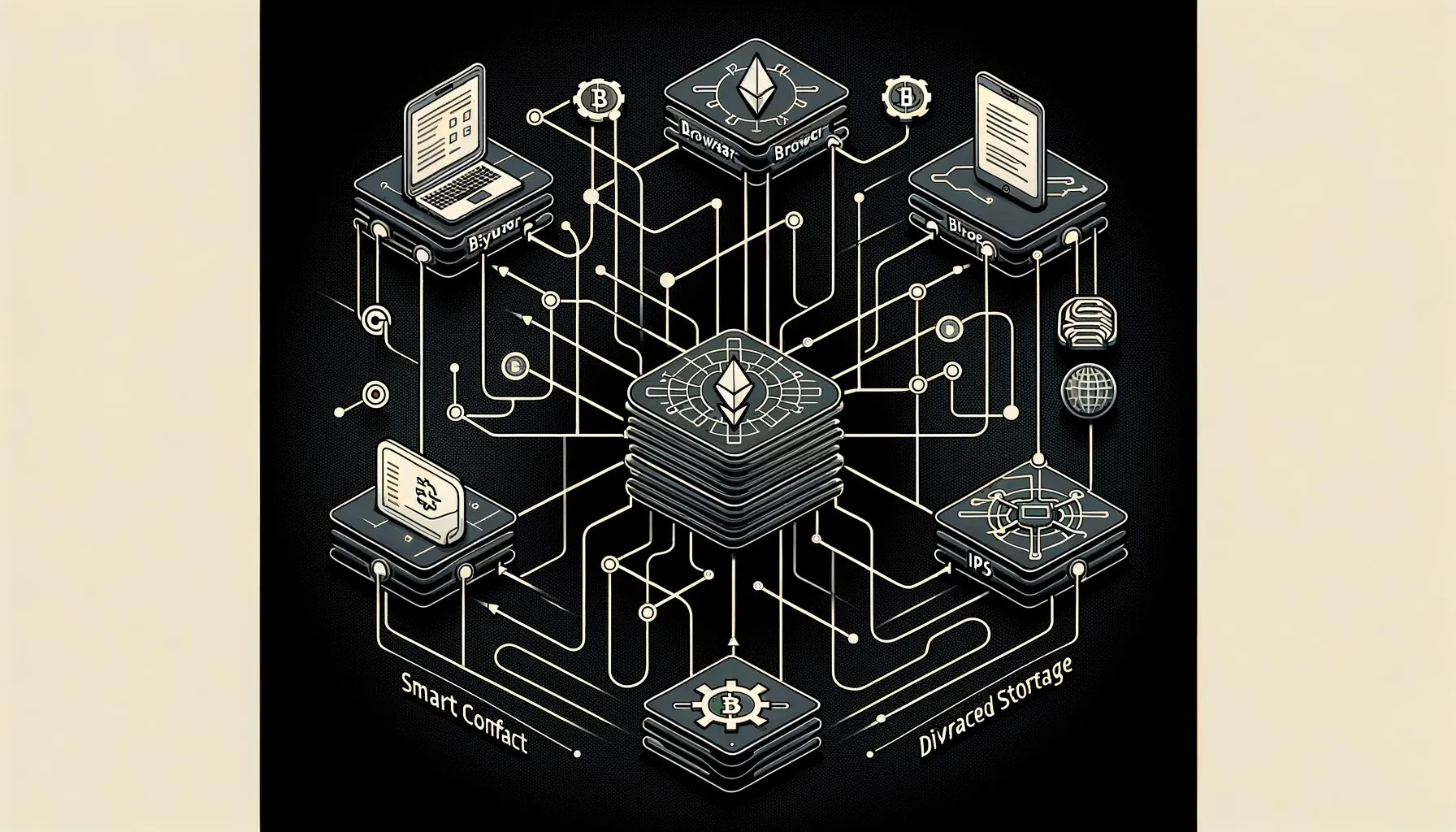
Every dApp has three layers working together. The frontend is a standard web interface built with HTML, CSS, and JavaScript, often hosted on decentralized storage like IPFS or Arweave so it cannot be taken down. The smart contract layer contains the application logic deployed on a blockchain. The blockchain itself serves as the database and execution environment, processing transactions and maintaining state.
Traditional App
- Server: Centralized (AWS, Google Cloud)
- Data: Company owns your data
- Censorship: Can be censored or shut down
- Reliability: Single point of failure
Decentralized App (dApp)
- Server: Blockchain network (distributed nodes)
- Data: User owns their data
- Censorship: Censorship resistant
- Reliability: Distributed, no single point of failure
When you interact with a dApp, here is what happens behind the scenes. You click a button on the frontend (for example, "Swap" on Uniswap). The frontend creates a transaction and sends it to your wallet (MetaMask, for instance) for approval. You review the transaction details and confirm it. Your wallet signs the transaction with your private key and broadcasts it to the blockchain. Validators or miners process the transaction by executing the smart contract code. The blockchain updates its state, and the frontend reflects the result.
This entire flow differs from a traditional app in one critical way: you must approve every action that involves your funds or data. The dApp cannot move your tokens or change anything on-chain without your explicit wallet signature. This is a fundamental shift in how applications handle user authorization.
How dApps Differ from Regular Apps
The differences between dApps and traditional applications go deeper than just where the code runs. In a traditional app, you create an account with an email and password. The company stores your credentials, and if their database gets hacked, your information is compromised. With a dApp, your wallet is your account. There is no email, no password, and no personal information stored on a server. You connect your wallet, and the blockchain recognizes your address.
Downtime is another major difference. When a centralized service goes down, everyone loses access. We have all experienced social media outages or banking app failures. dApps run on blockchains with thousands of nodes across the globe. As long as the blockchain is operational (and major blockchains have near-perfect uptime), the dApp functions. Even if the frontend website goes down, anyone can deploy an alternative interface that connects to the same smart contracts.
Updates work differently too. When Facebook changes its algorithm, users have no say. Many dApps are governed by DAOs where token holders vote on proposals to upgrade the protocol. Changes to the smart contracts require community consensus, giving users a direct voice in how the application evolves.
However, this decentralization comes with tradeoffs. dApps are generally slower than centralized apps because transactions need to be confirmed by the network. They cost money to use because of gas fees. And the user experience often lags behind polished Web2 applications because the technology is still maturing.
Connecting Your Wallet to a dApp
To use any dApp, you need a crypto wallet. The most common option is MetaMask, a browser extension and mobile wallet that supports Ethereum and all EVM-compatible chains. Other popular wallets include Phantom (for Solana), Rabby, Rainbow, and Coinbase Wallet. WalletConnect is a protocol that lets you connect mobile wallets to desktop dApps by scanning a QR code.
The connection process is straightforward. Visit the dApp's website, click "Connect Wallet," select your wallet provider, and approve the connection in your wallet popup. The dApp can then read your wallet address and token balances, but it cannot move funds or execute transactions without your approval for each action. Always verify you are on the correct website URL before connecting your wallet, as phishing sites that mimic popular dApps are common.
Top dApp Categories in 2026
The dApp ecosystem spans many verticals, but five categories dominate in terms of users, transaction volume, and innovation. Understanding these categories helps you navigate the landscape and find the applications that match your interests.
DeFi
Decentralized finance protocols for trading, lending, and earning yield without intermediaries.
Examples: Uniswap, Aave, Lido, Curve, MakerDAO
Gaming
Play-to-earn and on-chain games where players truly own their in-game assets as NFTs.
Examples: Axie Infinity, Gods Unchained, Illuvium, Pixels
Social
Decentralized social networks where users own their content and social connections.
Examples: Lens Protocol, Farcaster, Friend.tech
NFT Marketplaces
Platforms for buying, selling, and trading non-fungible tokens and digital collectibles.
Examples: OpenSea, Blur, Magic Eden, Tensor
Infrastructure
Backend services that other dApps rely on for data, oracles, indexing, and cross-chain communication.
Examples: The Graph, Chainlink, LayerZero, Filecoin
DeFi dApps: The Biggest Category
Decentralized finance remains the largest dApp category by total value locked (TVL) and transaction volume. DeFi dApps replicate traditional financial services without banks, brokers, or other intermediaries. You can swap tokens on a decentralized exchange like Uniswap, lend or borrow assets on Aave or Compound, provide liquidity to earn trading fees, or stake assets through protocols like Lido.
What makes DeFi powerful is composability. DeFi dApps can plug into each other like building blocks. You can deposit ETH into Lido for liquid staking, use the stETH you receive as collateral on Aave to borrow stablecoins, then deploy those stablecoins into a yield farming strategy on Curve. This kind of layered interaction is only possible because every protocol is open and permissionless.
Gaming and Social dApps
Blockchain gaming dApps let players own their in-game items as NFTs. In traditional games, your rare sword or character skin exists only within that game's servers. If the game shuts down, you lose everything. In blockchain games, items exist on-chain and can be traded on open marketplaces. Some games also reward players with tokens for gameplay, creating a play-to-earn model that gained massive popularity.
Decentralized social platforms represent one of the most exciting frontiers for dApps. Lens Protocol on Polygon lets users create profiles and content as on-chain assets. Farcaster is a decentralized social network with a growing developer community building clients and integrations on top of it. These platforms aim to solve the data portability problem: if you leave one client, your followers, posts, and reputation come with you.
dApp Browsers and Discovery
Finding and accessing dApps is easier than ever. Most crypto wallets now include built-in dApp browsers. MetaMask Mobile, Phantom, and Coinbase Wallet all have explore tabs that surface popular dApps across categories. On desktop, your browser extension wallet integrates directly with dApp websites you visit.
Dedicated discovery platforms like DappRadar, DeFi Llama, and State of the DApps aggregate data on thousands of dApps. DappRadar tracks unique active wallets, transaction counts, and volume across all major chains. DeFi Llama focuses specifically on DeFi protocols and is the industry standard for TVL tracking. These tools help you compare dApps, spot trends, and identify which platforms are gaining or losing users.
How to Evaluate dApp Safety
Not all dApps are created equal, and interacting with an unaudited or malicious dApp can result in total loss of funds. Before connecting your wallet or depositing any assets, you should evaluate several key factors to assess a dApp's trustworthiness.
Smart contract audits are the first thing to check. Reputable dApps undergo security audits by firms like Trail of Bits, OpenZeppelin, Certora, or Spearbit. Look for audit reports on the dApp's documentation site or GitHub. Multiple audits from different firms are better than one, and recent audits are more relevant than older ones.
Total Value Locked (TVL) indicates how much money users have deposited into the protocol. Higher TVL generally means more trust, but it is not foolproof. Check DeFi Llama for accurate TVL data. A sudden spike in TVL could indicate genuine growth or unsustainable incentive farming.
Protocol age and track record matter a lot. dApps that have been running for years without major security incidents have proven their smart contract code in the harshest testing environment possible: production with real money. Newer protocols carry higher risk regardless of their audit status.
Team transparency is another signal. While some legitimate projects have anonymous teams (Bitcoin itself was created anonymously), known teams with verifiable track records provide an additional layer of accountability. Check if the team has previously built successful projects and whether they are responsive to community concerns.
Open source code should be a non-negotiable requirement. If you cannot read the smart contract code on a block explorer like Etherscan, proceed with extreme caution. Verified and open source contracts let security researchers and the community inspect what the code actually does.
Gas Fees When Using dApps
Every transaction on a dApp costs gas fees, which are payments to the network validators who process your transaction. On Ethereum mainnet, gas fees can range from a few dollars during quiet periods to over $50 during high congestion. The complexity of the smart contract interaction determines how much gas is required: a simple token transfer costs less than a complex multi-step DeFi operation.
Gas fees are one of the biggest friction points for new dApp users. You need to hold the blockchain's native token (ETH for Ethereum, SOL for Solana, MATIC for Polygon) in your wallet to pay for gas, in addition to whatever tokens the dApp interaction requires. If your gas balance is too low, the transaction will fail but you may still lose the gas fee for the failed attempt.
Layer 2 dApps: Cheaper and Faster
Layer 2 networks have transformed the dApp experience by dramatically reducing costs and increasing speed. Networks like Arbitrum, Optimism, Base, and zkSync process transactions off the Ethereum mainnet while inheriting its security guarantees. Fees on Layer 2s typically range from fractions of a cent to a few cents, making dApps accessible to users who would be priced out of Ethereum mainnet.
Many popular dApps now operate on multiple chains simultaneously. Uniswap is available on Ethereum, Arbitrum, Optimism, Base, Polygon, and several other networks. Aave supports Ethereum, Arbitrum, Optimism, Avalanche, and more. When using these dApps, make sure your wallet is connected to the correct network. Bridging assets between chains is straightforward using bridge dApps, but always verify you are using an official or well-established bridge.
Solana takes a different approach as a high-throughput Layer 1 blockchain with sub-second finality and fees that are typically under a penny. The Solana dApp ecosystem includes Jupiter (the leading DEX aggregator), Marinade (liquid staking), and a thriving NFT marketplace scene on Tensor and Magic Eden.
Building dApps: A Developer Overview
If you are interested in building dApps, the two primary smart contract languages are Solidity (for Ethereum and EVM-compatible chains) and Rust (for Solana and some other chains). Solidity is the more accessible starting point, with extensive documentation, tutorials, and developer tools.
The typical dApp development stack includes: Solidity or Rust for smart contracts, Hardhat or Foundry as the development framework, ethers.js or viem for blockchain interaction from the frontend, React or Next.js for the user interface, and a wallet library like wagmi or RainbowKit for wallet connection. Testing is critical: tools like Foundry allow developers to write comprehensive tests and simulate transactions before deploying to mainnet.
Deploying a dApp involves compiling the smart contracts, deploying them to a testnet first (like Sepolia for Ethereum), thoroughly testing all functionality, getting a security audit for any non-trivial protocol, and finally deploying to mainnet. Once deployed, smart contracts are immutable by default, though many projects use upgradeable proxy patterns that allow the team to fix bugs or add features through governance proposals.
dApp Metrics: How to Read the Numbers
Understanding dApp metrics helps you identify healthy protocols and spot warning signs. The key metrics to track are daily active users (DAU), total value locked (TVL), daily transaction count, protocol revenue, and token holder distribution.
Daily Active Users (DAU) measures unique wallet addresses interacting with the dApp each day. This is the closest equivalent to traditional app engagement metrics, though one person can have multiple wallets. Consistent or growing DAU is a positive signal. A sudden drop might indicate users migrating to a competing protocol or a loss of confidence.
Total Value Locked (TVL) represents the total assets deposited into a DeFi protocol's smart contracts. It is the single most-watched metric in DeFi. TVL can be misleading if inflated by recursive strategies or incentive programs, so always compare TVL trends alongside DAU and revenue.
Protocol revenue shows how much the dApp earns from fees. Protocols that generate consistent revenue are more likely to sustain long-term development. Platforms like Token Terminal and DeFi Llama track protocol revenue across the ecosystem.
The Web3 Future of dApps
The dApp landscape is evolving rapidly. Account abstraction (ERC-4337) is making wallet interactions smoother by enabling features like gas sponsorship (where dApps pay your transaction fees), session keys (so you do not need to approve every single action), and social recovery (recovering your wallet through trusted contacts instead of a seed phrase). These improvements are closing the UX gap between dApps and traditional applications.
Cross-chain interoperability is another major trend. Protocols like LayerZero, Wormhole, and Axelar are enabling dApps to operate seamlessly across multiple blockchains. In the near future, users may not even need to know which chain they are on, as the infrastructure abstracts away the complexity of bridging and multi-chain transactions.
Privacy-focused dApps are gaining traction as well. Zero-knowledge proof technology enables applications that can verify information without revealing the underlying data. This opens up use cases in identity verification, private transactions, and confidential computing that were previously impossible on transparent blockchains.
Pros and Cons of dApps
Advantages
- No central authority can censor or shut down the app
- Users control their own data and assets
- Open source and transparent code
- Composable: dApps can build on top of each other
- Permissionless access for anyone with a wallet
- Community governance through DAOs and token voting
- Near-zero downtime on established blockchains
Disadvantages
- Gas fees add cost to every interaction
- Slower than centralized apps due to block confirmation times
- User experience still lags behind Web2 applications
- Smart contract bugs can lead to irreversible loss of funds
- No customer support or password recovery
- Regulatory uncertainty in many jurisdictions
- Steeper learning curve for new users
Video: dApps Explained
What are decentralized applications and how to use them.

Frequently Asked Questions
What is a dApp in simple terms?
A dApp (decentralized application) is an app that runs on a blockchain instead of a company's servers. The core logic lives in smart contracts that execute automatically, so no single company controls the application. You interact with dApps through a crypto wallet instead of a username and password.
How is a dApp different from a regular app?
Regular apps are controlled by a single company that owns the servers, data, and can change the rules at any time. dApps run on decentralized networks where the code is open source, users own their data, and changes require community consensus. The tradeoff is that dApps are generally slower and cost gas fees to use.
Do I need cryptocurrency to use a dApp?
In most cases, yes. You need the blockchain's native token (like ETH or SOL) to pay gas fees for transactions. Some dApps on Layer 2 networks offer gas sponsorship where the dApp pays the fee for you, but this is not yet universal. You will also need a crypto wallet to connect to any dApp.
Are dApps safe to use?
dApps range from extremely secure (battle-tested protocols like Uniswap and Aave with multiple audits) to highly risky (unaudited projects with anonymous teams). Always verify the smart contract is audited, check the TVL and user count, ensure the code is open source, and start with small amounts when trying a new dApp. Never interact with dApps from links in unsolicited messages.
What is the most popular dApp?
Uniswap is consistently one of the most-used dApps by transaction volume. In the DeFi space, Lido (liquid staking) and Aave (lending) are also top contenders. Outside DeFi, NFT marketplaces like OpenSea and Blur, and gaming dApps like Pixels see high user counts.
Can dApps be shut down?
The smart contracts on the blockchain cannot be shut down by any single entity as long as the blockchain runs. However, the frontend website that provides the user interface can be taken down. This is why many dApps host their frontends on decentralized storage like IPFS. Even if a frontend is removed, technically skilled users can interact with the smart contracts directly.
What wallet do I need for dApps?
MetaMask is the most widely supported wallet for Ethereum and EVM-chain dApps. Phantom is the standard for Solana dApps. Many dApps also support WalletConnect, which lets you connect various mobile wallets. Choose a wallet based on which blockchains you plan to use.
What are gas fees on dApps?
Gas fees are the transaction costs you pay to the blockchain network when using a dApp. Every action that writes data to the blockchain requires gas. Fees vary by network: Ethereum mainnet can be expensive ($5-$50+), while Layer 2 networks like Arbitrum and Base charge fractions of a cent. Solana fees are typically under one cent.
How do I find new dApps?
DappRadar, DeFi Llama, and State of the DApps are the leading discovery platforms. Your wallet's built-in dApp browser is another good source. Crypto Twitter (X), Discord communities, and newsletters like Bankless also surface new and trending dApps regularly. Always do your own research before interacting with any dApp you discover.
Can I build my own dApp?
Yes. If you know JavaScript, you can learn Solidity (the most common smart contract language) relatively quickly. Start with a development framework like Hardhat or Foundry, build on a testnet, and study existing open source dApps for patterns. The smart contract ecosystem has extensive documentation and tutorials.
What is a dApp browser?
A dApp browser is a feature built into crypto wallets that lets you visit and interact with dApps directly. MetaMask Mobile, Phantom, and Coinbase Wallet all include dApp browsers. On desktop, browser extension wallets like MetaMask inject into your regular browser, effectively turning Chrome, Firefox, or Brave into a dApp browser.
What is the difference between DeFi and dApps?
DeFi (decentralized finance) is a category of dApps focused specifically on financial services like trading, lending, borrowing, and earning yield. dApp is the broader term that includes DeFi but also covers gaming, social media, NFT marketplaces, infrastructure tools, and any other application built on a blockchain.
Are dApps legal?
dApps themselves are legal in most jurisdictions, but regulations vary by country and dApp category. Some governments have restricted access to certain DeFi protocols or required dApps to implement KYC (Know Your Customer) procedures. The regulatory landscape is still evolving, so check your local laws before using dApps, especially for financial activities.
What does "Web3" have to do with dApps?
Web3 is the vision of a decentralized internet built on blockchain technology, and dApps are its building blocks. If Web2 is the internet of platforms (Google, Facebook, Amazon), Web3 is the internet of protocols where dApps provide the same services without centralized gatekeepers. Every dApp is a piece of the Web3 ecosystem.
Frequently Asked Questions
What is a dApp?
A dApp is a decentralized application that runs on a blockchain network, utilizing smart contracts to automate processes without central authority.
How do dApps differ from traditional apps?
Unlike traditional apps controlled by a single entity, dApps operate on a decentralized network, making them censorship-resistant and transparent.
What are some common uses for dApps?
dApps are used in various sectors including decentralized finance (DeFi), gaming, social media, and supply chain management.
What technology powers dApps?
dApps are primarily powered by blockchain technology, with Ethereum being a common platform due to its robust smart contract capabilities.
Are dApps secure?
dApps inherit the security features of their underlying blockchain, but their security also depends on the quality of their smart contract code and auditing practices.
Related Guides
- How to Use WalletConnect Safely for dApp Connections (2026)
- Burner Wallet for Crypto: Complete Airdrop & Risky dApp Guide (2026)
- How to Use Coinbase Wallet: Self-Custody and dApp Guide (2026)
- Base Chain dApp Guide: Bridge, Swap, Lend and Use Base App (2026)
- Fee Revenue per Active Wallet vs Total Fees: Which Shows Real dApp Monetization?