What Is Web3? Complete Beginner Guide 2026
— By Tony Rabbit in Tutorials
Web3 explained for beginners: blockchain, smart contracts, tokens, DAOs, DeFi and NFTs, plus a clear Web1 vs Web2 vs Web3 comparison and how to start.
Web3 represents the next evolution of the internet, a decentralized version where users own their data, digital assets, and online identities without relying on Big Tech intermediaries. If you have been hearing about blockchain, crypto wallets, and decentralized apps but are not sure how they all connect, this guide breaks down everything you need to know about Web3 in 2026.
Whether you are a complete beginner or someone looking to understand the technical foundations, we will walk through the history of the web, the core principles driving Web3, the key technologies powering it, real-world use cases, and how you can start participating today.

The Evolution of the Web: From Web1 to Web3
To understand Web3, you first need to understand what came before it. The internet has gone through three distinct phases, each fundamentally changing how humans interact with information and each other online.
1990 - 2005
Mode: Read-Only
Web Evolution
Static pages
No interaction
Social media
Platforms own data
Decentralized
You own your data
Content: Static HTML pages
Interaction: One-way (consume only)

Data: Hosted on individual servers
Examples: GeoCities, early Yahoo, personal homepages
2005 - 2020
Mode: Read-Write
Content: User-generated content
Interaction: Two-way (create + consume)
Data: Platforms own your data
Examples: Facebook, YouTube, Instagram, Twitter
Web1: The Read-Only Web (1990-2005)
Web1 was the internet of static pages. Websites were built with basic HTML, and the vast majority of users were passive consumers of information. Think of personal homepages, early corporate websites, and online encyclopedias. There was no commenting, no social sharing, and no user accounts in the way we know them today. Content creators published, and everyone else read.
Web2: The Read-Write Web (2005-2020)
Web2 brought interactivity. Platforms like Facebook, YouTube, Twitter, and Instagram let anyone create and share content. This era gave us social media, mobile apps, cloud computing, and the gig economy. However, it came with a major tradeoff: a handful of corporations began controlling the vast majority of online activity. Your data, content, social connections, and digital identity all lived on servers owned by Big Tech. They could monetize your data, censor your content, or shut down your account at will.
Web3: The Read-Write-Own Web (2020+)
Web3 aims to fix the power imbalance of Web2 by giving users true ownership. Instead of platforms controlling everything, blockchain technology enables decentralized networks where users own their data, digital assets, and even the platforms themselves through governance tokens. No single entity has absolute control, and transactions happen peer-to-peer without trusted intermediaries.
Core Principles of Web3
Web3 is not just a technology upgrade. It represents a fundamentally different philosophy about how the internet should work. Four core principles define this vision.
1. Decentralization
In Web2, data lives on centralized servers controlled by companies like Google, Amazon, and Meta. In Web3, data is distributed across thousands of nodes in a peer-to-peer network. No single entity controls the network, and no single point of failure can bring it down. This is achieved through blockchain technology, which creates a shared, immutable ledger maintained by a global network of participants.
2. Trustless Interactions
In the traditional internet, you need to trust intermediaries. You trust your bank to process payments, you trust Facebook to protect your data, and you trust Uber to fairly match riders with drivers. Web3 replaces this trust with cryptographic verification. Smart contracts automatically execute agreements when predefined conditions are met, eliminating the need to trust any third party. The code is transparent, auditable, and runs exactly as programmed.
3. Permissionless Access
Anyone with an internet connection can participate in Web3 without needing approval from a gatekeeper. You do not need a bank account to access financial services, you do not need a social media company to approve your content, and you do not need a government-issued ID to prove your identity. This is particularly transformative for the estimated 1.4 billion adults worldwide who remain unbanked.
4. Native Payments
Web3 has money built directly into its infrastructure through cryptocurrencies and tokens. Unlike Web2, where payment processing requires third-party services like Stripe, PayPal, or credit card networks, Web3 enables native peer-to-peer value transfer. You can send money to anyone in the world in seconds without a bank, a payment processor, or currency exchange fees. Understanding tokenomics is essential to grasping how these economic systems are designed.
Key Technologies Powering Web3
Web3 is built on a stack of interconnected technologies. Each one plays a critical role in creating this decentralized internet. Let us break them down.

Blockchain
The blockchain is the foundational technology of Web3. It is a distributed, immutable ledger that records every transaction across a network of computers. Each block contains a batch of transactions and is cryptographically linked to the previous block, forming an unbreakable chain. Once data is written to a blockchain, it cannot be altered or deleted. This provides transparency, security, and a permanent record of all activity without relying on a central authority.
Smart Contracts
Smart contracts are self-executing programs stored on a blockchain that automatically run when predefined conditions are met. Think of them as digital vending machines: you put in the right input, and you get the guaranteed output without needing to trust a human operator. Smart contracts power everything in Web3, from decentralized exchanges to lending protocols, insurance products, and governance systems. They are the backbone of decentralized applications.
Cryptocurrency Tokens
Tokens are the digital assets of Web3. They come in several forms. Fungible tokens (like ETH, SOL, or USDC) work like digital money where each unit is interchangeable. Non-fungible tokens (NFTs) represent unique digital items like art, music, domain names, or in-game assets. Governance tokens give holders voting power over protocol decisions. Understanding the tokenomics behind these assets is crucial for evaluating any Web3 project.
Crypto Wallets
A crypto wallet is your gateway to Web3. Unlike a traditional wallet that holds cash, a crypto wallet holds your private keys, which are the cryptographic proof that you own your digital assets. Wallets like MetaMask let you interact with decentralized applications, sign transactions, and manage your tokens across multiple blockchains. For long-term storage and maximum security, cold wallets (hardware wallets) keep your private keys completely offline.
DAOs (Decentralized Autonomous Organizations)
DAOs are internet-native organizations governed by smart contracts and community voting rather than a CEO or board of directors. Members hold governance tokens that give them voting power proportional to their stake. DAOs manage treasuries, make protocol upgrades, allocate funding, and set the strategic direction of Web3 projects. They represent a new model of organizational governance that is transparent, democratic, and borderless.
DeFi (Decentralized Finance)
DeFi rebuilds traditional financial services like lending, borrowing, trading, and insurance on blockchain infrastructure without banks or brokers. Instead of depositing money in a bank that lends it out and keeps most of the interest, DeFi lets you lend directly to borrowers through smart contracts and earn the full yield. Platforms like Uniswap enable decentralized token swapping without a centralized exchange, while protocols like Aave and Compound offer lending and borrowing markets.
NFTs (Non-Fungible Tokens)
NFTs are unique digital tokens that represent ownership of a specific item, whether that is digital art, a music file, a virtual land plot, a domain name, or even a real-world asset. Unlike cryptocurrencies where each token is identical, every NFT is unique and cannot be replicated. In 2026, NFTs have evolved far beyond profile pictures. They now serve as tickets, membership passes, identity credentials, and proof of authenticity for both digital and physical goods.
dApps (Decentralized Applications)
dApps are applications built on blockchain networks rather than centralized servers. They look and feel similar to regular apps, but their backend logic runs on smart contracts and their data is stored on decentralized networks. This means no single company controls them, they cannot be censored by any single entity, and they operate transparently. Popular dApps span decentralized exchanges, lending platforms, NFT marketplaces, social networks, and gaming platforms.
Layer 2 Solutions
Layer 2 solutions are scaling technologies built on top of existing blockchains (Layer 1s) to increase transaction speed and reduce costs. Networks like Arbitrum, Optimism, Base, and zkSync process transactions off the main Ethereum chain while inheriting its security guarantees. Layer 2s have been essential in making Web3 practical for everyday use by bringing transaction fees down from dollars to fractions of a cent.
How Web3 Works Technically
Understanding the technical flow of a Web3 interaction helps demystify the entire ecosystem. Here is what happens step by step when you use a decentralized application.
Step 1: Connect your wallet. When you visit a dApp like Uniswap, the first thing you do is connect your crypto wallet. Your wallet acts as your identity and your bank account in Web3. There is no username or password. Your wallet address is your account.
Step 2: Initiate a transaction. You decide what action you want to take, whether that is swapping tokens, lending assets, minting an NFT, or voting on a DAO proposal. The dApp prepares a transaction with all the necessary details.
Step 3: Sign the transaction. Your wallet presents you with the transaction details and asks you to confirm. When you sign, you use your private key to cryptographically authorize the transaction. This proves you are the owner of the assets being used.
Step 4: Transaction broadcast. The signed transaction is broadcast to the blockchain network, where it enters a pool of pending transactions called the mempool.
Step 5: Validation and consensus. Validators (or miners, depending on the blockchain) pick up the transaction, verify its legitimacy, and include it in a new block. The network reaches consensus that the block is valid through mechanisms like Proof of Stake or Proof of Work.
Step 6: Smart contract execution. If the transaction involves a smart contract, the contract code executes automatically. For example, on a decentralized exchange, the smart contract swaps your tokens at the agreed-upon rate and sends the new tokens to your wallet.
Step 7: State update. The blockchain state is updated across all nodes in the network. Your wallet balance reflects the changes, and the transaction is permanently recorded on the ledger. Anyone can verify it happened by looking at the public blockchain explorer.
The entire process, from signing to confirmation, takes anywhere from a few seconds on fast chains like Solana to a couple of minutes on Ethereum Layer 1. On Layer 2 networks, transactions are typically confirmed in under two seconds.
The Web3 Ecosystem: Major Blockchains
Web3 is not built on a single blockchain. Multiple networks compete and coexist, each with different strengths, tradeoffs, and ecosystems. Here are the most significant ones in 2026.
Ethereum
Ethereum remains the largest and most established smart contract platform. It pioneered programmable blockchains and hosts the majority of DeFi protocols, NFT marketplaces, and DAOs. After transitioning to Proof of Stake in 2022 and implementing EIP-4844 (Proto-Danksharding) in 2024, Ethereum has significantly reduced its environmental impact and transaction costs on Layer 2s. Its ecosystem of Layer 2 networks including Arbitrum, Optimism, Base, and zkSync has made it accessible for everyday transactions.
Solana
Solana is known for its speed and low transaction costs. Processing thousands of transactions per second at fractions of a cent per transaction, it has become the go-to chain for high-frequency applications like decentralized exchanges, gaming, and consumer-facing dApps. Solana's monolithic architecture takes a different scaling approach than Ethereum's modular Layer 2 strategy, offering a simpler developer and user experience at the cost of higher hardware requirements for validators.
Polkadot
Polkadot focuses on interoperability, enabling different blockchains to communicate and share data with each other. Its parachain architecture lets specialized blockchains connect to a shared security layer, making it possible to build application-specific chains that still interact seamlessly with the broader ecosystem. Polkadot's approach addresses one of Web3's biggest challenges: fragmented liquidity and disconnected user experiences across different chains.
Other Notable Chains
Several other blockchains play important roles in the Web3 ecosystem. Avalanche offers high throughput with its subnet architecture. Cosmos provides a framework for building interconnected app-specific chains. Near Protocol focuses on developer and user experience with its account abstraction features. And newer entrants like Sui and Aptos bring innovations from their Move programming language and parallel transaction processing.
Web3 Use Cases in 2026
Web3 is no longer a theoretical concept. Real applications are being used by millions of people across multiple industries. Here are the most impactful use cases.
Decentralized Finance (DeFi)
DeFi is the largest and most mature Web3 use case. It includes decentralized exchanges like Uniswap, lending and borrowing platforms like Aave and Compound, stablecoin protocols, yield optimization tools, and decentralized insurance. DeFi provides financial services to anyone with an internet connection, operating 24/7 without bank holidays, business hours, or geographic restrictions. By 2026, DeFi has also expanded heavily into real-world assets (RWAs), tokenizing everything from treasury bills to real estate.
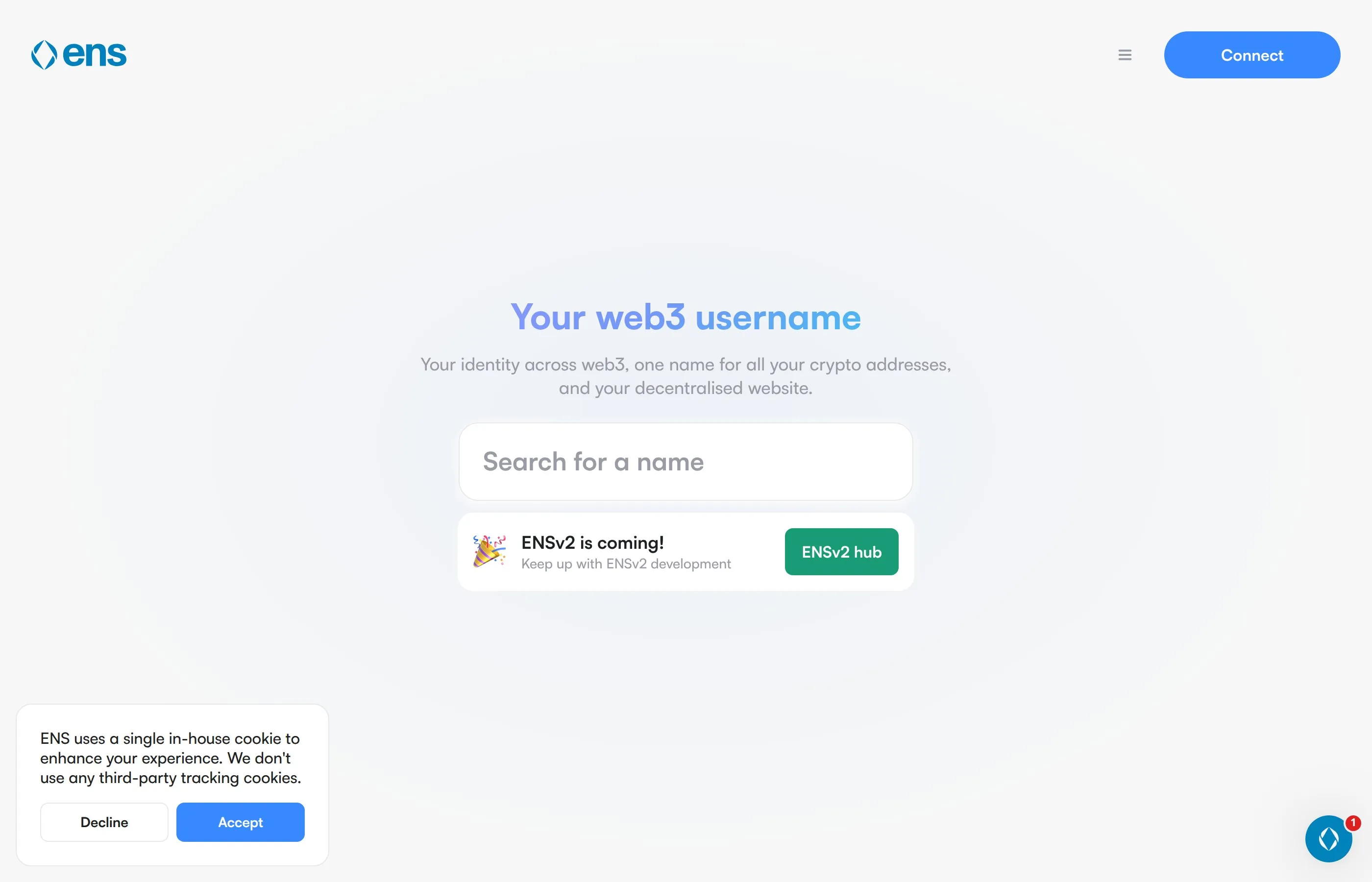
Digital Identity and ENS
Web3 enables self-sovereign identity, where you control your own digital identity without relying on Google, Facebook, or government databases. ENS (Ethereum Name Service) domains replace long wallet addresses with human-readable names like "yourname.eth" and serve as portable Web3 usernames across dApps. Decentralized identity protocols also enable verifiable credentials for age verification, professional certifications, and reputation systems without exposing unnecessary personal information.
Web3 Social Media
Decentralized social platforms give users ownership of their content, followers, and social graph. Unlike Twitter or Instagram where your account and audience are locked into one platform, Web3 social protocols like Lens Protocol and Farcaster let you carry your social identity across multiple applications. If one app shuts down or censors you, your content and followers remain intact on the underlying protocol.
Gaming and the Metaverse
Web3 gaming gives players true ownership of in-game items through NFTs. Instead of spending hundreds of hours grinding for a rare sword that exists only within one game's servers, you own that item as an NFT in your wallet. You can sell it, trade it, or potentially use it across multiple compatible games. Gaming has become one of the primary onboarding vectors for new Web3 users, with titles on networks like Immutable X, Ronin, and Solana attracting millions of players.
Supply Chain and Provenance
Blockchain technology enables transparent, tamper-proof tracking of goods from origin to consumer. Companies use Web3 infrastructure to verify the authenticity of luxury goods, track food safety from farm to table, and ensure ethical sourcing of raw materials. By recording each step of the supply chain on an immutable ledger, businesses and consumers can verify claims about product origin, handling conditions, and authenticity.
Real-World Assets (RWAs)
Real-world asset tokenization is one of the fastest-growing Web3 sectors in 2026. It involves creating blockchain-based tokens that represent ownership of physical or traditional financial assets. Tokenized treasuries, real estate, private credit, commodities, and even fine art are now traded on-chain. This unlocks fractional ownership, 24/7 trading, instant settlement, and global access to asset classes that were previously limited to institutional investors.
How to Get Started with Web3
Getting into Web3 might seem overwhelming, but you can get started in just a few steps. Here is a practical roadmap for beginners.
Step 1: Set Up a Wallet
Your first step is installing a crypto wallet. MetaMask is the most popular option and works as a browser extension and mobile app. It supports Ethereum and all EVM-compatible chains. For Solana, you would use Phantom wallet. When you create a wallet, you will receive a seed phrase (12 or 24 words). Write this down on paper and store it securely. Anyone with your seed phrase has full access to your funds. Never share it with anyone, never store it digitally, and never enter it on a website unless you are recovering your wallet.
Step 2: Get Some Crypto
To interact with Web3, you need cryptocurrency to pay for transaction fees (called gas). You can purchase ETH, SOL, or other tokens on centralized exchanges like Coinbase or Kraken, then transfer them to your wallet. Some services also let you buy crypto directly within wallet apps using a debit card. Start small while you are learning.
Step 3: Secure Your Assets
Once you have meaningful value in your wallet, consider upgrading to a cold wallet (hardware wallet) like Ledger or Trezor. These devices keep your private keys offline, making them virtually immune to hacks, phishing attacks, and malware. Use your hot wallet (MetaMask) for daily transactions and your cold wallet for long-term storage.
Step 4: Explore dApps
Start interacting with decentralized applications. Try swapping tokens on Uniswap, register an ENS domain, browse NFT marketplaces, or join a DAO. Each interaction teaches you something new about how Web3 works. Start with small amounts while you build familiarity with the ecosystem.
Step 5: Learn and Stay Safe
Web3 puts you in control, which also means you are responsible for your own security. Learn to recognize common scams like phishing sites, fake airdrops, and social engineering attacks. Always verify contract addresses, use hardware wallets for significant holdings, and never sign transactions you do not fully understand. Our guide to using MetaMask safely covers essential security practices.
Web3 vs Web2: Detailed Comparison
The following comparison highlights the fundamental differences between the current internet paradigm (Web2) and the decentralized internet (Web3) across every major dimension.
Challenges Facing Web3
Despite its promise, Web3 faces significant challenges that need to be addressed before it can achieve mainstream adoption. Being honest about these hurdles is important for anyone entering the space.
User Experience (UX)
Web3 UX remains more complex than Web2. Managing seed phrases, understanding gas fees, navigating different chains, and approving transactions creates friction for new users. While wallets and dApps have improved significantly since the early days, the experience still does not match the simplicity of signing in with Google or tapping Apple Pay. Account abstraction and smart wallets are closing this gap, but there is still work to do.
Scalability
While Layer 2 solutions have dramatically improved transaction throughput and reduced costs, blockchain networks still lag behind centralized systems in raw processing power. Visa processes roughly 65,000 transactions per second. No single blockchain matches that yet, though the combination of Layer 1 base chains and Layer 2 scaling networks is rapidly closing the gap. Ethereum's rollup-centric roadmap and Solana's continuous performance improvements are making Web3 increasingly viable for high-volume applications.
Regulation
The regulatory landscape for Web3 varies dramatically by jurisdiction and remains in flux. Some countries embrace crypto innovation while others restrict or ban it. Regulatory uncertainty creates challenges for builders and users alike, particularly around token classification, DeFi compliance, DAO legal structures, and cross-border transactions. In 2026, regulatory frameworks are gradually crystallizing, with the US, EU, and several Asian countries establishing clearer guidelines, but significant ambiguity remains in many areas.
Security and Scams
The irreversibility of blockchain transactions means that mistakes and exploits can result in permanent loss of funds. Smart contract vulnerabilities, phishing attacks, rug pulls, and social engineering scams remain prevalent. While auditing practices and security tools have matured, the responsibility for security ultimately falls on the user. Using a hardware wallet and practicing careful transaction verification are essential risk mitigation strategies.
Environmental Concerns
After Ethereum's shift to Proof of Stake in 2022, which reduced its energy consumption by over 99%, the environmental narrative around blockchain has improved considerably. Most modern blockchains use energy-efficient consensus mechanisms. However, Bitcoin still uses Proof of Work, and the overall energy footprint of blockchain infrastructure, including validators and data availability layers, continues to be a topic of discussion.
Pros and Cons of Web3
Advantages
True digital ownership: You own your assets, data, and digital identity. No platform can arbitrarily revoke your access or monetize your personal information without consent.
Financial inclusion: Anyone with internet access can use DeFi services regardless of their location, credit score, or banking status.
Transparency: All transactions and smart contract code are publicly verifiable on the blockchain. No hidden fees, no opaque algorithms, no behind-the-scenes manipulation.
Censorship resistance: Decentralized networks cannot be shut down or censored by any single government, corporation, or entity.
Composability: Web3 protocols are open and interoperable. Developers can build on top of existing protocols like building blocks, creating increasingly sophisticated applications. This is often called the "money legos" concept in DeFi.
Programmable money: Smart contracts enable financial instruments and agreements that execute automatically, reducing counterparty risk and eliminating the need for trusted intermediaries.
Global and borderless: Web3 operates 24/7 without geographic restrictions, business hours, or currency conversion barriers.
Disadvantages
Steep learning curve: Understanding wallets, gas fees, private keys, and blockchain mechanics requires significant education for new users.
Irreversible transactions: If you send crypto to the wrong address or fall for a scam, there is typically no recourse. There is no customer support to call and no chargeback mechanism.
Volatile markets: Cryptocurrency prices can swing dramatically. Assets that are worth thousands today could lose significant value tomorrow.
Regulatory uncertainty: The legal status of many Web3 activities remains unclear in most jurisdictions, creating risk for users and builders.
UX gaps: Despite improvements, the user experience still lags behind Web2 applications in terms of simplicity and intuitiveness.
Scalability limitations: While improving, blockchain networks still cannot match the throughput of centralized systems for all use cases.
Smart contract risk: Bugs in smart contract code can be exploited, potentially resulting in significant financial losses. Code audits reduce but do not eliminate this risk.
The Future of Web3: 2026 and Beyond
Web3 is maturing rapidly, and several major trends are shaping its trajectory going forward.
Account abstraction and smart wallets are making Web3 accessible to mainstream users by abstracting away seed phrases, gas fees, and complex transaction signing. Users will interact with dApps as easily as they use regular apps, with social recovery, session keys, and gasless transactions becoming standard.
Real-world asset tokenization is bridging traditional finance and Web3. As more real-world assets come on-chain, the total value locked in Web3 will grow exponentially. Major financial institutions are already tokenizing bonds, funds, and other instruments on blockchain rails.
Cross-chain interoperability is connecting previously siloed blockchain ecosystems. Bridges, messaging protocols, and standards like ERC-7683 are enabling seamless asset and data transfer across chains, making the multi-chain future more user-friendly.
AI and Web3 convergence is creating new possibilities. Decentralized AI networks, on-chain AI agents, and blockchain-verified AI outputs are emerging use cases that combine two of the most transformative technologies of our era.
Decentralized physical infrastructure (DePIN) is extending Web3 beyond purely digital applications. Networks of physical devices including sensors, wireless hotspots, compute nodes, and energy grids are being coordinated through blockchain incentive mechanisms, creating decentralized alternatives to traditional infrastructure providers.
Institutional adoption continues to accelerate. Major banks, asset managers, and corporations are building on or integrating with blockchain infrastructure. This brings more liquidity, credibility, and use cases to the Web3 ecosystem while also raising important questions about maintaining decentralization principles.
Video Explainer
Watch this video for a visual walkthrough of the concepts covered above.
Frequently Asked Questions
What is Web3 in simple terms?
Web3 is the next generation of the internet where users own their data, digital assets, and identities instead of large corporations controlling everything. It uses blockchain technology to create decentralized networks that run without central authorities or intermediaries.
Is Web3 the same as cryptocurrency?
No. Cryptocurrency is one component of Web3, but Web3 is much broader. It encompasses decentralized applications, digital identity, DAOs, NFTs, DeFi, and an entirely new paradigm for how the internet operates. Cryptocurrency serves as the native payment and incentive layer within this broader ecosystem.
Do I need cryptocurrency to use Web3?
In most cases, yes. You need small amounts of cryptocurrency (like ETH or SOL) to pay transaction fees when interacting with blockchain networks. However, gasless transactions and sponsored fees are becoming more common, and some dApps now cover gas costs for users.
Is Web3 safe?
Web3 protocols themselves are generally secure, but the ecosystem carries risks including smart contract vulnerabilities, phishing scams, and user error. Using a hardware wallet, verifying contract addresses, and educating yourself about common scam tactics significantly reduces your risk.
What is the difference between Web3 and blockchain?
Blockchain is the underlying technology. Web3 is the broader vision of a decentralized internet built using blockchain and related technologies. Think of blockchain as the engine and Web3 as the entire vehicle.
How do I start with Web3?
Start by setting up a MetaMask wallet, purchasing a small amount of ETH, and exploring a decentralized application like Uniswap. Focus on learning before investing significant money.
What is a dApp?
A dApp (decentralized application) is an application that runs on a blockchain network rather than centralized servers. Its backend logic is powered by smart contracts, making it transparent, censorship-resistant, and not controlled by any single company.
Can Web3 be hacked?
While blockchain networks themselves are extremely difficult to hack due to their distributed nature, individual smart contracts can contain vulnerabilities that attackers exploit. DeFi protocol hacks, phishing attacks, and social engineering scams have resulted in billions of dollars in losses across the industry. Security audits, bug bounties, and user education are the primary defenses.
What are gas fees in Web3?
Gas fees are the transaction costs you pay to use a blockchain network. They compensate validators who process and confirm your transactions. Gas fees vary based on network congestion and the complexity of the transaction. Layer 2 networks have reduced gas fees to fractions of a cent for most transactions.
Will Web3 replace Web2?
Web3 is unlikely to completely replace Web2 in the near term. Instead, the two will coexist and gradually merge. Many Web2 companies are already integrating Web3 features like digital wallets, token-based loyalty programs, and blockchain-verified credentials. Over time, users will interact with Web3 infrastructure without even realizing it, similar to how you use TCP/IP today without thinking about it.
What is a smart contract?
A smart contract is a self-executing program stored on a blockchain that automatically runs when specific conditions are met. They eliminate the need for intermediaries by encoding agreement terms directly into code. Once deployed, smart contracts operate exactly as programmed and cannot be altered by any single party.
What are the best Web3 wallets?
For beginners, MetaMask is the most widely used wallet for Ethereum and EVM chains. Phantom is the top choice for Solana. For maximum security, hardware wallets like Ledger and Trezor are recommended for storing significant holdings offline.
What is tokenomics and why does it matter?
Tokenomics refers to the economic model and design behind a cryptocurrency token, including its supply, distribution, utility, and incentive mechanisms. Understanding tokenomics is critical for evaluating whether a Web3 project has a sustainable economic model or is likely to fail long-term.
What are real-world assets in Web3?
Real-world assets (RWAs) are traditional assets like real estate, government bonds, commodities, and private credit that have been tokenized and brought onto blockchain networks. RWA tokenization enables fractional ownership, instant settlement, 24/7 trading, and global access to investment opportunities that were previously restricted to institutional investors.
Is Web3 only about finance?
Not at all. While DeFi is the most developed sector, Web3 also encompasses social media, gaming, digital identity, supply chain management, healthcare records, voting systems, content creation, and decentralized physical infrastructure. Any application that benefits from transparency, user ownership, or disintermediation can potentially be improved by Web3 technology.
What is an ENS domain?
An ENS (Ethereum Name Service) domain is a human-readable name (like "yourname.eth") that maps to your Ethereum wallet address. Instead of sharing a long hexadecimal address, you can share your ENS name to receive payments. ENS domains also serve as decentralized Web3 usernames and can point to decentralized websites.
Web3 is still in its early stages, but the infrastructure, applications, and user base are growing at an unprecedented rate. Whether you are interested in financial sovereignty, digital ownership, or simply understanding the next evolution of the internet, now is the time to start learning. Set up your wallet, explore some dApps, and experience the decentralized internet firsthand.