Fee Revenue per Active Wallet vs Total Fees: Which Shows Real dApp Monetization?
— By Whatsertrade in Tutorials

Crypto protocols often use total fees as a sign of success. If an application generates high fees, traders may assume that it has strong demand and a healthy bu
Crypto protocols often use total fees as a sign of success. If an application generates high fees, traders may assume that it has strong demand and a healthy business model.
But total fees can hide important details.
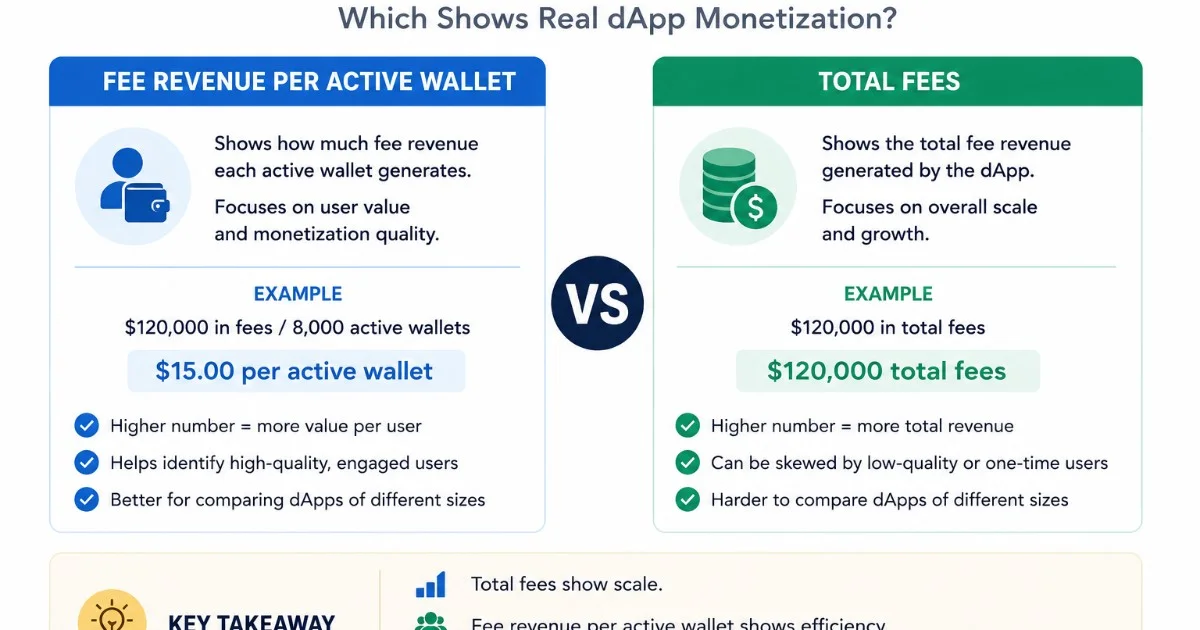
A dApp may generate high fees because it has many low value users, a temporary spike in activity or a small number of large traders. Another dApp may generate fewer total fees but earn more per active wallet, showing stronger monetization.
This is why fee revenue per active wallet matters.
Understanding fee revenue per active wallet vs total fees helps traders evaluate real dApp monetization more clearly.
What Are Total Fees?
Total fees measure the full amount of fees generated by an application or protocol over a period.
These fees may come from swaps, lending, borrowing, liquidations, subscriptions, mints, marketplace activity or other user actions.
Total fees are useful because they show that users are paying to interact with a product.
However, total fees do not show how efficiently the app monetizes each user.
What Is Fee Revenue per Active Wallet?
Fee revenue per active wallet measures how much fee revenue is generated for each active wallet.
For example, if a dApp generates $100,000 in fees from 10,000 active wallets, the fee revenue per active wallet is $10.
This metric helps traders understand user value.
It can show whether an application is attracting high quality users or only generating broad but shallow activity.
Fee Revenue per Active Wallet vs Total Fees: The Key Difference
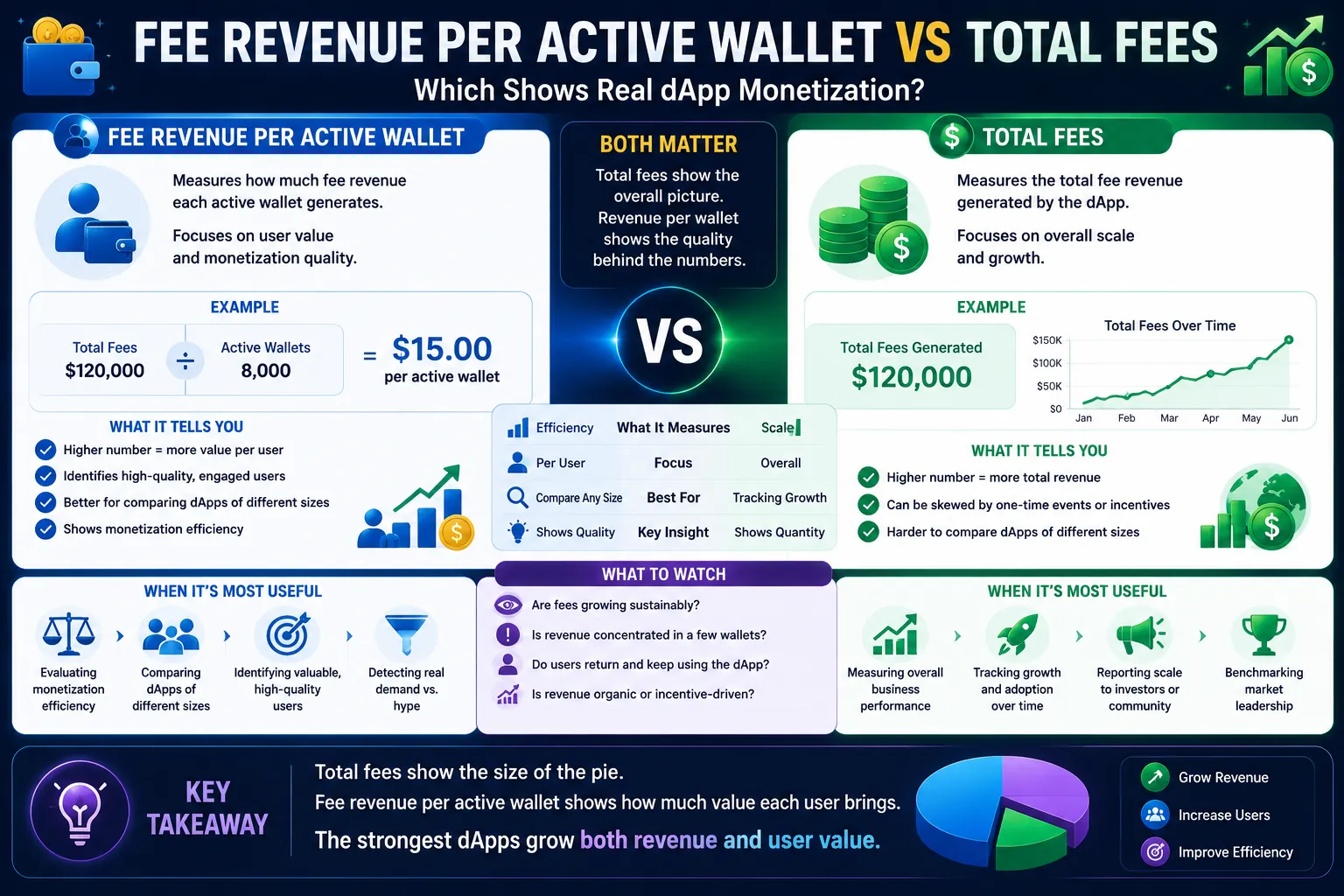
The key difference is scale vs monetization quality.
Total fees show how much the app earns overall. Fee revenue per active wallet shows how much value each active wallet contributes.
A dApp with high total fees may be large, but not necessarily efficient. A dApp with strong fee revenue per active wallet may have better monetization, even with a smaller user base.
Both metrics are useful, but they answer different questions.
Why Total Fees Can Be Misleading
Total fees can rise during temporary events.
A trading app may generate high fees during market volatility. An NFT platform may earn more during a minting trend. A lending protocol may earn more during a short period of high borrowing demand.
These spikes can make the app look stronger than it is.
If total fees fall when the event ends, monetization may not be durable.
Why Revenue per Active Wallet Matters
Revenue per active wallet shows how valuable each user may be.
If users consistently generate meaningful fee revenue, the product may have strong demand. This can suggest that users are not only visiting the app, but paying for real utility.
This metric can help compare dApps of different sizes.
A smaller app with high revenue per wallet may be more efficient than a larger app with weak user monetization.
When High Revenue per Wallet Can Be Risky
High revenue per active wallet is not always positive.
It may mean that the app depends on a small number of whales. If those users leave, revenue can drop quickly.
It may also mean that fees are too expensive, which could discourage wider adoption.
Traders should check whether revenue comes from a healthy user base or from a small number of large participants.
User Quality vs User Quantity
In crypto, user quantity can be inflated by incentives, airdrops or bots.
User quality is harder to fake.
A high quality user returns, pays fees, uses core features and contributes to protocol activity.
Fee revenue per active wallet helps reveal user quality because it connects activity with monetization.
What Healthy dApp Monetization Looks Like
A healthy dApp may show:
Growing total fees.
Stable or rising active wallets.
Consistent fee revenue per active wallet.
User retention.
Real transaction value.
Balanced user distribution.
Reduced dependence on incentives.
If total fees and fee revenue per wallet both improve, the monetization signal is stronger.
What Traders Should Analyze
Before trusting a dApp revenue narrative, traders should ask:
Are total fees growing?
Are active wallets growing too?
Is revenue per active wallet stable?
Is revenue concentrated among whales?
Are users paying organically?
Does revenue depend on incentives?
Do users return after campaigns end?
Does the token capture any value from fees?
These questions help traders avoid surface level revenue analysis.
How DEXTools Can Help
DEXTools can help traders monitor the token market connected to dApp monetization. Strong fees do not always mean strong token demand.
Traders should also check liquidity, volume, price action and transaction flow.
A profitable dApp with a weak token structure can still create trading risk.
Final Thoughts
Total fees and fee revenue per active wallet measure different things.
Total fees show overall revenue. Fee revenue per active wallet shows monetization quality.
For traders, total fees are useful, but they are not enough. The better question is whether users are valuable, recurring and willing to pay.
In crypto, large revenue numbers can create hype. Strong revenue per user can reveal real product strength.
How to Bridge Crypto Between Chains: Complete Cross-Chain Tutorial 2026 How to Use 1inch for Swaps: Classic, Fusion and Limit Orders (2026) OKX Web3 Wallet Tutorial 2026: Multi-Chain Setup GuideThe Nuances of Fee Revenue: Beyond Simple Transaction Costs
While total fees and fee revenue per active wallet offer critical insights, a deeper understanding requires dissecting the nature of the fees themselves. Not all fees are created equal in terms of their impact on a dApp's long-term sustainability and user perception. Transaction fees, for instance, are often seen as a necessary cost of doing business on a blockchain. However, subscription fees or premium feature access fees indicate a different kind of value proposition and user commitment.
A dApp primarily generating revenue from high transaction fees might struggle to retain users if competitors offer similar services with lower costs. Conversely, a dApp with lower total transaction fees but robust revenue from value-added services suggests a stronger competitive moat and a more engaged user base willing to pay for enhanced utility or exclusive access. This distinction is crucial for investors and users trying to gauge the true "stickiness" of a protocol.
Understanding Fee Modalities and Their Implications
- Gas Fees vs. Protocol Fees: Differentiate between network-level gas fees (paid to validators) and application-level protocol fees (captured by the dApp). Only the latter directly contributes to dApp monetization.
- Fixed vs. Variable Fees: Fixed fees can provide predictable revenue but may deter high-volume users. Variable fees, often percentage-based, scale with usage but can be volatile.
- Subscription/Membership Fees: These indicate a recurring value proposition and build a predictable revenue stream, signaling strong user loyalty.
- Premium Feature Access: Revenue from unlocking advanced tools or exclusive content suggests users perceive significant additional value beyond basic functionality.
- Burn Mechanisms: Fees that are partially or fully burned reduce token supply, potentially increasing token value for holders rather than directly boosting dApp treasury.
Related Guides
- Active Contracts vs Contract Deployments: Which Better Shows Real Developer Adoption?
- Fee Payer Growth vs Transaction Count: Which Better Shows Real Network Adoption?
- 10 Best Crypto to Mine 2026: Real Profit per kWh Calculated
- How to Use Token Terminal: Fees, Revenue and Crypto Fundamentals (2026)
- Token Transfer Velocity vs Holder Retention: What Shows Real Conviction?
Frequently Asked Questions
Why can total fees be misleading for a dApp?
Total fees show overall revenue but not how it is spread across users. A high total could come from a few large users rather than broad, healthy demand.
What is fee revenue per active wallet?
Fee revenue per active wallet divides total fees by the number of active wallets to show average revenue per user. It gives a sense of how much value each participant contributes.
Which metric better shows real monetization?
Fee revenue per active wallet can reveal the quality and depth of demand, while total fees only show scale. Looking at both helps distinguish genuine engagement from concentrated activity.
Why does user concentration matter for dApp revenue?
If most fees come from a small group of wallets, the protocol is vulnerable if those users leave. A wider base of fee paying users generally indicates more sustainable monetization.