Token Unlocks: Navigating Microcap Sell Pressure
— By Whatsertrade in Tutorials
Token unlocks can significantly impact microcap digital tokens. Learn how to analyze unlocking risks and protect your investments.
Microcap tokens can move fast, and a small purchase can elevate its price, allowing early traders to see significant percentage gains rapidly. However, this same market dynamic can also lead to substantial drawbacks.
One of the most often overlooked threats includes hidden sell pressure from token unlocks and digital token vesting schedules.
A chart may appear robust, liquidity might seem adequate, and social media could be buzzing. Yet, if a large supply is about to unlock, the market sentiment can swiftly turn. Traders who disregard unlocks might buy just as insiders, team wallets, advisors, or initial investors gain access to tokens they can sell.
This guide breaks down how token unlocks and vesting schedules affect microcap tokens, why they matter, and how traders can assess this risk before diving in.
Understanding Token Unlocks and Vesting Schedules
What Are Token Unlocks?
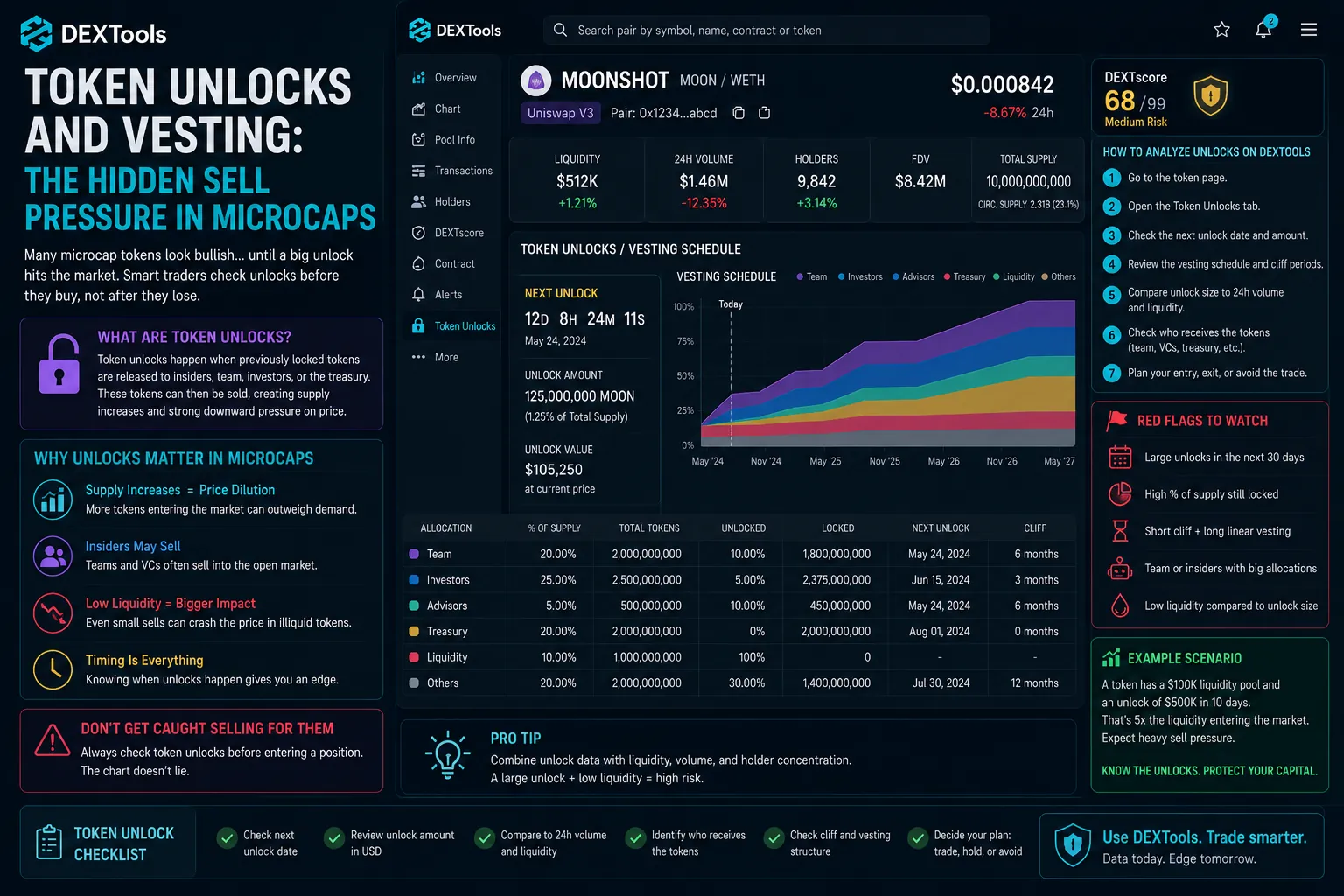
A token unlock occurs when previously locked tokens become available for transfer, trading, or selling. These tokens may be allocated to the team, investors, advisors, ecosystem funds, marketing reserves, staking rewards, or community incentive initiatives.
Unlocks are widespread in crypto projects and can form a part of responsible tokenomics when executed correctly. Problems arise when unlocks are large, poorly disclosed, or not matched by actual demand.
New supply entering the market may lead holders to sell. If demand is insufficient to absorb the supply, the price can drop.
What Is a Vesting Schedule?
A vesting schedule dictates when locked tokens become available. Rather than releasing all tokens to insiders at once, projects may distribute them gradually over time.
Common vesting arrangements include:
- Cliff unlocks
- Linear vesting
- Monthly unlocks
- Quarterly unlocks
- Milestone-based releases
- Ecosystem emission schedules
A cliff indicates tokens remain locked until a certain date, after which a portion unlocks. Linear vesting signifies that tokens become available gradually over a specified period.
For traders, these details are crucial. A small monthly unlock may be manageable, but a significant cliff unlock can exert intense sell pressure.
The Risks of Unlocks in Microcaps
Why Unlocks Are Especially Risky for Microcaps
Microcap tokens typically feature lower liquidity, smaller holder bases, and more tenuous demand. This makes them more susceptible to new supply.
A large-cap token might handle unlocks more efficiently due to deep liquidity and broad market participation. In contrast, a microcap may lack sufficient buyers to accommodate insider selling.
Risk is heightened when:
- Liquidity is scarce
- Volume is mostly speculative
- The token relies on hype
- Major wallets hold large supplies
- Communication is poor
- The chart has already surged before unlocks
In microcaps, even moderate selling can trigger dramatic declines.
How Unlocks Create Sell Pressure
While unlocks do not automatically result in a price drop, they introduce the potential for added supply on the market.
Sell pressure can originate from multiple groups.
Team Wallets
Team allocations are frequently locked to exhibit long-term commitment. Nevertheless, once tokens unlock, traders need to track whether the team is holding, transferring, or selling.
A responsible team may communicate transparently and act to avoid market harm, while a less forthcoming team might transfer tokens without notice.
Private Investors
Early investors frequently acquire tokens at lower prices than public traders. If the token has surged, these investors may be strongly inclined to take profits once their tokens unlock.
This situation is particularly noteworthy when private round prices are significantly below the current market price.
Advisors and Marketing Wallets
Advisor and marketing wallets can also contribute to sell pressure. These allocations might be less visible to retail traders but can still impact market supply.
Ecosystem and Rewards Emissions
Certain projects distribute tokens through staking, farming, or incentives. These emissions can become ongoing sell pressure if users earn rewards and immediately sell them.
Analyzing Unlock Risk Before Investment
Before investing in a microcap token, make unlock analysis part of your research routine.
Step 1: Review Tokenomics
Examine the total supply, circulating supply, locked supply, team allocation, investor allocation, and ecosystem allocation.
Crucial questions:
- How much supply is circulating currently?
- How much supply is still locked?
- Who possesses the locked supply?
- When does it unlock?
- How swiftly does new supply enter the market?
If circulating supply is low and future unlocks are substantial, the token may encounter dilution risk.
Step 2: Compare Unlock Size With Liquidity
This is a crucial evaluation.
A token might have a small unlock percentage-wise, but if liquidity is scant, even that unlock could be perilous.
Consider:
- What value is unlocking?
- How much liquidity is in the main pair?
- Is the pool capable of absorbing the selling?
- Could a small sale cause a significant price shift?
Unlock risk isn't purely about supply; it relates to supply in connection with liquidity.
Step 3: Monitor Top Wallets
Utilize wallet and holder data to understand concentration. If a few wallets hold a major portion of the supply, unlocks can be more hazardous.
Look for:
- Large wallets receiving unlocked tokens
- Transfers from vesting wallets
- Moving to exchange-linked wallets
- Splitting tokens across multiple wallets
- Selling after unlock dates
Wallet behavior often reveals the underlying narrative before official statements do.
Step 4: Check Price Action Before Unlocks
Exercise caution if a token shows a strong pre-unlock rally. A sudden pre-unlock spike may allow insiders or initial holders improved exit prices.
Indicative signals include:
- Sudden excitement preceding unlocks
- Influencer pushes near unlocks
- Large volume surges with unclear reasons
- Major wallets reducing stakes
- Price pressing against resistance before supply release
Not every rally is suspect, yet timing is critical.
Step 5: Monitor Project Communication
Transparent projects typically clarify unlock schedules. They may offer tokenomics pages, vesting timelines, wallet addresses, and updates.
Lack of transparency does not necessarily indicate fraud but elevates risk.
Robust communication should encompass:
- Defined allocation breakdown
- Vesting dates
- Wallet labels
- Proof of locks
- Strategy for unlocked tokens
- Pre-unlock updates
If the team can't clarify its supply schedule, traders should proceed cautiously.
Red Flags in Token Unlocks
Steer clear or mitigate risk when certain red flags emerge:
- Large cliff unlocks with scant liquidity
- Unknown team or investor wallets
- No public vesting outline
- Significant disparity between private and market prices
- Influencer frenzy near unlock dates
- Top wallets moving before announcements
- Locked supply markedly surpassing circulating supply
- Incentive emissions without real demand
- Inadequate communication
While a single red flag may not justify abandoning a trade, multiple signals can reflect substantial risk.
Healthy Unlocks vs Dangerous Unlocks
Not all unlocks pose a threat. Healthy unlocks are deliberate, transparent, gradual, and bolstered by demand.
A healthier unlock profile could include:
- Extended vesting periods
- Gradual unlocks
- Clear wallet labeling
- Solid liquidity
- Authentic product use
- Community engagement
- Team communication
- No abrupt insider activity
Dangerous unlocks, on the other hand, are abrupt, significant, obscure, and unsupported by market stability.
Why Traders Should Track Unlocks Even for Short Term Trades
Some traders err in thinking token unlocks only concern long-term investors. This is a misconception.
Short-term traders might be influenced if they enter during an unlock event. A token can appear robust on charts yet reverse once new supply is available.
Being aware of unlocks can assist traders to:
- Bypass unfavorable entries
- Better time exits
- Comprehend sudden selling
- Identify insider conduct
- Evade buying into promotional hype
In microcap trading, timing is key. Unlocks form an integral aspect of timing.
Conclusion
Token unlocks and vesting schedules are often visible yet ignored. Many traders concentrate on charts, buzz, and market cap, overlooking impending supply influx.
For microcap tokens, unlock risk can be dangerous since liquidity is frequently too limited to counter active selling. Before purchasing, traders should examine tokenomics, consider unlock size against liquidity, monitor top wallets, and watch for intriguing timing relating to promotions.
A compelling chart can rapidly weaken if new supply meets insufficient demand. Astute traders not only ponder where prices might go but also who will be selling next.
FAQ
What is a token unlock?
A token unlock occurs when locked digital tokens become transferable, tradable, or sellable.
What is vesting in crypto?
Vesting represents a schedule governing the release of tokens to teams, investors, advisors, or other groups.
Do token unlocks always cause price drops?
No. Unlocks don't invariably lead to price declines. Impact varies based on unlock size, liquidity, demand, holder actions, and communication by the project.
Why are unlocks risky for microcaps?
Microcaps often deal with limited liquidity and fragile demand. Minimal selling can result in significant price shifts.
How can traders reduce unlock risk?
Analyze tokenomics, scrutinize wallet movements, evaluate unlock size against liquidity, and avoid poorly described unlock events.
CTA: Before investing in a microcap digital token, utilize DEXTools to review liquidity, holders, transactions, and market movement. Always consider future supply as a potential risk.
How to Bridge Crypto Between Chains: Complete Cross-Chain Tutorial 2026 How to Use 1inch: Complete DEX Aggregator Swap Tutorial (2026) How to Use OKX Web3 Wallet: Multi-Chain DeFi Hub Guide (2026) How to Bridge Crypto Between Chains: Complete Cross-Chain Tutorial 2026 How to Use 1inch: Complete DEX Aggregator Swap Tutorial (2026) How to Use OKX Web3 Wallet: Multi-Chain DeFi Hub Guide (2026)Frequently Asked Questions
What are token unlocks?
Token unlocks refer to the scheduled release of previously restricted cryptocurrency tokens into the circulating supply. These tokens are often held by early investors, team members, or advisors.
How do token unlocks affect microcap cryptocurrencies?
Token unlocks can significantly impact microcap cryptocurrencies due to their smaller market capitalization and lower liquidity. A large influx of unlocked tokens can lead to increased selling pressure.
Why do early investors and teams have locked tokens?
Tokens are often locked to incentivize long-term commitment and prevent immediate sell-offs that could destabilize the project. This vesting schedule aligns the interests of early participants with the project's success.
What is 'sell pressure' in the context of token unlocks?
Sell pressure describes the downward force on a cryptocurrency's price caused by a large number of holders selling their tokens. When unlocked tokens become available, some holders may choose to sell, increasing this pressure.
How can investors track upcoming token unlocks?
Investors can track upcoming token unlocks through various crypto data platforms and dedicated unlock calendars. These resources often provide dates, amounts, and the percentage of supply being unlocked.
Related Guides
- Cliff Unlock vs Linear Vesting: Sell Pressure
- LP Lock Expiry Risk: What Happens When Token Liquidity Unlocks?
- How to Read Token Unlocks Before Buying in 2026
- What Is Order Flow in Crypto Trading? How to Read Buying and Selling Pressure (2026)
- CEX Deposit Pressure: How Exchange Inflows Can Signal Future Selling