LP Lock Expiry Risk: What Happens When Token Liquidity Unlocks?
— By Whatsertrade in Tutorials
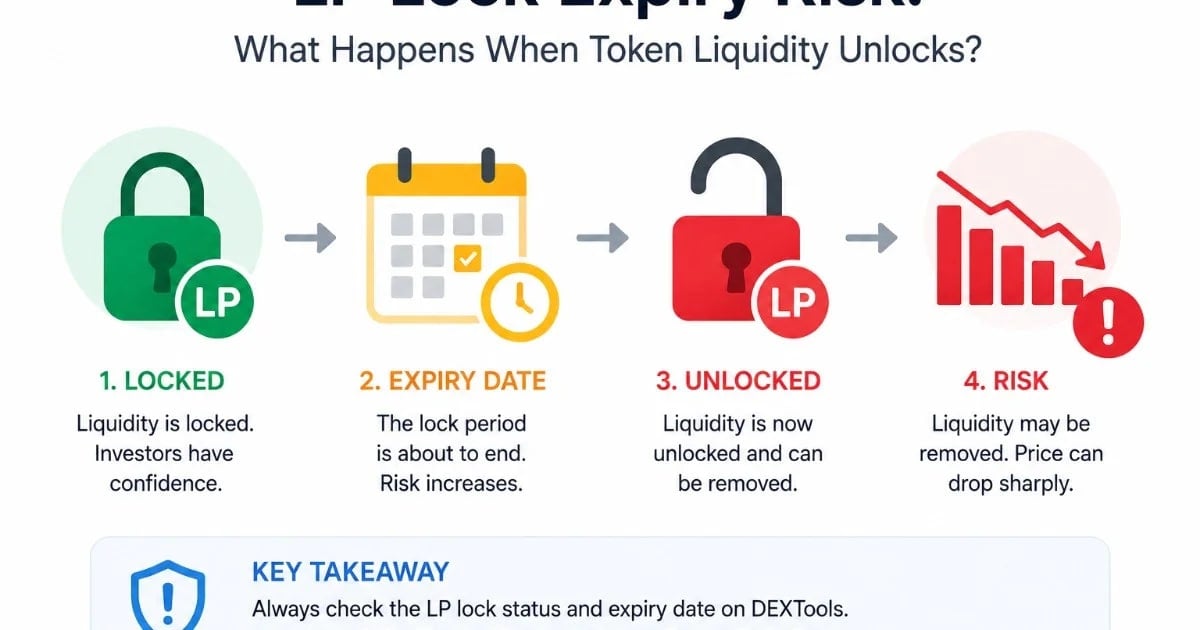
Locked liquidity is one of the most common trust signals in decentralized exchange trading. When a project locks its liquidity, traders may feel more confident
Locked liquidity is one of the most common trust signals in decentralized exchange trading. When a project locks its liquidity, traders may feel more confident that the pool cannot be removed immediately. However, a liquidity lock is not permanent unless it is designed that way. Every lock with an expiry date eventually reaches a critical moment.
LP lock expiry risk refers to the uncertainty that appears when locked liquidity approaches its unlock date. Traders often focus on whether liquidity is locked, but they forget to ask when it unlocks, who controls it after unlock, and what the project plans to do next.
Understanding this risk can help traders avoid entering a token just before market confidence changes.
What Is an LP Lock?
An LP lock means that liquidity provider tokens are locked for a specific period. These LP tokens represent ownership of liquidity in a decentralized exchange pool. If the LP tokens are unlocked and controlled by a wallet, that wallet may be able to remove liquidity from the pool.
Locking liquidity does not make a token risk free, but it can reduce one specific risk: sudden liquidity removal during the lock period. This is why many traders check whether liquidity is locked before buying a new token.
The problem is that a lock is only as strong as its duration, transparency, and follow up plan. A token with liquidity locked for two weeks does not carry the same risk profile as one locked for one year. A token whose lock expires tomorrow should not be treated the same as one whose lock expires months later.
Why LP Lock Expiry Matters
The expiry date can become a market event. As the unlock approaches, traders may begin asking what happens next. Will the team relock liquidity? Will they extend the lock before expiry? Will they migrate liquidity? Will they remove part of the pool? Will they stay silent?
Even if the team has good intentions, uncertainty can create volatility. Some traders may sell before the unlock to avoid risk. Others may wait for confirmation before entering. Market makers, whales, and short term traders may use the uncertainty to create sharp moves.
A liquidity unlock does not automatically mean something bad will happen. But it does increase the need for research.
The Best Case Scenario
The best case scenario is simple and transparent. The project communicates before the unlock, explains its plan, and relocks liquidity or manages the transition clearly. Traders can verify the action and market confidence remains stable.
In this scenario, the unlock can even become a positive moment. If the team relocks for a longer period, adds liquidity, or improves pool structure, traders may interpret the action as a confidence signal.
Timing matters. A relock announced and executed before expiry is usually stronger than a last minute response after community pressure. Clear communication reduces uncertainty.
The Risk Scenario
The risk scenario begins when the unlock approaches and no clear plan exists. The team may avoid questions, provide vague responses, or delay action. Traders begin to speculate. Liquidity may still be present, but confidence starts weakening.
If liquidity is removed after unlock, the pool may become thin and difficult to trade. Price impact can increase. Slippage can become severe. Holders may rush to exit, which can accelerate the decline.
Even partial liquidity removal can affect market perception. Traders may wonder why liquidity was reduced and whether more will be removed later.
How Traders Can Monitor LP Lock Expiry Risk
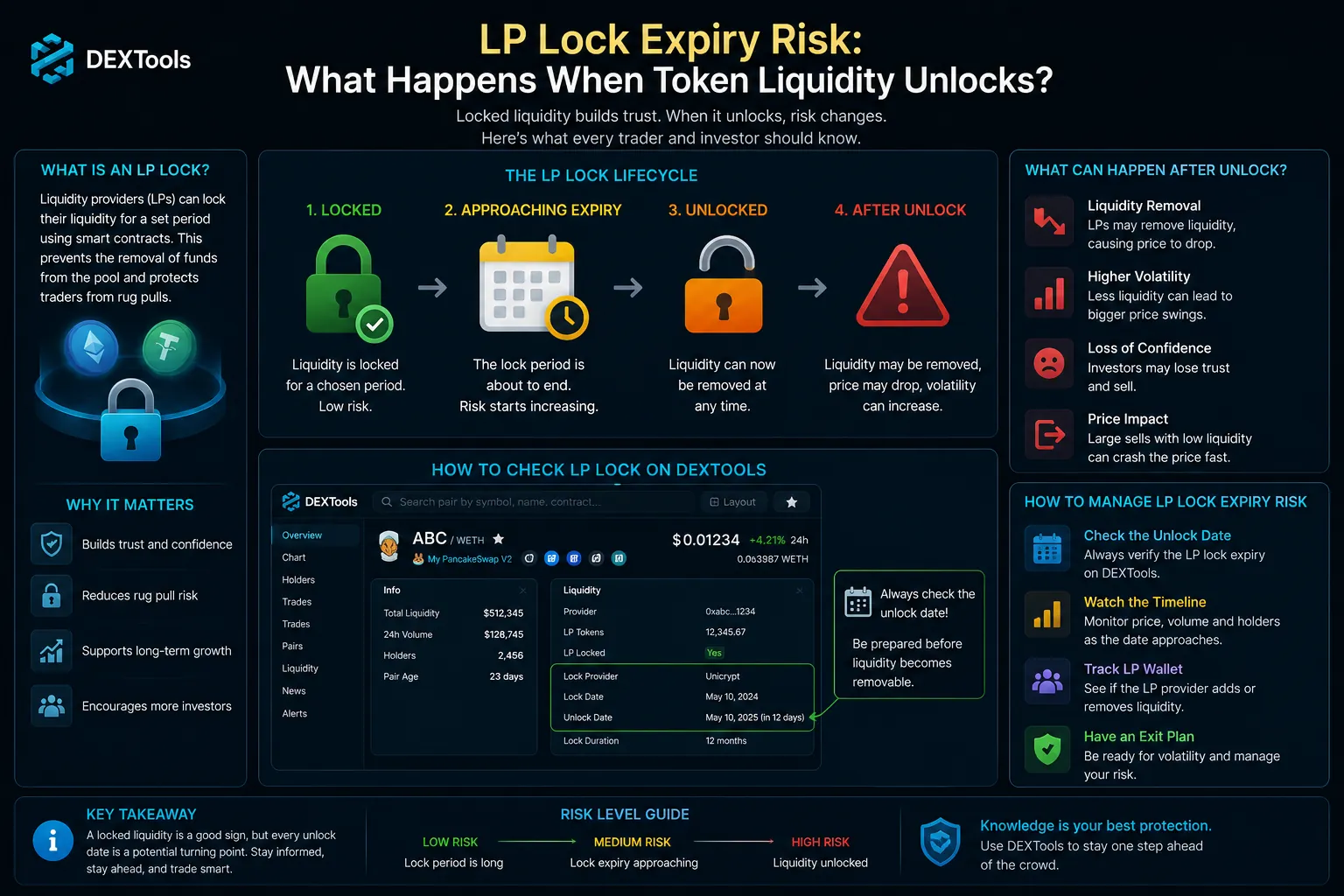
The first step is to know whether liquidity is locked and when the lock expires. Traders should not stop at the label. The date matters.
Next, traders should monitor the project's communication. A serious team should be able to explain what will happen before the unlock. Traders should also watch liquidity levels on DEXTools. If liquidity begins changing near the expiry date, that movement deserves attention.
Volume and price action can also reveal market anxiety. If volume rises while price falls before the unlock, some holders may be reducing exposure. If liquidity remains stable and price consolidates, the market may be waiting for confirmation.
Red Flags Before a Liquidity Unlock
Several patterns can increase concern. One is silence from the project as the unlock date approaches. Another is vague language about future liquidity plans. A third is unusual wallet activity around the LP controller or project wallets.
Traders should also be cautious if the token relies heavily on the locked liquidity narrative while offering little other proof of trust. If the strongest argument for the token is that liquidity is locked, the unlock date becomes even more important.
A sudden promotional push just before liquidity unlocks can also be suspicious. Traders should ask whether the campaign is building real demand or preparing exit liquidity.
What Happens After Liquidity Unlocks?
After liquidity unlocks, several outcomes are possible. The team may relock. They may add more liquidity. They may migrate to another pool. They may remove part of the liquidity. They may remove all of it. They may do nothing for a while.
The market reaction depends on what happens and how well it was communicated. A relock can restore confidence. A transparent migration may be acceptable if traders understand the reason. A quiet removal can damage trust quickly.
The period after unlock should be treated as a new phase of analysis. Traders should watch liquidity, volume, slippage, transaction flow, and holder behavior.
Why LP Lock Expiry Is Evergreen for Token Research
Liquidity unlocks happen across market cycles. They affect new tokens, memecoins, community projects, DeFi assets, and long running pools. This makes LP lock expiry risk an evergreen topic for traders.
A token may look safe today because liquidity is locked. But if the unlock date is close and unclear, the risk profile may be changing. Traders who understand this can avoid being surprised by predictable market events.
Conclusion
LP lock expiry risk is one of the most important details in decentralized exchange trading. Locked liquidity can support confidence, but the expiry date determines how long that confidence may last.
Traders should check when liquidity unlocks, who controls it, what the team communicates, and how the market behaves before and after the date. DEXTools can help traders monitor liquidity, volume, and price action as the unlock approaches.
A liquidity lock is not only a trust signal. It is also a countdown. Smart traders watch what happens before the clock reaches zero.
How to Bridge Crypto Between Chains: Complete Cross-Chain Tutorial 2026 How to Use 1inch for Swaps: Classic, Fusion and Limit Orders (2026) OKX Web3 Wallet Tutorial 2026: Multi-Chain Setup GuideFrequently Asked Questions
What is LP lock expiry risk?
LP lock expiry risk refers to the potential price volatility and liquidity changes that can occur when a significant amount of locked liquidity provider (LP) tokens become unlocked.
What happens when LP tokens unlock?
When LP tokens unlock, holders gain the ability to withdraw their underlying assets from the liquidity pool. This can lead to increased selling pressure if a large number of holders decide to exit their positions.
How does LP lock expiry affect token price?
The unlocking of LP tokens can increase the circulating supply of the underlying token, potentially leading to downward price pressure if there is a surge in selling. Conversely, if holders remain confident, the impact may be minimal.
What are the benefits of locking LP tokens?
Locking LP tokens provides stability to a decentralized exchange's liquidity pool, assuring users that there is sufficient liquidity for trading. It can also signal long-term commitment from project developers.
How can investors assess LP lock expiry risk?
Investors can assess LP lock expiry risk by reviewing the project's tokenomics, the unlocking schedule of LP tokens, and the overall market sentiment surrounding the project. Understanding the distribution of locked tokens is key.
Related Guides
- How to Check Liquidity Lock Before Buying a Token: Unlock Risk and Locker Verification (2026)
- How to Evaluate Tokenomics: Supply, Emissions and Unlock Risk Guide (2026)
- What Is Cliff Vesting in Crypto? Unlock and Price Risk
- What Is Impermanent Loss in DeFi? Beginner LP Definition and Why It Happens (2026)
- Token Unlocks: Navigating Microcap Sell Pressure
- What Happens to Your Crypto When You Die? Inheritance Guide