What Is DCA in Crypto? Benefits and Limits (2026)
— By Tony Rabbit in Tutorials

Learn what DCA means in crypto, why investors use dollar cost averaging, what it protects against, and where it still fails in weak or overhyped markets.
Intent check: This page owns the definition and theory behind DCA. If you want the practical implementation guide for setting intervals, sizing buys, and sticking to a plan, read How to Dollar Cost Average (DCA) in Crypto.
If you have spent any time in crypto, you have heard the advice repeated like a mantra: just DCA. Buy a fixed amount on a fixed schedule, forget the charts, and let time do the work. Over the last cycle, dollar-cost averaging quietly became the default strategy for everyone from first-time Bitcoin buyers to seasoned institutional treasuries. It is the closest thing the crypto industry has to a universally endorsed approach, and yet most of the articles explaining it are short, generic, and copy-paste from outdated TradFi material that never accounts for crypto's brutal volatility.
This guide is built to fix that. We are going to cover every angle of crypto DCA in depth: the precise mechanics, the underlying math, the psychology that makes it work, a fully worked example simulating $100 per week into Bitcoin across an entire 2021 to 2025 cycle, the six best automated tools available in 2026, the tax implications most beginners ignore, and a brutally honest section on when DCA actively loses you money. We will also cover advanced variants like dip DCA and RSI-triggered DCA, plus how to extend the strategy across a basket of assets without overcomplicating your life.
By the time you finish reading, you will have a complete operating manual for running a DCA plan, the math to defend it against any skeptic, and the awareness to know when DCA is genuinely the wrong tool. No buzzwords, no recycled investing platitudes, just the practical knowledge you need to deploy capital into crypto without losing sleep or chasing tops.
What Is Dollar-Cost Averaging?
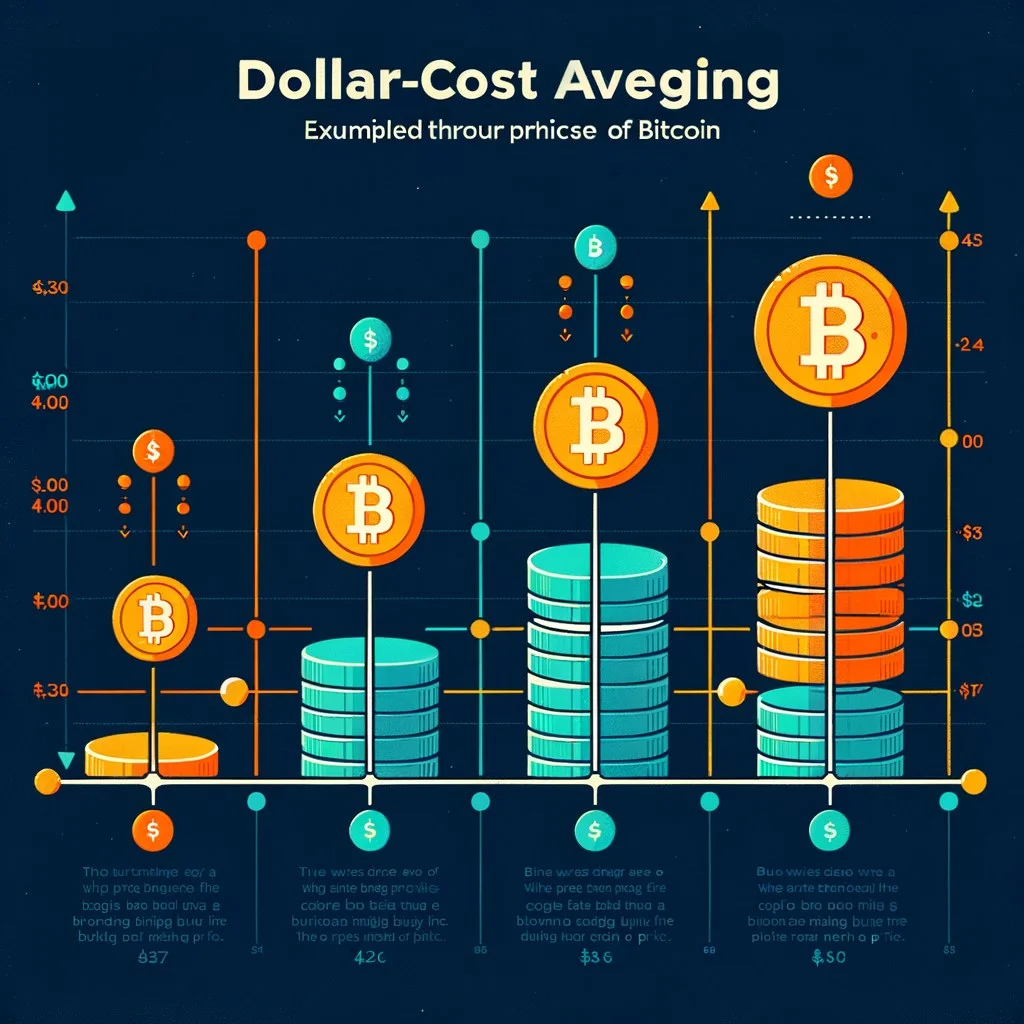
Dollar-cost averaging is an investment strategy where you invest a fixed dollar amount into an asset at regular intervals, regardless of the asset's price at the time of each purchase. Instead of trying to time the perfect entry, you commit to mechanical, repeated buys. When the price is low, your fixed dollar amount buys more units. When the price is high, it buys fewer. Over a long enough horizon, your average cost per unit converges toward something below the simple time-weighted average price of the asset.
The concept was originally popularized in traditional finance in the mid-twentieth century through mutual fund accumulation plans. Benjamin Graham, the father of value investing, endorsed it in his classic book The Intelligent Investor as the optimal approach for the defensive investor who cannot or does not want to evaluate markets actively. In TradFi, DCA is the engine behind 401(k) contributions, automatic IRA deposits, and pension fund accumulations. Every two weeks, the same dollar amount flows into the same index funds, completely independent of whether the S&P 500 is at all-time highs or in the middle of a 30% correction.
Crypto adopted the technique aggressively for one obvious reason: volatility. Bitcoin can move 20% in a week. Ethereum routinely swings 50% in a month. Trying to pick exact entries in an asset class that volatile is a recipe for paralysis, regret, and missed opportunity. DCA sidesteps the entire problem. You do not need to be right about timing. You just need to be consistent.
How DCA Works in Crypto Specifically
The mechanics of a crypto DCA plan are simple enough that you can set one up in under five minutes on any major exchange. The four building blocks are the asset you want to accumulate, the frequency of your purchases, the dollar amount per purchase, and the automation that executes the buys without you having to think about it. Once those four variables are locked in, your only job is to keep the funding source topped up.
Picking the asset is the most consequential decision in the whole process. The strategy works best on assets with long-term upward bias and durable demand: Bitcoin, Ethereum, and a small handful of established large-cap layer-1s. We will revisit this in detail when we cover when DCA fails. For now, just understand that DCA is a directional bet that an asset will be worth more in the future than the average of its prices today. If that assumption breaks, no amount of averaging will save you.
Frequency matters less than most people think. Weekly is the most common default because it balances administrative simplicity with smoothing power. Daily buys give marginally smoother averaging in extremely volatile assets but generate a much larger number of tax lots, which becomes painful at year-end. Monthly is fine if you are paid monthly and want to align your buys with your paycheck. The variance between daily, weekly, and monthly outcomes over a multi-year horizon is small. What dominates returns is the trend of the underlying asset, not the cadence of your buys.
The amount per purchase should be something you genuinely will not miss. The whole point of DCA is to keep the plan running through 70% drawdowns without panicking and pausing it. If your weekly buy is large enough that a bear market makes you sweat, you are buying too much. A useful rule of thumb is that your monthly DCA contribution should be no more than 10% to 20% of your monthly discretionary income, and never more than you could see drop 80% in value without losing sleep.
The Math Behind DCA
Most articles wave their hands at the math behind DCA. We are going to actually do it because the math is the entire reason the strategy works. The key insight is that when you invest a fixed dollar amount, your average cost per unit is the harmonic mean of the purchase prices, not the arithmetic mean. The harmonic mean is always less than or equal to the arithmetic mean, with the gap widening as price variance increases. This is the mathematical free lunch that DCA harvests from volatility.
Let us prove it with a minimal example. Suppose you DCA $100 into a token across four weeks at prices of $10, $5, $20, and $5. The arithmetic mean of those prices is ($10 + $5 + $20 + $5) / 4 = $10. So a naive thinker would say your average cost is $10. But that is not what actually happens. In week one you buy 10 tokens at $10. In week two you buy 20 tokens at $5. In week three you buy 5 tokens at $20. In week four you buy 20 tokens at $5. Total invested: $400. Total tokens accumulated: 55. Average cost per token: $400 / 55 = $7.27.
Your effective entry price of $7.27 is materially lower than the $10 simple average. That gap, the difference between the arithmetic mean of prices and your harmonic-mean-weighted cost basis, is the volatility premium that DCA captures. The higher the volatility of the underlying, the bigger the gap. This is why DCA is so well-suited to crypto specifically. The volatility that makes most strategies dangerous is what makes DCA quietly powerful.
One important caveat: this volatility premium only helps you if the asset ends up appreciating over your holding period. If the asset goes to zero, the harmonic mean of your entry prices is irrelevant. You lose 100% of capital deployed regardless of how cleverly you averaged in. We will keep coming back to this point because it is the single most important risk that DCA enthusiasts gloss over.
DCA vs Lump Sum vs Value Averaging
DCA is not the only way to deploy capital into an asset over time. The two main alternatives are lump sum investing (deploy everything at once) and value averaging (adjust each contribution based on portfolio value drift). Each has a regime where it wins, and understanding which regime you are in is more important than dogmatic loyalty to any one method.
Statistically wins about two-thirds of the time over a multi-year horizon because markets trend up more often than down.
You have high conviction and the asset is at a cyclical bottom or in early bull phase.
Trades some upside for massive emotional and behavioral consistency. Captures volatility premium via harmonic mean averaging.
You earn money in installments, the asset is volatile, or you have no idea where in the cycle you are.
Each period, buy enough to bring portfolio to a pre-set target value. Buys more in dips, less in pumps, sometimes sells.
You have a flexible cash buffer and discipline to size up aggressively into drawdowns.
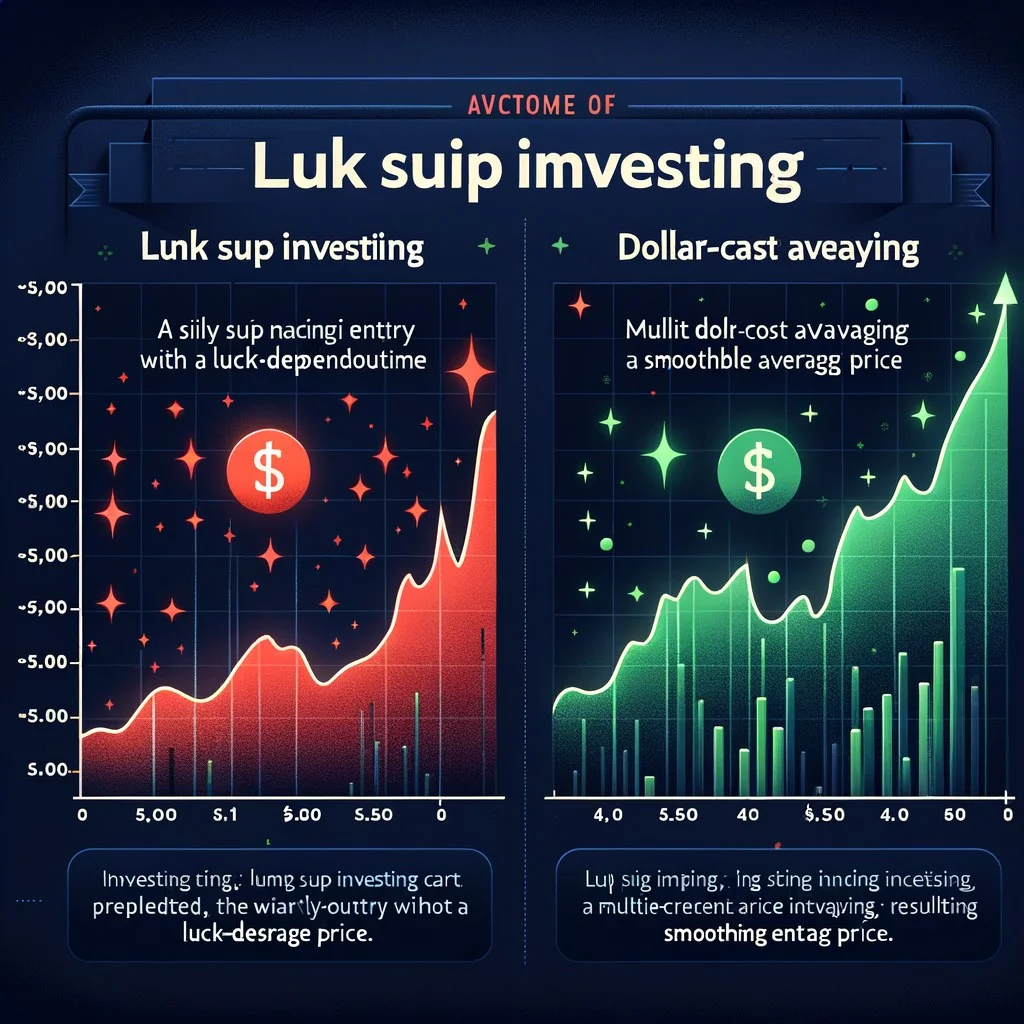
The academic literature on lump sum versus DCA is remarkably consistent. Vanguard published a famous study showing that lump sum beats DCA roughly 66% of the time over rolling 10-year windows in the US equity market. The same pattern holds in long-running studies of Bitcoin: if you had perfect conviction and lump-summed at any random point in the last decade, your terminal wealth would on average have been higher than if you had DCAed the same total capital across that period. But this is an academic result, not a behavioral one. Almost no one actually deploys lump sums into volatile assets at random points without freezing up.
The real argument for DCA is not that it maximizes expected return. It is that it is the strategy a normal human can actually execute without making catastrophic timing errors. The cost of being wrong about timing in a lump sum is enormous. The cost of being slightly suboptimal with DCA is negligible. That asymmetry is why DCA is the default recommendation for almost every retail crypto investor.
Value averaging is the academic optimum if you can execute it perfectly, because it forces you to buy more during drawdowns and less during euphoria. In practice it is brutally hard to run. During a deep bear market, value averaging may ask you to triple or quadruple your contribution exactly when your emotional state most wants to flee. Few people stick with it. DCA wins because it is the strategy that survives contact with human psychology.
The Psychology of DCA
The behavioral case for DCA is at least as important as the mathematical case. Markets do not punish bad analysis nearly as often as they punish bad emotional control. DCA's deepest gift is that it removes almost every decision point at which an emotional retail investor would make a mistake.
The first psychological trap DCA neutralizes is timing anxiety. When you face the question of when to buy, your brain inevitably constructs a story. Either the price is too high and you should wait for a pullback, or the price has been falling and you should wait for a bottom. Both stories lead to the same outcome: you do not deploy capital. Months pass, you stay in cash, and the asset either rallies without you or drops further and convinces you to keep waiting. DCA breaks this loop by making the question irrelevant. You buy every Tuesday at 9 AM. The chart does not matter. You do not need to have an opinion.
The second trap is FOMO. When an asset rips 40% in a week, the natural urge is to chase. DCA holds you to your scheduled buy size, which keeps you from blowing your monthly budget on a single overheated entry. It also keeps you in the market during euphoria so you do not miss the move entirely. The third trap is FUD-driven capitulation. When the market is down 70% and headlines are screaming about the death of crypto, DCA keeps you mechanically accumulating exactly when the harmonic mean math is most generous. The buys that feel the worst to make are usually the buys that contribute the most to your terminal wealth.
The fourth and most underrated psychological benefit is the freedom from the chart. Once you have a DCA plan running, you can genuinely stop checking prices. The plan does not care about the daily candle. Many seasoned DCA practitioners report that the strategy improved their sleep, their relationships, and their general life quality far more than it improved their returns. That is not a small benefit. Capital that you can hold for ten years without watching is capital that compounds. Capital you stare at every day is capital you eventually fumble.
Worked Example: $100/Week DCA Into BTC, 2021 to 2025
Generic articles are full of vague claims about how DCA works "over time." Let us do something different and actually walk through what a real $100 per week BTC DCA plan would have produced over the full 2021 to 2025 cycle. The numbers are approximate but representative of the actual cycle.
Notice what the math just did for you. Across roughly 260 weekly buys, your harmonic mean cost basis ended up near $42,620, which is dramatically below the simple time-weighted average price of Bitcoin across that period. The bear-market buys in 2022 and the recovery buys in early 2023 did the heavy lifting. They were also the buys that felt psychologically the worst at the time, when crypto was being declared dead in every mainstream outlet.
Now contrast this with two alternative scenarios. If you had lump-summed $25,700 at the November 2021 peak, you would have bought 0.39 BTC at roughly $66,000 and your position at $105,000 BTC would be worth approximately $41,000. That is still a gain, but it is meaningfully worse than the DCA outcome. If you had instead lump-summed the same $25,700 at the November 2022 cycle bottom around $16,500, you would have bought 1.56 BTC and your position would now be worth approximately $164,000. The bottom-tick lump sum dramatically outperforms DCA. The problem is that almost no one identified that bottom in real time. The DCA plan does not require you to.
The 6 Best Automated DCA Tools in 2026
Manual DCA is fine for a month or two, but human-executed plans almost always degrade over time. You miss a week because you forgot, you skip a buy because the price feels too high, and within a year the plan has quietly collapsed. Automation is what makes DCA actually work. These are the six platforms in 2026 that we recommend, ranked by reliability, fees, and feature depth.
Recurring buys from $1 in 100+ assets. Available in 100+ countries. Fee on Advanced Trade is ~0.6% maker / 1.2% taker for retail; on the simple interface it can be 1.5-3%.
First-time DCA users in the US, UK, EU.
Auto-Invest plans across 200+ tokens with fees around 0.2%. Supports portfolios with multiple assets in one plan. Daily, weekly, biweekly, monthly cadences.
Users who want a multi-asset basket and fee minimization.
US-focused Bitcoin-only exchange. Recurring buys carry zero transaction fees on automated plans. Integrated Lightning Network and full-reserve assurances.
US Bitcoin maximalists who want clean tax records.
Lets US users automatically convert a percentage of every paycheck into BTC via direct deposit routing. Fees on automated buys around 0.1% in 2026. Strong Lightning integration.
W-2 employees who want DCA tied directly to payroll.
Bitcoin-only DCA service that supports automatic withdrawal to your self-custody wallet at a chosen threshold. Fees around 0.99% on retail plans, lower at higher volume tiers.
Users who want DCA and self-custody automated together.
Combines recurring BTC buys with cashback in sats on debit card spending. Effectively turns daily transactions into a passive accumulation engine. Roughly 1% fees on direct buys.
Users who want passive sats stacking without changing spending habits.
Fee structures shift constantly, so always verify pricing on each platform before committing. The general 2026 pattern is that Bitcoin-only services like River and Strike compete on near-zero fees, full-service exchanges like Binance, Coinbase, and Kraken offer broader asset support at slightly higher cost, and value-add services like Swan and Fold bundle DCA with self-custody automation or spending rewards. If you are accumulating five figures or more per year, the difference between a 0.2% and a 1.5% fee structure compounds meaningfully over a decade.
Whichever platform you pick, make sure you can export a clean CSV of every executed buy with timestamps, prices, and amounts. This is essential for tax reporting and for sanity-checking your average cost basis. Also confirm that the platform supports withdrawal of your accumulated holdings to your own wallet. A DCA plan that ends with your coins permanently locked on a third-party exchange is not really an investment plan, it is a deposit. Always plan for eventual transfer to cold storage once your stack is large enough to justify it.
Crypto-Native DCA: Sats Stacking and Yield-Compounding DCA
Crypto has produced two DCA variants that have no clean equivalent in TradFi. The first is sats stacking, which is just Bitcoin-flavored DCA branded in the unit of satoshis. One BTC contains 100 million sats, so when you stack sats you are accumulating fractions of a Bitcoin denominated in a more intuitive unit. The branding matters psychologically. It is much easier to stay motivated about "stacking 10,000 sats this week" than about "buying 0.0001 BTC." The community around sats stacking is also unusually disciplined, with multi-year DCA plans being the norm.
The second variant is yield-compounding DCA, where your dollar contributions are first deployed into a stablecoin yield strategy and then incrementally converted into the target asset on a schedule. For example, you might park your monthly $400 contribution in a tokenized treasury fund earning 4 to 5% APY, then dollar-cost average it into BTC across the month. This gives you a small yield kicker on capital that would otherwise sit idle waiting to be deployed. The downside is added smart-contract risk, custody risk, and tax complexity. For most users, this is overengineered. For large allocators with discipline, it can add 0.5 to 1% per year to total returns.
A third crypto-native pattern is reinvestment DCA, where staking rewards, lending interest, or liquidity-provider yields are automatically routed back into recurring buys of the underlying asset. Many ETH holders run this style of plan: stake ETH, earn approximately 3% in ETH rewards, and automatically convert those rewards into more spot ETH. This compounds the position without requiring fresh capital. It is a particularly elegant approach for long-term holders of yield-bearing assets.
DCA Across Multiple Assets
Single-asset DCA is the simplest possible plan, but many investors want exposure to a basket. The two main approaches are weighted DCA and equal-weight DCA. Weighted DCA assigns a fixed percentage to each asset and the dollar amount per asset adjusts as weights change. Equal-weight DCA divides each contribution evenly across the assets, regardless of current portfolio composition.
A common 2026 retail basket looks something like 70% BTC, 20% ETH, and 10% in a single curated altcoin like SOL or LINK. If you DCA $200 per week, that becomes $140 to BTC, $40 to ETH, and $20 to the altcoin. The BTC dominance in the weighting reflects its position as the lowest-risk and most liquid crypto asset, with ETH as the second-largest and most established smart-contract platform, and the altcoin slice as a high-variance kicker.
Resist the urge to expand the basket beyond four or five names. Each additional asset adds tax complexity, increases the share of fees in your contributions (because each leg has its own minimum and slippage), and amplifies the risk that one of your holdings goes terminally to zero. A focused basket of two or three core assets almost always outperforms a sprawling basket of fifteen mid-caps over a full cycle. This is doubly true if you are not actively monitoring each project, which you almost certainly are not if you are committed to a hands-off DCA approach.
A useful rebalancing discipline pairs well with multi-asset DCA. Every twelve months, check whether your portfolio composition has drifted significantly from your target weights. If BTC has run hard and is now 85% of the portfolio versus a 70% target, you can either let it ride, redirect future DCA contributions toward the underweighted assets, or partially rotate. Beginners should default to redirecting contributions rather than actively selling, because selling generates immediate tax events.
When DCA Fails
This is the section most articles refuse to write because it complicates the marketing story. The truth is that DCA is not a magic shield. It is a strategy with very specific assumptions, and when those assumptions break, DCA can lose you significant money. Knowing the failure modes is what separates serious investors from people parroting Twitter advice.
Terminal altcoins. If you DCA into an asset that is structurally dying, you are just averaging into zero. The harmonic-mean trick only helps if the asset eventually appreciates. A chart that goes from $5 to $1 to $0.20 to $0.01 to dust has produced a wonderfully low average entry price for you, and you have still lost essentially everything.
Dying memecoins. Memecoins have a half-life measured in weeks or months. A DCA plan into last cycle's hot memecoin almost always ends with a worthless bag and a long list of small painful buys that add up to a meaningful loss. Memecoins are speculative trades, not long-horizon DCA candidates.
Concentrated single-asset bag in an unstable project. If your entire DCA plan goes into one mid-cap altcoin and the team rugs or the chain dies, you have just discovered that DCA is not a substitute for diversification. The strategy works because it deploys capital across time. It does not deploy capital across risk.
Structurally broken protocols. Some assets look fine on the surface but have broken tokenomics: relentless emission schedules, validator concentration risk, or hidden insider unlocks. DCAing into a token with 10% annual inflation that consistently outpaces demand is a losing trade no matter how disciplined your buys.
Long-horizon mismatch. DCA assumes you can hold for at least one full cycle, usually four years or more. If you need the capital in 12 months for a down payment or tuition, DCAing into volatile crypto is a bad fit regardless of how disciplined the plan is. The strategy works on long horizons, not short ones.
The pattern across all five failure modes is the same: DCA does not absolve you of the responsibility to pick an asset that will be worth something in five years. It only fixes the timing problem. If your asset selection is wrong, no DCA discipline can save you. This is why most serious practitioners limit their DCA programs to Bitcoin and Ethereum, with maybe a small carved-out experimental allocation. The high-conviction core gets the DCA plan. The speculative allocation gets traded or held with explicit acceptance that it might go to zero.
DCA Tax Implications
Every DCA buy creates a new tax lot with its own cost basis and acquisition date. This is fine in principle but becomes administratively painful at year-end if you are running weekly or daily buys across multiple assets. A weekly BTC DCA over five years produces 260 separate lots. A weekly multi-asset basket can easily produce 800 to 1,000 lots. Tax software handles this, but only if your data is clean.
In the US, the default cost-basis method on most exchanges is first-in-first-out (FIFO), meaning when you sell, the oldest lots are considered sold first. For a long-running DCA plan that has appreciated, FIFO maximizes your taxable gain on early sales because the oldest lots have the lowest cost basis. Switching to specific-identification (Spec-ID) lets you choose which lots to sell, optimizing for long-term capital gains rates or for tax-loss harvesting against high-basis lots. As of 2026, you must designate specific lots at or before the time of sale and keep auditable records. Most major exchanges now expose this functionality natively.
In the UK, the equivalent rule is the share-pooling system, which averages your cost basis across all holdings of a given asset (with same-day and 30-day rules layered on top). In Germany, individual lots held for more than 12 months can be sold tax-free, which strongly favors long-running DCA plans where the oldest lots eventually mature past the one-year threshold. In Spain, Italy, and most of the rest of the EU, capital gains on crypto are taxed at progressive rates and FIFO is typically the default. Always verify with a tax professional in your jurisdiction. The general principles are the same: track every lot, hold for the long-term capital gains threshold where possible, and use tax-loss harvesting during deep drawdowns to bank losses against future gains.
One often-missed point: simply moving coins from an exchange to your own wallet is not a taxable event in any major jurisdiction. Self-custody is not a sale. Many DCA plans pair seamlessly with monthly or quarterly sweeps to a hardware wallet, and as long as you are not converting between assets or off-ramping to fiat, those moves do not create taxable events.
Advanced: Dip DCA, RSI-Triggered DCA, and Range-Bound DCA
Once you have run a vanilla DCA plan for a year or two and built confidence, you can experiment with rules-based modifications that try to capture a bit more upside without sacrificing the behavioral integrity of the strategy. The three most common variants are dip DCA, RSI-triggered DCA, and range-bound DCA.
Dip DCA layers conditional extra buys on top of your base plan. The rule might be: continue normal weekly buys of $100, plus add an extra $200 buy whenever the asset is down more than 20% from its 90-day high. This concentrates additional capital into drawdowns without requiring you to predict tops. The danger is that you need to reliably have spare capital available to deploy when the rule triggers, and emotional self-control to actually pull the trigger. Many investors prepare a dedicated dip-buy reserve in stablecoins specifically for this purpose, sized to roughly 20 to 40% of their annual DCA budget.
RSI-triggered DCA modulates your contribution size based on the asset's RSI indicator on a weekly or daily chart. A typical rule might be: buy $100 when RSI is between 40 and 60, $150 when RSI is below 30 (oversold), and $50 when RSI is above 70 (overbought). This is mechanical enough to remove emotion but adaptive enough to lean into oversold conditions. It tends to outperform vanilla DCA in choppy markets and slightly underperform in straight-line bull moves where the asset stays overbought for months.
Range-bound DCA is designed for assets that have spent extended periods chopping inside a defined price range. You define an upper and lower band of the range and weight your contributions toward the lower band. The risk is that ranges always break eventually, and once the asset trends decisively out of the range, you have to revert to a normal DCA approach. As an advanced tool for periods of clear consolidation, it can work well; as a permanent strategy, it is brittle.
All three variants share a common warning: they reintroduce decision points into a strategy whose primary value is the elimination of decisions. If you cannot execute the rules with the same mechanical discipline as the base DCA plan, you are better off staying with vanilla DCA. The behavioral edge is the largest component of total returns.
How to Start Your First DCA Plan Today
If you have made it this far and you do not yet have a DCA plan running, the actionable checklist below will get you live in under an hour. Do not overthink it. A mediocre plan executed for years beats a perfect plan that you never start.
Step one is choosing an exchange. Pick one that supports recurring buys, has been operational for at least five years, allows easy withdrawals to self-custody wallets, and is regulated in your jurisdiction. For most US users that means Coinbase, Kraken, or River. For most European users, Bitstamp, Kraken, or Binance. For UK users, Kraken or Bitstamp.
Step two is funding the account. Connect a bank account or debit card and verify that the funding mechanism supports recurring debits. Wire and ACH-based funding generally has the lowest fees but slowest settlement. Card funding settles instantly but typically carries 1.5 to 3% surcharges. For a recurring plan, ACH or SEPA is almost always the right choice.
Step three is configuring the recurring buy itself. Pick your asset (BTC if you are not sure, ETH if you specifically want smart-contract exposure), your cadence (weekly is the recommended default), your amount (start with something you definitely will not miss, like 1 to 5% of monthly income), and your start date. Most platforms let you preview the first three or four scheduled buys before you commit.
Step four is automation hygiene. Set a calendar reminder for one year from today to review the plan. Confirm the recurring buy is still running, your funding source is still valid, and the total deployed capital is on track. Do not check more often than that. The whole point of the plan is to disappear into the background. Set an additional reminder to move accumulated coins to a hardware wallet once your stack exceeds whatever threshold makes you uncomfortable (commonly $5,000 to $10,000).
Step five, optional but recommended, is documenting your why. Write a one-paragraph statement of why you are doing this, your target horizon, and what would cause you to actually stop. Save it somewhere you will see during the next bear market. The plan is only as durable as your commitment to it, and a written statement of intent is shockingly effective at preventing capitulation when sentiment turns ugly. For more on this kind of long-term holding mindset, see our guide to HODL.
FAQs
Q Is DCA the best crypto strategy?
DCA is the best strategy for the vast majority of crypto investors because it eliminates timing risk, neutralizes the most damaging emotional traps, and is genuinely executable for years without burnout. It is not the strategy that maximizes expected return in any single backtest. A perfectly timed lump sum at a cycle bottom will always beat DCA mathematically. But almost nobody can identify a cycle bottom in real time, and the variance of timing-based strategies is enormous. DCA is the highest-return strategy that an emotionally normal human can actually stick with, which makes it the best strategy in practice.
Q How much should I DCA into BTC?
A reasonable rule of thumb is 5 to 15% of your monthly discretionary income, depending on your overall financial situation, your time horizon, and your conviction level. The absolute amount matters less than the consistency. $50 per week for ten years beats $500 per week for six months. Never DCA money you might need for living expenses, debt servicing, or near-term obligations. Crypto's volatility means that capital you deploy could be down 70% at any point in the cycle, and you must be able to leave it alone through that drawdown.
Q Does DCA work in a bear market?
DCA works exceptionally well in a bear market. In fact, bear-market buys are the most valuable buys in the entire plan because the harmonic-mean math is most generous when prices are depressed. The psychological challenge is that bear-market DCA also feels the worst. Every buy looks like a mistake within weeks as the asset keeps falling. Investors who maintain their plan through the bear are the ones who own a disproportionate share of the eventual upside when the cycle turns. Investors who pause their DCA during the bear, with the intention of restarting "when things look better," almost always restart well above their pause price.
Q Should I DCA into altcoins?
Cautiously, and only into a handful of large-cap, established names. The failure mode of DCA into a dying altcoin is total capital loss, and the altcoin graveyard is enormous. If you do want altcoin DCA exposure, limit it to no more than 10 to 20% of your total crypto DCA budget, focus on assets with multi-cycle track records, durable demand, and credible roadmaps, and accept that the altcoin slice has materially higher failure probability than BTC or ETH. For most retail investors, a 90/10 split between BTC plus ETH and a single curated altcoin works better than a sprawling basket of small-caps.
Q What is the best DCA frequency?
Weekly is the practical sweet spot. It is frequent enough to smooth out volatility meaningfully, but infrequent enough to keep your tax records manageable. Daily DCA does offer slightly better averaging in extremely volatile assets, but the marginal benefit is small and the tax-lot proliferation is significant. Monthly is fine if it aligns with your paycheck cadence, but you do give up some smoothing power. Avoid anything less frequent than monthly: quarterly or annual buys defeat much of the purpose of the strategy.
Q Is DCA better than HODL?
DCA and HODL are not competing strategies, they are complementary phases of the same approach. DCA is how you accumulate. HODL is what you do with the accumulated stack. A complete long-term crypto plan typically runs a DCA accumulation phase for many years, gradually moves the accumulated coins into cold storage, and then holds through multiple cycles, perhaps taking partial profits at extreme tops via clear pre-defined take-profit rules. The combination of DCA accumulation plus HODL retention is the dominant strategy for retail investors over the last decade and is likely to remain so through the next cycle, which will be shaped in part by the next Bitcoin halving dynamics.
Conclusion
Dollar-cost averaging is the closest thing crypto has to a universally applicable strategy because it solves the right problem. The problem retail investors face is not insufficient analysis or poor charting skills. It is emotional volatility in the presence of asset volatility. DCA neutralizes that by removing the decision point. You commit once to a plan, automate the execution, and let years of compounded mechanical accumulation produce a position you would never have built by trying to time the market.
The math justifies the strategy: the harmonic-mean averaging effect captures a real volatility premium that scales with the asset's volatility, which is why DCA works disproportionately well on crypto specifically. The psychology justifies the strategy: years of accumulated buys without checking the chart is genuinely achievable, while years of perfect timing is not. The history justifies the strategy: the worked example of $100 per week into BTC across the 2021 to 2025 cycle produced roughly a 146% net unrealized return with zero emotional cost.
What DCA does not do is absolve you of your responsibility to pick an asset that will be worth something in five years. The strategy fails on terminal altcoins, dying memecoins, structurally broken projects, and short horizons. It is a tool, not a religion. Used on the right assets and over the right horizons, it is the closest thing crypto has to a default winning play. Used on the wrong assets, it just averages you into zero in slow motion.
If you do not have a plan running today, start one. Pick an exchange, pick BTC or a small basket, pick weekly cadence, pick an amount you will not miss, and turn it on. Set a reminder for one year out and walk away. Years from now, the version of you who started today will own a stack that the version who waited never will. That is the entire pitch, and after 5,000 words, it remains the only thing that really matters.
Related Guides
- How to Dollar Cost Average (DCA) in Crypto: Entry Plan, Sizing and Rules (2026)
- Understanding Screeners for DEXs: Functionality and Benefits
- What is Ethena (USDe)? Synthetic Dollar Explained
- What Is an Anti-Whale Token? Limits Explained
- How to Use Jupiter DEX on Solana: Complete Swap, Limit Order and DCA Tutorial (2026)
- Dollar