What Is Order Flow in Crypto Trading? Guide (2026)
— By Tony Rabbit in Tutorials

Order flow lets crypto traders read live buying and selling pressure. Learn aggression, absorption, imbalances, and a beginner workflow for cleaner reads.
Order flow sounds advanced, but the core idea is simple. Price does not move because a candle looks bullish after the fact. Price moves because buyers and sellers keep hitting the market, consuming liquidity, defending levels, or failing to do either. Order flow is the live record of that interaction.
Quick answer: order flow in crypto means reading the real-time interaction between aggressive buyers and aggressive sellers to understand buying pressure, selling pressure, absorption, and imbalance. It goes beyond static chart candles by asking who is initiating the trade, how liquidity is reacting, and whether the move looks genuine, trapped, or fragile.
- Order flow is about pressure, not just volume. A big volume bar does not tell you who was aggressive or whether the move was accepted.
- Order flow is not the same as the order book. The book shows resting liquidity, while order flow focuses on the trades actually hitting the market.
- Reaction matters more than noise. The useful question is not only whether green or red prints appeared, but what price did when they appeared.
- Thin markets distort the picture. Low-liquidity memecoins can create fake conviction and messy reads very quickly.
- DEXTools helps translate the concept into practice. Pair behavior, recent trades, liquidity context, and whale activity are beginner-friendly order-flow clues.
What order flow means in crypto
Order flow is the study of how buy and sell orders actually hit the market and how price responds. Instead of only looking at the final candle, you ask whether buyers were truly aggressive, whether sellers absorbed the pressure, and whether the move happened in real liquidity or in a temporary vacuum.
That is why order flow often feels more alive than standard chart reading. Candles summarize what already happened. Order flow helps you watch the argument while it is still unfolding.
This matters because two candles that look almost identical on a chart can come from completely different conditions underneath. One breakout candle may be driven by steady aggressive buying that keeps holding above the level. Another may come from a brief lack of liquidity that gets sold into immediately. Order flow helps separate genuine acceptance from a move that only looked strong for a moment.
Order flow vs order book vs volume
An order book shows resting bids and asks. Volume shows how much traded in a given period. Order flow tries to answer the missing question: who forced the trade through, and how did the market react?
| Tool | What it shows | What it misses on its own |
|---|---|---|
| Order book | Resting liquidity and visible bid or ask levels | Whether those levels actually hold when hit |
| Volume | Total traded activity in a period | Which side initiated the move and how price reacted |
| Order flow | Aggression, absorption, imbalance, acceptance | Broader higher-timeframe context if used alone |
Why aggressive buyers and sellers matter
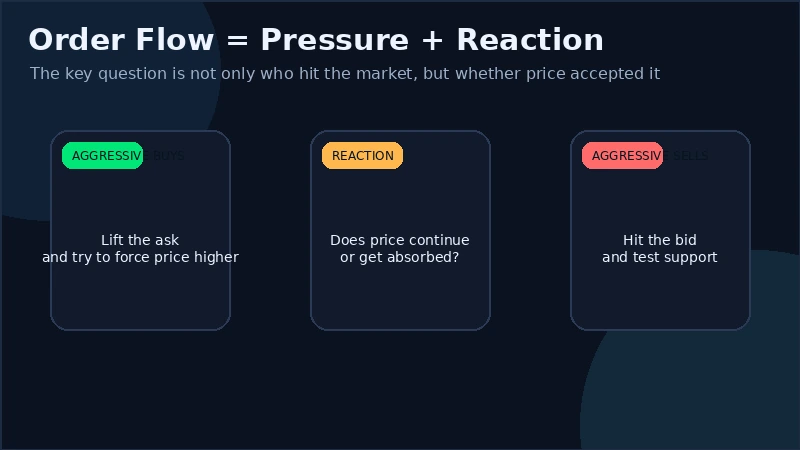
When a trader places a market buy, they cross the spread and lift the ask. When a trader places a market sell, they cross the spread and hit the bid. Those aggressive orders are what usually create immediate movement. Passive orders provide liquidity, but aggressive orders test it.
This is why a huge candle is not enough information by itself. You also want to know whether the move came from sustained aggressive participation, one sudden sweep, or a thin book that offered little resistance.
Core order-flow concepts traders need first
Beginners do not need a professional footprint terminal to understand order flow. They need a small group of ideas and some clear mental pictures.
Trade aggression
The first concept is aggression. Aggressive buyers are willing to pay the ask right now. Aggressive sellers are willing to hit the bid right now. That urgency matters because urgent orders are what push the market through visible liquidity.
Absorption
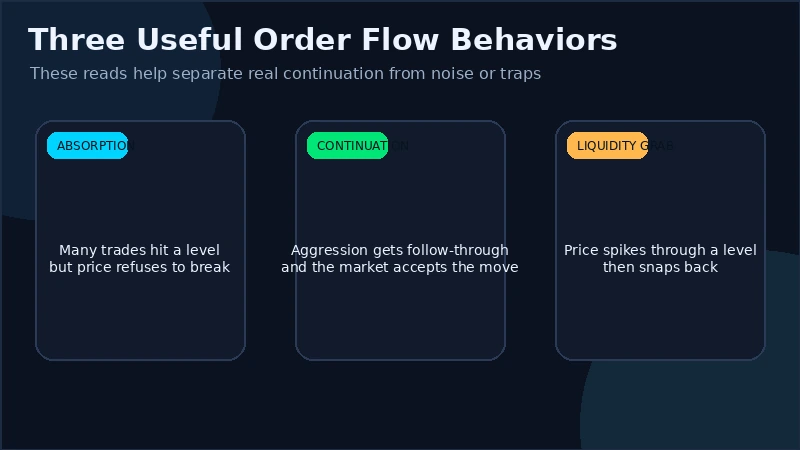
Absorption happens when aggressive orders keep hitting a level but price refuses to continue through it. Imagine repeated market buys printing at resistance while the market barely moves higher. That can mean a larger seller is calmly supplying enough liquidity to absorb the buying. Loud activity is happening, but successful progress is not.
Absorption is one of the most useful order-flow ideas because it teaches traders not to confuse excitement with strength. A level that absorbs repeated aggression is often more informative than a level that breaks on one dramatic candle.
Imbalance and delta
Imbalance describes a short-term skew where one side is clearly more aggressive than the other. Delta is a common way to compare aggressive buying and aggressive selling. Positive delta means market buying is dominating. Negative delta means market selling is dominating.
These terms sound technical, but the intuition is simple. If one side is repeatedly crossing the spread and the other side is not matching it, the market is leaning in that direction. The next question is whether price is accepting that pressure or quietly resisting it.
Sweeps, spoofing, and liquidity grabs
A sweep happens when aggressive orders consume several price levels quickly. Spoofing refers to visible orders that appear large but may disappear before execution. A liquidity grab is a sharp move through an obvious high or low that triggers stops or breakout entries before reversing.
These ideas matter because order flow is not only about speed. It is also about sincerity. Some visible liquidity is real, some is temporary, and some movement is driven more by trapped traders than by durable conviction.
Three simple order-flow examples beginners can picture
Order flow becomes easier once you can attach the terms to market behavior you have probably already seen.
1. The breakout that actually works
Price pushes into resistance, aggressive buyers keep lifting the ask, and each burst of buying produces real follow-through. The market does not instantly snap back into the range. Instead, the old resistance starts behaving like support. That is the kind of breakout where order flow is supporting the move instead of merely decorating it.
2. The breakout that fails
Price jumps above resistance, the tape fills with green prints, and the move looks exciting. Then the market stalls. More aggressive buyers arrive, but price barely advances. A larger seller may be absorbing the flow. Soon the market slips back into the range. The mistake is not that traders noticed buying. The mistake is that they assumed buying automatically meant acceptance.
3. The support level that refuses to break
Now flip the picture. Price tests support and repeated market sells keep hitting the bid, yet price stops making meaningful progress lower. That can suggest sellers are exhausting themselves or a larger buyer is quietly absorbing inventory. Again, the useful clue is the reaction. Heavy activity with weak progress often tells a better story than the candle color alone.
How to read order flow in practice
The practical read starts with context. Where is price relative to support, resistance, prior highs or lows, or a fresh breakout level? Order flow is strongest when it is answering a specific market question rather than performing in isolation.
Start with a level and a question
A beginner-friendly way to use order flow is to begin with one clear question. Is this breakout being accepted? Is this support actually failing? Are sellers getting traction, or only making noise? Starting with a question prevents you from staring at fast prints and inventing stories out of every burst of activity.
That approach also keeps order flow in its proper role. It is a decision-support tool, not a substitute for market structure. When you already know which level matters, the tape becomes easier to interpret because you are judging whether the market is accepting or rejecting a specific price area.
Recent trades and tape behavior
The recent-trades feed is the most accessible order-flow view for many crypto traders. Watch for repeated aggressive prints, unusual speed, and whether each burst of activity actually moves price. Fast green prints that do not push price higher can reveal absorption. Repeated red prints into support that fail to break it can reveal the opposite.
Tape speed matters too. A sudden acceleration in prints near a major level can signal urgency, trapped traders, or a fast change in participation. It does not matter because it is exciting. It matters because it changes the odds that the level holds or fails.
Footprint charts, CVD, and heatmaps in plain English
Advanced tools such as footprint charts, cumulative volume delta, and heatmaps give a richer view of aggression and liquidity. They can be useful, but the beginner goal should stay modest. In plain English, these tools are trying to show who was aggressive, where visible liquidity sat, and whether the market accepted or rejected that pressure.
You do not need every advanced tool to learn the core lesson. If you can already recognize aggression, absorption, and failed follow-through in recent trades and price reaction, you are learning the right habits.
When liquidation cascades distort the read
Crypto order flow can become misleading during liquidation events. A sharp cascade may look like clean directional conviction when it is really forced exits hitting a fragile market. That is why order flow works best alongside broader context such as liquidation maps or derivatives crowding, not as a totally isolated lens.
A beginner checklist while watching the tape
If you are new to order flow, keep the live read simple. Ask five things in order: where is price, who is aggressive, is the move getting follow-through, is liquidity deep enough to trust the read, and does the behavior fit the higher-timeframe chart? That checklist sounds basic, but it filters out a huge amount of noise.
For example, fast green prints near resistance mean something very different from fast green prints after price has already reclaimed the level and started holding above it. The first case may be buyers running into supply. The second may be buyers building acceptance. The tape alone does not tell you which one you are watching unless you anchor it to context.
The same discipline helps on the downside. Heavy red prints in the middle of a range are often just motion. Heavy red prints through a major support level that cannot reclaim are more meaningful. Order flow becomes clearer when you compare pressure with location and outcome, not when you count colors on the screen.
DEXTools-friendly workflow for token traders
DEXTools gives crypto traders a practical way into order flow because it keeps the concept tied to real token markets instead of abstract tape-reading theory.
- Start with a pair that deserves attention. Check liquidity depth, pair age, and whether recent activity looks organic enough to trust.
- Watch recent trades around a real level. Order flow is more useful near breakouts, failed breakouts, support tests, and reversal attempts than in random mid-range noise.
- Ask what price is doing with the pressure. Are aggressive buys producing follow-through, or getting absorbed? Are aggressive sells actually breaking support, or merely making noise?
- Layer the signal with other clues. Whale activity, volume profile, and Pair Explorer trend-reversal coverage can help confirm whether the behavior is real or fragile.
- Stay skeptical in weak markets. If the pool is shallow or one wallet seems to dominate the flow, reduce trust in the read rather than increasing conviction.
Readers who want the wallet angle can continue to how to track whale wallets using DEXTools, which complements order-flow work without turning this page into a whale-tracking tutorial.
When order flow is most useful
Order flow shines when the market is at a decision point. Breakouts, failed breakouts, local reversals, support retests, and fast news moves all become easier to interpret when you can see whether aggression is being accepted or absorbed.
It is less useful when traders try to force it into every minute of every session. Some periods are mostly noise. Order flow should improve clarity, not create an addiction to micro-movement.
What order flow cannot tell you on its own
Order flow can improve timing and realism, but it does not answer every important question. It will not tell you whether a token has good fundamentals, whether a macro event is about to hit the market, or whether a thin pair is being promoted by wallets that may disappear tomorrow. Those answers require other tools.
It also cannot remove uncertainty. A market can show healthy buying pressure and still fail because a larger participant steps in, because news changes the environment, or because the move already ran too far. The point of order flow is not certainty. The point is to make your read of pressure and acceptance less naive.
Common traps when using order flow
- Reading green prints as automatic strength: buyers can be aggressive and still lose if a larger seller absorbs them.
- Trusting low-liquidity memecoins too much: one wallet can create exaggerated prints that look like broad conviction when they are not.
- Believing visible walls are always real: fake liquidity can vanish before it matters.
- Ignoring the higher-timeframe level: a burst of flow means less if it runs directly into major resistance or a forced-liquidation zone.
- Staring at tape without a plan: order flow is best for refining conviction, not for inventing random trades.
The clean rule is that order flow should sharpen an existing idea. It should not become an excuse to chase every burst of activity.
Frequently asked questions
What is order flow in crypto trading?
It is the study of how aggressive buyers and sellers interact in real time to create pressure, absorption, imbalance, and price movement.
Is order flow the same as the order book?
No. The order book shows resting liquidity, while order flow focuses on the trades actually hitting the market and how price reacts to them.
Can you use order flow on DEXTools?
You can use DEXTools-friendly clues such as recent trades, pair behavior, liquidity quality, and whale activity to build a practical order-flow view for token markets.
Which order flow signals matter most for beginners?
Trade aggression, follow-through, absorption, and liquidity quality are the clearest starting signals. Reaction matters more than isolated flashes of volume.
Does order flow work on low-liquidity memecoins?
It can still offer clues, but the signals are much easier to distort, so traders should trust the read less and stay more selective.
Final takeaway: order flow matters because it shows the market's live pressure, not just its finished candle. If you learn to watch aggression, reaction, liquidity quality, and absorption together, you will read breakouts and reversals with more realism. Just do not let one burst of tape convince you to ignore the wider market context.
Disclaimer: This draft is for educational purposes only and does not constitute investment, financial, legal, or trading advice. Order-flow signals can improve timing and context, but they do not eliminate market risk.
Related Guides
- CEX Deposit Pressure: How Exchange Inflows Can Signal Future Selling
- How to Read Token Unlocks Before Buying in 2026
- How to Read Liquidity Pool Data Before Buying a Token (2026)
- What Is an Iceberg Order in Crypto Trading? (2026)
- Crypto Order Types: The Complete 2026 Guide to Every Order Type in Trading
- What Is the Money Flow Index (MFI) in Crypto Trading? (2026)
Frequently Asked Questions
What is order flow in crypto trading?
Order flow is the real-time stream of buy and sell orders hitting the market, showing where traders are aggressively buying or selling. Reading it helps you gauge live buying and selling pressure rather than relying only on lagging price charts.
What is the difference between aggression and absorption in order flow?
Aggression refers to market orders that actively take liquidity and push price, while absorption is when resting limit orders soak up that aggression without price moving much. Spotting absorption can hint that one side is defending a level despite heavy pressure.
What is an order flow imbalance?
An imbalance occurs when buying activity strongly outweighs selling activity, or vice versa, at a given price level. Large or persistent imbalances can signal that one side is in control and may foreshadow continued movement in that direction.
Is order flow useful for beginner crypto traders?
Order flow can be valuable for beginners as a confirmation tool, but it has a learning curve and works best alongside context like trend and support or resistance. Starting with simple reads of aggression and absorption is usually more practical than trying to interpret everything at once.