What Is a DEX Aggregator: Complete Guide to 1inch, Jupiter and ParaSwap (2026)
— By Tony Rabbit in Tutorials

What is a DEX aggregator? Complete 2026 guide: split-order routing, top 6 platforms compared (1inch, Jupiter, ParaSwap, Matcha, CoW), MEV protection and best execution.
If you have ever swapped tokens on a DEX in 2026 and received a quote that magically beat every single decentralized exchange you checked manually, you almost certainly used a DEX aggregator without realizing it. Aggregators have quietly become the default execution layer of decentralized finance, routing more than half of all on-chain swap volume on Ethereum and well over ninety percent on Solana. They are the invisible plumbing that turns a fragmented landscape of hundreds of liquidity pools into a single best price.
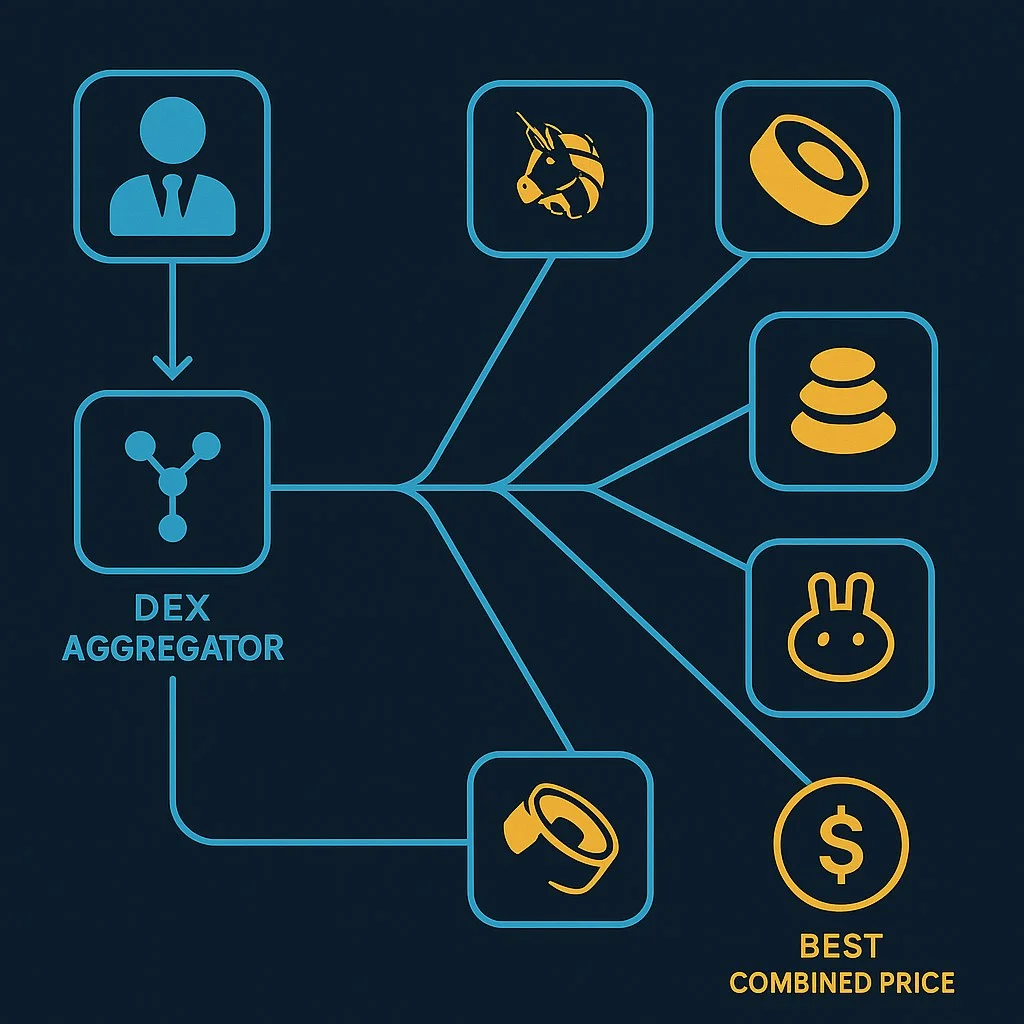
A DEX aggregator is a smart contract router that scans every reachable liquidity source on a given chain, splits your order across the optimal combination of pools, and delivers the best net output after gas. Instead of trading on one AMM and accepting whatever price that pool quotes, you let an algorithm shop your trade across the entire ecosystem in a single transaction. The result is consistently better fills, especially on large orders where slippage on any single venue would eat your face.
In this guide you will learn exactly what a DEX aggregator is, how split-order routing actually works under the hood, why aggregators routinely beat single-DEX trades on size, and how the top six players (1inch, Jupiter, ParaSwap, Matcha, CoW Protocol, and Kyber Swap) stack up against each other in 2026. You will also learn what intent-based aggregation is, how it neutralizes MEV, and how to actually use 1inch and Jupiter step by step with real screenshots from your wallet.
What Is a DEX Aggregator?
A DEX aggregator is a protocol that sits one layer above the individual decentralized exchanges. When you submit a swap request, the aggregator queries dozens or even hundreds of liquidity sources, calculates every viable path between your input token and your desired output token, and returns the route (or combination of routes) that produces the most output after fees, gas, and slippage. You sign a single transaction, and the aggregator's smart contract executes the entire multi-hop, multi-pool trade atomically on your behalf.
The simplest way to picture an aggregator is as a flight search engine for tokens. When you book a flight from Madrid to Tokyo, you do not call every airline separately. You open Skyscanner or Google Flights, which queries every carrier, finds direct routes, layover combinations, and even mixed-carrier itineraries, then shows you the cheapest total option. A DEX aggregator does exactly the same thing for token swaps, except the airlines are Uniswap, Curve, Balancer, SushiSwap, Maverick, PancakeSwap, and dozens more, and the layovers are intermediate tokens like WETH, USDC, or DAI.
Aggregators emerged as a necessary response to the explosion of DeFi liquidity in mid 2020. Before then, most volume traded on Uniswap V1 and V2 by default. Then SushiSwap forked Uniswap, Curve launched stable-swap pools, Balancer introduced weighted pools, and suddenly the same token pair had ten different prices across ten different venues. Manually checking each one was impossible. 1inch launched in May 2020, ParaSwap in August 2020, and Matcha (by 0x Labs) in early 2020, all racing to solve the same problem: how do you give a retail user the best possible execution without forcing them to become a quant?
By 2022 aggregators routed about a third of Ethereum DEX volume. By 2024 that number passed fifty percent on most major chains. In 2026, on Solana, Jupiter alone handles over ninety percent of all swap volume on the chain, making it the de facto execution layer rather than an optional tool. The aggregator is no longer a power-user feature. It is the front door.
How Split-Order Routing Works
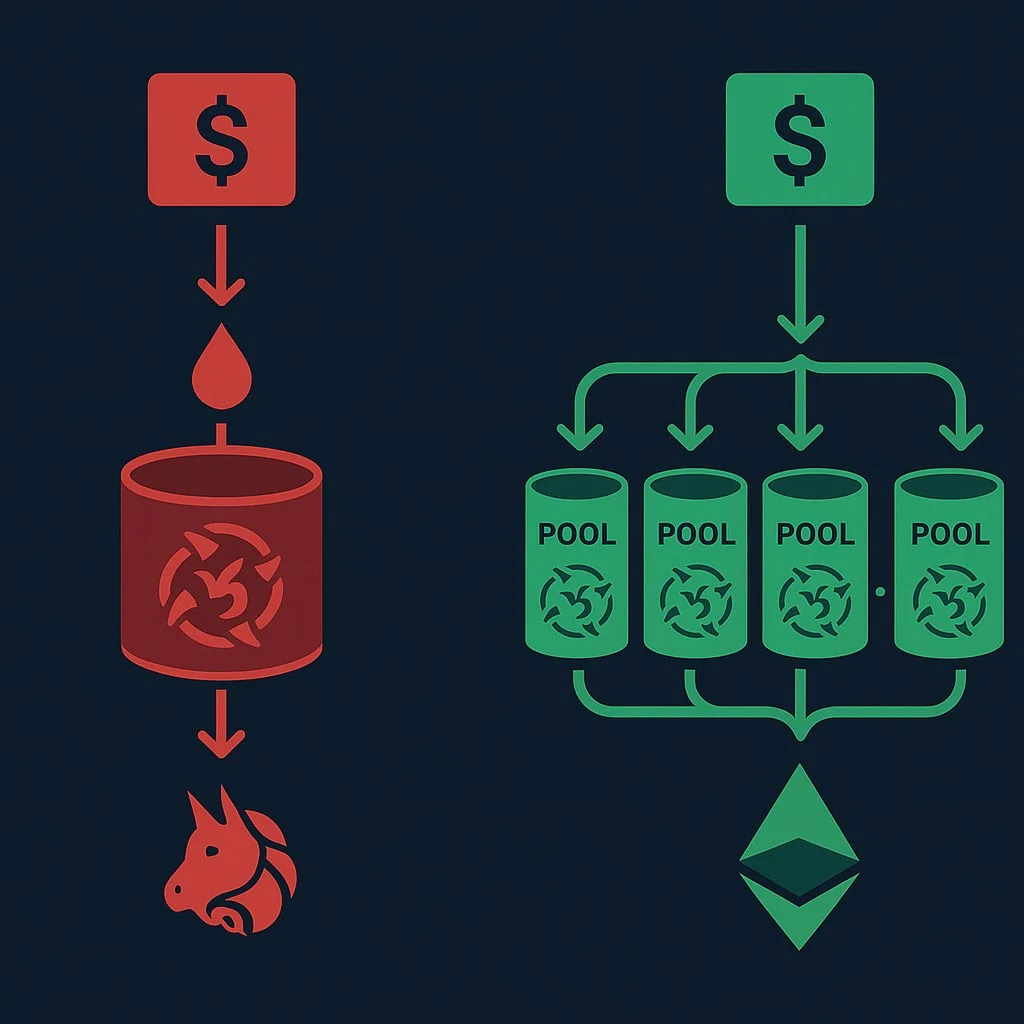
The single most important thing a DEX aggregator does is split a large order across multiple pools to minimize price impact. To understand why this is so powerful, you need to remember how an AMM determines price. In a constant-product market maker like Uniswap V2, the price you receive depends on the ratio of reserves in the pool and on the size of your trade relative to those reserves. A small trade barely moves the price. A large trade moves it a lot. This is slippage, and it scales nonlinearly with order size.
If you try to swap $100,000 of USDC for ETH on a single Uniswap V3 pool that holds $5 million of liquidity, your trade represents 2% of the pool's depth and could cost you anywhere from 0.5% to 2% in price impact. But if you split that same $100,000 across three or four pools on different DEXs, each pool only absorbs a fraction of the trade, so the price impact on each one is dramatically smaller. The aggregator's pathfinding algorithm (1inch calls theirs Pathfinder) calculates the exact optimal split.
Under the hood, the pathfinding problem is a constrained optimization. The aggregator builds a graph where every token is a node and every pool is an edge with its own pricing function. It then searches for the set of paths and weights (the percentage of the order to route through each path) that maximizes the output token, subject to gas-cost constraints. Splitting an order across too many small pools saves slippage but explodes gas, so the algorithm has to balance both. Modern pathfinders like 1inch Pathfinder V3 explore millions of candidate routes per second using a combination of dynamic programming, beam search, and machine learning heuristics.
The order can also include multi-hop paths through intermediate tokens. Suppose you want to swap a small-cap token A for another small-cap token B, but there is no direct A/B pool. The aggregator might route A to WETH on one DEX, then WETH to USDC on another, then USDC to B on a third venue. Each hop adds gas but can dramatically improve the effective price if the direct pool is shallow. The pathfinder evaluates all of these hop combinations simultaneously.
Why Aggregators Beat Single DEXs on Large Trades
The case for aggregators is most obvious on large orders. Below is a worked comparison of the same trade executed on a single DEX versus through an aggregator, using realistic 2026 liquidity figures for the USDC/ETH pair.
That 1.81 ETH difference is roughly $4,200 at $2,300 per ETH. The aggregator paid an extra $14 in gas and saved $4,200 in slippage. That ratio (gas cost to slippage savings) is exactly what the pathfinder is optimizing. For smaller trades the math flips. On a $500 swap, the gas cost of three hops can exceed the slippage savings of splitting, and a good aggregator will recognize this and route the entire trade through a single pool. The smarter the algorithm, the better it handles this trade-off across the full range of trade sizes.
Slippage savings scale roughly with the square root of liquidity depth. If the aggregator gives you access to four times more total liquidity, your price impact roughly halves. This is why aggregators dominate for institutional sizes (anything above $50,000) and why they are increasingly important even for $1,000 retail swaps on chains with fragmented liquidity. If you want to understand the math more deeply, our guide on what slippage is and how to set it correctly walks through the constant-product formula step by step.
The 6 Major DEX Aggregators in 2026
The aggregator landscape has consolidated around six dominant protocols, each with a slightly different focus, fee structure, and chain coverage. Here is the head-to-head breakdown nobody else seems to publish.
Note that "fee" here means the protocol-level fee charged by the aggregator itself. You always pay the underlying DEX swap fees (Uniswap's 0.05% to 1% tier fees, for example) and the network gas fee. The aggregator's revenue model varies wildly. 1inch's classic mode is technically free, monetized via Fusion order spreads and the 1INCH governance token. ParaSwap and CoW capture a slice of any positive slippage (the amount by which the actual fill beats the quoted minimum). Matcha takes a small explicit cut. There is no free lunch, but the differences are usually invisible compared to the slippage savings the aggregator delivers.
1inch Deep Dive
1inch is the original and still the largest EVM-side aggregator by volume. Founded in 2019 by Sergej Kunz and Anton Bukov at an ETHGlobal hackathon, the protocol now operates across more than fifteen chains including Ethereum, Arbitrum, Optimism, Base, Polygon, BNB Chain, Avalanche, Gnosis, and zkSync. The flagship technology is the Pathfinder algorithm, which by 2026 is on its third major version and integrates over four hundred liquidity sources per chain.
1inch operates in two distinct modes. Classic Swap is the original on-chain routing where you pay gas yourself and the aggregator's smart contract executes the multi-pool split in a single transaction. Fusion Mode, launched in late 2022 and dramatically expanded in 2024 and 2025, is intent-based. You sign a Dutch auction order off-chain, professional market makers (called resolvers) compete to fill it at the best price, and the winning resolver pays the gas for you. Fusion is gasless from the user's perspective and offers strong MEV protection because the order never enters the public mempool.
The 1INCH token is the governance token and also accrues value through resolver staking in Fusion. To become a resolver and earn order flow, market makers must stake 1INCH tokens. This creates a real, non-speculative source of demand for the token and aligns resolver behavior with the protocol's reputation. 1inch also offers a limit order protocol, an RFQ system for whales who want quotes from professional desks without leaking their order to the public market, and a dedicated mobile wallet.
Jupiter Deep Dive
Jupiter is the Solana ecosystem's default execution layer and arguably the most dominant aggregator on any single chain. Where 1inch handles maybe twenty percent of Ethereum DEX volume, Jupiter routinely handles over ninety percent of Solana DEX volume. Almost every Solana wallet, dApp, and bot integrates the Jupiter API rather than going direct to Raydium, Orca, or Meteora. This is partly because Solana's transaction model (cheap, parallel, atomic) makes split routing trivially cheap, and partly because Jupiter's team has executed relentlessly on developer experience.
The Jupiter router connects to every meaningful Solana DEX, including Raydium AMM and CLMM, Orca Whirlpools, Meteora DLMM, Phoenix, Lifinity, OpenBook, GooseFX, and dozens of long-tail venues. Routes can include up to ten hops with arbitrary splits, and because Solana gas is measured in fractions of a cent, the pathfinder is free to explore far more complex routes than its EVM counterparts. The Jupiter quote API returns multiple route options with full transparency into which pools were used and what the expected impact is on each leg.
Jupiter launched the JUP token in January 2024 via one of the largest community airdrops in DeFi history, distributing tokens to over one million wallets. JUP is used for governance and to fund the Jupiter Working Group that builds new products. Since the airdrop, Jupiter has expanded into perpetual futures (Jupiter Perps, now one of the highest-volume perp DEXs in DeFi), a launchpad, a limit order book, and a DCA (dollar-cost averaging) product. The aggregator remains the core, but Jupiter is becoming a full DeFi suite.
ParaSwap, Matcha, CoW Protocol, Kyber Swap
ParaSwap is the second-largest EVM aggregator after 1inch and is particularly popular with wallets and dApps that want to embed swap functionality. ParaSwap supports more than twelve EVM chains and offers both a classic on-chain mode and Delta, an intent-based mode similar in spirit to 1inch Fusion. ParaSwap monetizes by capturing approximately fifteen percent of any positive slippage the route generates, which is transparent and only triggers when you receive more than your quoted minimum.
Matcha is the consumer-facing front end built by 0x Labs, the team behind the 0x protocol that pioneered RFQ-style trading in DeFi. Matcha's distinguishing feature is its hybrid model: it combines on-chain AMM routing with off-chain RFQ quotes from professional market makers. For large trades or illiquid pairs, the RFQ desks often beat AMM pricing significantly. Matcha charges a transparent 0.15% fee on most pairs and supports nine chains including Ethereum, Arbitrum, Optimism, Polygon, Base, and BNB Chain.
CoW Protocol (Coincidence of Wants) takes a fundamentally different approach. Instead of routing every order through AMMs, CoW first looks for direct matches between users who want to trade in opposite directions in the same batch. If Alice wants to sell ETH for USDC and Bob wants to sell USDC for ETH, CoW matches them peer-to-peer at a fair price with zero AMM fees and zero slippage. Unmatched portions are routed to AMMs by solvers in a sealed-bid batch auction. CoW has zero direct user fees because solvers pay the gas and compete to win the right to settle the batch.
Kyber Swap is one of the oldest names in DEX aggregation, originally launched in 2018 as a single liquidity protocol and pivoted to a full aggregator after the rise of 1inch. Kyber's Dynamic Trade Routing algorithm covers more than fourteen EVM chains and integrates almost every major DEX. Kyber suffered a $48 million exploit in November 2023 that briefly knocked it offline, but the protocol restored operations and continues to handle meaningful volume, particularly on chains where competition is thinner.
Intent-Based Aggregation: The Next Generation
The biggest shift in aggregator design between 2023 and 2026 has been the move from on-chain routing to intent-based architectures. The difference is profound. In a classic aggregator like 1inch Classic or Kyber, you publish a fully formed transaction to the mempool that says, in effect, "execute exactly this set of swaps." Searchers and validators can see your transaction before it lands, and they can sandwich attack it by front-running with a buy, letting your swap push the price, then dumping immediately after.
Intent-based aggregators flip the model. Instead of publishing a transaction, you sign an off-chain message that describes your desired outcome: "I want at least 34.5 ETH in exchange for $100,000 USDC, before this deadline." This is the intent. The signed intent is sent to a network of professional solvers (1inch calls them resolvers, CoW calls them solvers, ParaSwap calls them agents). The solvers compete in a sealed-bid auction to find the best route, then the winning solver submits the transaction and pays the gas. You only sign, never broadcast.
This solves several problems at once. First, MEV is largely neutralized because your order never enters the public mempool where searchers can see it. Second, you pay zero gas as a user (the solver pays gas and bakes it into the auction price). Third, professional solvers have access to off-chain inventory (RFQ desks, market maker books, even other intents in the same batch) that on-chain routers cannot reach. Fourth, in CoW Swap specifically, the batch settlement enables true Coincidence of Wants matching that bypasses AMMs entirely for opposite-direction trades.
By 2026 the majority of new aggregator volume is intent-based. 1inch Fusion handles more than half of 1inch's total volume. CoW Swap regularly settles over $1 billion per week. ParaSwap Delta is growing fast. The trade-off is settlement latency. An intent-based swap can take ten to thirty seconds to fill (sometimes longer for illiquid pairs) versus the immediate execution of a classic on-chain swap. For most users this delay is invisible and the gas savings plus MEV protection are worth it.
Hands-On: How to Use 1inch
Using 1inch is straightforward once you understand the interface. Here is the step-by-step flow for a typical swap on Ethereum mainnet.
Step 1: Open the app and connect your wallet. Go to app.1inch.io and click "Connect wallet" in the top right. 1inch supports MetaMask, Rabby, Coinbase Wallet, Trust Wallet, Ledger, Trezor, WalletConnect, and most other major wallets. Choose your wallet provider and approve the connection request that pops up. The 1inch dApp never has access to your funds. You sign every transaction yourself.
Step 2: Select your chain and tokens. The chain selector is at the top of the interface. Make sure you are on the correct network (Ethereum, Arbitrum, Base, Polygon, etc.) and that your wallet is on the same network. Then choose the input token (what you are selling) and the output token (what you want to buy). For small-cap tokens, paste the contract address rather than searching by name to avoid scam tokens with copycat tickers. You can verify the contract on Etherscan or DexTools before pasting.
Step 3: Enter the amount and review the route. Type the input amount and 1inch will instantly calculate the best route. Click the "Show route" or arrow icon to see exactly which pools your trade will pass through and what percentage of the order each pool absorbs. This is the moment to verify that the slippage tolerance (default 1% on volatile pairs, 0.1% on stables) and gas settings make sense for your trade size. For an ERC-20 token you have never swapped before, you will see two transactions: an approval first, then the swap.
Step 4: Choose Classic or Fusion mode. 1inch will recommend Fusion for most swaps because it is gasless and MEV-protected. For very small trades or for tokens that lack resolver coverage, Classic may be faster. Toggle between the two modes at the top of the swap card. In Fusion mode, you will see an "auction" progress bar after submitting; this is the Dutch auction descending until a resolver fills your order.
Step 5: Approve the token, then sign the swap. If this is the first time you are swapping a particular token from this wallet, MetaMask will prompt you to approve the 1inch router contract to spend that token. This costs gas in Classic mode but is free in Fusion (the resolver pays). After approval, sign the actual swap. In Classic mode the transaction is broadcast immediately. In Fusion mode the signed intent goes to the resolver auction. Either way, you will see a confirmation screen and a transaction hash within seconds to a couple of minutes.
Hands-On: How to Use Jupiter on Solana
Jupiter is even simpler because Solana's UX is more forgiving than Ethereum's (no separate gas token math, no approval transactions for SPL tokens once the associated token account exists, near-instant finality).
Step 1: Connect a Solana wallet. Go to jup.ag and click "Connect wallet" in the top right. Jupiter supports Phantom, Solflare, Backpack, Glow, Trust Wallet, Ledger, and WalletConnect. Phantom is the most popular for retail users. After connecting, your SOL balance and any token balances will be visible inside the swap card.
Step 2: Select the input and output tokens. Click the token selector and search by ticker or paste the SPL mint address for small caps. Jupiter aggregates a token list that includes verified tokens flagged by community curators, but always double-check the mint address for new tokens. The interface shows a small icon next to verified tokens.
Step 3: Enter the amount and check the route. The route visualizer at the bottom of the swap card shows every pool the order will touch and the percentage of the order going through each. For a typical SOL to USDC swap, you might see a route that uses 60% Raydium CLMM, 25% Orca Whirlpool, and 15% Meteora DLMM. Click "Show details" to see the price impact estimate (Jupiter shows a colored impact warning at 1%, 3%, and 5%).
Step 4: Set slippage and priority fee. Jupiter's default slippage is 0.5% on most pairs and 0.1% on stable pairs. For volatile small caps you may need to raise this to 1-3%. Solana also charges a priority fee in addition to base fees; during congestion, setting a higher priority fee (a few thousand lamports) ensures your transaction lands quickly. Jupiter has an "Auto" priority fee setting that adjusts based on current network conditions.
Step 5: Click Swap and approve in your wallet. Phantom or Solflare will pop up showing the exact tokens being moved and the simulated outcome. Confirm. The transaction usually finalizes in 0.5 to 2 seconds. If it fails (most often because slippage was too tight), Jupiter will display an error and you can retry with adjusted parameters.
Aggregator Fees vs Direct DEX Trade
One question that comes up constantly: does using an aggregator cost more than swapping directly on a DEX? The honest answer is "it depends, but almost never enough to matter."
When you swap directly on Uniswap V3, you pay the pool's fee tier (0.01%, 0.05%, 0.30%, or 1.00% depending on the pair) plus gas. When you swap the same pair through 1inch Classic, you pay exactly the same pool fees (the aggregator does not charge anything on top in Classic mode) plus a slightly higher gas cost because the router contract adds a thin layer of overhead and may split across multiple pools, each with its own gas cost. The aggregator typically adds 30,000 to 80,000 gas units compared to a single direct swap.
However, the aggregator nearly always delivers a better net price even after that extra gas. Here is a concrete 2026 example: a $5,000 USDC to ETH trade on Ethereum mainnet pays roughly $4 in gas direct on Uniswap V3, versus roughly $8 in gas on 1inch. The aggregator's price impact is maybe 0.05% lower than the single pool, which on $5,000 is $2.50. The aggregator quote is the same or slightly worse on this specific trade. But on a $50,000 trade the slippage savings jump to $25 or more and the gas overhead is the same, so the aggregator wins easily. On $500,000 it is not even close. The aggregator wins by hundreds or thousands of dollars.
For intent-based aggregators like 1inch Fusion or CoW Swap, the fee structure is different again. You pay zero gas. The resolver or solver pays gas and bakes that cost plus a small profit margin into the auction price. The auction's competitive pressure usually means the resolver's margin is razor-thin, often below the gas cost you would have paid yourself, especially during high gas periods. The net result for the user is usually a better effective price than Classic mode plus the MEV protection bonus.
MEV Risk: Why Some Aggregators Are Safer
Classic on-chain aggregators publish your transaction to the public mempool before inclusion, where MEV bots can simulate it, identify profitable extraction opportunities, and execute sandwich attack patterns against your trade. On large swaps without private RPC routing, MEV losses can exceed slippage. Use Fusion, CoW Swap, or a private RPC like Flashbots Protect for any trade above $10,000.
MEV (Maximal Extractable Value) is the profit that validators or specialized searchers can extract by reordering, inserting, or censoring transactions within a block. The most common MEV pattern that targets retail swappers is the sandwich. A searcher sees your pending swap in the mempool, places a buy order just before yours (driving the price up), lets your trade push the price further, then dumps everything they just bought immediately after. Their profit is your slippage.
Aggregators differ dramatically in how exposed they leave you. Classic mode aggregators (1inch Classic, Kyber Swap, ParaSwap classic) all publish your transaction to the public mempool. Without additional protection, your trade is fully visible and sandwichable. To mitigate this, most of these aggregators offer optional private mempool routing through services like Flashbots Protect, MEV Blocker, or bloXroute. With private RPC enabled, your transaction is sent directly to block builders rather than the public mempool, and sandwich attacks become impossible.
Intent-based aggregators are MEV-protected by design. In 1inch Fusion, you sign an intent off-chain and a resolver builds the settlement transaction. The resolver has every incentive to execute cleanly because their reputation and staked 1INCH tokens are on the line. CoW Swap goes further by settling all orders in a batch with a single uniform clearing price, meaning no transaction within the batch can be sandwiched by any other transaction in the batch. Matcha's RFQ flow is similar: when the quote comes from a professional market maker, it is settled in a private channel that cannot be sandwiched.
For trades above $10,000 on any EVM chain, the rule of thumb in 2026 is: use intent-based mode by default. Use Classic only when you need immediate execution and have private RPC enabled. Never publish a five-figure swap to the public mempool without protection. Jupiter on Solana faces a slightly different MEV landscape (Solana has no public mempool in the EVM sense, but it has its own forms of priority gaming) and Jupiter's transaction simulator plus priority fee tooling handles most of the risk transparently.
Pros and Cons of DEX Aggregators
- Best net price across all reachable liquidity
- Dramatic slippage reduction on large trades via split routing
- Access to long-tail venues you would never check manually
- Multi-hop pathfinding finds prices the user cannot
- Intent-based modes neutralize MEV and eliminate gas for the user
- Single transaction settles complex multi-DEX trades atomically
- Wallet integrations make swaps available everywhere
- Higher gas cost than a single direct swap on small trades
- Public-mempool routing exposes trades to sandwich MEV
- Smart contract risk: the router contract itself can be exploited
- Intent-based modes can have settlement latency (10-30s)
- Quote can drift between display and signature on volatile pairs
- Complex routes can fail more often than direct swaps
- Long-tail tokens may not be supported on all aggregators
Aggregators for Bots and Programmatic Traders
Every major aggregator exposes a public API that bots, market makers, and automated strategies can use to fetch quotes and execute swaps programmatically. The API surface is broadly similar across protocols: a quote endpoint that returns the best route and expected output for a given input, and a transaction endpoint that returns the encoded calldata your contract or bot can broadcast.
1inch's API (api.1inch.dev) supports both Classic and Fusion modes and is rate-limited based on an API key tier. Free keys allow a few requests per second, paid plans scale to thousands. Jupiter's API (quote-api.jup.ag) is famously generous with rate limits and is the foundation of much of the Solana trading bot ecosystem, including Jito-MEV searchers, DCA bots, and arbitrage scripts. ParaSwap and 0x both publish detailed Swagger specs and SDKs in JavaScript, Python, and Rust.
For sophisticated traders, the killer feature is the gasless intent flow. A bot can sign hundreds of Fusion orders without holding ETH for gas, hand them off to resolvers, and treat the entire flow as off-balance-sheet inventory management. This is particularly valuable for treasury management at DAOs, hedge funds, and high-frequency strategies that would otherwise be bottlenecked by gas-token operations.
Aggregators on EVM vs Non-EVM Chains
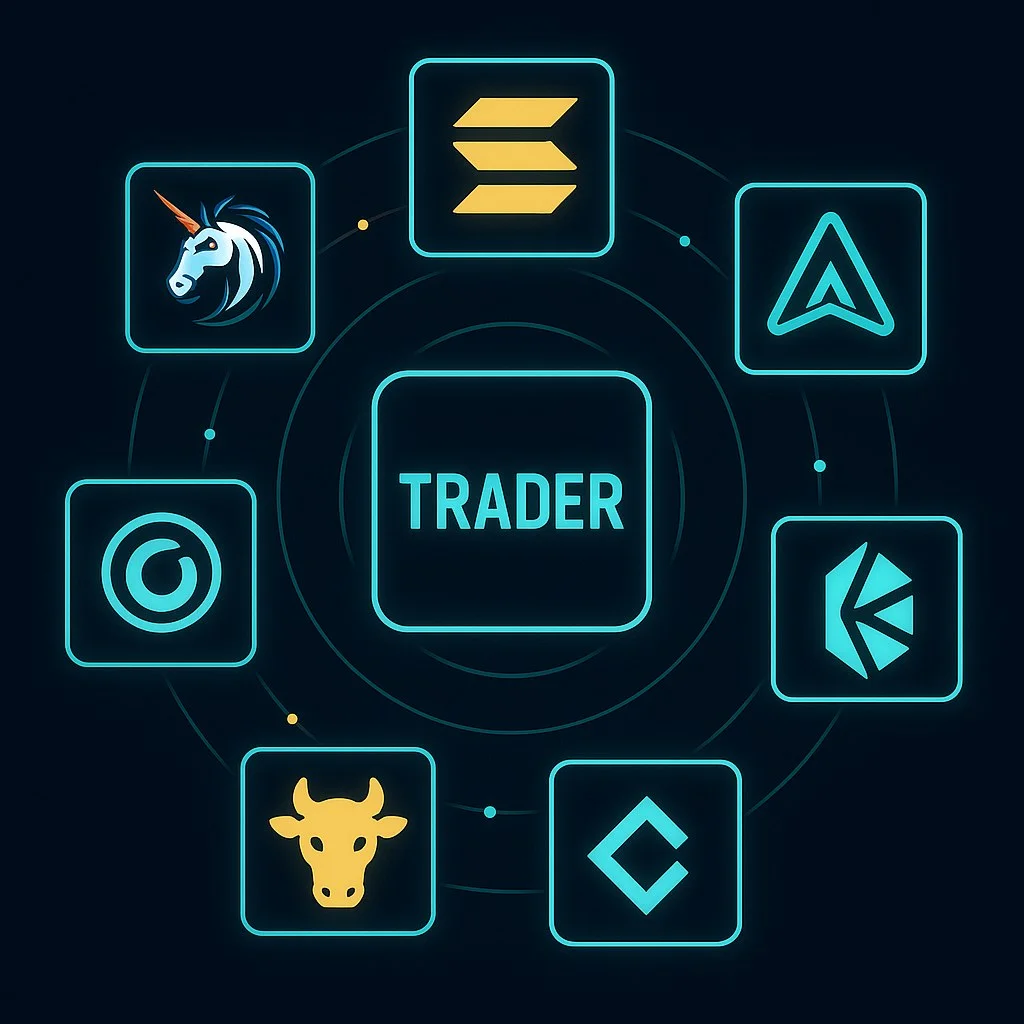
The aggregator landscape looks fundamentally different across chain families. On EVM chains (Ethereum, Arbitrum, Base, Optimism, Polygon, BNB Chain, Avalanche, etc.) the competitive dynamics are similar everywhere. 1inch, ParaSwap, Matcha, Kyber, CoW, and OpenOcean all compete for the same swap volume. Wallets like MetaMask integrate multiple aggregators behind the scenes and route to whichever returns the best quote. The user rarely picks an aggregator explicitly.
Solana is dominated by Jupiter. There is essentially no second-place aggregator with meaningful share. Almost every Solana wallet and dApp uses the Jupiter SDK, and Jupiter has expanded into perpetuals, launchpads, and DCA to deepen the moat. The closest competitor, DFlow, is a fraction of the volume.
On the OP Stack and Superchain rollups (Base, Optimism, Mode, Worldchain), aggregators face a unique challenge: a lot of the liquidity sits in chain-native protocols like Aerodrome on Base and Velodrome on Optimism, which use vote-escrowed token economics and concentrated liquidity. Aggregators have integrated these venues but routing on Base often differs from routing on Ethereum because the relative depth of pools is so different. On these chains, native aggregators or chain-specific routers sometimes outperform the EVM generalists on certain pairs.
On Cosmos and Cosmos-SDK chains, the aggregator scene is much younger. Skip Protocol (now part of Polkachu and broader Cosmos infrastructure) and Squid Router specialize in cross-IBC routing, which is technically a different problem from intra-chain DEX aggregation. As IBC and modular ecosystems mature, expect to see more pure DEX aggregators on chains like Sei, Injective, and dYdX V4. The same is true for emerging Move-based chains (Aptos, Sui) where aggregators like Cetus, Aftermath, and Hippo are gaining traction.
If you are trading across multiple chain families, your aggregator choice depends mostly on which chains you use. For pure EVM execution, 1inch and CoW are the safest defaults. For Solana, Jupiter is the only realistic answer. For cross-chain swaps, you need a bridge-aggregator hybrid like LI.FI, Squid, or Socket, which combine swap aggregation with bridging logic. The boundary between DEX aggregator and bridge aggregator is increasingly blurry.
Frequently Asked Questions
Are DEX aggregators safe?
Major aggregators like 1inch, Jupiter, ParaSwap, CoW Protocol, and Matcha are battle-tested with billions in monthly volume and have undergone repeated audits by firms like OpenZeppelin, Trail of Bits, and Halborn. The smart contract code is open source and the routers themselves have a long track record of zero serious user-fund losses. Kyber Swap was exploited for $48 million in late 2023, so no aggregator is immune, but the leaders all have bug bounties (1inch's is north of $1 million) and active security teams. The largest residual risk is approving a malicious or compromised router contract; always verify you are on the official URL before connecting your wallet.
Which DEX aggregator is best?
It depends on the chain and the trade size. For Ethereum and L2 EVM trades above $10,000, CoW Swap and 1inch Fusion lead on MEV protection and effective price. For smaller EVM trades, 1inch Classic and ParaSwap are excellent defaults. For any Solana trade, Jupiter is the answer. For RFQ-heavy flows with professional market makers, Matcha is strong. There is no single "best aggregator"; the right choice is contextual.
Do aggregators charge fees?
Most aggregators do not charge explicit user fees in their classic mode. 1inch Classic, Kyber, and Jupiter charge zero protocol fees on top of the underlying DEX fees. Matcha charges a small explicit fee (around 0.15%). ParaSwap and 1inch Fusion monetize by capturing a portion of any positive slippage. CoW Protocol charges no direct user fee; solvers compete in an auction and bake their margin into the clearing price. In every case, you also pay the underlying DEX swap fees and (on Classic modes) the network gas fee.
What is the difference between 1inch and Jupiter?
1inch is an EVM-side aggregator that runs on Ethereum and over fifteen other EVM-compatible chains. Jupiter is Solana-only. The underlying problem (find the best route across many liquidity sources) is the same, but the implementation differs because Solana's transaction model is different. Jupiter routes are typically more complex (more hops, more splits) because Solana gas is essentially free, while 1inch must balance gas cost against routing complexity on EVM chains. 1inch also offers intent-based Fusion mode and has a richer set of products like limit orders and RFQ. Jupiter is moving in that direction with its perps and launchpad products but does not yet have a full intent-based equivalent.
Can DEX aggregators be front-run?
Classic on-chain aggregators publish transactions to the public mempool and can be sandwich-attacked just like any other DEX trade. To avoid this, use an intent-based aggregator (1inch Fusion, CoW Swap, ParaSwap Delta) or a private mempool service like Flashbots Protect or MEV Blocker. Jupiter on Solana faces different MEV patterns (Jito-MEV and priority bidding) but the priority fee mechanism plus Jito's MEV-aware block production has significantly reduced sandwich incidence on Solana. For any swap above $10,000, intent-based routing is the safer default.
Why is my aggregator quote different than the actual fill?
The quote you see in the UI is a snapshot calculated at the moment of the query. By the time you sign, the underlying pool prices may have moved (other traders are constantly swapping in the same pools), so the actual fill can be slightly better or worse than the quote. The aggregator protects you from getting too much worse a fill by enforcing your slippage tolerance: if the actual price would exceed your tolerance, the transaction reverts. In Classic mode you still pay gas on a reverted swap. In Fusion or Delta mode you pay nothing if the order does not fill. If your fill is consistently worse than the quote, raise your slippage tolerance slightly or switch to an intent-based mode where the solver assumes price-movement risk.
Conclusion
DEX aggregators turned the fragmented chaos of DeFi into a unified, programmable best-price layer. In 2020 they were a niche power-user tool. In 2026 they are the default. Every meaningful wallet integrates an aggregator, every serious trader uses one, and every new chain rushes to attract its first aggregator listing as a prerequisite for liquidity bootstrapping.
The most important conceptual shift to understand is the move from on-chain routing to intent-based architectures. Classic aggregators saved you money on slippage. Intent-based aggregators (1inch Fusion, CoW Swap, ParaSwap Delta) save you money on slippage and on MEV and on gas, all at once, while introducing only a short settlement delay. For any trade above a few thousand dollars in 2026, the right default is intent mode with a major aggregator. The price is better, the gas is free, and the MEV protection is built in.
If you trade on Solana, Jupiter is essentially the only answer and it is an excellent one. If you trade on EVM chains, pick 1inch, CoW Swap, ParaSwap, or Matcha based on your specific needs and chain coverage. Bookmark our companion guides on AMMs, slippage, MEV, and DEX vs CEX to round out the picture. Once you understand how the underlying execution layer works, you trade with much more confidence and noticeably more profit per dollar deployed. That is the aggregator's quiet, durable edge.
Frequently Asked Questions
What is a DEX aggregator?
A DEX aggregator is a platform that scans multiple decentralized exchanges (DEXs) to find the best possible trade execution for users, optimizing for price, slippage, and fees.
How does 1inch work?
1inch sources liquidity from various DEXs and private liquidity pools, using its Pathfinder algorithm to split orders across multiple platforms to achieve optimal pricing and minimal slippage.
What are the key features of Jupiter?
Jupiter is a leading DEX aggregator on Solana, known for its comprehensive routing across various Solana DEXs, limit orders, dollar-cost averaging (DCA), and perpetual futures trading.
What makes ParaSwap unique?
ParaSwap focuses on providing efficient multi-chain swaps by aggregating liquidity from numerous DEXs across supported networks, offering competitive rates and gas optimization features.
Why use a DEX aggregator in 2026?
DEX aggregators remain crucial in 2026 for navigating the fragmented decentralized finance (DeFi) landscape, ensuring users consistently get the best trade prices and reduce transaction costs across an expanding number of DEXs.
Related Guides
- 1inch Explained: Pathfinder, Fusion and How the DEX Aggregator Works (2026)
- How to Use 1inch for Swaps: Classic, Fusion and Limit Orders (2026)
- Jupiter on Solana: Routing Engine, JLP and JUP Token Explained (2026)
- Uniswap vs Jupiter vs PancakeSwap: Best DEX Comparison 2026
- How to Use Jupiter DEX on Solana: Complete Swap, Limit Order and DCA Tutorial (2026)