What Is FUD in Crypto? Meaning Explained 2026
— By Tony Rabbit in Tutorials

FUD in crypto means fear, uncertainty, and doubt. Learn what FUD looks like, common examples, how traders react, and how to think clearly during panic.
This guide explains the meaning of FUD and the psychology behind it. It is not a rug-pull checklist or a honeypot-detection guide, even though those topics often appear during the same panic cycle.
FUD is one of the most overused words in crypto and one of the most misused. The acronym is shouted on social media every time price drops more than 3%, and used to dismiss any criticism, valid or not. The honest version is more useful: FUD is a real, recurring market dynamic. Knowing what it is, when it shows up, and how to handle it is one of the cheapest skills a crypto trader can build.
Quick answer: FUD stands for Fear, Uncertainty, and Doubt. In crypto, it describes information (real or manufactured) that pushes traders toward fear-driven selling. FUD comes from many sources: real bad news, sensationalist headlines, coordinated short campaigns, regulator commentary, and good-faith criticism that gets framed as panic. Smart traders evaluate FUD on its merits instead of either ignoring it entirely or reacting to all of it.
- FUD = Fear, Uncertainty, Doubt. Originally a marketing/sales term, adopted into crypto culture.
- Not all FUD is wrong. Some "FUD" turns out to be early warnings about real problems.
- Not all bad news is FUD. Real risks should not be dismissed because the price reaction is uncomfortable.
- FUD often clusters at tops and bottoms. Maximum fear bottoms and maximum euphoria tops both produce loud reactions.
- The right response is process, not reflex. Verify the source, weigh the impact, decide based on plan.
Where the term FUD came from
The acronym predates crypto by decades. It was originally used in sales and marketing to describe a strategy of casting fear, uncertainty, and doubt about a competitor's product to influence buyer decisions. IBM was famously accused of using FUD against open-source competitors in the 1990s. The term was already well established when crypto adopted it in the 2010s.
In crypto, FUD took on a slightly different shape. It became shorthand for any negative narrative around a token, a project, or the asset class as a whole, regardless of whether the narrative was true. That broadening of the term is part of what makes it both useful (everyone knows what you mean) and problematic (it gets used to silence valid criticism).
The three pieces, broken down
- Fear. Emotional reaction to perceived threat: news of a hack, a regulatory crackdown, a token unlock cascade.
- Uncertainty. Information gaps that make outcomes hard to predict: vague regulator statements, project announcements with missing details.
- Doubt. Loss of confidence in a thesis: a key narrative weakening, founders behaving badly, on-chain data not matching the marketing.
Each piece can exist on its own and each can be triggered by real events, manufactured ones, or simple misunderstanding. The mix is what makes FUD hard to evaluate from the outside.

Where FUD actually comes from
Understanding the source of FUD is half the battle. Different sources demand different responses.
Real news
Some FUD is just bad news that traders do not want to hear. A genuine exchange insolvency, a real protocol exploit, an actual regulator action. Calling these "FUD" to dismiss them is a way of avoiding reality. The price reaction is often correct, even painful.
Sensationalist coverage
Mainstream and crypto media both amplify negative stories because attention rewards them. The underlying event might be small, but the headline is huge. The price reacts to the headline, not the substance, and recovers as the sensational framing fades. This is the most common type of "fadeable" FUD.
Regulator statements
A regulator's vague comment can move markets without changing any actual rule. The uncertainty is the trigger. These reactions often unwind once specifics are clarified, but in the moment they look like genuine threats.
Coordinated campaigns
Short sellers and competing projects sometimes push narratives designed to drive selling. Sometimes those narratives are based on real concerns. Sometimes they are pure misdirection. Hard to tell in real time, easier with hindsight.
Good-faith criticism
Sometimes "FUD" is just smart analysis that exposes a weakness. The community labels it FUD because it is uncomfortable, but the analysis is correct. The clearest red flag is when a project responds to honest criticism by attacking the messenger rather than addressing the substance.
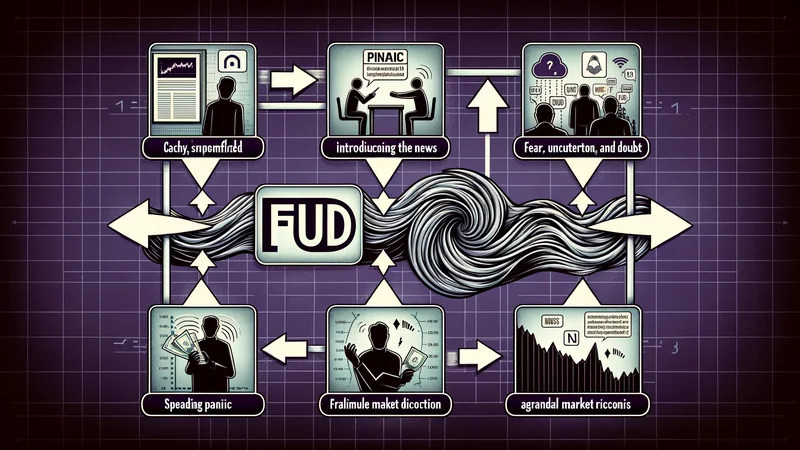
How to evaluate FUD without panicking
The most important skill is not to ignore FUD entirely or to react to every instance. It is to filter. A clean four-step process catches most of what matters.
Step 1: Verify the source
Before reacting, check who is saying what. A direct statement from a major regulator deserves more weight than a viral tweet from an anonymous account. A reputable journalist citing primary sources is different from a screenshot taken out of context. Many "FUD" episodes collapse when the source turns out to be one anonymous account amplified by bots.
Step 2: Distinguish information from interpretation
What is the actual fact, separate from the framing? "X exchange paused withdrawals" is a fact. "X exchange is collapsing" is an interpretation. Both might be true at the same time, or only one. Strip the dramatic framing and ask what is genuinely known.
Step 3: Weigh the second-order impact
Even when news is real, the market sometimes overreacts to first-order shocks. Real events have direct impacts (the hack itself) and indirect impacts (does it change the bull thesis?). Distinguishing the two prevents both panic and complacency.
Step 4: Compare to your plan
The cleanest defense against FUD is having a written plan before the news arrives. If the plan said "I sell when X happens," then act on it. If the news is not X, the right action is usually nothing. Trades made in reaction to headlines almost always feel right at the time and look stupid in hindsight.

Real FUD vs manufactured FUD
| Signal | Likely real concern | Likely manufactured |
|---|---|---|
| Source | Verifiable, named, on-chain or official | Anonymous, vague, screenshot-only |
| Evidence | Multiple independent confirmations | Single source, repeated by clones |
| Reaction pattern | Slow build, sustained drop, broad participation | Sharp spike, fast recovery, narrow participation |
| Project response | Addresses substance, provides data | Attacks messenger, refuses specifics |
| On-chain confirmation | Wallet movements match the narrative | Chain data does not support the claim |
FUD vs FOMO: two sides of the same coin
FUD has a partner: FOMO (Fear Of Missing Out). FUD pushes traders to sell at lows; FOMO pulls them to buy at tops. Both come from emotion overriding plan. Both produce the same kind of regret in hindsight.
The defense against both is the same: pre-write the rules, follow them in heat. Traders who only know how to fight FUD often fall apart during FOMO, because the underlying problem (acting on emotion) was never solved. Strong process discipline handles both.
Why FUD works on smart people
Even disciplined traders sometimes fall for FUD. Three psychological factors are doing most of the work.
- Loss aversion. Losses sting more than equivalent gains feel good. A 20% drop activates more emotion than a 20% rise.
- Information cascades. Watching others sell makes it feel rational to sell too, even if the underlying news is weak.
- Recency bias. The last drawdown feels representative of the future, distorting probability assessments.
- Identity attachment. When a trader's ego is tied to a position, criticism of the position feels like personal attack, which makes evaluation impossible.
- Sleep deprivation and screen time. Late-night reactions to FUD are systematically worse than morning reactions to the same news.
Famous FUD examples in crypto history
History rhymes. Some patterns repeat almost verbatim.
- "Bitcoin is dead" articles. A long-running joke. Major outlets have declared Bitcoin dead hundreds of times. Every cycle adds new entries.
- China bans bitcoin. Variations of this headline have moved markets repeatedly, sometimes correctly, sometimes not.
- Project insolvency rumors. Sometimes accurate (early warning signs of real failures). Sometimes coordinated short campaigns. Hard to tell in real time.
- Regulator commentary. Every cycle includes vague statements that move markets temporarily.
- Founder drama. Personal disputes that escalate online and trigger token sell-offs, often unrelated to the project's actual health.
The point is not that all FUD is wrong. It is that the same patterns repeat, which means they are recognizable, which means they can be filtered.
How traders defend against FUD reactions
- Write your plan before the news. Pre-defined rules survive headlines; mental rules do not.
- Set position sizes that allow you to think. Oversized positions force emotional decisions when prices move.
- Follow primary sources. Build a small list of reputable accounts, on-chain dashboards, and official channels.
- Wait at least one news cycle. Most exaggerated FUD fades within 24 to 72 hours; positions made in the first hour are usually the worst ones.
- Pair narrative checks with on-chain data. Use on-chain analytics to confirm or refute what social media is saying.
Common FUD mistakes
- Dismissing every concern as FUD. Sometimes the bears are right.
- Reacting to FUD without verifying. Selling on the headline often means buying back at the high after the correction.
- Trading off social media sentiment alone. Sentiment is data, not a decision.
- Confusing FUD with technical analysis. A price drop is not "FUD"; it is just a price drop.
- Letting identity attach to a token. Once "I bought X" becomes "I am an X holder," objective evaluation collapses.
Frequently asked questions
What does FUD mean in crypto?
FUD stands for Fear, Uncertainty, and Doubt. In crypto, it refers to negative information (real or manufactured) that pushes the market toward fear-driven selling. The term is overused but describes a real, recurring market dynamic.
Is FUD always wrong or fake?
No. Some FUD is rooted in real risks. Dismissing every concern as FUD is a defense mechanism that protects bad positions. The skill is evaluating each instance on its merits, not labeling it.
How can I tell real FUD from manufactured FUD?
Check the source, verify with primary documents, look at on-chain data, and notice how the project responds. Real FUD tends to come from named sources with evidence and broad participation; manufactured FUD tends to be anonymous, narrow, and recovers fast.
What is the opposite of FUD?
FOMO (Fear of Missing Out) is the typical opposite: the urge to buy because everyone else is. Both are emotion-driven and produce similar mistakes at opposite ends of the cycle.
Does FUD affect Bitcoin and altcoins differently?
Yes. Bitcoin's higher liquidity and more stable holder base usually absorb FUD faster than smaller altcoins, where thinner liquidity and weaker conviction can amplify reactions. The same FUD that produces a 5% Bitcoin dip might produce a 30% altcoin drop.
Final takeaway: FUD is a real market force, not just an excuse to dismiss criticism. The best traders treat each instance as data: verify the source, weigh the impact, and act based on a plan written before the headline. Reflex selling on FUD costs accounts; ignoring all FUD costs them too. The middle path is process, and process is the only durable defense.
Disclaimer: This guide is for educational purposes only and does not constitute investment, financial, legal, or trading advice. Market sentiment can shift rapidly and past patterns of FUD do not guarantee future market behavior.
Related Guides
- What Is XRP Market Cap? Complete 2026 Guide
- What Is HODL in Crypto? Meaning and Strategy 2026
- What Is a CTO in Crypto? Community Takeover Meaning, Risks and What to Check (2026)
Frequently Asked Questions
What does FUD mean in crypto?
FUD stands for fear, uncertainty, and doubt, and it describes negative sentiment or information that can drive panic among traders. It may be based on real concerns or spread deliberately to influence prices.
What are common examples of FUD in crypto?
Common FUD includes exaggerated warnings about a project failing, rumors of regulation, or claims that an asset is about to collapse. These messages often spread quickly on social media during periods of volatility.
How do traders react to FUD?
Some traders panic-sell in response to FUD, which can amplify price drops, while others try to evaluate whether the concerns are factual before acting. Recognizing FUD helps people avoid making decisions driven purely by fear.
How can I think clearly during crypto FUD?
It helps to separate verifiable facts from emotional or unverified claims and to consider the source and intent behind negative information. Sticking to your own research and risk plan reduces the chance of reacting impulsively to panic.