What Is Token Burn in Crypto: Complete Guide to Burn Mechanisms and Deflationary Tokens (2026)
— By Tony Rabbit in Tutorials
What is token burn in crypto? Complete guide: 3 burn types (buyback, fee, scheduled), BNB/ETH/SHIB real burn data, does burning increase price and tracking tools (2026).
If you have spent any time around crypto, you have seen the headlines. "Project X just burned 100 million tokens." "BNB burns $1 billion in Q2." "SHIB community torches 410 billion SHIB." Every project, big or small, eventually announces a token burn, and the marketing teams treat it like a sacred ritual that will inevitably send prices to the moon. But what is actually happening when tokens get burned, and does it really make your bag more valuable?
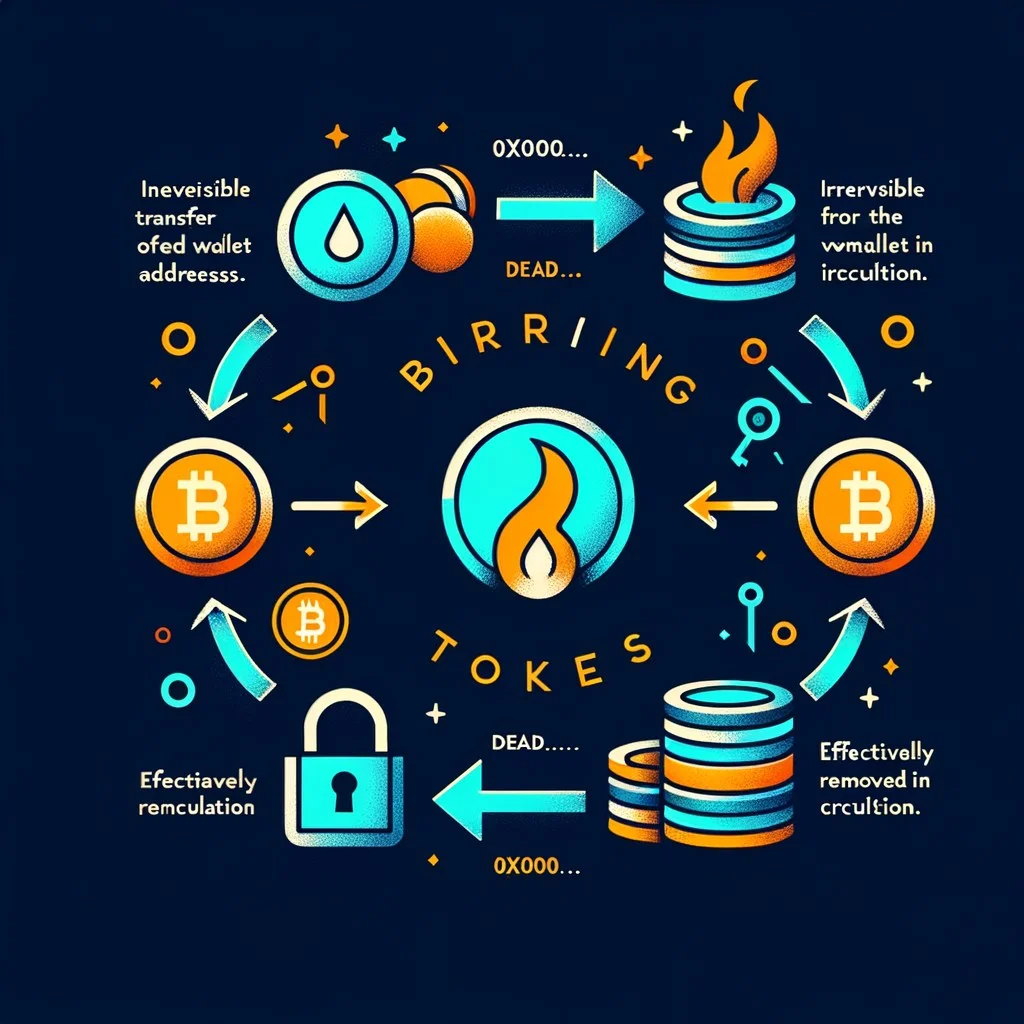
A token burn is the permanent and irreversible removal of cryptocurrency tokens from circulation. The tokens are sent to a special address known as a burn address, typically 0x000...dead, which has no known private key. Once tokens land there, nobody can ever spend them again. They are not deleted in the literal sense, they still exist on the blockchain, but they are functionally destroyed because the address that holds them is mathematically unreachable. This reduces the circulating supply by exactly the amount that was burned.
In this guide, you will learn exactly how token burns work, the three main mechanism types used by major projects, how the famous BNB quarterly burn and Ethereum's EIP-1559 fee burn actually function, the real numbers behind years of burns, and the honest answer to the question every investor asks: does burning tokens actually increase the price? You will also see when burns are legitimate tokenomics features and when they are pure marketing theatre designed to dump on retail.
What Is Token Burn in Crypto?
Token burning is the deliberate act of taking cryptocurrency tokens out of circulation forever by sending them to a wallet address that nobody controls and nobody can ever access. The concept is simple but the implications are surprisingly deep. Unlike fiat money where central banks can destroy bills by physically incinerating them, crypto burns are public, verifiable, and absolute. Every burn transaction is recorded on the blockchain, anybody can audit how many tokens went to the burn address, and there is no way to reverse the action.
The economic theory behind burning is rooted in basic supply and demand. If you reduce the supply of any asset while demand stays constant or grows, the price per unit should increase. This is why projects market burns as bullish events. By cutting max supply or reducing circulating supply, each remaining token theoretically represents a larger share of the network. In practice, the impact on price depends entirely on whether the burn meaningfully changes the supply relative to demand, which is something most marketing teams conveniently ignore.
Burns are different from token locks and vesting schedules. A locked token is still owned by somebody and will eventually unlock and re enter circulation. A vested token will gradually be released to a team or investors over time. A burned token is gone. It cannot be recovered, redistributed, or unlocked. This permanence is what makes burns a genuinely deflationary mechanism when implemented correctly.
The act of burning has become so common that you can find burn functions baked into most modern token standards. Solidity has a burn() function in OpenZeppelin's ERC20Burnable contract. SPL tokens on Solana have a native burn instruction. BEP-20 tokens on BNB Chain inherit the same functionality from ERC-20 patterns. The infrastructure is universal, but how projects choose to use it is what separates legitimate deflationary tokenomics from cheap marketing tricks.
The Burn Address: 0x000...0000dEaD Explained
Every token burn ends at the same destination, a wallet address that nobody controls. On Ethereum and EVM compatible chains, the two most commonly used burn addresses are 0x0000000000000000000000000000000000000000, known as the zero address, and 0x000000000000000000000000000000000000dEaD, often called the dead address. Both serve the same purpose, but the second one has become more popular because it is recognizable and gives token explorers something to label on dashboards.
Why are these addresses unspendable? Ethereum addresses are derived from private keys through cryptographic operations. To spend tokens at any address, you need the matching private key. The dead address was not generated from a private key, it was constructed by simply typing zeros and the word "dead" in hexadecimal. The probability that any private key would randomly produce this address is so astronomically small that for all practical purposes it is zero. To brute force a private key for the dead address would take longer than the heat death of the universe with all the computing power humanity has ever produced.
Some chains and tokens use slightly different burn destinations. Bitcoin scripts can use OP_RETURN outputs that are provably unspendable. Some ERC-20 tokens implement a true burn function that actually decreases the totalSupply variable in the contract storage, which is even cleaner than sending to a burn address because the tokens technically cease to exist rather than just sitting in a frozen wallet. Solana SPL tokens use a similar instruction that directly subtracts from the supply.
This is why audits and burn trackers matter. When a project says "we burned 50% of supply," you need to verify whether they actually called the burn function and reduced totalSupply, or whether they just sent tokens to a burn wallet. Both work in practice, but the latter requires more trust because in theory the token contract could have a backdoor that pulls tokens back. Most reputable tokens use immutable contracts where this is impossible, but the distinction matters when evaluating obscure projects.
The 3 Main Types of Token Burn
Not all burns are created equal. The mechanism a project uses to burn tokens reveals a lot about its tokenomics philosophy. Some projects burn based on protocol revenue, others burn as a function of network usage, and others burn on a fixed schedule regardless of conditions. Each approach has trade offs and produces different supply dynamics over time.
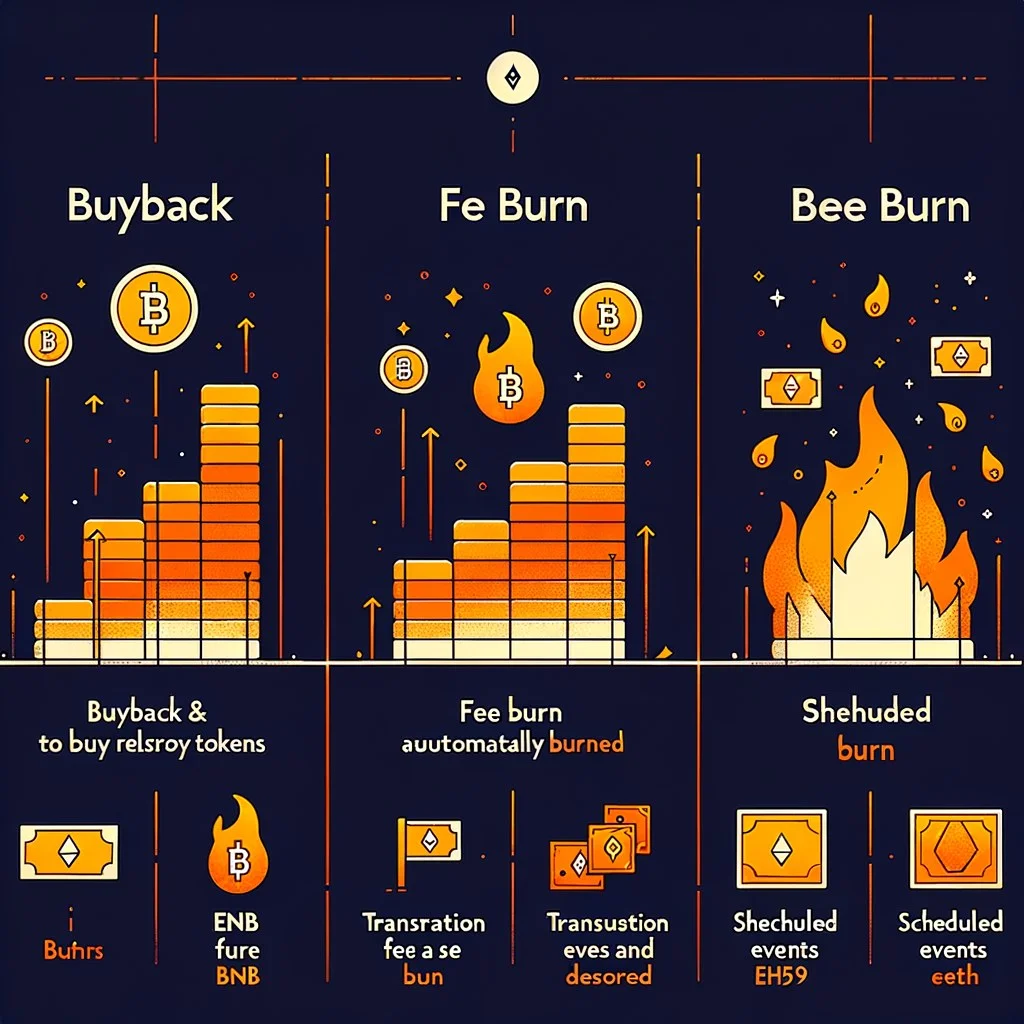
Project uses revenue or treasury funds to buy tokens off the open market, then sends them to the burn address. Creates real buy pressure plus permanent supply reduction.
A portion of every transaction fee is automatically destroyed. Burn rate scales with network usage. The more people use the chain, the faster the burn.
Tokens are burned on a predetermined schedule regardless of revenue or activity. Can be community driven, treasury driven, or smart contract automated.
Beyond these three primary categories there is also the one off manual burn, where founders or treasuries make a discretionary decision to destroy a large chunk of supply at a specific moment. This is usually done at launch to signal commitment or after a token generation event to reduce the initial float. We will cover this separately because the dynamics are different from recurring burns.
Buyback + Burn: The BNB Model
Binance Coin pioneered the modern buyback + burn approach in 2017 and the model remains one of the most copied in crypto. The original concept was that Binance would use 20% of its quarterly exchange profits to buy BNB on the open market and send it to a burn address. The schedule was quarterly, the amount was tied to actual revenue, and the burns were verifiable on chain. Investors loved it because it created two simultaneous tailwinds: persistent buy pressure from the exchange itself plus a steady reduction in supply.
In 2021, Binance updated the mechanism with what they called Auto Burn. Instead of tying burns to exchange profits (which Binance does not publicly disclose), the new formula uses BNB's average market price and the number of BNB blocks produced on BNB Chain in the quarter. The formula is deterministic and publishable, which addresses one of the original criticisms that Binance could fudge the revenue numbers. Auto Burn is designed to continue quarterly until BNB total supply is reduced from the original 200 million down to 100 million, a 50% reduction in max supply.
The mechanic works like this. The token has a hard cap of 200 million BNB. After each quarter, Binance calculates the burn amount based on the formula, then executes a transaction that sends the BNB to the burn address. The burns happen in public, the transactions are visible on BscScan, and analysts can track the cumulative total in real time. Some quarters have burned over 2 million BNB, others have burned less depending on price and block production. The model has become a template for centralized exchanges that issue native tokens. Most major exchange tokens now have some variant of buyback + burn baked into their tokenomics.
The strength of the buyback + burn model is that the burn is funded by genuine economic activity. The project earns revenue, uses that revenue to buy tokens, then destroys them. This is fundamentally different from burning tokens that were never in circulation. Real money is being spent to pull supply off the market. Critics argue that buybacks would create the same buy pressure without the burn step, but the burn adds a credibility signal that the supply will never come back, which matters for long term holders trying to model future tokenomics.
Fee Burn: Ethereum's EIP-1559 Mechanism
Ethereum's EIP-1559 upgrade in August 2021 introduced one of the most elegant burn mechanisms in crypto. Before EIP-1559, Ethereum used a simple auction system where users bid for blockspace and the entire fee went to miners. After the upgrade, every transaction has two components, a base fee that is algorithmically determined by network congestion and automatically destroyed, and an optional priority fee or tip that goes to validators.
The base fee adjusts up or down between blocks based on how full previous blocks were. When demand for blockspace is high, the base fee rises, and more ETH gets burned per transaction. When the chain is quiet, the base fee drops to near zero. The burn rate is therefore a direct function of how much people actually use Ethereum. This is genuinely beautiful tokenomics because it ties supply contraction to network value. If Ethereum is useful enough that people are willing to pay high fees, ETH gets scarcer. If nobody uses it, the burn slows down, but so does the need for ETH.
The combination of EIP-1559 plus Ethereum's transition to proof of stake in September 2022 (the Merge) created the conditions for ETH to become a deflationary asset. Under proof of work, miners were issued large amounts of new ETH per block, which meant net issuance was always positive. Under proof of stake, validator rewards are much smaller. When base fee burns exceed validator issuance, total ETH supply actually decreases. The community calls this "ultrasound money," a play on Bitcoin's "sound money" branding.
Whether ETH is actually deflationary at any given moment depends on activity levels. During periods of intense network usage, the burn vastly exceeds issuance and supply shrinks. During quiet periods, especially after the rollout of layer 2 scaling solutions that moved a lot of transaction volume off mainnet, ETH supply has actually been growing again because there is not enough mainnet activity to offset issuance. This nuance is important. The mechanism is deflationary by design but the actual supply trajectory depends on demand for blockspace.
Scheduled Burn: The SHIB and Memecoin Approach
Shiba Inu and many memecoins use a scheduled or community driven burn model. There is no protocol revenue to fund buybacks, there is no fee burn mechanism baked into the token, but the community organizes regular burns to reduce supply. SHIB launched with a total supply of one quadrillion tokens, which is one followed by 15 zeros, an absurdly large number that is almost impossible to reason about. To make SHIB more scarce, the team and community have built various burn mechanisms over the years.
The most famous SHIB burn was when Vitalik Buterin, who had been gifted half the SHIB supply as a marketing stunt, sent 410 trillion SHIB to the burn address in May 2021. That single transaction burned roughly 41% of total supply in one move. It was simultaneously the largest token burn in dollar terms in history and a perfect illustration of how supply numbers can be manipulated. Vitalik also donated 50 trillion SHIB to an India COVID relief fund, which functionally removed those tokens from immediate circulation though they could theoretically be sold.
Beyond the Vitalik burn, the SHIB community has organized smaller ongoing burns through dApps and marketplaces that contribute a percentage of revenue to burn the token. The cumulative impact of these community burns has been measurable but small relative to the remaining supply. As of 2026, there are still hundreds of trillions of SHIB in circulation, meaning even aggressive burns make a marginal dent in per token value. This is the fundamental trap of memecoins with massive initial supplies. To meaningfully impact price through burns, you would need to destroy a huge fraction of remaining supply, which requires either enormous treasury reserves or coordinated community action over many years.
Other memecoins like BONK, PEPE, and FLOKI have adopted similar scheduled burn approaches, often paired with marketing announcements timed to coincide with positive price action. The mechanic is straightforward but the impact is mostly psychological unless the burn is large enough to meaningfully change supply dynamics. We will discuss the honest economics of this later.
Manual Founder Burn: The One-Time Supply Cut
Sometimes a project decides to burn a chunk of supply as a one off event rather than a recurring mechanism. This is most common in two scenarios. First, after a token launch or ICO, founders may burn unsold tokens to prevent excess supply from hitting the market. Second, in the early days of meme tokens, projects often launch with 50% or more of supply locked in a liquidity pool, then burn the liquidity pool tokens to signal that the developers cannot rug pull by removing liquidity.
Liquidity pool burns are particularly important on decentralized exchanges. When you provide liquidity on Uniswap or PancakeSwap, you receive LP tokens that represent your share of the pool. If you hold those LP tokens, you can remove the liquidity at any time. If you burn the LP tokens, you have permanently locked the liquidity in the pool. This is a credible commitment that the developers cannot pull the rug, because removing liquidity now requires the LP tokens, which no longer exist.
However, LP burns are not the same as token burns. Burning LP tokens locks liquidity but does not reduce the supply of the underlying token. The tokens in the pool are still circulating, they just cannot be withdrawn by the developer. This distinction is important because many sketchy projects market LP burns as if they are supply burns, when really they are just liquidity locks with extra steps. A real token burn reduces totalSupply or sends tokens to the dead address, an LP burn just removes the developer's withdrawal capability from the trading pool.
Founder burns can also be used as marketing. A team that pre mined an absurd amount of supply might burn 90% of it before listing the token, then market "90% of supply was burned" to make the token look scarcer than it is. The remaining 10% might still be enough to crash the price if the team decides to dump, so the headline burn percentage matters less than the absolute supply still in circulation and who owns it.
Real Burn Data: BNB, ETH, and SHIB in Numbers
Marketing is one thing, real numbers are another. Let us look at how the three major burn mechanisms have actually performed over their lifetimes. These figures are what you can verify on blockchain explorers and dedicated tracking dashboards.
- Burned to date: ~64,000,000+
- Target: reduce to 100M
- Frequency: quarterly
- Largest single burn: ~2.1M BNB
- Estimated value: $15B+ at avg
- Post-Merge: net deflation in active periods
- Highest single day: ~30k ETH
- Source: ultrasound.money
- Vitalik burn: 410T (May 2021)
- Community burns: ~5T cumulative
- Remaining supply: ~589T
- % burned: ~41%
The BNB story is particularly instructive. Despite burning over 64 million BNB across years of quarterly burns, BNB price has gone through full bull and bear cycles. The burns clearly contributed to long term scarcity but they did not insulate the token from broader market downturns. This is the most important lesson from real burn data: burns matter on long timeframes but they cannot override macro conditions or token specific demand issues in the short term.
Ethereum's burn is even more interesting because the supply trajectory has flipped multiple times. In the months immediately after the Merge in September 2022, ETH supply actually decreased meaningfully, dropping by tens of thousands of ETH net per month during high activity periods. Then in 2024 and 2025, as layer 2 networks like Arbitrum, Base, and Optimism captured an increasing share of transaction volume, mainnet activity dropped and ETH issuance again exceeded burns. The mechanism is the same, the deflation depends entirely on whether people use the chain.
For SHIB, the 41% figure sounds impressive until you realize the absolute remaining supply is still 589 trillion tokens. Even if community burns continue at their current rate of roughly 100 million SHIB per day, it would take centuries to meaningfully reduce that number. The Vitalik burn was a one off event that cannot be repeated. The ongoing burns are essentially marketing noise relative to the size of the supply still circulating.
Does Burning Tokens Actually Increase Price?
This is the question every investor wants answered, and the honest answer is: it depends entirely on whether the burn is large enough relative to circulating supply to actually shift the supply curve, and whether demand is stable or growing. A burn that destroys 0.01% of supply is essentially a marketing event. A burn that destroys 20% of supply is a real economic event. Most burns fall closer to the first category than the second.
- Demand is stable or growing
- Burn is funded by real revenue, not pre mine
- Mechanism is automatic and verifiable
- Token has utility driving demand
- Burn schedule continues over years
- No real demand driver beyond hype
- Burn announced to pump price for insider exit
- Tokens burned were never in circulation
- Project burns LP, then mints more elsewhere
- Burn is timed to distract from bad news
The math is straightforward. If a token has 1 billion circulating supply and the project burns 1 million, that is 0.1% of supply. Even if demand stays constant, the price impact from pure supply effects would be roughly 0.1%. That is well within daily volatility and gets washed out instantly. For a burn to meaningfully move price through supply mechanics alone, it needs to be on the order of single digit percentages of circulating supply, and that level of burn is rare for established tokens.
There is also a second order effect: announcement risk. When projects announce upcoming burns, traders sometimes front run the news and bid the price up before the burn executes. After the burn happens, the price often drops back to where it was, or lower, because the actual supply impact was less than the speculative buying. This is the classic "buy the rumor, sell the news" pattern, and it applies heavily to scheduled burns where the timing is known in advance.
The cleanest examples of burns affecting price are usually when the burn is combined with genuine demand growth. BNB grew enormously during the 2021 bull run not just because of the burns but because Binance Smart Chain was exploding with DeFi activity. ETH became briefly deflationary not because of EIP-1559 alone but because activity around NFTs and DeFi was driving massive base fees. The lesson is that burns are amplifiers. They make a strong fundamental story stronger, but they cannot save a token with no real demand.
Tools to Track Token Burns
Verifying token burns is one of the most important due diligence steps for any investor. Fortunately, the on chain transparency of crypto makes this easy if you know where to look. Several specialized tools have emerged that aggregate burn data across chains and tokens, saving you from manually parsing blockchain explorers.
The most general purpose tool is the dead address itself. On any EVM chain you can view the balance of 0x000...dead for any token and see exactly how much has been burned over time. Etherscan, BscScan, and similar explorers list the holders for any token, and the burn address usually appears at or near the top of the list for tokens with significant burns. You can click into the transaction history to see when each burn happened and how much was burned.
Watcher Guru runs one of the most popular burn tracking accounts on X (Twitter), reporting major burns across the largest tokens in near real time. They aggregate data from multiple chains and post alerts when significant burn events occur. For SHIB specifically, Shibburn.com tracks community burns and provides historical totals with daily and weekly breakdowns. Ultrasound.money is the canonical source for ETH burn statistics, showing supply changes since the Merge in real time with charts and projections.
For developers and advanced users, you can query burn data directly from blockchain RPC nodes. The total burned for any ERC-20 token is simply the balance held at the burn addresses plus, in tokens that decrement totalSupply, the difference between max supply and current totalSupply. Subgraphs on The Graph protocol expose this data in clean GraphQL queries for many major tokens. If you want to track burns programmatically for your own dashboards or alerts, this is the most reliable approach.
One subtle but important verification step is checking whether the burn was a real supply reduction or just a wallet movement. Some projects send tokens to a "burn wallet" that is actually controlled by an admin key, especially older or low quality projects. For maximum confidence, look for tokens that use a true burn function that decreases totalSupply. You can verify this by reading the contract code on Etherscan and confirming that the burn function calls _burn(from, amount) and updates the supply variable, rather than transferring to a hardcoded address.
Burning vs Locking vs Vesting: The Differences
These three concepts get conflated constantly in crypto marketing but they are fundamentally different mechanisms with different implications for supply. Understanding the difference helps you correctly read tokenomics documents and avoid being misled.
A burn is permanent. Tokens are destroyed forever, totalSupply or circulating supply drops by the burn amount, and the tokens cannot ever re enter the market. This is the most deflationary action a project can take. Once burned, those tokens are gone for good.
A lock is temporary. Tokens are sent to a smart contract that prevents them from being moved for a defined period. After the lock period expires, the tokens become spendable again. Token lockers are commonly used to lock liquidity pool tokens, team allocations, and investor positions. Locked tokens are still part of total supply, they are just temporarily out of circulation. When the lock ends, supply effectively increases again from the market's perspective.
A vest is gradual release. Tokens are released to recipients over time according to a predetermined schedule. Vesting is most commonly used for team allocations, advisor grants, and investor unlocks. Each scheduled token unlock increases circulating supply by the vested amount. Vesting is more flexible than locks because the release can be linear, cliff based, or milestone based.
The key insight is that locks and vests are reversible in the sense that the tokens eventually become circulating. Burns are not. When projects say "we locked X tokens," that does not have the same long term supply impact as "we burned X tokens." Unfortunately, many marketing materials conflate the two, especially in the memecoin space. Always check whether tokens are truly burned or just locked or vested, because the long term tokenomics are completely different.
There is one analogy worth mentioning. Bitcoin halvings are not technically burns but they have a similar deflationary effect by reducing new issuance rather than destroying existing supply. Read our guide on Bitcoin halving for the full picture. Both burns and halvings are mechanisms for creating supply scarcity, but they operate on different sides of the supply equation, destruction versus issuance reduction.
Famous Token Burns in 2026
Token burns continue to be a feature of major projects in 2026. Some have been operating since 2017, others are recent additions to the tokenomics landscape, and a few have created notable price moves when they executed. Here are the most relevant burns to know about right now.
BNB Auto Burn continues quarterly as the longest running burn program among major cryptocurrencies. As of 2026, BNB has burned more than 64 million tokens since 2017 and is moving steadily toward the target of 100 million total supply. Each quarterly burn typically removes between 1 million and 2.5 million BNB depending on the formula inputs. The Q1 2026 burn was the latest in this consistent track record.
Ethereum's ongoing EIP-1559 burn remains the most economically meaningful burn in crypto by dollar value. The exact deflationary or inflationary status of ETH varies week to week based on network activity, but the cumulative burn since 2021 sits well over 4.5 million ETH worth tens of billions of dollars at average prices. The community continues to debate whether layer 2 growth dilutes the burn mechanism, with proposals circulating to capture more value back to mainnet.
SHIB burns continue through community efforts and the Shibarium ecosystem. The launch of Shibarium, the SHIB layer 2 network, added a new burn mechanism where transaction fees contribute to burning SHIB. The pace is modest relative to total supply but it represents an evolution from pure community burns to mechanism based burns. The SHIB community has burned tens of trillions of additional tokens through these channels since 2022.
BONK and PEPE burns have become regular events in the memecoin space. BONK has executed several large burns funded by the Solana ecosystem and community campaigns. PEPE has used community organized burns to reduce its circulating supply, though the absolute amounts remain small relative to the trillions of tokens still in circulation. These burns serve more as community engagement tools than as serious deflationary mechanisms.
Other notable burns include various exchange tokens (KCS, OKB, HT historically) which all run buyback + burn programs similar to BNB, and gaming tokens like GALA and AXS which have implemented usage based burns for in game transactions. The pattern is becoming standard practice for any token that aspires to have utility beyond pure speculation.
Are Burns a Scam Red Flag?
While most burns are legitimate, the burn narrative has also been weaponized by scam projects to manipulate retail investors. There are specific patterns where a burn announcement should make you more cautious, not more confident. Recognizing these patterns can save you from significant losses, especially in the low cap memecoin space where rug pulls are common.
The first red flag is when a project burns supply but the developers retain a massive premine that was never in circulation. The marketing says "90% of supply was burned" but the truth is that 90% was burned and the remaining 10% is still concentrated in a few wallets controlled by the team. The headline percentage is meaningless because the burn was on tokens that were never going to hit the market anyway. This is a common setup for projects that plan to dump on retail once the price pumps from the burn narrative.
The second red flag is timing. Legitimate burns happen on predictable schedules or are tied to predictable mechanisms like fees and revenue. Suspicious burns are announced suddenly, often coinciding with bad news the project wants to distract from. If a project hit a bug, lost partnerships, or had a security incident, and then immediately announces a large burn, the burn is probably a distraction tactic rather than a substantive tokenomics improvement.
The third red flag is mint authority. If the project has the ability to mint new tokens, then burning tokens does nothing for long term scarcity. They can burn 50% today and mint 100% more next month. Always check whether the token contract has been renounced or has hardcoded the maximum supply. On Solana, you can verify whether mint authority is set to None. On Ethereum, you can check whether the contract is upgradeable or has owner only minting functions. Burns without mint protection are theatre.
The fourth red flag is when "burn" is conflated with related but different mechanisms. Some projects market liquidity locks as burns, others count tokens sent to staking contracts as burned even though they are simply restaked. Real burns reduce supply permanently. If you cannot verify supply reduction on chain, treat the claim as marketing rather than fact. For more on this kind of deception, see our guide on rug pulls which covers many of the same patterns.
Finally, some burns are legitimate but their marketing inflates their importance. A project that burns 0.001% of supply quarterly and markets each event as a major milestone is using burns for engagement and brand building rather than as a serious deflationary mechanism. There is nothing inherently wrong with this but you should price the actual supply impact correctly when evaluating the investment thesis.
How to Burn Your Own Token: Developer Perspective
If you are a developer building a token and want to implement burning, the standard approach is to use OpenZeppelin's ERC20Burnable extension. This adds two functions to your token contract, burn(uint256 amount) which lets any holder burn their own tokens, and burnFrom(address account, uint256 amount) which lets approved spenders burn tokens on behalf of others (subject to allowance limits).
The implementation is roughly this. You import ERC20Burnable in your Solidity contract and inherit from it alongside ERC20. The internal _burn(address from, uint256 amount) function handles the actual supply reduction, subtracting the amount from the holder's balance and from totalSupply atomically. This is the cleanest pattern because it actually reduces totalSupply, which is what most burn trackers and supply oracles read when displaying a token's current supply.
The alternative pattern is to simply transfer tokens to a hardcoded burn address like 0x000...dead. This works but it is slightly worse because totalSupply does not change, the burned tokens just sit in an inaccessible wallet. Some tokens use this pattern because their original contract did not include burn functionality and they needed a workaround. If you are starting fresh, prefer the OpenZeppelin extension because it produces cleaner supply numbers and is easier to verify.
For protocol level burn mechanisms (like EIP-1559 style fee burns), the design is more complex. You need to define which events trigger burns, how much gets burned, who has authority to call the burn function, and how to prevent griefing or manipulation. Most modern smart contract platforms have built in patterns for this. Solana's program design lets you call the burn instruction directly within any transaction that handles fees. Cosmos chains can use module level burns at the consensus layer.
If you are implementing a buyback + burn for your project, the typical flow is to accumulate revenue in a treasury wallet, periodically swap that revenue into your token using a DEX, then call the burn function on the resulting tokens. You can automate this with a smart contract that triggers buybacks based on time or accumulated treasury balance. The risk is that automated buybacks can be front run by MEV bots, so many projects use commit reveal patterns or off chain triggers to obscure the buy execution.
Frequently Asked Questions
Does token burning increase price?
Sometimes, but not automatically. The price impact of a burn depends on how large the burn is relative to circulating supply and whether demand is stable or growing. Small burns (under 1% of supply) typically have negligible price impact. Large burns combined with growing demand can meaningfully shift supply demand dynamics. Burns alone, without demand, do not drive sustained price increases.
Where do burned tokens go?
Burned tokens are sent to a special address known as a burn address, typically 0x000...dead or 0x000...0000 on EVM chains. These addresses have no associated private key, meaning nobody can ever spend the tokens that arrive there. Alternatively, some tokens use a burn function that directly reduces the totalSupply variable in the smart contract, so the tokens functionally cease to exist.
Can burned tokens be recovered?
No. Burned tokens are mathematically unrecoverable. The burn addresses used in crypto have no private keys, and the cryptographic security of the underlying blockchain ensures that nobody can spend tokens at an address they do not control. For tokens that burn by decreasing totalSupply, the tokens literally no longer exist in any wallet. Burns are permanent and irreversible by design.
Is Ethereum deflationary?
Sometimes, depending on network activity. Ethereum's EIP-1559 mechanism burns the base fee from every transaction. When transaction volume is high, the burn rate exceeds new ETH issuance to validators, and total ETH supply decreases. When activity is low, particularly when transaction volume shifts to layer 2 networks, issuance can exceed burns and ETH supply grows. Over the long run since the Merge in 2022, ETH has alternated between deflationary and mildly inflationary periods.
How much BNB has been burned?
As of 2026, more than 64 million BNB have been burned since the program began in 2017. The original total supply was 200 million BNB, and the Auto Burn program is designed to reduce supply to 100 million over time. Each quarterly burn typically removes between 1 million and 2.5 million BNB depending on the formula that accounts for BNB price and block production on BNB Chain.
What is the difference between burning and locking?
Burning permanently destroys tokens by sending them to an unrecoverable address or reducing totalSupply. Locking temporarily prevents tokens from being spent by storing them in a smart contract for a defined period. After the lock expires, the tokens re enter circulation. Burns are deflationary and irreversible. Locks are reversible and only temporarily reduce circulating supply. They are completely different mechanisms despite sometimes being marketed similarly.
Are token burns the same as Bitcoin halvings?
No, but they have a similar deflationary effect. Bitcoin halvings reduce the rate at which new BTC is created, cutting issuance in half every four years. Token burns destroy tokens that already exist. Both mechanisms reduce supply over time, but halvings work by slowing future creation while burns work by destroying current supply. The economic effect on scarcity is comparable but the technical implementation is completely different.
Conclusion: Understanding the True Value of Burns
Token burns are one of the most marketed and least understood mechanisms in crypto. The headline numbers projects throw around (90% burned, billions destroyed, deflationary forever) sound dramatic but they often mask the underlying economics. A burn is meaningful only if it reduces circulating supply in a way that matters relative to demand, if the mechanism is verifiable and durable, and if the project has genuine utility that creates ongoing demand for the token.
The three primary burn types we covered (buyback + burn, fee burn, scheduled burn) each have legitimate use cases when implemented well. BNB's quarterly burns have created a credible supply reduction story over nearly a decade. Ethereum's EIP-1559 has produced the most economically meaningful burn in crypto history, even if its deflationary status fluctuates with network activity. SHIB's community burns demonstrate how scheduled burns can build engagement even when their absolute impact is small. Each model fits different project contexts.
The most important takeaway is to evaluate burns with the same skepticism you bring to any tokenomics claim. Verify the burn on chain. Calculate the burn percentage relative to circulating supply. Check whether the mechanism is automatic or discretionary. Look for mint protections that prevent the project from offsetting burns with new issuance. Understand whether the burn is funded by real revenue or just destroys tokens that were never going to circulate anyway. These checks separate substantive deflationary tokenomics from marketing optics.
Finally, remember that burns are one variable in a much larger tokenomics equation. A project with a beautiful burn mechanism but weak demand, poor product market fit, or a bloated initial supply will not be saved by burns alone. Conversely, a project with strong fundamentals does not need aggressive burns to succeed. Treat burns as evidence about how a team thinks about long term token economics rather than as a magic price catalyst. The projects that win over years tend to have thoughtful, sustainable burn mechanisms paired with genuine utility, not just headline burn announcements timed to retail FOMO. Compare burn mechanisms to other deflationary primitives like stablecoin redemption mechanisms for a fuller picture of how supply control works across the crypto ecosystem.
Frequently Asked Questions
What is a token burn in crypto?
A token burn is the permanent removal of cryptocurrency tokens from circulation. This is typically achieved by sending them to an unspendable address, often called a 'burner' or 'black hole' address.
Why do projects burn tokens?
Projects burn tokens for various reasons, including reducing supply to potentially increase scarcity, stabilizing price, or distributing value to remaining token holders. It can also be part of a deflationary economic model.
How does a token burn work technically?
Technically, a token burn involves a transaction that sends tokens to a public address for which no private key exists. This makes the tokens irretrievable and effectively removes them from the total circulating supply.
What are the different types of token burn mechanisms?
Token burn mechanisms can be manual, where a project team decides when and how many tokens to burn, or algorithmic, where burns are triggered automatically by predefined conditions or smart contract rules.
What is the impact of token burns on token value?
By reducing the total supply of tokens, a burn can, in theory, increase the scarcity of the remaining tokens. This reduction in supply, if demand remains constant or increases, could potentially influence the token's market value.