How to Read Token Unlocks Before Buying in 2026
— By Tony Rabbit in Tutorials
Learn how to read token unlocks before buying in 2026 by checking circulating supply, next unlock dates, cliff vs linear schedules, recipient allocations, and how future supply compares with real liquidity.
Token unlocks matter because they tell you how much new supply can reach the market after your entry. A token can look strong today and still face a heavy unlock schedule tomorrow. If you ignore that supply path, you may be judging price action without judging the pressure that could hit it next.
This is one reason traders get trapped by clean charts and exciting narratives. They check price, volume, and maybe even liquidity, but skip the tokenomics calendar entirely. That is risky. Unlocks are not a guarantee of a dump, but they are a clear input into future sell pressure, and that makes them worth reading before you buy.
Quick answer
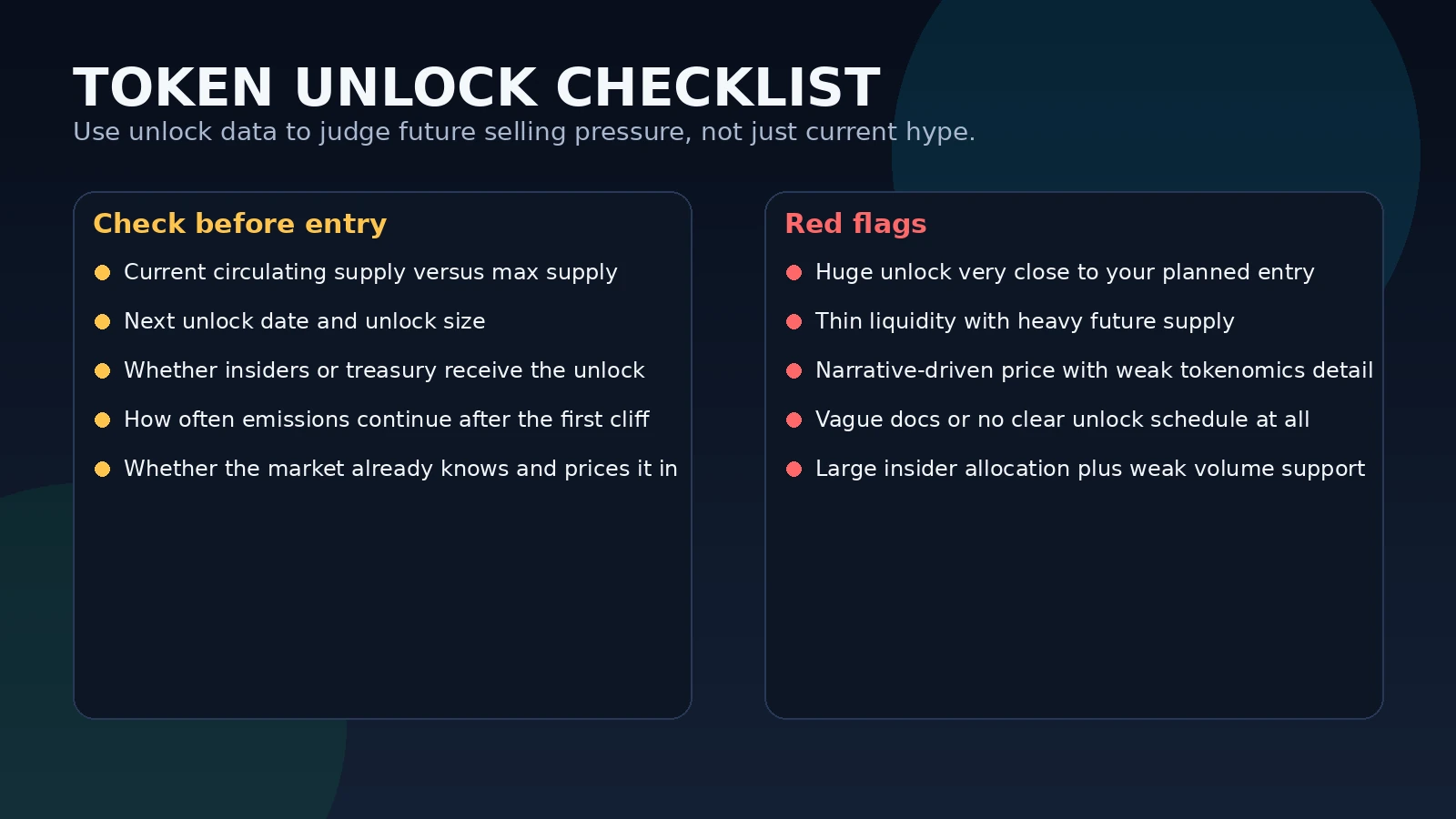
- Check circulating supply versus max supply.
- Find the next unlock date and how large it is.
- Ask who receives the unlocked tokens.
- Compare upcoming supply with liquidity and volume before you size the trade.
- What a token unlock actually tells you
- Cliff unlock vs linear unlock
- Start with circulating supply vs max supply
- Find the next unlock and its size
- Ask who gets the tokens
- Compare unlocks with liquidity and volume
- Where to track token unlock schedules
- Common unlock red flags
- A simple token unlock workflow before buying
- Frequently asked questions
What a Token Unlock Actually Tells You
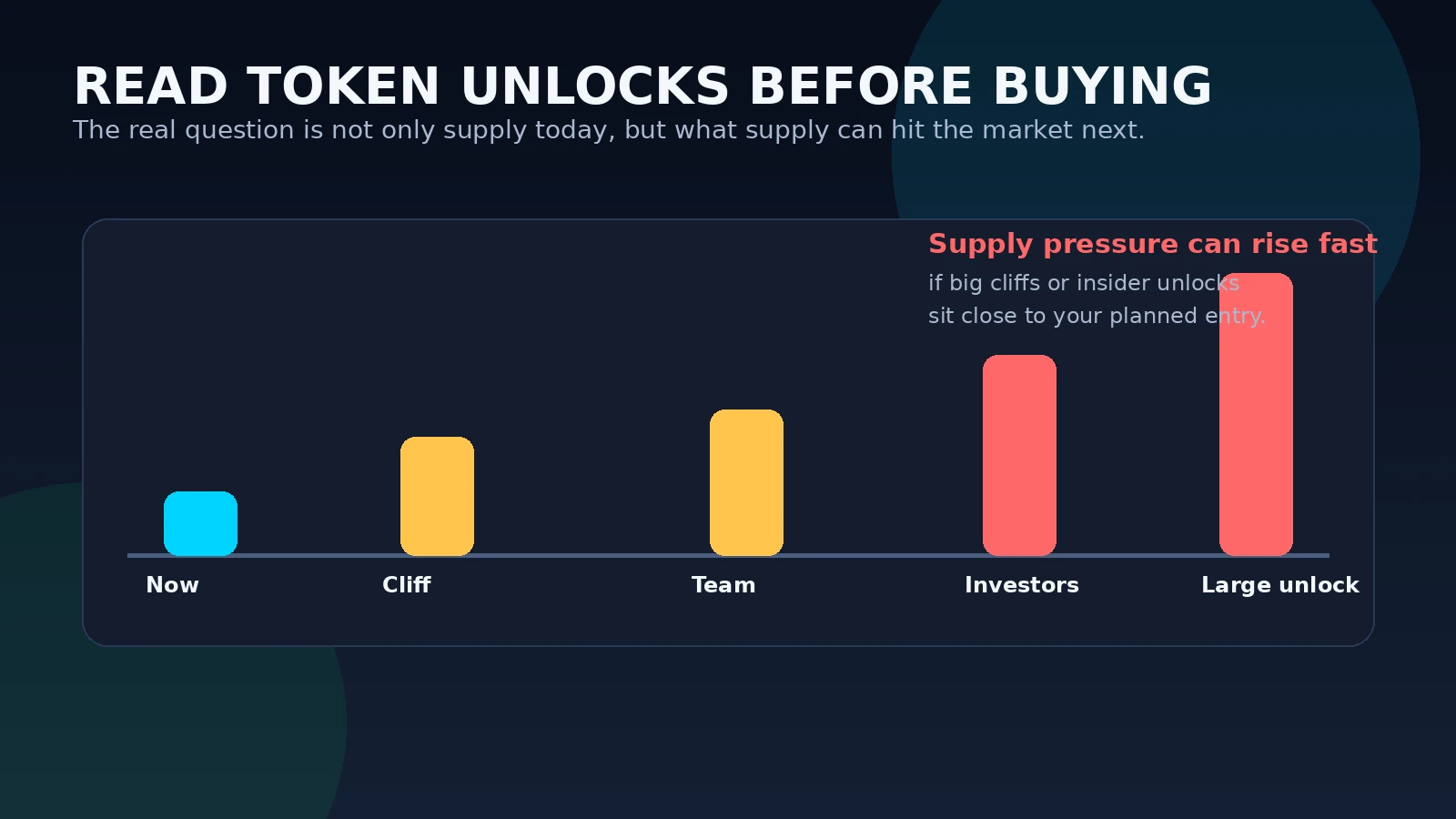
An unlock schedule shows when previously restricted tokens can become available. Those tokens may go to team members, investors, treasury wallets, ecosystem incentives, or other allocations. The exact impact depends on who receives them, how large the unlock is, and what the market structure looks like at the time.
This is why unlocks should not be reduced to one shallow conclusion like, "Unlock equals crash." Sometimes the market absorbs them well. Sometimes the event is already priced in. Sometimes recipients do not sell immediately. But ignoring unlocks completely is still a bad habit, because they change the supply picture whether the chart looks calm or not.
Cliff unlock vs linear unlock
One of the simplest ways to improve unlock analysis is to ask how the new supply reaches the market. Not every schedule behaves the same way. A large one-time release can shock a chart very differently from a smooth monthly stream.
Practical read
1. Start With Circulating Supply vs Max Supply
A simple first question is this: how much of the token is already circulating, and how much still sits outside the market? If only a small portion of total supply is circulating, future unlocks matter more because the market still has a lot of supply left to digest.
This is also where unlock analysis connects naturally to valuation analysis. If the token is already trading on a rich narrative while a large portion of supply has not yet reached the market, then future unlocks deserve extra attention. The current chart is only one snapshot. The supply curve is the longer story.
2. Find the Next Unlock and Its Size
The most useful unlock question is not abstract. It is concrete: what is the next meaningful unlock event, and how large is it relative to current circulating supply? A tiny scheduled release is one thing. A large cliff release near your planned entry is another.
When traders say they want to read unlocks before buying, this is the practical core of the task. You are not reading tokenomics for entertainment. You are asking whether fresh supply could change the risk profile of your trade in the near term.
Questions that matter most
3. Ask Who Gets the Tokens
Not all unlocks are equal because not all recipients behave the same way. If an unlock is tied to early investors, team wallets, or concentrated insiders, the market may worry more about near-term selling. If the unlock is tied to ecosystem incentives or structured emissions, the pressure may be more gradual. The point is not to guess motives perfectly. It is to understand where the supply is going.
This is one reason broad tokenomics language is not enough. "Ecosystem allocation" or "community growth" can sound harmless until you inspect the actual schedule and how concentrated the supply still is.
4. Compare Unlocks With Liquidity and Volume
An unlock schedule means more when you compare it with actual market structure. A market with strong liquidity and durable two-way volume can absorb future supply better than a thin market living on hype. If liquidity is weak and the next unlock is meaningful, the risk profile changes fast.
This is why unlock analysis should not happen in isolation. It works best when you combine tokenomics with liquidity depth, volume quality, and valuation context. A token can be exciting and still be structurally fragile.
Where to track token unlock schedules
Good unlock research is not just about reading one article. It is about checking the actual schedule on reliable sources, then cross-checking whether the project team and the data platforms tell the same story.
- Open the unlock calendar.
- Check current circulating supply and the next event size.
- Confirm recipients and vesting details in official docs.
- Then compare that supply path with real liquidity and volume.
Common Unlock Red Flags
A Simple Token Unlock Workflow Before Buying
- Check current circulating supply and max supply.
- Look up the next unlock date and unlock size.
- Identify who receives the unlocked tokens.
- Compare the future supply with current liquidity and volume.
- If the supply path feels heavy, either reduce size or skip the trade.
Frequently Asked Questions
Why should I read token unlocks before buying?
Because unlocks affect future supply. A token can look strong now and still face meaningful sell pressure if a large unlock is near.
Does every token unlock lead to a price drop?
No. Some unlocks are already priced in or absorbed well. The point is not certainty. The point is understanding supply risk before you trade.
What matters more, unlock size or unlock date?
Both matter, but they only become useful when you compare them with circulating supply, liquidity, and volume.
Why does recipient type matter in token unlocks?
Because team, investor, treasury, and incentive allocations can create different market behavior after tokens become available.
What is the biggest unlock mistake beginners make?
They focus on current price action and ignore future supply. That can make a strong-looking chart much riskier than it seems.
Related reading
Disclaimer: This article is for educational purposes only and does not constitute investment, tax, legal, or financial advice. Token unlock schedules can change, and market impact depends on liquidity, sentiment, and recipient behavior.
Related Guides
- How to Read Liquidity Pool Data Before Buying a Token (2026)
- How to Verify Token Safety Before Buying: A Pre-Buy Crypto Checklist
- How to Check Liquidity Lock Before Buying a Token: Unlock Risk and Locker Verification (2026)
- How to Check if a Token Can Be Sold (2026)
- How to Check Buy and Sell Tax Before Buying a Token (2026)