Spotting Artificial Crypto Holder Growth
— By Whatsertrade in Tutorials
Understand crypto holder growth by distinguishing between organic participation and manipulated wallet activity.
A growing holder count can look bullish. More holders may suggest more demand, wider distribution and stronger community interest. But holder growth is not always what it seems.
Key Takeaways
- Why Holder Growth Matters
- What Organic Holder Growth Looks Like
- What Fabricated Holder Growth Looks Like
- The Problem With Dust Wallets
- Holder Growth vs Holder Conviction
- Compare Holders With Liquidity and Volume
In DeFi markets, wallet activity can be fragmented, automated or intentionally designed to create the appearance of adoption. This means traders should not ask only how many holders a token has. They should ask what kind of holders they are.
Why Holder Growth Matters
Holder growth can be a useful sign when it reflects real participation. A token that attracts new buyers over time may be building awareness and community depth. If holders continue to grow during normal pullbacks, that can suggest durable interest.
However, holder count alone is an incomplete metric. A token with many low value wallets is not automatically healthier than a token with fewer but more committed holders.
Quality matters more than quantity.
What Organic Holder Growth Looks Like
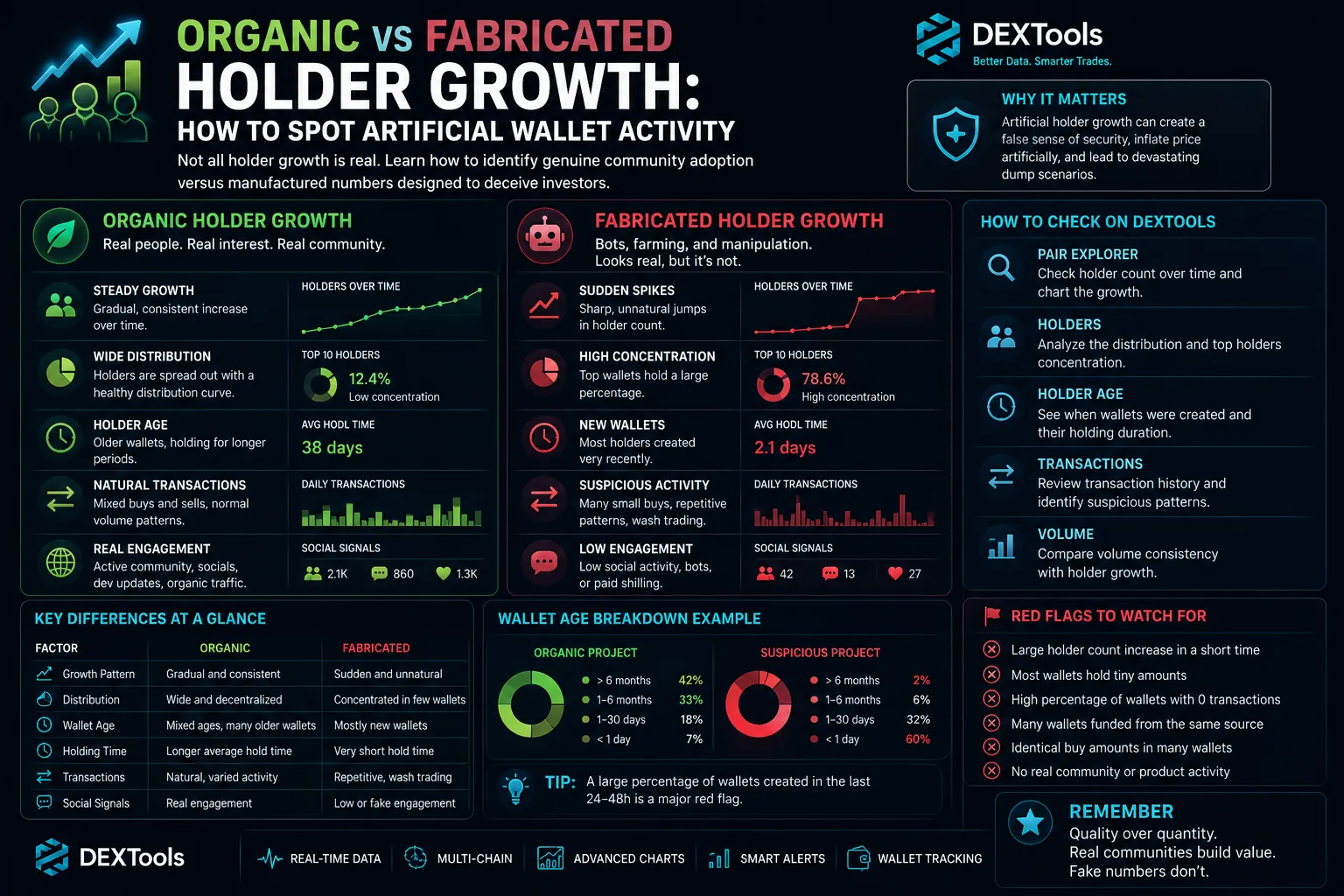
Organic holder growth usually develops in a steady and believable way. It is often connected to market activity, community growth or a clear catalyst.
Signs of organic growth can include:
- New holders appearing alongside real trading volume
- Buyers entering at different price levels
- Holder count remaining stable after volatility
- A balanced mix of small, medium and larger wallets
- Repeat buying from existing participants
- Growth that matches social and market activity
Organic growth is rarely perfectly smooth. But it usually makes sense when compared with the rest of the market data.
What Fabricated Holder Growth Looks Like
Fabricated holder growth is designed to make a token appear more widely adopted than it really is. This can happen through dust wallets, wallet splitting or coordinated micro purchases.
Warning signs can include:
- Sudden spikes in holders with little meaningful volume
- Many wallets holding tiny amounts
- Similar transaction sizes across many new wallets
- Holder count rising while liquidity remains weak
- New wallets appearing without price support
- Distribution that looks wide but has little economic value
A large number of holders does not help much if most of them cannot influence real demand.
The Problem With Dust Wallets
Dust wallets are wallets that hold very small amounts of a token. Some dust is normal, especially in active markets. But excessive dust can distort the perception of distribution.
If a token has thousands of holders but most hold insignificant amounts, the holder count may exaggerate real adoption. Traders should look beyond the headline number and consider whether holders have meaningful exposure.
Holder Growth vs Holder Conviction
Growth shows how many wallets are joining. Conviction shows whether they stay.
A token may gain many holders during a hype cycle, but if they become inactive or sell quickly, the growth may not support long term strength. Stronger holder behavior includes retention, repeat buying and resilience during pullbacks.
A useful question is: are holders accumulating, holding or simply passing the token to the next wave of buyers?
Compare Holders With Liquidity and Volume
Holder growth should be compared with other market signals. If holders rise while volume and liquidity also improve, the growth may be more credible.
If holders rise while liquidity stays thin and price action weakens, the growth may be less meaningful. If holder count increases rapidly but volume looks artificial or repetitive, caution is needed.
No single metric should make the decision. The pattern matters.
How Traders Can Use Holder Analysis
Holder analysis can help traders avoid low quality setups. Before entering a token, check whether holder growth looks natural and whether distribution supports the market thesis.
During a trade, monitor whether new holders continue to enter after the first hype wave. A token that keeps attracting real participants may have stronger staying power than one that only gains wallets during a short pump.
Final Thoughts
Holder growth can be a powerful signal, but only when it reflects real demand. Artificial wallet activity can make a token look healthier than it is.
Traders should focus on holder quality, retention, distribution and the relationship between holders, liquidity and volume. A rising holder count is a starting point, not a conclusion.
Real adoption is not measured only by how many wallets appear. It is measured by whether meaningful participants stay.
How to Bridge Crypto Between Chains: Complete Cross-Chain Tutorial 2026 How to Use 1inch: Complete DEX Aggregator Swap Tutorial (2026) How to Use OKX Web3 Wallet: Multi-Chain DeFi Hub Guide (2026) How to Bridge Crypto Between Chains: Complete Cross-Chain Tutorial 2026 How to Use 1inch: Complete DEX Aggregator Swap Tutorial (2026) How to Use OKX Web3 Wallet: Multi-Chain DeFi Hub Guide (2026)Frequently Asked Questions
Q
What is artificial crypto holder growth?
Q
Why do projects create artificial holder growth?
Q
How can one identify artificial holder growth?
Q
What are the implications of artificial holder growth for investors?
Q
Are there tools to detect artificial holder growth?
Related Guides
- Tourist vs Native Capital: Spotting Crypto Growth
- Fake Volume vs Real Demand: How to Spot Artificial Momentum in DeFi Trading
- What Is a Top Holder in Crypto? Concentration, Supply Risk, and Red Flags
- Token Transfer Velocity vs Holder Retention: What Shows Real Conviction?
- Holder Count vs Holder Quality: Key Factors in Token Analysis