Holder Count vs Holder Quality in Token Analysis
— By Whatsertrade in Tutorials

Holder count vs holder quality explained: learn why distribution, whale behavior, and retention can matter more than raw numbers in token analysis.
Many traders look at holder count before buying a token. A rising number of holders can make a project look popular, active, and early. But holder count alone can be misleading.
A token can have thousands of holders and still be weak. Some holders may own tiny amounts. Some may be airdrop wallets. Some may be bots. Some may be inactive. Some may be waiting to sell. What matters is not only how many holders a token has, but what kind of holders they are.
This is where holder quality becomes important. Holder quality looks at distribution, wallet behavior, retention, whale activity, and whether buyers show real conviction.
This guide explains holder count vs holder quality, why the difference matters, and how to use DEXTools and on-chain data to analyze token holders before buying.
What Is Holder Count?
Holder count is the number of wallets that hold a token. It is often used as a simple popularity signal.
A growing holder count may suggest that more wallets are buying or receiving the token. This can be a positive sign, especially if growth is organic and supported by volume, liquidity, and social activity.
However, holder count is only a surface level metric. It does not tell you how much each wallet holds, whether those wallets are real users, or whether they are likely to sell.
What Is Holder Quality?
Holder quality refers to the strength and behavior of the wallets holding a token.
High quality holders may include wallets that buy with conviction, hold through volatility, add during pullbacks, avoid dumping into every pump, and help create healthier distribution.
Low quality holders may include bots, airdrop farmers, dust wallets, short term speculators, insider wallets, or whales waiting for exit liquidity.
Holder quality is harder to measure than holder count, but it gives a much better view of token strength.
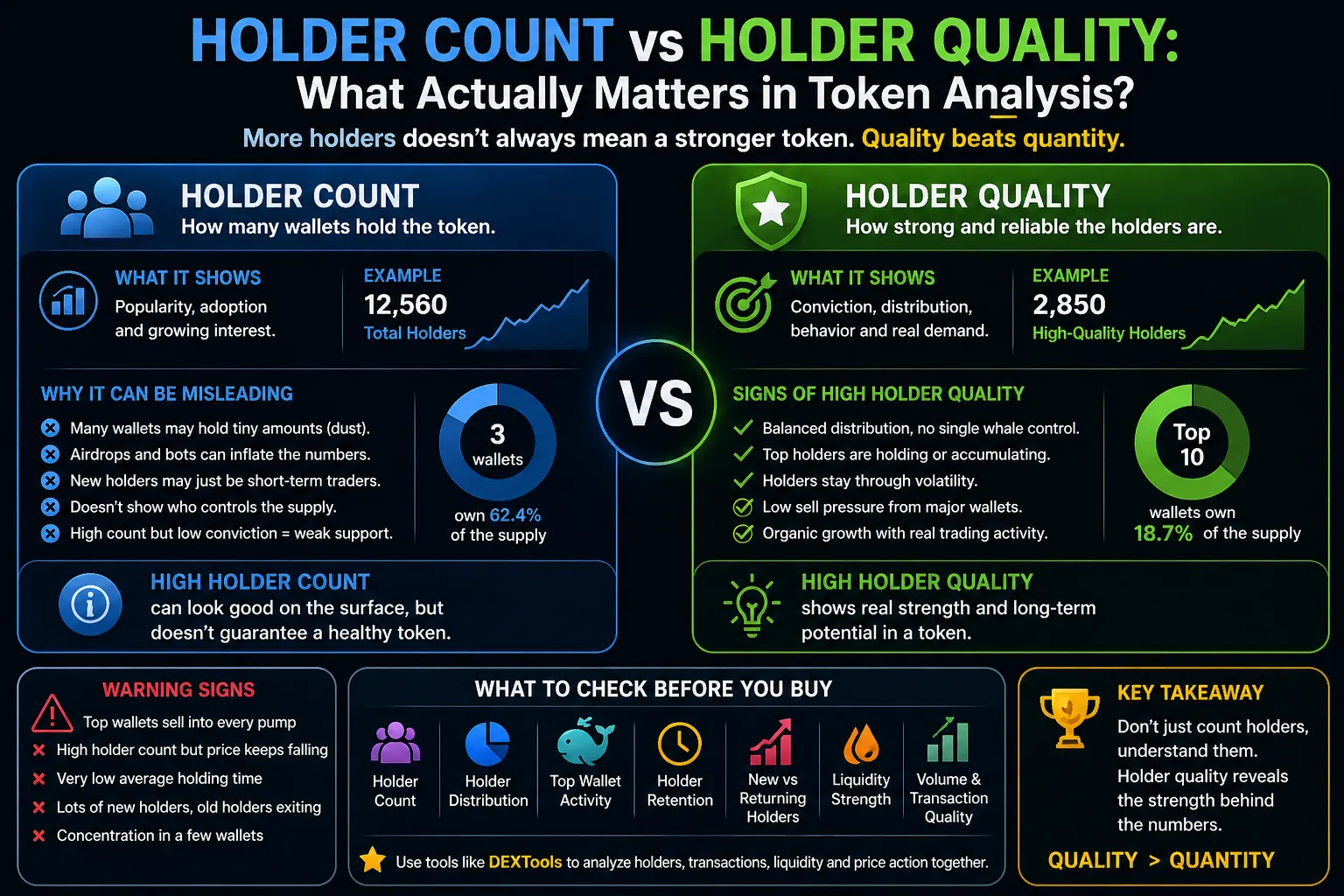
Why Holder Count Can Be Misleading
Holder count can be manipulated or misunderstood.
A project may show a large number of holders because tokens were airdropped to many wallets. Some wallets may hold only tiny amounts. Bots may create many addresses. Marketing campaigns may encourage small buys only to increase the holder number.
A high holder count does not always mean strong demand.
Holder count can mislead when:
- Many wallets hold dust amounts
- Airdrops inflate the number
- Bots create fake distribution
- Most supply is controlled by a few whales
- Holders are inactive
- New holders enter while old holders exit
- Wallets split holdings across multiple addresses
This is why traders should look deeper.
Why Holder Quality Matters More
Holder quality matters because price is affected by behavior, not just numbers.
A token with fewer holders but strong retention can be healthier than a token with many weak holders who sell quickly. A project with balanced distribution and steady accumulation may be stronger than one with a large holder count but heavy whale control.
Holder quality helps you understand:
- Who controls supply
- Whether whales are accumulating or selling
- Whether holders are staying
- Whether new demand is real
- Whether distribution is improving
- Whether early buyers are exiting
- Whether the token is becoming more decentralized
Good holder quality supports healthier market structure.
Check Holder Distribution
Holder distribution shows how supply is spread across wallets.
A token where the top wallets control too much supply can be risky. If one or two large wallets sell, the price may drop sharply. If supply is more evenly distributed, the token may be less vulnerable to a single wallet’s behavior.
Look for:
- Percentage held by top wallets
- Exchange or liquidity pool wallets
- Team or treasury wallets
- Burn address
- Contract wallets
- Whale concentration
- Changes in top holder balances
Not all large wallets are bad. Some may be liquidity pools, centralized exchanges, treasury wallets, or burn addresses. The key is to identify what they are and how they behave.
Watch Whale Behavior
Whales can strongly influence price, especially in low liquidity tokens.
A whale that holds through volatility may support confidence. A whale that sells into every rally can limit upside. A whale that transfers tokens to fresh wallets may be preparing to sell or distribute risk.
Watch for:
- Large buys
- Large sells
- Wallets reducing position over time
- Transfers to exchange wallets
- Splitting tokens across wallets
- Repeated selling into pumps
- Whale accumulation during pullbacks
Holder count may rise while whales quietly exit. That is a major warning sign.
Analyze Holder Retention
Holder retention means whether wallets continue holding after buying.
If many new wallets buy and then quickly sell, the token may have weak conviction. If holders stay through normal volatility, the token may have stronger support.
Good retention may show:
- Holders staying after pullbacks
- Fewer panic sells
- Wallets adding over time
- Distribution improving gradually
- New holders joining without old holders leaving aggressively
Poor retention may show:
- Fast wallet turnover
- Many short term holders
- Old holders selling into new buyers
- Holder count rising but price weakening
- Large exits after social hype
Holder retention is one of the clearest signs of real demand.
New Holders vs Returning Holders
New holders can show growing awareness, but returning holders can show renewed conviction.
A token that attracts new buyers is positive, but if previous buyers never return, demand may be shallow. When wallets buy again after earlier entries, it may show stronger belief in the token.
Compare:
- Are new wallets buying only during pumps?
- Are existing holders adding during pullbacks?
- Are old holders selling into new demand?
- Are returning buyers increasing position size?
- Does holder growth match price structure?
Strong tokens often show both new adoption and existing holder conviction.
Holder Count and Liquidity Must Be Read Together
Holder analysis should always be compared with liquidity.
A token with many holders and low liquidity may still be hard to trade. If holders start selling at the same time, the pool may not support exits.
Ask:
- Is liquidity deep enough for the holder base?
- Are there many holders but little trading activity?
- Can whales sell without crashing price?
- Is volume supported by liquidity?
- Are holders growing while liquidity is shrinking?
Holder count without liquidity can create false confidence.
Holder Count and Volume Must Be Read Together
Volume helps confirm whether holder growth reflects real demand.
If holder count rises but volume is tiny, the growth may come from dust transfers, airdrops, or very small buys. If volume rises with holder count and liquidity remains healthy, the signal is stronger.
Watch for:
- Holder growth with real buy volume
- Transaction diversity
- Organic trade sizes
- Balanced buys and sells
- Holder growth after major announcements
- Holder growth during consolidation, not only pumps
The best holder growth is supported by real market activity.
How to Use DEXTools in Holder Analysis
DEXTools can help traders review token activity and market behavior around holder growth.
Use it to check:
- Holder count trends
- Transaction flow
- Buy and sell pressure
- Volume
- Liquidity
- Pair activity
- Price structure
- Whale related market impact
- Contract and pair details
Holder analysis becomes stronger when combined with liquidity, volume, and price action.
Signs of Strong Holder Quality
Strong holder quality may include:
- Balanced distribution
- Top wallets not selling aggressively
- Holders adding during pullbacks
- New holders entering steadily
- Liquidity growing with holder count
- Volume supporting adoption
- No extreme whale concentration
- Fewer panic sells during normal volatility
- Real users discussing the token, not only bots
This does not guarantee success, but it improves the quality of the setup.
Signs of Weak Holder Quality
Weak holder quality may include:
- Top wallets controlling too much supply
- Large wallets selling into every pump
- Holder count rising while price falls
- Many dust wallets
- Airdrop inflated holder numbers
- Fast wallet turnover
- Bots creating fake distribution
- Liquidity too low for holder count
- New buyers replacing early sellers
These signs suggest that holder count may be hiding risk.
Practical Checklist Before Buying
Before buying a token, ask:
- How many holders does the token have?
- Are holders growing organically?
- How concentrated is the supply?
- What are top wallets doing?
- Are whales accumulating or selling?
- Are holders staying or rotating quickly?
- Is holder growth supported by volume?
- Is liquidity deep enough?
- Are new holders entering while old holders exit?
- Does holder behavior match the chart?
Which Matters More?
Holder count is useful, but holder quality matters more.
Holder count tells you how many wallets hold the token. Holder quality tells you whether those wallets create strength or risk.
A token with many weak holders can collapse quickly. A token with fewer but stronger holders may build more sustainable momentum.
The best analysis uses both metrics together.
Final Thoughts
Holder count is one of the easiest metrics to check, but it is also one of the easiest to misunderstand. A rising holder number can look bullish, but it does not always mean real conviction.
Before buying, look beyond the number. Study holder quality, distribution, whale behavior, retention, liquidity, volume, and transaction flow.
Use DEXTools to connect holder data with real market activity. In token analysis, the question is not only “how many holders are there?” The better question is “what kind of holders are they?”
FAQ
Is a high holder count always bullish?
No. A high holder count can be positive, but it can also be inflated by airdrops, bots, dust wallets, or weak holders.
What is holder quality in crypto?
Holder quality refers to the behavior and strength of token holders, including distribution, whale activity, retention, and whether holders show real conviction.
Why can holder count be misleading?
Holder count does not show how much each wallet holds, whether holders are active, or whether large wallets are preparing to sell.
How do whales affect holder quality?
Whales can support or damage a token depending on whether they hold, accumulate, distribute, or sell aggressively into demand.
How can DEXTools help analyze holders?
DEXTools can help you review holder trends, transactions, liquidity, volume, pair activity, and market behavior before trading.
How to Bridge Crypto Between Chains: Complete Cross-Chain Tutorial 2026 How to Use 1inch: Complete DEX Aggregator Swap Tutorial (2026) How to Use OKX Web3 Wallet: Multi-Chain DeFi Hub Guide (2026)Related Guides
- Holder Churn Rate: Why Growing Holder Count Can Still Be Bearish
- Bitcoin Price Prediction 2026: Expert Analysis, Scenarios and Key Levels
- How to Evaluate Yield Farms in Crypto: APY Quality, Risks and Red Flags (2026)
- Yield Farming Strategies, APY Quality and Risk Management (2026)
- What Is a Top Holder in Crypto? Concentration, Supply Risk, and Red Flags
Frequently Asked Questions
What is the difference between holder count and holder quality?
Holder count is simply the number of wallets that own a token, while holder quality looks at how supply is distributed and how those holders behave. A high count means little if a few wallets control most of the supply or holders sell quickly.
Why can a high holder count be misleading?
Holder counts can be inflated by airdrops, dust amounts, or wallets created to fake decentralization, so the raw number can overstate real interest. Distribution and retention often tell you more about a token's health than the headline count.
How does whale concentration affect a token?
When a small number of large wallets hold a big share of supply, they can move the price sharply or exit all at once, increasing risk for other holders. Checking concentration helps you understand how vulnerable a token is to coordinated selling.
What does holder retention tell you?
Retention measures whether holders keep their tokens over time instead of dumping quickly, which signals more genuine conviction. Strong retention alongside broad distribution is generally a healthier picture than a large but fleeting holder base.