Token Transfer Velocity vs Holder Retention: What Shows Real Conviction?
— By Whatsertrade in Tutorials

Crypto traders often analyze holder count, transfers and wallet activity to understand token demand. A token that moves frequently may look active. A token with
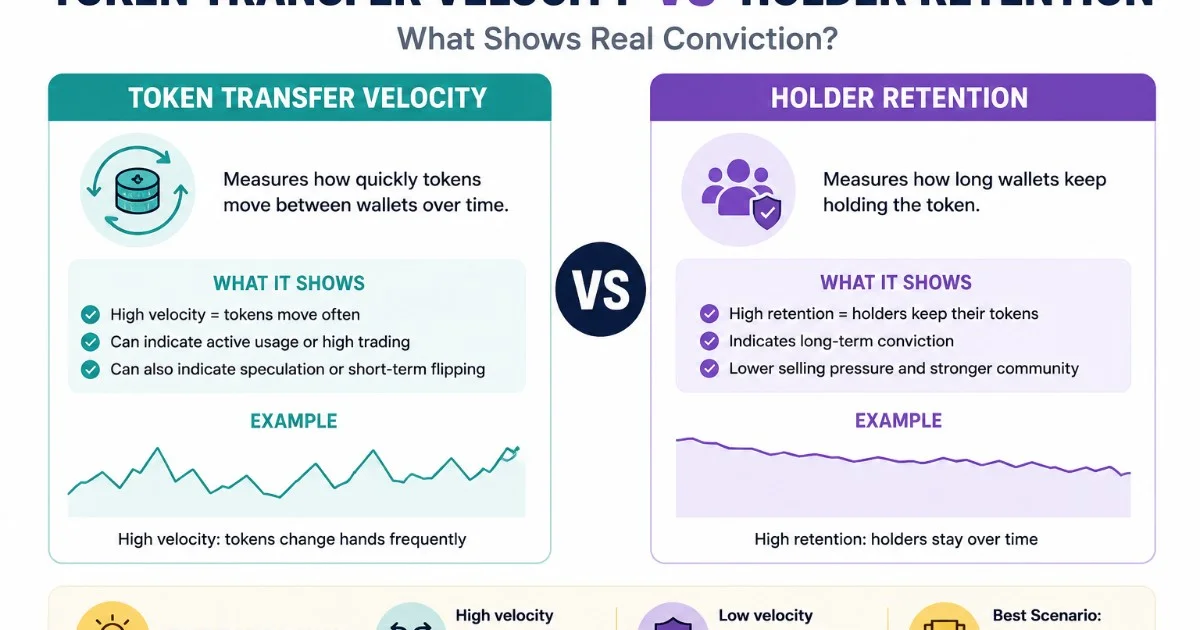
Crypto traders often analyze holder count, transfers and wallet activity to understand token demand. A token that moves frequently may look active. A token with many holders may look strong.
But activity does not always mean conviction.
A token can move quickly between wallets because users are trading, farming, selling or rotating capital. At the same time, real long term holders may be leaving.
This is why traders should compare token transfer velocity vs holder retention.
Together, these metrics can help reveal whether a token is being used, dumped, held or accumulated with real conviction.
What Is Token Transfer Velocity?
Token transfer velocity measures how quickly tokens move between wallets over time.
High velocity means tokens are changing hands frequently. Low velocity means tokens are moving less often.
High velocity can reflect active usage, strong trading activity or ecosystem demand. But it can also reflect speculation, short term flipping or selling pressure.
Velocity needs context.
What Is Holder Retention?
Holder retention measures whether wallets continue holding the token over time.
If many holders keep their tokens across days, weeks or months, retention may be strong. If holders leave quickly after buying or receiving tokens, retention may be weak.
Holder retention can reveal conviction.
A token with strong retention may have a community that believes in the project, uses the token or expects future value.
Token Transfer Velocity vs Holder Retention: The Key Difference
The key difference is movement vs commitment.
Token transfer velocity shows how often tokens move. Holder retention shows whether users stay.
A token with high velocity and low retention may be heavily traded but weakly held. A token with lower velocity and strong retention may have a more committed holder base.
The best signal depends on the token's purpose.
Why High Token Velocity Can Be Misleading
High token velocity may look like strong demand, but it can also signal weak conviction.
If tokens move quickly because users are selling rewards, flipping launches or farming incentives, velocity may rise while real community strength falls.
A token can be active without being trusted.
This is why velocity should not be interpreted as bullish by itself.
When High Velocity Is Positive
High velocity can be positive when it reflects real utility.
For example, a token used for payments, fees, gaming, trading or app interactions may naturally move more often.
In this case, velocity may show product usage.
The key is whether velocity is connected to real demand or short term speculation.
Why Holder Retention Matters
Holder retention helps traders understand whether users are willing to keep exposure to the token.
Strong retention can suggest belief in the project, confidence in tokenomics or continued use of the ecosystem.
If holders stay through volatility, the token may have a more resilient community.
Weak retention can suggest that users only wanted rewards, quick profits or exit liquidity.
The Best and Worst Patterns
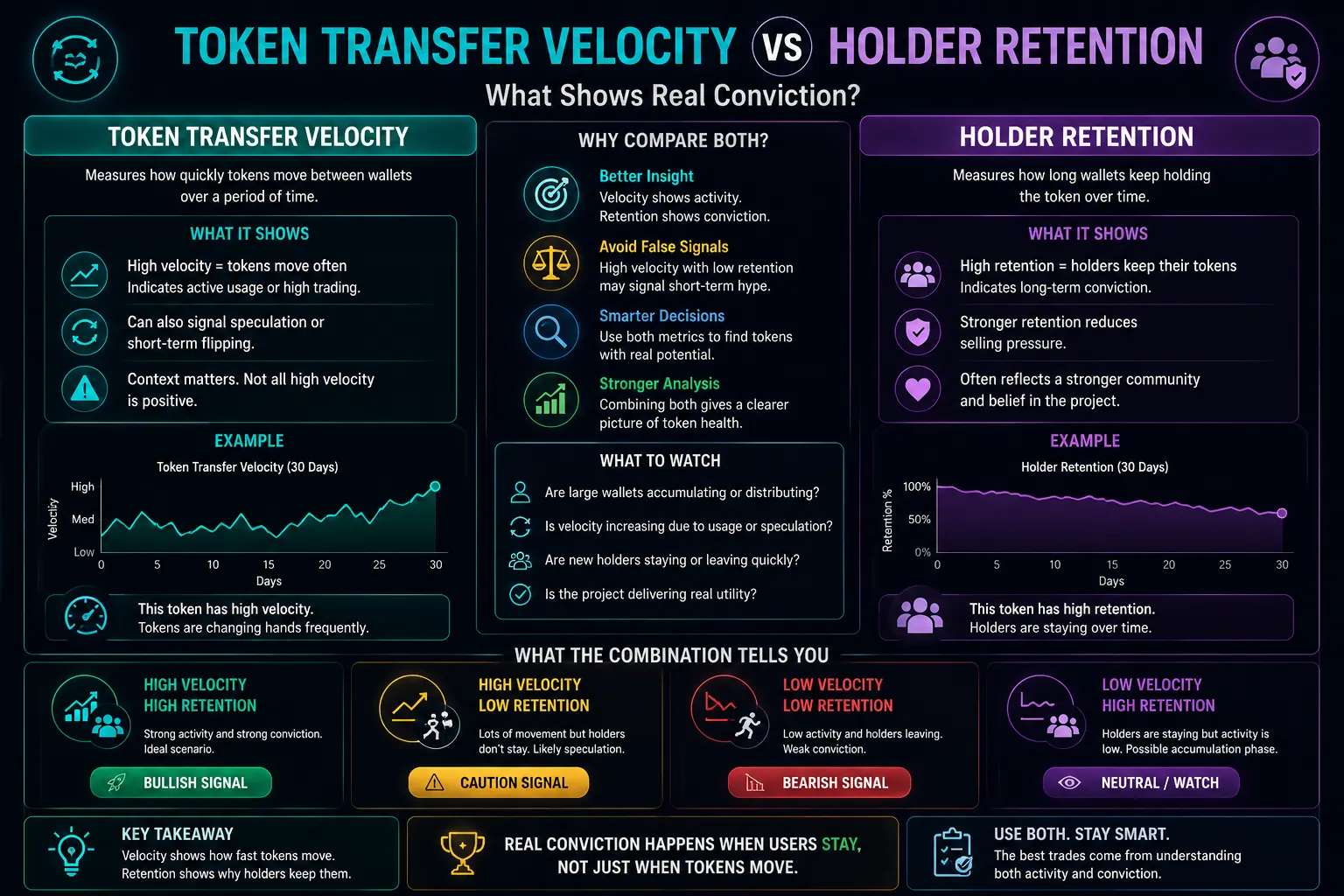
A token with high velocity and strong holder retention may have both usage and conviction. This can be a healthy signal if liquidity is also strong.
A token with high velocity and weak retention may be dominated by speculation or selling pressure.
A token with low velocity and strong retention may have loyal holders, but limited activity.
A token with low velocity and weak retention may be losing both attention and demand.
Traders should compare both metrics instead of relying on one.
What Traders Should Analyze
Before judging holder conviction, traders should ask:
Are tokens moving because of utility or selling?
Are holders staying after launch?
Are large wallets accumulating or distributing?
Is transfer activity connected to real app usage?
Are rewards being claimed and sold?
Is holder retention improving over time?
Is liquidity strong enough to support exits?
Are old holders still active?
These questions help traders understand whether token activity is healthy.
Why This Matters for Price Action
Token price can be affected by both velocity and retention.
High transfer velocity may create volatility. Weak retention can increase sell pressure. Strong retention can reduce circulating supply pressure if holders are not selling.
However, strong retention without demand does not guarantee price growth.
The healthiest markets usually combine real use, liquidity, retention and sustainable demand.
How DEXTools Can Help
DEXTools can help traders monitor live token behavior, including price action, liquidity, transaction flow and volume.
When combined with holder and transfer analysis, this can help traders identify whether a token is building real conviction or just cycling through short term wallets.
Final Thoughts
Token transfer velocity and holder retention show different sides of token behavior.
Velocity shows how often tokens move. Retention shows whether holders stay.
For real conviction, holder retention is often more important than raw activity. But for real utility, healthy velocity can also matter.
The best analysis compares both. A strong token should not only move. It should give users a reason to stay.
How to Bridge Crypto Between Chains: Complete Cross-Chain Tutorial 2026 How to Use 1inch for Swaps: Classic, Fusion and Limit Orders (2026) OKX Web3 Wallet Tutorial 2026: Multi-Chain Setup GuideBeyond the HODL: Deconstructing "Sticky" Liquidity and Its Implications
While holder retention often signals long-term conviction, a deeper dive reveals that not all retained tokens are created equal. "Sticky" liquidity refers to tokens held by participants who are less likely to sell quickly, even amidst market volatility. This goes beyond mere inactivity; it implies a strategic or fundamental reason for holding, contributing to a more stable price floor and reduced susceptibility to large sell-offs.
Conversely, "weak" hands, even if they appear as long-term holders, might still pose a risk if their conviction is low or they are simply unaware of their holdings. Differentiating between these types of retention is crucial for understanding a token's true resilience and the underlying strength of its community.
Identifying Sources of Sticky Liquidity
- Tokens locked in staking mechanisms or yield farming protocols with significant unbonding periods.
- Tokens held by core development teams, venture capital funds, or strategic partners with long-term vesting schedules.
- Tokens held in governance contracts where participation requires locking assets for extended durations.
- Tokens owned by users actively contributing to the project's ecosystem, indicating a vested interest beyond speculative trading.
- Tokens forming part of significant liquidity pools on decentralized exchanges, especially those with incentives for long-term provision.
Related Guides
- Settlement Volume vs Transfer Count: Which Better Shows Real On Chain Value Movement?
- Loan Origination vs Outstanding Debt: Which Shows Real Lending Growth?
- Fee Revenue per Active Wallet vs Total Fees: Which Shows Real dApp Monetization?
- Fee Payer Growth vs Transaction Count: Which Better Shows Real Network Adoption?
- Active Contracts vs Contract Deployments: Which Better Shows Real Developer Adoption?
- What Is Token Velocity in Crypto? The Velocity Problem (2026
Frequently Asked Questions
What is token transfer velocity?
Token transfer velocity refers to how frequently a token moves between wallets over a period of time. High velocity means tokens change hands often, which can reflect active use or speculative churn.
What is holder retention in crypto?
Holder retention measures how long wallets keep a token rather than selling or moving it quickly. Strong retention can suggest that holders have longer-term conviction in the asset.
Does high transfer velocity mean a token is healthy?
Not necessarily, because high velocity can come from speculation, wash activity, or short-term trading rather than genuine demand. It is more informative when analyzed alongside holder behavior and other on-chain metrics.
Why compare transfer velocity with holder retention?
Looking at both together can help distinguish real conviction from surface-level activity. A token can appear busy through frequent transfers while still lacking committed long-term holders.