
Yield farming has become one of the most popular ways to earn passive income in decentralized finance (DeFi). By supplying your crypto assets to protocols, you can earn rewards that often surpass anything traditional finance offers. But the opportunity comes with its own set of complexities and risks. This comprehensive guide covers everything you need to know about yield farming in 2026, from the basic mechanics to advanced strategies used by experienced DeFi participants.
Intent split
- This page owns the core definition of yield farming, including mechanics and beginner context.
- For strategy comparison, APY quality and risk filters, read Yield Farming Strategies, APY Quality and Risk Management.
Whether you are a complete beginner exploring DeFi for the first time or an intermediate user looking to optimize your returns, this guide will walk you through the concepts, platforms, strategies, and risks involved in yield farming. We will also compare it to other popular earning methods like staking and lending so you can decide which approach fits your goals.
Quick answer
- Yield farming means depositing crypto into DeFi protocols so the position can earn fees, interest, token incentives, or a mix of all three.
- For most beginners, the cleanest starting point is stablecoin lending, stablecoin pools, or battle-tested vaults, not high-APY farms on new protocols.
- The biggest hidden cost is often impermanent loss, and the biggest operational risk is still smart contract failure.

What Is Yield Farming?
Yield farming is the practice of depositing cryptocurrency into DeFi protocols to earn rewards. These rewards can come in the form of interest, transaction fees, governance tokens, or a combination of all three. The concept is sometimes called "liquidity mining" because participants provide liquidity that enables decentralized exchanges and lending platforms to function.

At its core, yield farming works by letting you put your idle crypto assets to work. Instead of simply holding tokens in a wallet, you deposit them into a smart contract. That smart contract uses your assets for various purposes, such as facilitating trades on a decentralized exchange (DEX) or enabling loans on a lending platform. In return, you receive a share of the fees or newly minted tokens as compensation.
The term "farming" comes from the idea of planting seeds (your crypto) and harvesting rewards over time. Yield farmers often move assets between different protocols seeking the highest returns, a strategy sometimes called "crop rotation" in DeFi circles. The annual percentage yield (APY) can vary from modest single-digit returns on stablecoins to extremely high (and riskier) triple-digit APYs on newer or less established protocols.
Yield farming gained mainstream attention during the "DeFi Summer" of 2020 when Compound launched its COMP governance token distribution. Since then, the ecosystem has matured significantly. Protocols have become more sophisticated, security practices have improved, and the range of available strategies has expanded dramatically. For a broader understanding of the DeFi ecosystem, check out our complete guide to decentralized finance.
How Yield Farming Works: Liquidity Pools and AMMs
To understand yield farming, you need to understand two fundamental concepts: liquidity pools and automated market makers (AMMs). These are the building blocks that make decentralized trading and yield generation possible.
Liquidity Pools Explained
A liquidity pool is a collection of cryptocurrency tokens locked in a smart contract. These pools serve as the trading reserves for decentralized exchanges. When someone wants to swap Token A for Token B on a DEX, they are not trading with another person directly. Instead, they are trading against the liquidity pool that contains both tokens.
Liquidity providers (LPs) are the people who deposit tokens into these pools. In most cases, you need to deposit two tokens in equal value. For example, if you want to provide liquidity to an ETH/USDC pool, you would deposit $500 worth of ETH and $500 worth of USDC. In return, you receive LP tokens that represent your share of the pool.
Every time someone makes a trade using that pool, a small fee (typically 0.2% to 0.3%) is charged. That fee is distributed proportionally to all liquidity providers based on their share of the pool. If you own 1% of the pool, you earn 1% of all trading fees collected.
Automated Market Makers (AMMs)
AMMs are the algorithms that determine token prices within liquidity pools. Unlike traditional exchanges that use order books where buyers and sellers set prices, AMMs use mathematical formulas. The most common formula is the constant product formula: x * y = k, where x and y are the quantities of the two tokens and k is a constant.
This means that as one token is bought from the pool (reducing its supply), its price automatically increases relative to the other token. The larger the trade relative to the pool size, the more the price moves, which is known as slippage. This mechanism ensures there is always a price available for any trade, eliminating the need for a counterparty.
Modern AMMs have evolved beyond the basic constant product formula. Uniswap V3 introduced concentrated liquidity, allowing LPs to focus their capital within specific price ranges for greater capital efficiency. Curve Finance uses a specialized formula optimized for assets that should trade near parity, like different stablecoins. Balancer allows pools with more than two tokens and variable weights.
The Reward Mechanism
Yield farming rewards come from multiple sources. Trading fees are the most straightforward: every swap generates fees that go to LPs. Protocol incentives are additional token rewards that protocols distribute to attract liquidity. For instance, a new DEX might distribute its governance tokens to LPs who provide liquidity to specific pools. These incentive programs can significantly boost returns but are usually temporary.
Some protocols also offer boosted rewards for users who lock their tokens for longer periods or who hold the protocol's native token. Curve's "ve" (vote-escrowed) tokenomics model pioneered this approach, and many protocols have adopted similar mechanisms. The combination of trading fees plus incentive rewards creates the total APY that yield farmers target.
Types of Yield Farming
Yield farming encompasses several distinct strategies, each with its own risk and reward profile. Understanding these types will help you choose the approach that best matches your goals and risk tolerance.

Liquidity Provision (LP Farming)
This is the most classic form of yield farming. You deposit token pairs into a DEX liquidity pool and earn trading fees plus any additional token incentives. Popular pools include ETH/USDC on Uniswap, ETH/WBTC on SushiSwap, and various stablecoin pools on Curve Finance.
LP farming offers some of the highest yields but also carries the risk of impermanent loss (covered in detail below). The best LP farming opportunities typically involve pools with high trading volume relative to their liquidity depth, as this generates more fees per dollar deposited.
Lending and Borrowing
Lending protocols like Aave, Compound, and Morpho allow you to deposit assets and earn interest from borrowers. This is generally considered lower risk than LP farming because there is no impermanent loss. Your deposited assets remain the same tokens; you simply earn interest on them.
Interest rates fluctuate based on supply and demand. When borrowing demand is high, lenders earn more. Many lending protocols also distribute governance tokens as additional incentives. Advanced users can combine lending with borrowing to create leveraged yield farming positions, though this increases risk substantially.
Staking Rewards
While staking is often treated as a separate category from yield farming, many DeFi protocols blur the line. Staking governance tokens to earn protocol revenue, staking LP tokens to earn additional rewards, or liquid staking through protocols like Lido all fall into yield farming territory.
Liquid staking has become particularly popular. When you stake ETH through Lido, you receive stETH that can be used in other DeFi protocols. This means you can earn staking rewards on your ETH while simultaneously using the stETH in a lending protocol or liquidity pool, effectively earning double or triple yields.
Yield Aggregators and Vaults
Yield aggregators like Yearn Finance, Beefy Finance, and Convex Finance automate yield farming strategies. You deposit tokens into a vault, and the protocol automatically compounds rewards, rebalances positions, and optimizes returns. This saves gas fees and time while often achieving better returns than manual farming.
Vaults are especially attractive for beginners because they handle the complexity of strategy management. Each vault follows a specific strategy documented by the protocol. Some vaults simply auto-compound LP rewards, while others execute more complex strategies involving multiple protocols. The trade-off is that vaults charge management and performance fees, typically 2% management and 20% of profits.

Beginner rule set
- Start on a cheap chain or Layer 2 if gas cost matters.
- Prefer simple strategies first: stablecoin lending, major stable pools, or established vaults.
- Do not chase triple-digit APYs until you understand where the yield is actually coming from.
- Track deposits, withdrawals, and rewards from day one so taxes do not become the real hidden loss.
Understanding Impermanent Loss
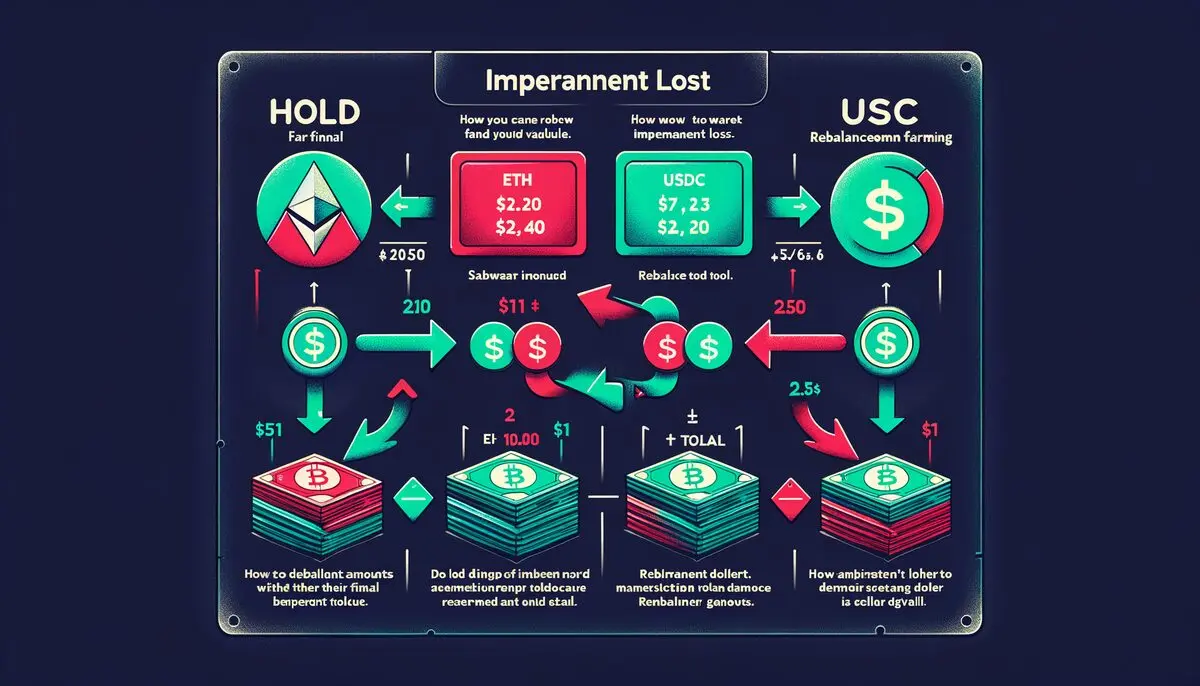
Impermanent loss (IL) is the most important concept for any yield farmer to understand. It is the difference in value between holding tokens in a liquidity pool versus simply holding them in your wallet. Despite its name, the loss can become very real and permanent if you withdraw at the wrong time.
For a deep dive into this critical topic, see our dedicated guide to impermanent loss.
How Impermanent Loss Occurs
When you provide liquidity to a pool, the AMM algorithm maintains a constant ratio between the two tokens. If the price of one token changes significantly relative to the other, the pool automatically rebalances by selling the appreciating token and buying the depreciating one. This means you end up with more of the token that dropped in price and less of the token that increased in price.
Consider this example: You deposit $1,000 worth of ETH and $1,000 worth of USDC into a pool. If ETH doubles in price, the pool rebalances. When you withdraw, you might have $1,414 worth of assets in the pool, but if you had simply held your original ETH and USDC, you would have $1,500. The $86 difference is your impermanent loss, roughly 5.7% in this scenario.
Impermanent Loss by Price Change
Impermanent loss rule of thumb
The key takeaway is that impermanent loss accelerates as price divergence increases. For stablecoin pairs that trade near 1:1, impermanent loss is negligible. For volatile token pairs, the trading fees earned must exceed the impermanent loss for the position to be profitable overall.
Mitigating Impermanent Loss
Several strategies can help reduce impermanent loss exposure. Choosing pools with correlated assets (like ETH/stETH or USDC/USDT) minimizes price divergence. Using concentrated liquidity positions on Uniswap V3 can maximize fee earnings to offset IL, though this requires active management. Some newer protocols offer impermanent loss protection mechanisms, and yield aggregator vaults often implement strategies designed to minimize IL exposure.
Top Yield Farming Platforms in 2026
The DeFi landscape has matured considerably, with several platforms establishing themselves as reliable, battle-tested options for yield farming. Here is a comparison of the top platforms available in 2026.
When choosing a platform, consider factors beyond just APY. Look at the protocol's track record, audit history, total value locked (TVL), the team's transparency, and the chain you are comfortable using. Higher APYs almost always correlate with higher risk. Established protocols with billions in TVL and multiple audits are generally safer choices, even if yields are more modest.
How to Start Yield Farming: Step by Step
Getting started with yield farming can seem overwhelming, but the process becomes straightforward once you understand each step. Here is a practical walkthrough for beginners.
Step 1: Set Up a Wallet
You need a non-custodial wallet that supports the blockchain you plan to farm on. MetaMask is the most popular choice for Ethereum and EVM-compatible chains. Rabby Wallet has gained popularity for its multi-chain support and security features. For mobile, Trust Wallet and Coinbase Wallet are solid options. Write down your seed phrase and store it securely offline. Never share it with anyone or enter it on any website.
Step 2: Fund Your Wallet
Transfer crypto from a centralized exchange to your wallet. You will need the native token of the blockchain for gas fees (ETH for Ethereum, MATIC for Polygon, etc.) plus the tokens you want to farm with. If you are a beginner, start on a Layer 2 network like Arbitrum or Base where gas fees are significantly lower than Ethereum mainnet.
Step 3: Choose Your Strategy
Decide which type of yield farming suits your goals. For beginners, stablecoin lending on Aave or a stablecoin LP on Curve are excellent starting points with lower risk. For intermediate users, providing liquidity on Uniswap or using a yield aggregator vault can offer higher returns. Match your strategy to your risk tolerance and the amount of time you can dedicate to managing positions.
Step 4: Connect and Deposit
Navigate to your chosen protocol's website (always verify you are on the official URL). Click "Connect Wallet" and approve the connection in your wallet. For LP farming, you will need to approve token spending, then deposit your tokens into the pool. Read any warnings carefully and start with a small amount to ensure everything works as expected before committing more capital.
Step 5: Monitor and Manage
Track your positions using portfolio trackers like DeBank, Zapper, or the protocol's own dashboard. Monitor your earned rewards, check for impermanent loss on LP positions, and decide when to harvest (claim) your rewards. Some strategies require regular harvesting and redepositing, while vault strategies handle this automatically. Set calendar reminders to check your positions at least weekly.
Step 6: Claim Rewards and Rebalance
Periodically claim your earned rewards and decide whether to reinvest (compound) or take profits. Consider gas costs when claiming; on Ethereum mainnet, it may not be worth claiming small amounts due to high gas fees. Evaluate whether your current farm is still performing well or if better opportunities exist elsewhere. Rebalance your portfolio as needed to maintain your desired risk exposure.
Yield Farming Strategies: Conservative vs. Aggressive
Your yield farming approach should align with your risk tolerance, capital size, and time commitment. Here are the main strategy categories and what they involve.
Conservative Strategies (Lower Risk, Lower Reward)
Stablecoin Lending (APY: 3-10%): Deposit stablecoins like USDC, USDT, or DAI into lending protocols such as Aave or Compound. You earn interest from borrowers with no impermanent loss risk. This is the closest DeFi equivalent to a high-yield savings account. Returns fluctuate based on market demand for borrowing, but your principal remains in stablecoins.
Stablecoin LP Farming (APY: 5-15%): Provide liquidity to stablecoin pairs on Curve Finance (e.g., USDC/USDT/DAI). Impermanent loss is minimal because the assets trade near parity. You earn trading fees plus any incentive rewards. Using Convex Finance to boost Curve yields can increase returns further without significantly changing the risk profile.
Blue-Chip LP Positions (APY: 5-20%): Provide liquidity for established asset pairs like ETH/USDC or WBTC/ETH on major DEXs. These pools have deep liquidity and high trading volume, generating consistent fees. Impermanent loss is a factor, but the established nature of these assets provides more predictable price behavior compared to small-cap tokens.
Moderate Strategies (Medium Risk, Medium Reward)
Yield Aggregator Vaults (APY: 8-30%): Deposit into vaults on Yearn, Beefy, or Convex that automatically execute and compound strategies. These handle the complexity of multi-step strategies while auto-compounding rewards for better returns. The additional smart contract risk from using an aggregator on top of a base protocol is the main trade-off.
Liquid Staking Plus DeFi (APY: 6-15%): Stake ETH through Lido to get stETH, then use stETH in a lending protocol or liquidity pool. This approach earns staking yield on the base ETH plus additional DeFi yield on the liquid staking derivative. The layered approach increases smart contract risk but offers excellent capital efficiency.
Aggressive Strategies (Higher Risk, Higher Reward)
New Protocol Incentive Farming (APY: 50-500%+): New protocols often launch with extremely high incentive rewards to attract liquidity. These "mercenary capital" opportunities can be very profitable short-term, but the reward tokens frequently decline in value, and the protocols carry higher smart contract risk due to being newer and less audited. Only commit capital you can afford to lose entirely.
Leveraged Yield Farming (APY: 30-100%+): Borrow against your deposited assets to increase your farming position. For example, deposit ETH, borrow stablecoins against it, then use those stablecoins to farm. This amplifies both gains and losses and introduces liquidation risk. Platforms like Alpaca Finance specialize in leveraged farming. This strategy requires constant monitoring and is unsuitable for beginners.
Options and Structured Products (APY: 15-60%): Protocols like Ribbon Finance and Friktion offer structured products that sell options on your deposited assets to generate yield. These can offer attractive APYs but involve complex risk profiles and potential capital loss if the underlying asset moves sharply against the position.
Risks of Yield Farming
Understanding the risks is just as important as understanding the rewards. Every yield farming strategy carries risk, and the higher the promised returns, the higher the risk involved. Here are the main risks you should be aware of.
Smart Contract Risk
Every DeFi protocol is built on smart contracts, which are code deployed on the blockchain. If there is a bug or vulnerability in the code, your deposited funds can be stolen or permanently locked. Even audited protocols have been exploited. In 2023 alone, billions of dollars were lost to smart contract exploits across DeFi. Mitigate this risk by using battle-tested protocols with multiple audits, insurance coverage, and a strong track record.
Impermanent Loss
As covered earlier, impermanent loss can significantly reduce or eliminate your farming profits when providing liquidity. In extreme market movements, impermanent loss can exceed the fees earned, resulting in a net loss compared to simply holding your tokens. Always calculate potential IL scenarios before entering a position and ensure the expected fees and rewards justify the risk.
Rug Pulls and Scams
Not all DeFi projects are legitimate. Some are designed specifically to steal user funds. Red flags include anonymous teams with no verifiable track record, unaudited contracts, unusually high APYs with no clear source, and contracts that allow developers to drain liquidity. Stick to established, well-known protocols and thoroughly research any new project before depositing funds.
Market and Liquidation Risk
Crypto markets are highly volatile. A sudden crash can cause cascading liquidations in lending protocols, depegging of algorithmic stablecoins, or dramatic increases in impermanent loss. If you are using leverage, a sharp market downturn can liquidate your position entirely. Always maintain conservative collateral ratios and have a plan for extreme market scenarios.
Regulatory Risk
DeFi operates in a rapidly evolving regulatory environment. New regulations could affect the availability of certain protocols or tokens in your jurisdiction, the tax treatment of your farming activities, or even the legality of certain DeFi activities. Stay informed about regulatory developments in your country and consult a tax professional familiar with cryptocurrency.
Protocol Governance Risk
DeFi protocols are often governed by token holders who vote on changes. A governance attack or poorly considered proposal could negatively affect the protocol you are farming on. Large token holders (whales) can sometimes push through changes that benefit themselves at the expense of regular users. Monitor governance forums and proposals for protocols where you have significant capital deployed.
Yield Farming vs. Staking vs. Lending
These three DeFi earning methods are often confused. While they share the goal of generating returns on crypto holdings, they differ significantly in mechanism, risk, and reward potential. Here is a detailed comparison to help you understand which approach fits your needs.
For most beginners, staking or lending is the best starting point due to lower complexity and risk. As you gain experience and confidence, you can gradually explore yield farming strategies. Many experienced users combine all three approaches, allocating capital based on risk tolerance: a stable base in staking and lending, with a portion allocated to higher-yield farming opportunities.
Tax Implications of Yield Farming
Yield farming creates complex tax situations that vary by jurisdiction. While this guide cannot provide tax advice, here are the key considerations you should discuss with a qualified tax professional.
Common Taxable Events
In most jurisdictions, the following yield farming activities may trigger taxable events: receiving reward tokens (typically treated as income at fair market value when received), swapping tokens to enter or exit a farm (potential capital gains or losses), selling reward tokens (capital gains or losses from the sale), and in some cases, even depositing into or withdrawing from liquidity pools may be considered disposals.
Record-Keeping Best Practices
Maintaining detailed records is essential. Track every transaction including dates, token amounts, fair market values, gas fees paid, and the protocols used. Tools like Koinly, CoinTracker, and TokenTax can help automate this process by importing your wallet transactions. Keep records for at least seven years, as tax authorities can audit past returns. Screenshot your positions regularly and save transaction hashes for reference.
Jurisdiction-Specific Considerations
Tax treatment varies significantly by country. The United States treats crypto as property, and the IRS has been increasingly focused on DeFi activity. The European Union's MiCA framework introduces standardized reporting requirements. Some countries like Portugal and the UAE have more favorable crypto tax regimes. Always consult a tax professional familiar with cryptocurrency in your specific jurisdiction before engaging in yield farming.
Advanced Yield Farming Concepts
For experienced DeFi users looking to deepen their knowledge, here are several advanced topics that can improve your farming outcomes.
Concentrated Liquidity Management
Uniswap V3's concentrated liquidity allows LPs to allocate capital within specific price ranges rather than across the full price spectrum. This dramatically increases capital efficiency. A position concentrated in a narrow range can earn the same fees as a much larger full-range position. However, if the price moves outside your range, you stop earning fees entirely and experience maximum impermanent loss for that range. Successful concentrated liquidity management requires understanding volatility, setting appropriate ranges, and actively monitoring and adjusting positions.
Yield Tokenization (Pendle Finance)
Pendle Finance pioneered the concept of yield tokenization, splitting yield-bearing assets into Principal Tokens (PT) and Yield Tokens (YT). PT holders receive the underlying asset at maturity (allowing them to buy assets at a discount), while YT holders receive all the yield generated until maturity. This enables fixed-rate yield (buying PT), yield speculation (buying YT), and arbitrage between the two. Understanding yield tokenization opens up sophisticated strategies for managing interest rate risk in DeFi.
Bribes and Vote Markets
The "Curve Wars" introduced the concept of vote markets and bribes. Protocols compete for CRV emissions by offering incentives (bribes) to veCRV holders who vote to direct emissions to specific pools. Platforms like Votium and Hidden Hand facilitate this market. Savvy yield farmers can earn significant returns by participating in these vote markets, essentially getting paid to direct protocol incentives. Understanding governance token economics and the dynamics of vote markets can unlock additional yield opportunities.
Cross-Chain Yield Farming
With DeFi expanding across multiple blockchains, cross-chain strategies allow you to access the best yields regardless of which chain hosts them. Bridges like Stargate, LayerZero, and Across Protocol enable moving assets between chains. Cross-chain aggregators help identify the best opportunities across ecosystems. However, bridging introduces additional smart contract risk and complexity. Each bridge is another potential point of failure, and several bridges have been exploited for hundreds of millions of dollars. Evaluate bridge security carefully before moving significant capital cross-chain.
Restaking and EigenLayer
Restaking protocols like EigenLayer allow you to use already-staked ETH to secure additional networks and services, earning extra rewards. This creates a layered yield structure: base ETH staking rewards plus restaking rewards plus any DeFi yield from liquid restaking tokens (LRTs). While the capital efficiency is impressive, restaking introduces slashing risks from multiple networks simultaneously. The restaking ecosystem is still maturing, and participants should understand the additional risks involved in these multi-layered yield strategies.
MEV and Its Impact on Yield Farming
Maximum Extractable Value (MEV) refers to the profit that block producers can capture by reordering, inserting, or censoring transactions. MEV affects yield farmers in several ways. Sandwich attacks can increase your slippage when entering or exiting positions. Just-in-time (JIT) liquidity can reduce the fees earned by regular LPs. Some protocols have implemented MEV protection measures, and using private mempools or MEV-aware DEX aggregators like CoW Swap can help mitigate these effects. Understanding MEV dynamics is important for anyone farming significant amounts.

Frequently Asked Questions
What is the minimum amount needed to start yield farming?
There is no strict minimum, but gas and slippage matter. On Layer 2 networks, a few hundred dollars can be enough to learn without fees eating the whole strategy. On Ethereum mainnet, small deposits often make less sense.
Is yield farming safe?
No DeFi strategy is fully safe. Stablecoin lending on established protocols is much safer than farming on a new unaudited pool, but smart contract, market, and operational risks never disappear completely.
What is the difference between APR and APY?
APR is the simple annual rate without compounding. APY assumes rewards are reinvested. In DeFi, both can change quickly because rewards depend on TVL, borrowing demand, and incentive programs.
Can I lose money yield farming?
Yes. You can lose money through impermanent loss, token price moves, smart contract exploits, liquidation risk in leveraged strategies, or simply by chasing incentives that disappear faster than expected.
Which blockchain is best for yield farming?
There is no universal best chain. Ethereum has the deepest DeFi liquidity, but Layer 2s such as Arbitrum and Base often offer a better balance between opportunity and cost for smaller portfolios.
What is the best yield farming strategy for beginners?
A conservative route such as stablecoin lending, stablecoin LP positions, or an established auto-compounding vault is usually the best place to start. Learn the mechanics before moving into aggressive farms.
Related DEXTools tutorials
- What Is DeFi? Complete Guide to Decentralized Finance
- What Is Impermanent Loss? Complete DeFi Liquidity Guide
- How to Use Aave: Complete DeFi Lending and Borrowing Tutorial
- Top 5 Liquid Staking Protocols in 2026
- What Is Real Yield in DeFi? Sustainable vs Emissions
- What Is Level (lvlUSD)? The DeFi Yield Stablecoin Explained
Key Takeaways
- Yield farming lets you earn passive income by depositing crypto into DeFi protocols, but it comes with meaningful risks that you must understand before participating.
- Start with conservative strategies like stablecoin lending or stablecoin LP farming, then gradually explore more complex approaches as your knowledge grows.
- Impermanent loss is the biggest hidden cost for liquidity providers. Always calculate potential IL before entering a position and ensure expected fees justify the risk.
- Use established, well-audited protocols and diversify across multiple platforms to minimize smart contract risk.
- Keep detailed records of all DeFi transactions for tax purposes, and consult a crypto-savvy tax professional in your jurisdiction.
- Never invest more than you can afford to lose, and treat extremely high APYs with skepticism as they usually signal higher risk.