Deposit Growth vs Borrow Growth in DeFi: Guide
— By Whatsertrade in Tutorials

Deposit growth vs borrow growth in DeFi lending: learn to spot passive liquidity, real borrowing demand, and stronger protocol momentum in the data.
This page is about deposit growth vs borrow growth as a DeFi demand signal. If you want adjacent metrics, pair it with Utilization Rate vs TVL and Protocol Revenue vs TVL.
Key Takeaways
- What Is Deposit Growth?
- What Is Borrow Growth?
- Why Deposit Growth Can Look Strong but Be Weak
- Why Borrow Growth Can Signal Real Demand
- Four Possible Growth Patterns
- Deposits Grow and Borrows Grow
DeFi lending protocols depend on two sides of the market: depositors and borrowers. Depositors supply assets to earn yield. Borrowers use those assets for leverage, liquidity, hedging or other strategies.
When analyzing a lending protocol, many traders focus only on deposits. If deposits are growing, the protocol may look strong. But deposit growth alone does not always show real momentum.
Borrow growth is just as important. Comparing deposit growth vs borrow growth helps traders understand whether a lending protocol is attracting passive capital, real borrowing demand or both.
What Is Deposit Growth?
Deposit growth measures how much capital users are supplying to a lending protocol over time.
If users deposit more assets, total supplied liquidity increases. This can improve confidence and make the protocol more attractive to borrowers.
Deposit growth may come from trust, better yields, incentive programs, new asset listings or broader market conditions.
However, deposit growth does not always mean that the protocol is being used actively.
What Is Borrow Growth?
Borrow growth measures how much capital users are borrowing from the protocol over time.
This is important because borrowing activity usually creates interest payments, protocol fees and deeper economic activity.
Borrowers may use funds to trade, farm yield, manage liquidity or access leverage.
A protocol with strong borrow growth may be showing real demand for credit.
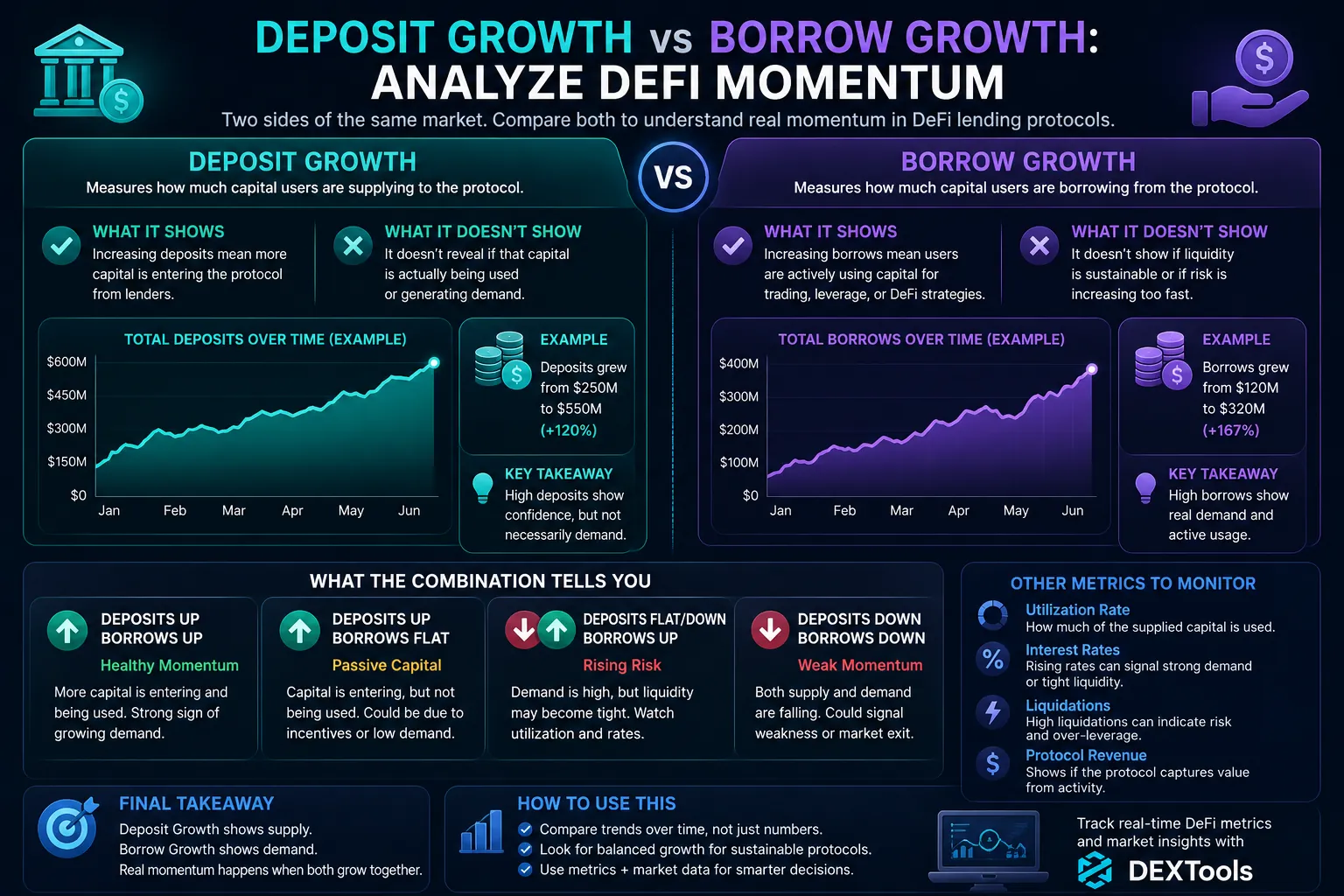
Deposit Growth vs Borrow Growth: The Key Difference
The key difference is supply vs demand.
Deposit growth shows that users are willing to supply capital. Borrow growth shows that users are willing to pay to use that capital.
A lending protocol needs both sides to be healthy.
If deposits grow but borrowing does not, capital may be idle. If borrowing grows but deposits do not, liquidity can become tight and rates may become unstable.
Why Deposit Growth Can Look Strong but Be Weak
Deposit growth can be driven by incentives. Users may supply assets because rewards are attractive, not because the protocol has strong organic demand.
This can create a large supply base without matching borrower activity.
If incentives decline, depositors may leave. This can reduce TVL and weaken liquidity.
For traders, this means deposit growth should always be compared with borrow growth.
Why Borrow Growth Can Signal Real Demand
Borrow growth can be a stronger signal of real usage because borrowers are paying to access capital.
If users are willing to borrow, it suggests that the protocol is useful for market strategies, liquidity needs or DeFi activity.
Sustained borrow growth may indicate that the protocol is becoming more important within the ecosystem.
However, borrow growth should also be analyzed carefully. Excessive borrowing can increase liquidation risk if market conditions change.
Four Possible Growth Patterns
Deposits Grow and Borrows Grow
This is usually the healthiest pattern. More users are supplying capital, and more users are borrowing it.
This suggests that the protocol is growing on both sides of the market.
Deposits Grow but Borrows Stay Flat
This can suggest passive capital accumulation. The protocol may have high TVL, but demand for borrowing is weak.
This may happen when incentives attract depositors faster than borrowers.
Borrows Grow but Deposits Stay Flat
This can suggest strong demand but limited liquidity expansion. Borrow rates may rise, and the market may become more sensitive to withdrawals.
This can be positive in moderation, but risky if utilization becomes too high.
Deposits Fall and Borrows Fall
This may suggest weakening protocol momentum. Users may be leaving, demand may be falling or market conditions may be less favorable.
Traders should be cautious when both sides decline.
Why Momentum Matters for Token Traders
Lending protocol momentum can affect token sentiment. If deposits and borrowing are both growing, traders may view the protocol as gaining traction.
If deposits grow only because of incentives, token performance may be weaker once rewards decline.
If borrow growth supports protocol revenue, the token may benefit if value capture is strong.
The key is to understand whether growth is real, balanced and sustainable.
What Traders Should Check
When analyzing deposit growth vs borrow growth, traders should ask:
Are deposits growing organically?
Are borrows growing at the same time?
Are rates stable?
Is utilization healthy?
Are incentives driving most of the activity?
Are liquidations increasing?
Does the protocol capture value from borrowing activity?
These questions help traders avoid surface level analysis.
How DEXTools Can Help
DEXTools can help traders analyze the token market connected to lending protocols. Even if protocol metrics look strong, the token may still have weak liquidity, unstable volume or speculative price action.
By combining protocol growth metrics with live market data, traders can better assess whether momentum is supported by actual trading demand.
Deposit growth and borrow growth reveal different sides of a lending protocol.
Deposit growth shows capital supply. Borrow growth shows demand for that capital.
The strongest lending protocols often show balanced growth across both. Traders who analyze only deposits may miss whether the protocol is actually being used.
In DeFi lending, real momentum comes from both sides of the market working together.
Utilization Rate vs TVL in DeFi Lending: Revealing True Demand Protocol Revenue vs TVL: Understanding DeFi Demand What Is Impermanent Loss in DeFi? Complete Liquidity Provider Guide What Is Yield Farming in Crypto? Complete DeFi Strategy Guide Protocol Owned Liquidity vs Mercenary LiquidityRelated Guides
- How to Use Aave: Deposit, Borrow, Repay and Manage Health Factor (2026)
- Fake Volume vs Real Demand: How to Spot Artificial Momentum in DeFi Trading
- Borrow Cap vs Supply Cap: How Lending Limits Protect DeFi Markets
- Protocol Revenue vs TVL: Understanding DeFi Demand
- Borrower Diversity vs Whale Borrowing: How Concentrated Loan Demand Creates DeFi Risk
Frequently Asked Questions
What is the difference between deposit growth and borrow growth in DeFi?
Deposit growth tracks how much capital is being supplied to a lending protocol, while borrow growth tracks how much of that capital is actually being borrowed. Comparing the two helps separate passive parked liquidity from active borrowing demand.
Why does borrow demand signal stronger momentum than deposits alone?
Deposits can rise simply because users are chasing yield without anyone using the funds, whereas rising borrowing reflects real demand to put that capital to work. Borrow growth is often a stronger sign of genuine protocol momentum.
What does passive liquidity mean in DeFi lending?
Passive liquidity refers to deposits that sit in a protocol earning rewards but are not being borrowed or actively used. Large amounts of passive liquidity can inflate deposit figures without reflecting real economic activity.
How do I read deposit and borrow growth together?
Looking at both metrics side by side shows whether new deposits are being matched by actual borrowing, which indicates healthier demand. Deposits growing while borrowing stays flat may point to yield-chasing rather than sustainable momentum.