How to Use Binance: Complete Trading Tutorial (2026)
— By Tony Rabbit in Tutorials
Learn how to use Binance in 2026 step by step: register, KYC, deposit, spot, futures, Earn, BNB discount, security and fees explained for beginners.
Binance is the largest cryptocurrency exchange in the world by spot volume, derivatives open interest, and registered user count. In 2026 it serves more than 280 million users across 180 plus jurisdictions, processes tens of billions of dollars in daily trades, and offers a feature menu that ranges from simple Convert quotes to 125x perpetual futures and on-chain MPC wallets.
That breadth is both the appeal and the problem. New users open the app, see twenty tabs they do not recognize, and freeze. This guide walks through every section in the order a real user encounters them, with no fluff and no marketing language.
This is the post DOJ settlement era. Binance paid $4.3 billion to United States authorities in November 2023, founder Changpeng Zhao (CZ) stepped down, and Richard Teng has been running the company since. The product has changed: more KYC, more region locks, and a sharper split between Binance.com (global) and Binance.US (US users only). You need to know which platform you can actually use before you create an account.
To use Binance in 2026: (1) confirm your country is supported on Binance.com (US residents must use Binance.US instead), (2) register with email or phone and pass Intermediate KYC verification, (3) enable 2FA plus anti phishing code, (4) deposit crypto from another wallet or buy with card, SEPA, or P2P, (5) move funds to the wallet section you need (Spot, Futures, Earn) and start with small Convert or Spot trades before touching leverage.
Read time: 22 minutes. Skill level: Beginner to intermediate.
What Is Binance and Who Runs It in 2026
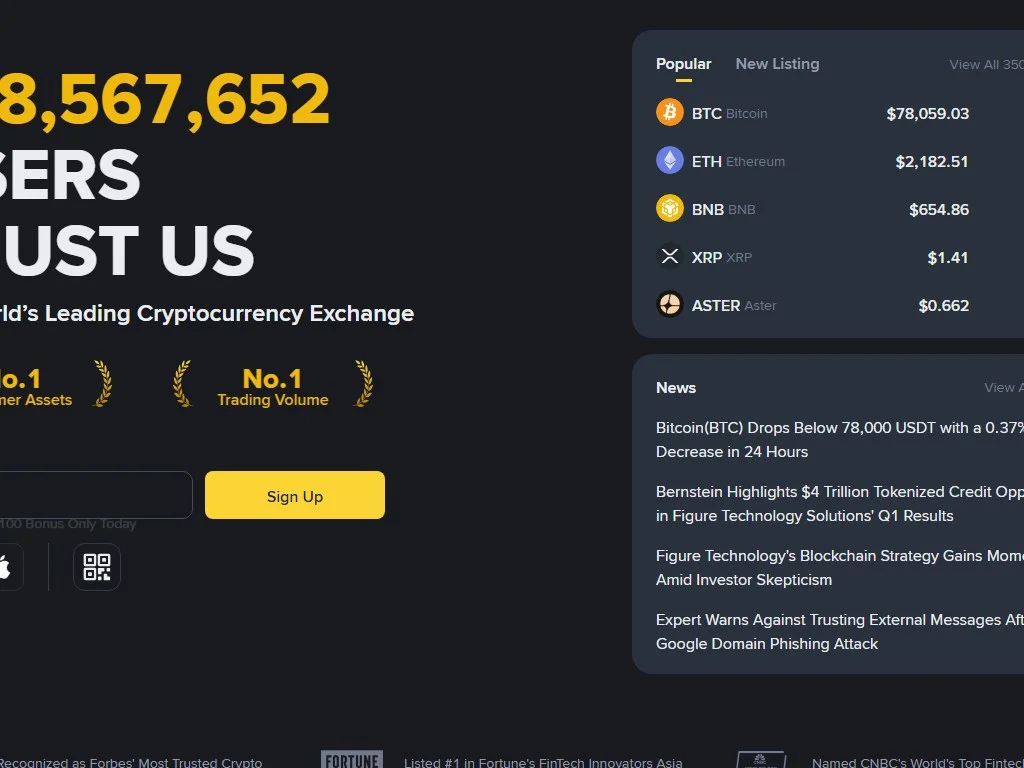
Binance is a centralized cryptocurrency exchange (CEX) founded in 2017 by Changpeng Zhao and Yi He. It functions as a marketplace where users can buy, sell, trade, lend, stake, and store digital assets, plus adjacent products: a Layer 1 blockchain (BNB Chain), an MPC self custody wallet (Web3 Wallet), a fiat payment rail (Binance Pay), and an educational portal (Binance Academy).
The company's lack of a formal global headquarters became central to the 2023 settlement with the United States Department of Justice. Binance pleaded guilty to Bank Secrecy Act violations, failure to register as a money transmitter, and sanctions violations. CZ pleaded guilty individually, paid a $50 million fine, and was sentenced to four months in federal prison. Richard Teng, a former director at the Abu Dhabi Financial Services Regulatory Authority, took over as CEO in November 2023. His mandate: stronger compliance, a chief compliance officer hire, and active engagement with regulators.
BNB, the native token of the Binance ecosystem, remains the third asset most users encounter. Holding BNB on Binance unlocks a 25 percent fee discount on spot trades, Launchpool participation, Megadrop eligibility, and the BNB Vault yield product. BNB also powers BNB Chain, an Ethereum compatible Layer 1 with low fees.
Is Binance Available Where You Live
This is the first question, not the last. Binance.com (the global platform covered in most of this article) is unavailable to residents of the United States, and feature availability differs sharply by jurisdiction.
Under the EU Markets in Crypto Assets (MiCA) framework, Binance operates through entities licensed in member states such as France, Italy, and Spain. Spot trading works normally, but several Earn and derivatives products are region restricted. UK users can trade spot but derivatives have been off limits to retail since 2021. If you are a US resident, do not try to circumvent the geoblock with a VPN: doing so violates Binance.com terms and can freeze your account with funds inside. Use Binance.US, a separate legal entity with no derivatives and a narrower feature set. The two platforms do not share accounts.
Creating Your Binance Account in 6 Steps
Account creation in 2026 is more rigorous than it was in 2020. Identity verification is essentially required before you can deposit fiat, trade meaningful size, or withdraw to many destinations. Plan to do it correctly the first time.
Visit binance.com (or .us in the United States), click "Register," choose email or phone, set a 12 plus character password, accept the terms.
Enter the 6 digit code sent to your contact method. This unlocks the dashboard but not trading.
Go to Security settings, enable Google Authenticator or Binance Authenticator, save the backup seed offline. Optionally add a passkey.
Create a unique phrase that real Binance emails will display. Any "Binance" email without it is phishing.
Submit a government ID (passport, national ID, or driver license), complete a live selfie liveness check, provide name and date of birth.
Add proof of address (utility bill, bank statement) to raise fiat deposit and withdrawal limits above standard thresholds.
Verification typically completes in minutes for clean submissions and within 24 hours for human review. Common failure reasons: glare on ID photos, lighting in selfies, name mismatches, expired documents. Once Intermediate verification is approved, you can deposit crypto without limit, deposit fiat up to local thresholds, trade spot and futures (where available), and withdraw. Advanced is mainly for higher fiat throughput.
Funding Your Account: Deposit Methods Explained
Binance supports three categories of deposit: crypto transfer from another wallet, card purchase (Buy Crypto), and fiat bank transfer. Each has different fees, speed, and limits.
Crypto deposit is cheapest if you already hold assets elsewhere. Navigate to Wallet, Spot Wallet, Deposit, select the coin, pick a network (BEP20, ERC20, TRC20, Solana, Arbitrum), copy the address, and send from your origin wallet on the same network. Network mismatch is the most common cause of lost deposits. If you send ERC20 USDT to a BEP20 address, the funds may be unrecoverable.
Buy Crypto with card (Visa, Mastercard, Apple Pay, Google Pay) is fastest for new users but most expensive. Card processing fees are typically 1.8 to 2.5 percent plus spread, and your issuer may treat the purchase as a cash advance.
Bank transfer (SEPA in Europe, Faster Payments in the UK, ACH, SWIFT) is recommended for larger fiat positions. SEPA deposits in EUR are free and usually arrive within minutes. P2P (peer to peer) matters in jurisdictions where bank rails to crypto exchanges are restricted. Binance P2P is an escrow marketplace where you buy crypto directly from another user using local bank transfer, mobile money, or cash. P2P is essential in Nigeria, Argentina, Turkey, and Pakistan.
Our guide on USDT and how stablecoins move across networks covers the network selection problem in detail, and our piece on gas prices and Ethereum fees explains why ERC20 withdrawals cost more than TRC20 or BEP20.
The Binance Wallet Structure
One of the most confusing things for new users is that Binance does not have a single balance. Funds live in different wallet sections depending on what you intend to do with them, and you must manually transfer between sections.
Use the Transfer function in the wallet menu to move funds between sections. Transfers are instant and free. The most common mistake is depositing fiat into Funding, trying to trade BTC/USDT in Spot, and not realizing your money is in the wrong wallet. If a balance shows zero where you expect funds, check Funding and Spot before assuming something is broken.
The Binance Spot Trading Interface
Spot trading is buying or selling actual crypto without leverage. If you buy 0.1 BTC with USDT, you own 0.1 BTC. There is no liquidation, no funding rate, no expiry. For 90 percent of users, spot is and should remain the primary use of Binance.
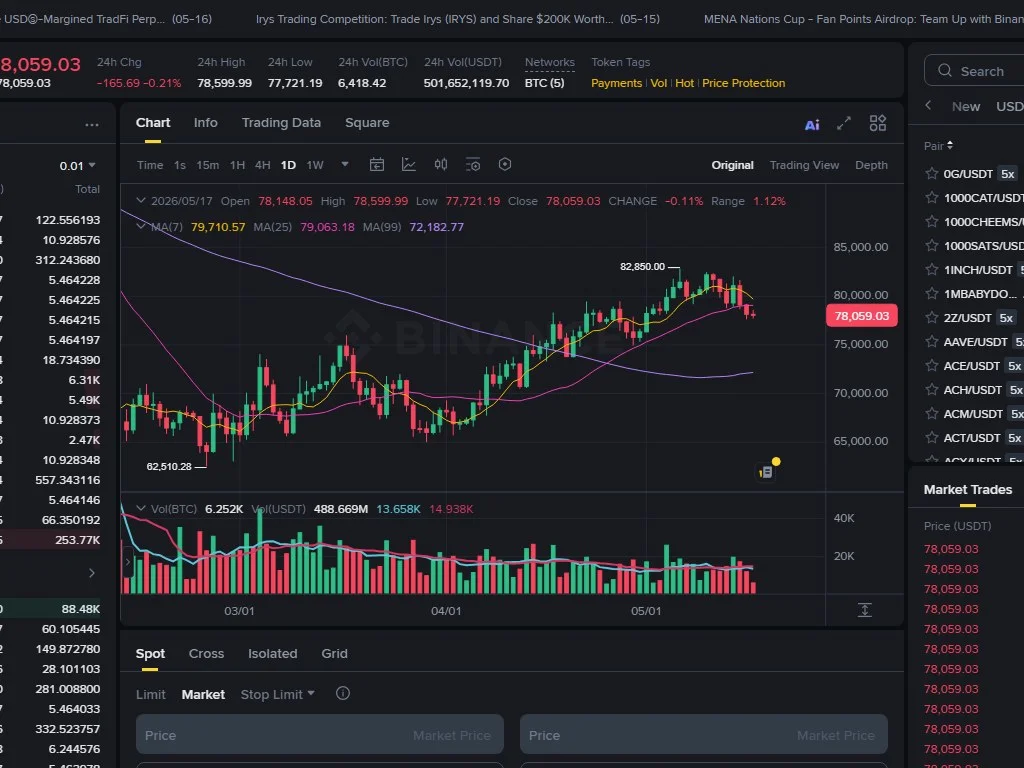
Binance offers two layouts. Classic is a single screen with chart, order book, trades, and order entry visible at once. Advanced (sometimes labeled Pro or TradingView Pro) gives you more chart real estate, more indicators, and a denser order entry panel. Beginners should start with Classic. The toggle is in the top right corner.
The key components of the spot screen:
- Pair selector in the top left lets you pick a market (BTC/USDT, ETH/USDC, SOL/FDUSD, etc.). The quote currency on the right side of the slash is what you pay or receive.
- Chart panel in the center shows price history. You can switch timeframes, add indicators, and draw trendlines.
- Order book on the right or left lists live bids (green, buy orders) and asks (red, sell orders). The narrower the spread between best bid and best ask, the more liquid the pair.
- Recent trades shows the last fills with size and side. Useful for reading flow.
- Order entry panel is where you actually place trades. Tabs include Limit, Market, Stop Limit, OCO (One Cancels Other), and TWAP for larger orders.
- Open orders and order history at the bottom track what is live, filled, and cancelled.
The single most useful habit for new spot traders is to default to limit orders rather than market orders. A limit order lets you specify the exact price you will pay, which forces patience and protects against slippage on thin pairs. Market orders are fine on BTC/USDT and ETH/USDT where the book is deep, and dangerous on low cap pairs where you can move the price 2 percent with a $5,000 order. Our slippage explainer covers the same problem in a decentralized exchange context, but the principle is identical on Binance.
Binance Convert: Zero Fee Instant Swaps
Convert is the simplest trading tool on Binance and the one most beginners should use first. You pick a "from" asset, a "to" asset, enter an amount, get a quote that is locked for a few seconds, and confirm. There is no order book to read, no chart to interpret, no spread to worry about (the spread is baked into the quote).
Convert is marketed as zero fee, which is technically true: there is no separate trading fee line item. The cost is in the quoted spread, which is wider than the spot order book mid price. For small trades the convenience is worth it. For trades above a few thousand dollars, the spot order book with a limit order is usually cheaper.
Convert supports thousands of pairs, including direct conversions between low cap altcoins that do not exist as spot markets. If you want to swap, say, FET to RNDR without going through USDT, Convert handles it in one click.
Binance Futures: USDT M, COIN M, and Leverage
Binance Futures is the largest crypto derivatives venue by open interest and volume. It offers USDT margined and COIN margined products plus quarterly delivery contracts. Leverage goes up to 125x on the most liquid pairs, though Binance has reduced default leverage for new accounts and limits the highest tiers to users with sufficient history.
Leveraged perpetuals can liquidate your entire margin in a single price move. A 10x position on BTC liquidates if BTC moves 10 percent against you (minus maintenance margin buffer). A 100x position liquidates on a 1 percent move. Most retail futures accounts lose money. Binance Futures is appropriate for traders who already understand directional risk on spot, not as a "try crypto with more leverage" starting point.
USDT M futures are linear contracts settled in USDT. The most popular contract by far. COIN M futures are inverse contracts settled in the underlying coin (BTCUSD margined and paid in BTC), preferred by long term BTC holders.
Funding rates are payments exchanged between longs and shorts every 8 hours to keep the perpetual price tethered to spot. Positive funding means longs pay shorts; sustained positive funding signals crowded long positioning.
Cross vs isolated margin. Cross uses your entire futures wallet as collateral for all positions; a losing trade can drain other positions. Isolated locks margin per position so liquidations are contained. Beginners should default to isolated. Our breakdown of liquidation zones goes deeper. If you are weighing leverage at all, read our piece on long vs short positions in crypto first.
Binance Margin Trading
Margin trading is separate from futures and lives between spot and futures in complexity. You borrow assets from Binance to buy or short on the spot market. Maximum leverage on cross margin is 10x for most pairs, lower for less liquid markets.
Cross margin pools collateral across the entire margin account. Isolated margin creates a separate borrowing account per pair, so a liquidation only burns that pair's collateral. Borrow interest accrues hourly and is charged whether you are profitable or not. Interest rates are visible on each pair and float based on demand.
Margin is mostly useful for two things: shorting altcoins that lack a futures market, and getting leverage on the spot order book without the funding rate and contract structure of futures. For most directional plays, futures are cleaner.
Binance Earn: Flexible, Locked, and DeFi Staking
Earn is Binance's umbrella for passive yield products. It is genuinely useful but the marketing language ("up to 30 percent APR") masks heterogeneity in risk. Read what you are subscribing to.
- Flexible Savings lets you deposit a coin and withdraw any time. Yields are low (3 to 6 percent on stablecoins, lower on majors) and counterparty risk sits with Binance.
- Locked Savings commits funds for 7, 30, 60, 90, or 120 days for a higher yield. Early withdrawal is usually possible but forfeits interest.
- ETH Staking stakes ETH through Binance for native staking yield plus a WBETH token you can hold or trade. Withdrawal back to spot ETH takes time, but the WBETH ticker stays liquid.
- BNB Vault deposits BNB into a meta product that routes the BNB through Launchpool, Flexible Savings, DeFi staking, and other yield sources automatically. The headline APR fluctuates with which Launchpools are active.
- Dual Investment is a structured product that pays a high APR but settles in either of two assets depending on price. Effectively a sold option. Not a savings product, despite the placement in the Earn menu.
- DeFi Staking bundles third party protocols (some Cosmos chains, Polkadot ecosystem, etc.) behind a Binance wrapper. The risk includes the underlying protocol, not just Binance.
For genuinely decentralized alternatives to the Earn menu, our guides on Rocket Pool and liquid staking and decentralized finance more broadly cover what you give up and what you gain by routing yield through smart contracts rather than an exchange.
Launchpool, Launchpad, and Megadrop
These are Binance's primary mechanisms for distributing new tokens to its user base. They differ in mechanics and accessibility.
Launchpool is the most accessible. You stake BNB (or another base asset like FDUSD) for 3 to 7 days and farm a brand new token whose first listing happens on Binance after the farm ends. You earn proportional to your share of the pool.
Launchpad is the older token sale model. BNB holders during a snapshot window can buy a fixed allocation at a discounted launch price. Launchpads have been rare since 2024 as Binance prioritized Launchpool. Megadrop combines Launchpool farming with optional Web3 Wallet tasks for bonus allocation, designed to filter for engaged users rather than BNB whales. All three are restricted in certain jurisdictions based on your KYC region.
Binance Web3 Wallet: Self Custody Inside the App
The Web3 Wallet is Binance's MPC (multi party computation) wallet embedded in the app since 2023. Unlike custodial balances, it is self custody: your private key is split into shards across your device, Binance, and a third party recovery service. Supports Ethereum, BNB Chain, Polygon, Arbitrum, Optimism, Solana, and more.
The wallet has its own DEX aggregator that pulls liquidity from PancakeSwap, Uniswap, 1inch, and others. If you want to buy a memecoin not listed on Binance spot, the Web3 Wallet handles it without leaving the app. Our guide on how DEX aggregators source liquidity applies directly. The catch: MPC wallets are not the same security model as hardware wallets. For meaningful self custody size, a dedicated hardware wallet remains the standard.
Trading Bots, Copy Trading, and Strategy Tools
Binance has progressively added automated strategy tools that lower the bar for users who do not want to babysit charts.
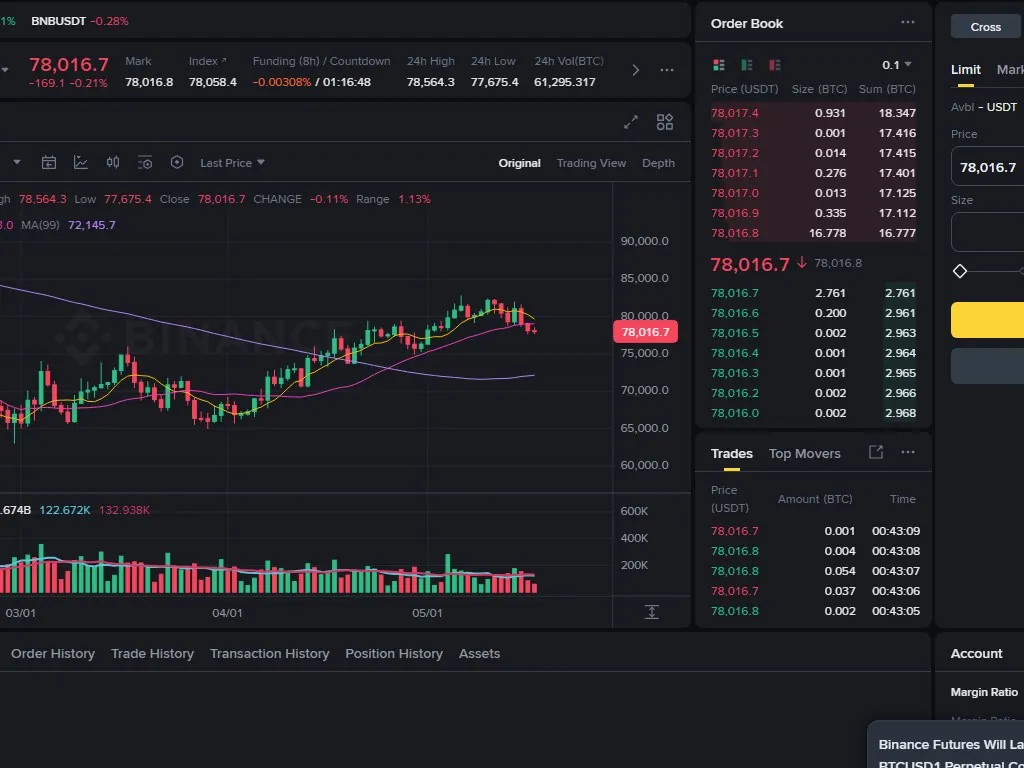
Spot Grid places a ladder of buy and sell limit orders within a range you define. The bot buys low and sells high as price oscillates. Works well in sideways markets and badly in trends, where price exits your range. Futures Grid applies the same logic with leverage and real liquidation risk if the range is tight.
Rebalancing Bot maintains a target allocation across multiple assets, trimming winners and adding to losers automatically. TWAP and Iceberg orders reduce market impact for larger fills: TWAP slices into equal pieces over time, Iceberg shows only a small slice on the book.
Copy Trading mirrors the trades of a selected lead on Futures or Spot. Leads are ranked by ROI, PnL, drawdown. Past performance does not guarantee returns and lead traders can blow up. Before relying on any lead, read about how to detect fake volume and manipulated performance, because the same patterns appear in copy trading rankings.
Binance Pay, Gift Card, and Peer Transfers
Binance Pay is a free internal transfer rail. You can send any supported crypto to another Binance user instantly using their Pay ID, email, or phone, with zero fee. Useful for paying friends, splitting bills among Binance users, or moving funds between your own accounts. Some merchants in Latin America, Turkey, and parts of Asia accept Binance Pay at checkout.
Gift Card lets you create a redemption code for a specific crypto amount that any Binance user can redeem. Functionally similar to Pay but works without knowing the recipient's account details upfront. Useful for tips, prizes, or onboarding new users.
Sub Accounts and API Trading
For users running serious volume, two features matter: sub accounts and the API.
Sub accounts let a master account create up to 200 isolated trading accounts under one verified identity. Each sub account has its own balance, its own API keys, and its own trading history. Useful for strategy isolation, separate fee tracking, or giving different traders access without sharing master credentials.
API trading is how every market making firm, algorithmic trader, and treasury system interacts with Binance. The REST API handles order placement, balance queries, account management. The WebSocket feeds stream order book updates, trades, and account events in real time. Rate limits scale with your VIP tier and stake of BNB. If you are building a bot, start with the testnet sandbox before pointing keys at production.
Fee Tiers, VIP Levels, and BNB Discount
Binance fees depend on three variables: your VIP level (based on 30 day volume and BNB balance), whether you are a maker or taker, and whether you have BNB fee deduction enabled.
Holding BNB and toggling fee deduction in account settings saves 25 percent. The BNB you use for fees is debited from your spot balance automatically. The savings compound for active traders. If you trade 50,000 USDT a month on spot, the BNB discount alone saves you 12.50 USDT in fees.
Futures fees follow a separate schedule with lower base rates (0.0200% maker, 0.0500% taker for regular users), and additional discounts for using BNB as fee currency on USDT M perpetuals.
Binance vs Coinbase vs OKX vs Bybit in 2026
The exchange you pick depends on jurisdiction, fee sensitivity, feature needs, and trust posture. Here is the honest comparison.
Binance wins on liquidity, feature breadth, and global access. Loses on US availability and trust premium (post settlement).
Coinbase wins on US accessibility, regulatory clarity, and ease of use for absolute beginners. Loses on fees (highest of the four) and feature limitations.
OKX wins on listing speed for newer altcoins and a strong Web3 wallet. Loses on US accessibility and global brand trust relative to Binance.
Bybit wins on derivatives execution quality and aggressive listings. Loses on fewer fiat onramps and a thinner spot ecosystem outside major pairs.
Security: SAFU, 2FA, Anti Phishing, and Address Whitelist
Binance has been the target of multiple intrusion attempts since 2018 and has built a layered defense system that users should fully configure.
SAFU (Secure Asset Fund for Users) is an insurance fund that holds a percentage of trading fees. As of 2026 SAFU exceeds $1 billion and has been used to reimburse users in past incidents (the 2019 hot wallet breach is the canonical example). It is not deposit insurance in the FDIC sense, but it is a real backstop.
Two factor authentication is mandatory for withdrawals and configurable as required for login. Use an authenticator app (Google Authenticator, Authy, or Binance Authenticator) rather than SMS, which is vulnerable to SIM swap attacks. Better yet, register a passkey backed by your phone or hardware key for a phishing resistant second factor.
Anti phishing code is a unique phrase that appears in every legitimate Binance email. If an email purporting to be from Binance does not show your code, it is a phishing attempt. Set this in Security settings on day one. For broader context on how to protect crypto holdings, our wallet security tips and guide to avoiding address poisoning scams are essential reading.
Withdrawal address whitelist restricts withdrawals to a pre approved list of addresses. New addresses require a 24 hour cooling period plus 2FA confirmation. This single feature blocks the most common post compromise attack: attacker logs in, immediately withdraws to their own address. With whitelist on, that attack fails.
API key restrictions. If you use the API, never grant withdrawal permissions to a key unless you absolutely must. Tie keys to specific IP addresses. Rotate keys quarterly.
Mobile App vs Desktop vs Lite Mode
The Binance mobile app (iOS and Android) is feature complete and includes a Lite mode toggle for users who want a stripped down interface focused on Buy, Sell, and basic Convert. Lite is appropriate for first time users and holders. Switching back to Pro reveals the full menu. The desktop site is recommended for serious trading: chart real estate, multi window order management, and keyboard shortcuts are not replicable on mobile.
Common Mistakes New Binance Users Make
- Sending crypto on the wrong network (ERC20 to a BEP20 address or vice versa). Always confirm the network on both ends before broadcasting.
- Trying to access Binance.com from the US with a VPN. Detection results in account freeze and KYC review with frozen funds.
- Trading futures before understanding liquidation math. Even 10x can wipe an account on a normal weekend wick.
- Leaving the entire balance in Funding or Spot when you intended to trade in Futures, then assuming the trade failed.
- Using SMS 2FA instead of an authenticator app or passkey.
- Subscribing to a Locked Earn product without checking the early withdrawal penalty.
- Copy trading a leader with 90 day ROI of 500 percent and no drawdown disclosure. The drawdown is hidden, not absent.
- Holding all funds on the exchange for years. Use self custody for cold storage; the exchange is for active trading.
How to Withdraw From Binance
Withdrawing crypto is the reverse of depositing. Navigate to Wallet, Spot, Withdraw, select the coin, paste the address, pick the correct network, enter the amount, confirm with 2FA. Network fees vary by coin. BTC fees are dynamic based on mempool. TRC20 USDT is usually 1 USDT flat; BEP20 USDT is fractions of a cent. Fiat withdrawals depend on verification tier and region: SEPA EUR is free or a small flat fee; card withdrawals cost more. Always do a small test withdrawal when sending to a new address or network.
Tax Reporting and Transaction History
Binance provides a tax tools section that exports transaction history in CSV, PDF, and integrates with TurboTax, Koinly, CoinTracker, and TaxBit. The export covers spot, futures, margin, Convert, Earn, Launchpool, and P2P. Crypto tax rules vary by jurisdiction (Spain, Germany, Portugal, UK, US, Brazil all treat gains, staking income, and airdrops differently). Use a dedicated tax tool that handles your country's rules and import the Binance export rather than building a spreadsheet by hand.
BNB Chain: The L1 Behind Binance
BNB Chain is the EVM compatible Layer 1 blockchain run by validators selected through delegated proof of stake. It is separate from the exchange but tightly integrated: transactions can be initiated from the Web3 Wallet, PancakeSwap is the dominant DEX, and many Launchpool tokens launch first on BNB Chain. Advantages: low fees (under $0.10 per swap), 3 second blocks, broad token availability. Tradeoffs: more centralized than Ethereum (21 active validators) and weaker DeFi composability. For users coming from Binance into broader Web3, BNB Chain is the gentlest onramp. Once comfortable, branch out to Uniswap v4 and Ethereum AMMs or alternative L1s like Sui and NEAR.
Binance vs Self Custody: Where Should Your Crypto Live
The most important framing for any new user. Binance is a custodian. Your assets on Binance are claims on the exchange, not coins you own on chain. If Binance is hacked, restricted by regulators, or fails operationally, your access can be interrupted regardless of your account balance.
The standard practice for users with meaningful holdings:
- Keep on Binance the amount you are actively trading or earning yield on, plus a small buffer.
- Move long term holdings to a hardware wallet (Ledger, Trezor, GridPlus) and back up the seed phrase offline.
- Use the Binance Web3 Wallet for medium term self custody and DeFi interactions where convenience matters and amounts are moderate.
- Verify the proof of reserves disclosures Binance publishes periodically. They are not a full audit, but they are a partial assurance.
FAQ
Q Q Q How do I start using Binance as a complete beginner?
Register an account, verify your email or phone, enable 2FA with an authenticator app, set an anti phishing code, complete Intermediate KYC with a government ID, then deposit a small amount of crypto or buy with a card to test the flow. Start with Convert or a small spot trade on BTC/USDT before exploring futures, margin, or Earn.
Q Q Q Can US residents use Binance?
US residents cannot use Binance.com (the global platform) and must use Binance.US, a separate legal entity. Binance.US offers spot trading and limited staking but does not offer futures or most Earn products. Attempting to access Binance.com from the US with a VPN violates terms of service and can result in account freezes.
Q Q Q Is Binance safe in 2026 after the DOJ settlement?
Binance is the largest exchange by volume and operates under enhanced compliance after the $4.3 billion 2023 settlement with US authorities. CEO Richard Teng has expanded the compliance team and added a chief compliance officer. SAFU exceeds $1 billion as an insurance backstop. No exchange is risk free: keep long term holdings in self custody, use the exchange for active trading.
Q Q Q What is the minimum deposit on Binance?
Crypto deposits have no minimum at the platform level, though each coin has a network minimum (typically a few dollars equivalent) below which the deposit will not be credited. Buy Crypto with card starts at around 15 USD or equivalent. Bank transfer minimums vary by currency and rail.
Q Q Q What are Binance trading fees in 2026?
Standard spot trading fees are 0.10 percent maker and 0.10 percent taker for regular users. Holding BNB and enabling fee deduction provides an additional 25 percent discount, bringing the effective rate to 0.075 percent. VIP tiers based on 30 day volume reduce fees further, down to 0 percent maker at VIP 9. Futures fees are lower at 0.0200 percent maker and 0.0500 percent taker for regular users.
Q Q Q What is the difference between Spot, Margin, and Futures on Binance?
Spot means you buy or sell the underlying asset directly without leverage. Margin means you borrow assets from Binance to buy or short on the spot market, with up to 10x leverage and hourly interest. Futures are derivative contracts with up to 125x leverage, funding rates exchanged between longs and shorts, and the risk of liquidation if the price moves against your position.
Q Q Q How long does Binance KYC verification take?
Intermediate verification typically completes within minutes for clean submissions, with a maximum review window of about 24 hours when human review is needed. Common reasons for delay or rejection include glare on ID photos, lighting in the selfie, name mismatches between ID and registration, or expired documents.
Q Q Q Should I keep my crypto on Binance or move it to a wallet?
Keep on Binance only what you are actively trading or earning yield on. Move long term holdings to a hardware wallet for cold storage. Custodial exchange balances are claims on the exchange and can be affected by hacks, regulatory action, or operational issues. Self custody removes that counterparty risk.
Q Q Q What is BNB and do I need to hold it?
BNB is the native token of the Binance ecosystem and the gas token of BNB Chain. Holding BNB on Binance and enabling fee deduction provides a 25 percent discount on trading fees, eligibility for Launchpool farming, access to Megadrop campaigns, and the BNB Vault yield product. You do not need to hold BNB to use Binance, but for active traders the fee savings usually justify a small allocation.
Q Q Q What is the safest 2FA option on Binance?
A passkey backed by a hardware key or a passkey on a phone with biometric protection offers the strongest phishing resistance. Authenticator apps (Google Authenticator, Authy, Binance Authenticator) are the next best option. SMS based 2FA is the weakest option because it is vulnerable to SIM swap attacks and should be avoided when other options are available.
Q Q Q Can I use Binance Earn for stablecoins?
Yes. Flexible Savings on USDT, USDC, and FDUSD typically yield 3 to 6 percent APR with no lockup. Locked Savings can offer higher yields for 7 to 120 day commitments. Dual Investment can pay much higher headline APR but settles in either of two assets depending on the strike, so it is closer to selling an option than a savings product.
Q Q Q What happens if my Binance account gets restricted?
Common restriction triggers include suspected sanctions exposure, KYC mismatches, suspicious withdrawal patterns, or attempted geo circumvention. Restrictions typically freeze withdrawals while trading may continue. Resolution requires contacting Binance support with the requested documentation. Maintaining accurate verification details and using Binance from your declared jurisdiction reduces the risk of restriction.
Conclusion: A Realistic Path for a New Binance User
If you just opened a Binance account, here is the path that has worked for the largest number of users without producing avoidable losses: verify properly, set up security on day one, fund a small amount with the cheapest method for your region, learn the Spot and Convert interfaces first, hold a small BNB position for the fee discount, and resist opening a futures position until you have done at least a dozen spot trades.
Binance in 2026 is not the Binance of 2020. The product is broader, the compliance is heavier, and the geographic restrictions are real. The platform is genuinely useful, but only if you treat it as a serious financial tool rather than a casino. For deeper context, our guide on how cryptocurrencies work and our walkthrough of Ethereum for beginners are natural next reads. For trading methodology, backtesting fundamentals and how to use VWAP will save you from impulse trading.
Use Binance for what it is good at: deep liquidity, broad asset coverage, integrated yield. Use self custody for what it is good at: removing counterparty risk on capital you do not need to trade this week. The combination is more resilient than either alone.