NEAR Chain Abstraction Explained: Nightshade, Signatures and AI Infra (2026)
— By Tony Rabbit in Tutorials
Learn how NEAR chain abstraction works through Nightshade sharding, multi-chain signatures, account model design, and the network's push into AI agent infrastructure.
Intent check: This page owns the advanced NEAR architecture angle. If you want the simpler beginner overview first, read What Is NEAR Protocol?.
If you have ever wondered why most blockchains slow to a crawl during high demand while NEAR keeps humming along at sub-second finality, the answer is a piece of architecture called Nightshade. NEAR Protocol is one of the very few production blockchains that has implemented true horizontal sharding, and as of 2026 it runs four parallel shards processing transactions independently while still feeling like a single unified chain to users.
NEAR is a layer-1 blockchain designed from the ground up to scale without sacrificing decentralization or security, the three pillars famously known as the blockchain trilemma. Where Ethereum chose to push scaling onto layer 2 rollups and Solana chose to push everything through a single monolithic chain at high hardware cost, NEAR took a third path. It built a fully sharded base layer with human-readable account names, sub-cent fees, and a developer experience that lets you write smart contracts in Rust or JavaScript instead of Solidity.
In 2026 NEAR has evolved well beyond a fast cheap chain. It pioneered chain abstraction, a stack of multi-party computation services that let a single NEAR account sign transactions on Bitcoin, Ethereum, Solana, and dozens of other networks without bridges. It launched NEAR AI, a verifiable agent infrastructure where autonomous programs can hold keys, transact across chains, and prove their inference results on chain. And it spun out Aurora, a fully EVM-compatible environment that runs as a smart contract on NEAR while inheriting its low fees and finality. This guide takes you through all of it: what NEAR is, where it came from, how Nightshade sharding actually works under the hood, how chain signatures replace bridges, the AI agent layer, the Aurora EVM, the top dApps in the ecosystem, how NEAR stacks up against Solana, Aptos and Sui, and how to start using and building on NEAR today.
What Is NEAR Protocol?
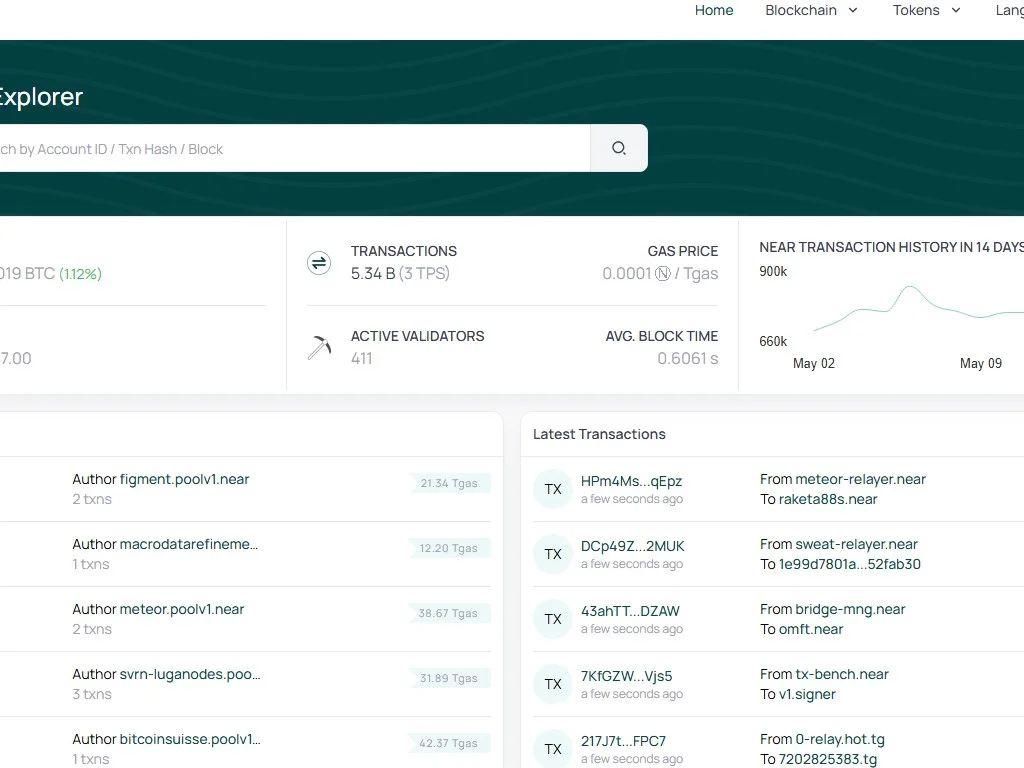
NEAR Protocol is a proof-of-stake layer-1 blockchain that uses sharding to process transactions in parallel across multiple chains that collectively form a single network. From a user perspective, NEAR feels like one chain with one balance and one account. From the protocol perspective, transactions are distributed across four independent shards in 2026, each producing blocks every 600 milliseconds, with cross-shard communication happening transparently within the same block height. The result is a network capable of more than 100,000 transactions per second in theory and routinely processing tens of millions of transactions per day in practice, all with finality measured in a second or two.
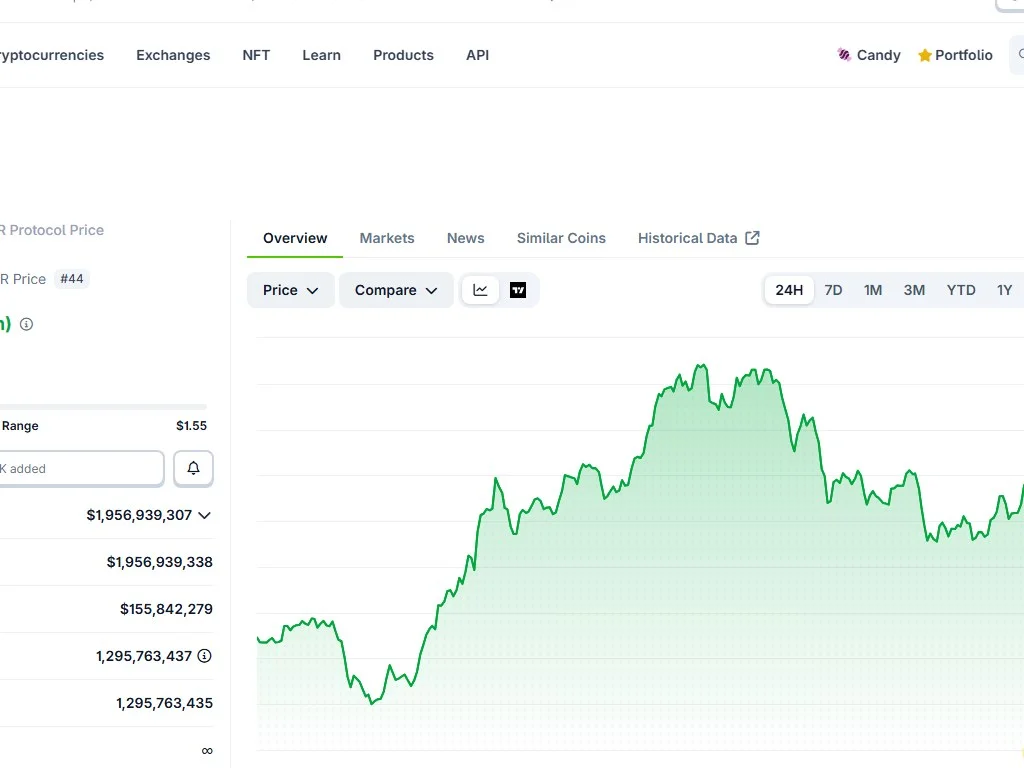
The token that powers the network is NEAR. It is used to pay transaction fees (gas), to stake with validators to secure the network, to vote on protocol governance, and increasingly as collateral inside NEAR-native DeFi protocols. NEAR has a built-in inflation model of approximately 5 percent per year, with most of that going to validators and a portion burned through transaction fees. As of 2026 the circulating supply sits a little above 1.2 billion NEAR with a maximum that grows slowly over time, although the burn rate now offsets a meaningful slice of the issuance during periods of high network activity.
What sets NEAR apart from most chains is the obsessive focus on usability. Account names are human readable, like alice.near or bunny.near, instead of long hexadecimal strings. Accounts can be funded by other accounts before they ever sign a transaction, which means new users can be onboarded without owning any crypto first. Smart contracts can pay gas fees on behalf of their users through a feature called meta transactions, eliminating the dreaded "buy gas first, then use the dApp" experience that has held back mainstream adoption on most other chains.
A Brief History: From 2018 to Modular NEAR
NEAR was founded in 2018 by Illia Polosukhin and Alex Skidanov. Polosukhin had been at Google Research where he was one of the co-authors of the original Transformer paper that underpins essentially every modern AI model. Skidanov came from MemSQL where he led core database engineering. Their original goal was actually to build a machine learning programming tool, and they were trying to crowdsource code from developers in various countries. They needed a payment system that worked globally without banking friction, looked at existing blockchains, and concluded none of them were ready for real-world consumer use. So they pivoted and built their own.
The NEAR Foundation was incorporated in Switzerland in 2020, mainnet launched in April of that year under a phased "MainNet Restricted" model where transfers were locked until token holders voted to enable them, and full mainnet went live in October 2020. The early years were dominated by building out the validator set, implementing the first phase of sharding (Simple Nightshade) in late 2021, and onboarding the first wave of developers and dApps.
The Aurora EVM environment launched in 2021 as a way to give Ethereum developers a familiar landing zone on NEAR. The Rainbow Bridge connected NEAR to Ethereum for asset transfers. Phase 2 of Nightshade, which added chunk-only producers, shipped in 2023 and dramatically lowered the hardware requirements for participating in block production. Phase 3, including stateless validation and full state sharding, rolled out across 2024 and 2025, bringing NEAR to its current four-shard configuration with a path to thirty-plus shards in the coming years.
In 2023 the original development company Pagoda announced a strategy called Pagoda Discovery which evolved by 2024 into what is now called modular NEAR. Pagoda itself wound down its consumer-facing operations and core development was redistributed to a constellation of independent teams including the NEAR Foundation, NEAR One (the new core protocol team), HERE Wallet, Proximity Labs, and several others. This decentralization of the development organization mirrored the technical decentralization of the chain itself. By 2026 NEAR has essentially no single point of corporate failure, with multiple teams in different jurisdictions independently maintaining and upgrading the protocol.
Nightshade Sharding: How NEAR Actually Scales
If you only remember one thing about NEAR, remember this: it is one of the only major blockchains that has actually shipped working sharding. Ethereum spent years planning sharding before abandoning execution sharding in favor of rollup-centric scaling. Polkadot has parachains but they are independent chains, not shards of a single state machine. NEAR built Nightshade, a unique sharding design where a single logical chain is split into multiple physical chains called shards, each producing its own block at every height, with the protocol guaranteeing that everything stays consistent and atomic across shards.
In Nightshade, each block at height H is actually a collection of chunks, one chunk per shard. So at block height H you have chunk 0 from shard 0, chunk 1 from shard 1, chunk 2 from shard 2, and chunk 3 from shard 3. A separate group of validators called chunk producers are responsible for producing these chunks. A higher tier of validators called block producers aggregate the chunk headers from all shards into a single block, sign it, and propagate it across the network. This means the chain has a unified header but parallel execution.
Cross-shard transactions, which would be a nightmare in most sharded designs, are handled by an asynchronous receipt model. When a transaction on shard 0 needs to invoke a contract that lives on shard 2, the transaction first executes on shard 0 (deducting gas, recording the call), and then a receipt is forwarded to shard 2 where it gets included in the next block on that shard. The user does not see this complexity. They see a transaction that took maybe two blocks to fully finalize instead of one, which on NEAR means roughly 1.2 seconds instead of 600 milliseconds.
Stateless validation, which shipped in 2024, was the unlock that allowed shards to scale further without forcing every validator to hold the entire state of every shard. In a stateless model, the chunk producer includes a cryptographic proof (a state witness) alongside the chunk. Anyone can verify the chunk by checking the witness against the state root, without needing to actually store the underlying state. This decouples the size of the global state from the hardware requirements of validators, which is the bottleneck that prevented most other chains from sharding successfully.
The roadmap published by NEAR One targets thirty shards by 2027 and a long-term ceiling that is bounded only by demand. Adding shards is now a routine governance action rather than a major protocol upgrade. The chain can grow elastically as transaction volume grows.
Chain Abstraction: Signing Bitcoin, Ethereum and Solana From NEAR
Sharding is the technical headline, but chain abstraction is arguably NEAR's most important innovation of the past two years and the one most likely to define its future. The core idea is that users should not have to know which chain a particular asset or application lives on. A wallet should just hold their portfolio, and applications should just work regardless of underlying network.
NEAR delivered this through a stack of three primitives. The first is chain signatures, a multi-party computation service running on the NEAR validator set. Validators collectively hold a threshold-shared secret key. When a user's NEAR account requests a signature for a Bitcoin or Ethereum transaction, the validators run an MPC protocol to produce a signature without any single validator ever seeing the full private key. The user can derive a deterministic Bitcoin address, an Ethereum address, a Solana address, or addresses on dozens of other chains, all controlled by their NEAR account.
The second primitive is the OmniBridge, a generalized message passing layer that complements chain signatures. While chain signatures let NEAR accounts directly control external addresses, OmniBridge handles the inverse direction: external chains pushing messages and assets into NEAR. Combined, the two primitives let any NEAR application function as a multi-chain hub without ever wrapping assets or relying on a centralized bridge custodian.
The third primitive is the intent layer. Users express intents like "swap my Bitcoin for USDC on Solana at the best available rate" and a network of solvers competes to fulfill that intent. The user signs one message on NEAR; the solver handles the cross-chain choreography. This is the user-facing result of chain abstraction. From the user's perspective there is one wallet, one balance view, one signature, and the destination chain is just an implementation detail.
User declares "swap BTC for SOL". Solvers compete to execute across chains. One signature, multi-chain result.
Generalized message passing. External chains pushing assets/state into NEAR without wrapped tokens or centralized bridges.
Validators jointly sign Bitcoin, Ethereum, Solana, Cosmos transactions on behalf of NEAR accounts. No bridges, no wrapped assets, no custodians.
Why does this matter? Because the dominant friction in crypto in 2026 is not throughput or fees, it is fragmentation. Hundreds of chains, thousands of bridges, dozens of wallets, and an endless maze for users. Chain abstraction tries to solve this at the protocol level instead of pretending it does not exist. NEAR's bet is that the chain that abstracts away other chains becomes the default user entry point, even if the underlying assets live elsewhere.
NEAR AI: Verifiable Agent Infrastructure
The other major NEAR initiative of 2025 and 2026 is NEAR AI. With Illia Polosukhin's background as a co-author of the original Transformer paper, it was almost inevitable that NEAR would push into AI infrastructure. The pitch is that autonomous AI agents need three things to operate at internet scale: a payment rail that does not require a credit card, an identity system that does not require KYC for every interaction, and verifiable inference so users can trust what an agent claims to be doing.
NEAR provides all three. The payment rail is the native NEAR token plus access to USDC and Bitcoin through chain signatures. The identity system is human-readable accounts that an agent can use to receive payments, hold reputation, and prove its history. Verifiable inference is delivered through trusted execution environments and zero-knowledge proofs that anchor model outputs to the chain.
The NEAR AI hub launched in 2024 and by 2026 hosts thousands of agents that range from trading bots running on top of decentralized exchanges to content moderation agents to autonomous DAO treasury managers. Agents are first-class on-chain entities. They can hold NEAR, sign cross-chain transactions through chain signatures, and crucially, prove their reasoning through verifiable inference proofs. This is the part most other chains cannot do. Solana has the speed for agents to operate but no native verifiability layer for AI. Ethereum has the security but not the throughput or the agent primitives.
Each agent owns a NEAR account, builds reputation, can be granted spending limits and revocable keys.
Through chain signatures, an agent can act on Bitcoin, Ethereum, Solana and Cosmos chains from a single NEAR identity.
Model outputs are anchored on chain via TEEs or zk proofs, so anyone can audit what an agent actually computed.
Sub-cent fees and meta-transactions mean agents can charge per inference, per query, or per millisecond.
The implication for the broader crypto ecosystem is significant. If agentic AI becomes the dominant interface to the internet in the coming years, the chain that already has working agent infrastructure has a substantial head start. NEAR's pivot to AI is not a hype trade. It is leveraging a co-founder who literally helped invent the architecture behind modern LLMs and a chain whose performance profile happens to match exactly what high-frequency agent workloads need.
Aurora: The EVM on NEAR
Not every developer wants to learn Rust or pick up the NEAR account model. To meet Ethereum developers where they are, NEAR shipped Aurora, a fully EVM-compatible execution environment that runs as a smart contract on NEAR. From a developer perspective, Aurora looks and feels like Ethereum. Same Solidity contracts, same tooling, same RPC interface. From the NEAR perspective, Aurora is just another contract sitting on a shard, inheriting NEAR's finality and fee structure.
Aurora gas fees are paid in ETH by default, although the user pays NEAR-native equivalents in practice through built-in conversion. Block times match NEAR's, and finality is in the same one to two second range. Many DeFi protocols, lending markets, and AMMs that originated on Ethereum have deployed copies on Aurora to take advantage of cheaper fees while preserving their tooling investment. Aurora has its own token, AURORA, used for governance of the Aurora DAO, separately from the underlying NEAR economics.
The strategic value of Aurora is that it gives NEAR a second go-to-market path. Builders who want NEAR's native experience use Rust and the NEAR account model. Builders who want maximum compatibility with the existing Ethereum tooling and developer pool use Aurora. Both paths share the same underlying chain, the same finality, and increasingly the same liquidity pool through cross-contract calls between Aurora and the rest of NEAR.
The NEAR Token: Utility, Staking, and Economics
The NEAR token serves four primary purposes. Paying transaction fees, which are typically a fraction of a cent and partly burned. Staking with validators to secure the network and earn rewards in the 8 to 10 percent range depending on total stake and network activity. Voting on governance proposals through the NEAR Foundation and the increasingly active token-holder forum. And finally serving as collateral or pricing asset inside NEAR-native DeFi.
Validators on NEAR must run a node and provide stake. With chunk-only producers introduced in 2023, the hardware bar is dramatically lower than running a Solana validator, although the stake requirement remains meaningful, currently around 30,000 NEAR for chunk-only producer slots and considerably higher for full block producer slots. Regular token holders who do not want to run a node can delegate to existing validators through any major NEAR wallet, sharing in the staking rewards while paying a validator commission typically in the 1 to 10 percent range.
The inflation model is approximately 5 percent annual issuance with 90 percent going to validators (and through them to delegators) and 10 percent going to the protocol treasury. Transaction fees are partly burned, which means at high network activity NEAR is mildly deflationary, and during quiet periods it is mildly inflationary. The design goal is to make staking economically rational for long-term holders while keeping transaction costs negligibly small for users.
Top dApps and the NEAR Ecosystem in 2026
The NEAR ecosystem in 2026 spans DeFi, gaming, social, AI, and consumer-facing applications. A few names dominate.
Ref Finance is the leading native automated market maker on NEAR, the equivalent of Uniswap in the ecosystem. It supports concentrated liquidity, multi-hop swaps across NEAR-native and bridged assets, and increasingly integrates intent-based routing through the chain abstraction stack. Total value locked on Ref Finance has grown steadily as the chain abstraction layer brought in Bitcoin and Ethereum native liquidity without requiring wrapped assets.
Burrow is NEAR's leading lending protocol, similar in design to Aave on Ethereum. Users supply assets to earn yield and borrow against them. With chain signatures, Burrow now natively accepts Bitcoin and Ethereum as collateral without those assets having to be wrapped on NEAR, a capability that no other major lending market can replicate.
Meteor Wallet and HERE Wallet are the two leading consumer wallets, both supporting chain signatures so that a single NEAR account holds a unified portfolio across Bitcoin, Ethereum, Solana and dozens of other chains. NEAR Mobile targets the same use case from a mobile-first design.
The BOS, or Blockchain Operating System, was an experiment launched by Pagoda in 2023 to build a chain-agnostic frontend layer. It evolved over 2024 and 2025 into a component registry and rendering system used by many NEAR-native consumer apps. While the original ambitions around BOS as a universal frontend were scaled back, the component model remains widely used by NEAR developers shipping consumer applications.
NEAR Lake is an infrastructure layer that streams every block, chunk and receipt from the chain to subscribers, used by analytics platforms, indexers, and AI agents that need real-time chain data. It plays roughly the same role as The Graph does in the Ethereum ecosystem but is operated as a first-party NEAR service.
Beyond these core names, the ecosystem includes consumer apps like SWEAT (move-to-earn with millions of users), Calimero (private shards for enterprise), Mintbase (NFT minting and marketplaces), Pikespeak (analytics), and a long tail of AI agent projects, gaming dApps, and social applications. As of 2026 the total value locked across NEAR DeFi (excluding Aurora) sits in the high hundreds of millions to low billions depending on the asset price cycle, while the application layer generates more daily active users than most layer-1 chains thanks to the SWEAT app alone.
NEAR vs Solana vs Aptos: How They Compare
NEAR, Solana, and Aptos are all proof-of-stake layer-1 chains positioned as alternatives to Ethereum, but their architectural choices are dramatically different. Solana is a single monolithic chain pushing every transaction through a single pipeline at the cost of very high validator hardware requirements. Aptos, built by former Meta engineers from the Diem project, uses a parallel execution engine (Block-STM) on a single chain with a Move-based programming model. NEAR is the only one of the three with native sharding.
In simple terms, Solana wins on raw single-shard throughput and has the deepest current DeFi liquidity outside Ethereum. Aptos has a cleaner programming model with Move and excellent parallel execution but a smaller ecosystem. NEAR wins on usability, sharding-based scalability, and chain abstraction. None of them are strictly better than the others. They optimize for different things.
How to Use NEAR: Wallet Setup and First Transactions
Getting started with NEAR is genuinely one of the easiest onboarding experiences in crypto. Pick a wallet (HERE Wallet, Meteor Wallet, or NEAR Mobile are the most popular consumer choices). Create an account. Unlike most chains, you do not need to fund your account before using it. A friend, a dApp, or even a faucet can fund the account for you. The wallet will let you choose a human-readable name ending in .near, which becomes your address.
To bring assets onto NEAR, you have a few options. The Rainbow Bridge connects NEAR to Ethereum and supports major ERC-20 tokens. Centralized exchanges like Binance, OKX, Coinbase, and Kraken all support direct NEAR deposits and withdrawals. With chain signatures and OmniBridge live, the friction of moving assets into NEAR has dropped dramatically. Most modern NEAR wallets simply show your Bitcoin, Ethereum, and Solana balances directly under your .near account, and you swap between them through the intent layer without ever doing a manual bridge step.
Once you have a wallet with NEAR in it, you can stake to a validator for yield, swap tokens on Ref Finance, lend on Burrow, mint and trade NFTs on Mintbase, or simply use NEAR-native consumer apps like SWEAT or NEAR Social. All of this happens with sub-second confirmation and fees you will not notice. For most users, that is the practical day-to-day experience: it just feels fast and free.
Developer Experience: Building on NEAR
NEAR has invested heavily in developer experience and it shows. Smart contracts are written in Rust by default, with first-class support for JavaScript through the near-sdk-js toolkit. This is rare. Most chains force you to learn Solidity or Move. NEAR lets a frontend developer who knows JavaScript ship a working smart contract within an afternoon.
The tooling stack includes the NEAR CLI for command-line interaction, the NEAR SDK for Rust and JS contract development, near-workspaces for integration testing, and the NEAR Lake framework for streaming chain data. The official developer documentation is thorough and includes interactive tutorials. For consumer-facing apps, the BOS component model lets developers ship UI as on-chain components that can be loaded by any compatible frontend, providing a degree of frontend decentralization that no other major chain matches.
Gas costs are predictable and very low. Contract storage is paid for through a deposit refund model: you lock NEAR tokens proportional to the storage you use, and when you delete the data the tokens are returned. This avoids the "state bloat" problem that has plagued other chains.
For developers coming from Ethereum, Aurora provides a near-zero-friction path. Existing Solidity contracts deploy unchanged. Existing tooling like Hardhat, Foundry, and Ethers.js work out of the box. The main difference is the fee structure, which is dramatically cheaper, and the underlying finality, which is dramatically faster.
Risks and Honest Trade-offs
No chain is perfect, and NEAR has real risks and trade-offs that anyone considering it should understand.
The first is ecosystem size. Despite NEAR's technical advantages, its DeFi liquidity is still much smaller than Ethereum's or Solana's. If you need deep liquidity for very large trades, NEAR may not be the right venue today. The chain abstraction stack mitigates this somewhat by giving NEAR users access to liquidity on other chains, but the native NEAR liquidity remains relatively shallow.
The second is validator centralization risk. While chunk-only producers have lowered the hardware bar, the actual distribution of stake is still concentrated among a relatively small number of large validators. This is similar to the situation on most other proof-of-stake chains but worth being aware of.
The third is the complexity of cross-shard execution. While Nightshade's asynchronous receipt model works well in practice, it does introduce subtle developer-facing complexity. Cross-contract calls that land on different shards may take multiple blocks to fully resolve, which means dApp developers need to design with eventual consistency in mind for some workflows.
The fourth is the chain signatures and MPC trust model. While the design is cryptographically sound, it does depend on the honesty of a threshold of NEAR validators. A coordinated attack by a majority of validators could in principle compromise the MPC keys. The same risk exists for any threshold signing scheme; it is not unique to NEAR but it is worth understanding.
Finally, there is the broader market risk that comes with any layer-1 token. NEAR's price has been volatile through multiple cycles, and like any crypto asset it can lose value rapidly. Token issuance through the 5 percent inflation rate also creates persistent sell pressure from validators and delegators monetizing their rewards.
The Road Ahead: NEAR in 2026 and Beyond
NEAR's published roadmap through 2027 focuses on three priorities. Continuing to scale Nightshade toward thirty shards and beyond, with full elasticity so that shards can be added and removed in response to demand. Maturing chain abstraction so that more applications support intent-based interactions natively rather than as an optional layer. And growing the AI agent ecosystem with new verifiability primitives, better TEE integration, and tighter ties between NEAR and the broader open-source AI community.
The strategic bet is that the future of crypto looks less like dozens of competing chains and more like a small number of interoperable hubs through which users move freely without thinking about underlying networks. NEAR is wagering that its combination of native sharding, chain abstraction, and AI infrastructure positions it as one of those hubs. Whether that bet pays off depends on execution, ecosystem development, and the broader trajectory of crypto adoption.
For users, the takeaway is simpler. NEAR works. It is fast, cheap, easy to onboard, and increasingly the most natural place to operate a multi-chain portfolio without bridge headaches. For developers, NEAR offers a programming model that does not require learning a new language and a chain that does not break under load. For investors, NEAR is one of a handful of layer-1 tokens with genuine technical differentiation rather than a marginal variation on existing designs.
Frequently Asked Questions
Q What is NEAR Protocol in simple terms?
Q How is NEAR different from Ethereum?
Q What is Nightshade sharding?
Q What is chain abstraction on NEAR?
Q What is the NEAR token used for?
Q Is NEAR faster than Solana?
Q Can I run Ethereum smart contracts on NEAR?
Q How do I stake NEAR?
Q What is NEAR AI?
Q Is NEAR Protocol a good investment in 2026?
Conclusion
NEAR Protocol in 2026 is one of the most technically distinctive layer-1 blockchains in production. It is the only major chain that has successfully shipped horizontal sharding through Nightshade, the first to ship working chain abstraction through chain signatures and the OmniBridge, and one of the very few with genuine native infrastructure for AI agents. Combined with human-readable account names, sub-cent fees, sub-second finality, and a developer experience that supports Rust, JavaScript, and Solidity via Aurora, NEAR has carved out a position that none of its competitors can fully replicate.
Whether NEAR ultimately wins or loses the layer-1 race over the next decade will depend on factors well beyond technology, including ecosystem growth, regulatory developments, and the broader trajectory of crypto adoption. But the technical foundation is real, the team behind it is exceptional (especially in AI given Polosukhin's history), and the chain works today in production at the scale that matters. If you have not tried NEAR yet, install a NEAR wallet, pick a human-readable name, swap a small amount through Ref Finance, and see what a sharded chain with chain abstraction actually feels like. It is the closest thing in crypto today to a blockchain that just works.
Related Guides
- What Is NEAR Protocol? Beginner Guide to Nightshade, Sharding and NEAR Token (2026)
- Chain Abstraction: Why 2026 Ends the L1 vs L2 War
- NEAR vs Solana: Layer 1 Blockchains Compared (2026)
- What Is Chain Abstraction: The End of Bridging in Crypto (2026)
- What Is Biconomy: Account Abstraction, Gasless UX and Cross-Chain Execution (2026)