Stablecoin Market Cap vs On-Chain Liquidity Guide
— By Whatsertrade in Tutorials

Stablecoin market cap vs on-chain liquidity explained: learn why usable liquidity often matters more for trading, DeFi access, and order execution.
This page compares stablecoin market cap vs on-chain liquidity. It is about usable liquidity and execution quality, not stablecoin peg mechanics.
Stablecoins are one of the most important parts of crypto markets. Traders use them to enter and exit positions, move value across chains, provide liquidity and access DeFi protocols.
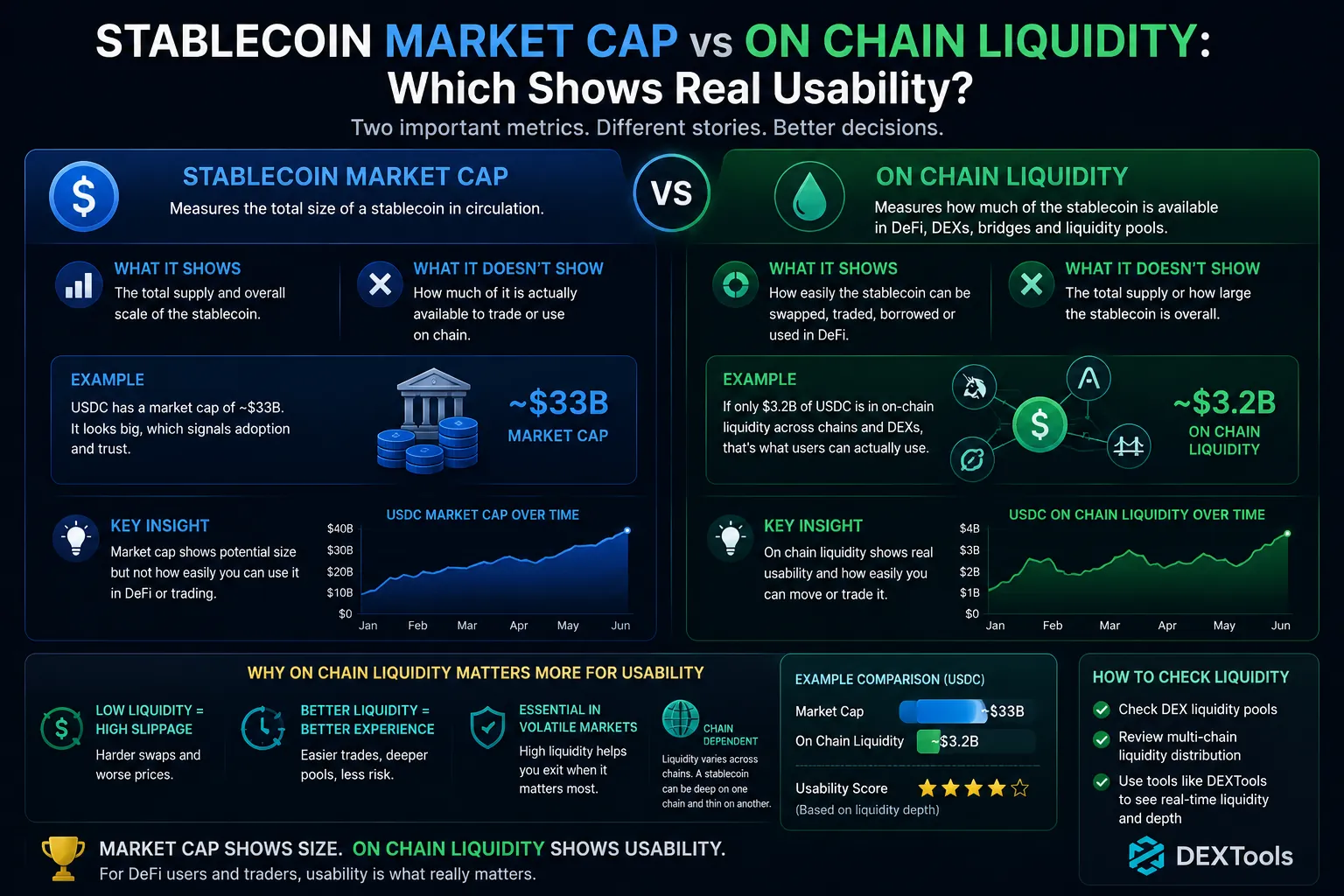
Many people judge stablecoins by market cap. A large market cap can suggest trust, adoption and scale. But market cap does not always show how usable a stablecoin is on chain.
To understand real usability, traders should also look at on chain liquidity. Comparing stablecoin market cap vs on chain liquidity can reveal whether a stablecoin is widely issued, actively usable or mostly concentrated in limited environments.
What Is Stablecoin Market Cap?
Stablecoin market cap measures the total value of a stablecoin supply. If a stablecoin has 10 billion tokens in circulation and each token is worth around one dollar, its market cap is about $10 billion.
Market cap can show the size of a stablecoin. It may indicate broad adoption, strong issuance and user trust.
However, market cap alone does not show where the stablecoin is available or how easily it can be traded.
A large stablecoin may still have poor liquidity on a specific chain, DEX or trading pair.
What Is On Chain Liquidity?
On chain liquidity refers to how much of a stablecoin is available in decentralized markets, liquidity pools, bridges and DeFi protocols.
This metric shows practical usability. If a stablecoin has deep liquidity across major pools, users can swap, lend, borrow and bridge it more efficiently.
On chain liquidity matters because traders do not only need stablecoins to exist. They need to use them without high slippage, delays or poor execution.
Stablecoin Market Cap vs On Chain Liquidity: The Key Difference
The key difference is size vs usability.
Market cap shows how large a stablecoin is. On chain liquidity shows how usable it is in live DeFi markets.
A stablecoin can have a large market cap but limited liquidity on a specific network. Another stablecoin may have a smaller market cap but strong liquidity in the ecosystem where users actually trade.
For DeFi users, local liquidity often matters more than global market cap.
Why Market Cap Can Be Misleading
Market cap can create a false sense of accessibility. Traders may assume that a large stablecoin is easy to use everywhere, but stablecoin liquidity is often fragmented across chains.
A stablecoin may be dominant on one network and weak on another. It may have strong centralized exchange support but limited DEX liquidity. It may exist in multiple versions, such as native and bridged forms, which can confuse users.
This is why traders should avoid judging stablecoins only by global supply.
Why On Chain Liquidity Matters
On chain liquidity affects execution quality. If a stablecoin has deep liquidity, traders can move in and out of positions with lower slippage.
It also affects DeFi usability. Lending protocols, DEXs, yield markets and bridges all depend on stablecoin liquidity.
A stablecoin with strong on chain liquidity can become a base asset inside an ecosystem. Traders may use it as a quote asset, liquidity pair or collateral asset.
This type of usability can be more important than market cap alone.
Chain Specific Liquidity Matters
Stablecoin liquidity is not equal across networks.
A stablecoin may be highly liquid on Ethereum but less useful on a smaller chain. Another stablecoin may dominate one ecosystem because it has better integrations with local DEXs and lending protocols.
Before using a stablecoin on any chain, traders should check whether there is enough liquidity for the actions they want to take.
A stablecoin that is useful in one ecosystem may be inconvenient in another.
How Stablecoin Liquidity Affects Traders
Stablecoin liquidity affects several parts of trading:
Swap execution.
Slippage.
Bridge routes.
Collateral availability.
Yield opportunities.
Exit options during volatility.
Pair depth on DEXs.
During calm markets, weak liquidity may not seem important. During stress, it can become critical. Traders may need to exit quickly, move funds or rotate into safer assets.
If stablecoin liquidity is thin, those actions become harder.
What Real Stablecoin Usability Looks Like
A highly usable stablecoin usually has strong liquidity across major DEXs, integration with lending protocols, reliable bridge support and active use as a trading pair.
It should also have enough depth to support large transactions without major slippage.
Real usability is not only about supply. It is about access, movement and execution.
How DEXTools Can Help
DEXTools can help traders review stablecoin pairs, liquidity, volume and market activity. This is useful when deciding whether a stablecoin is actually usable in a specific DeFi environment.
Instead of assuming that a stablecoin is liquid because it has a large market cap, traders can check live pool data and trading behavior.
This helps reduce execution risk.
Stablecoin market cap and on chain liquidity measure different things. Market cap shows total size. On chain liquidity shows practical usability.
For DeFi traders, usability often matters more than headline supply. A stablecoin needs deep liquidity, strong integrations and efficient trading routes to be truly useful.
The best stablecoin analysis compares both metrics. A large market cap is helpful, but real on chain liquidity is what allows traders to use the stablecoin effectively.
How to Read On-Chain Data: Metrics, Wallet Flows and Dashboards Protocol Revenue vs TVL: Understanding DeFi Demand What Is Impermanent Loss in DeFi? Complete Liquidity Provider Guide What Is Yield Farming in Crypto? Complete DeFi Strategy Guide Protocol Owned Liquidity vs Mercenary LiquidityRelated Guides
- Market Cap vs Liquidity: Which Matters More?
- What Is XRP Market Cap? Complete 2026 Guide
- What Is Market Cap in Crypto? Complete Beginner Guide (2026)
- FDV vs Market Cap in Crypto: How to Read Unlock Risk Before You Buy (2026)
- Market Cap vs FDV in Crypto: What the Gap Really Means (2026)
- Fake Market Cap vs Real Exit Liquidity
Frequently Asked Questions
What is the difference between stablecoin market cap and on-chain liquidity?
Stablecoin market cap is the total value of all coins in circulation, while on-chain liquidity is the portion actually available in pools and venues for trading. A large market cap does not guarantee that funds are easily usable for swaps.
Why does on-chain liquidity matter more for trading?
On-chain liquidity determines how easily you can trade in and out of a stablecoin without large slippage, which affects real execution. Market cap reflects total supply but not how much of it is readily available where you trade.
Can a stablecoin have a high market cap but low usable liquidity?
Yes, because much of the supply may sit idle in wallets or be locked rather than placed in active trading pools. In that case, large trades can still face slippage despite the high reported market cap.
How does on-chain liquidity affect DeFi access and execution?
Deeper on-chain liquidity generally allows smoother swaps, better pricing, and easier access to DeFi protocols. Thin liquidity can lead to higher slippage and difficulty executing larger transactions even for widely held stablecoins.