What Is Market Cap in Crypto? Full Guide 2026
— By Tony Rabbit in Tutorials
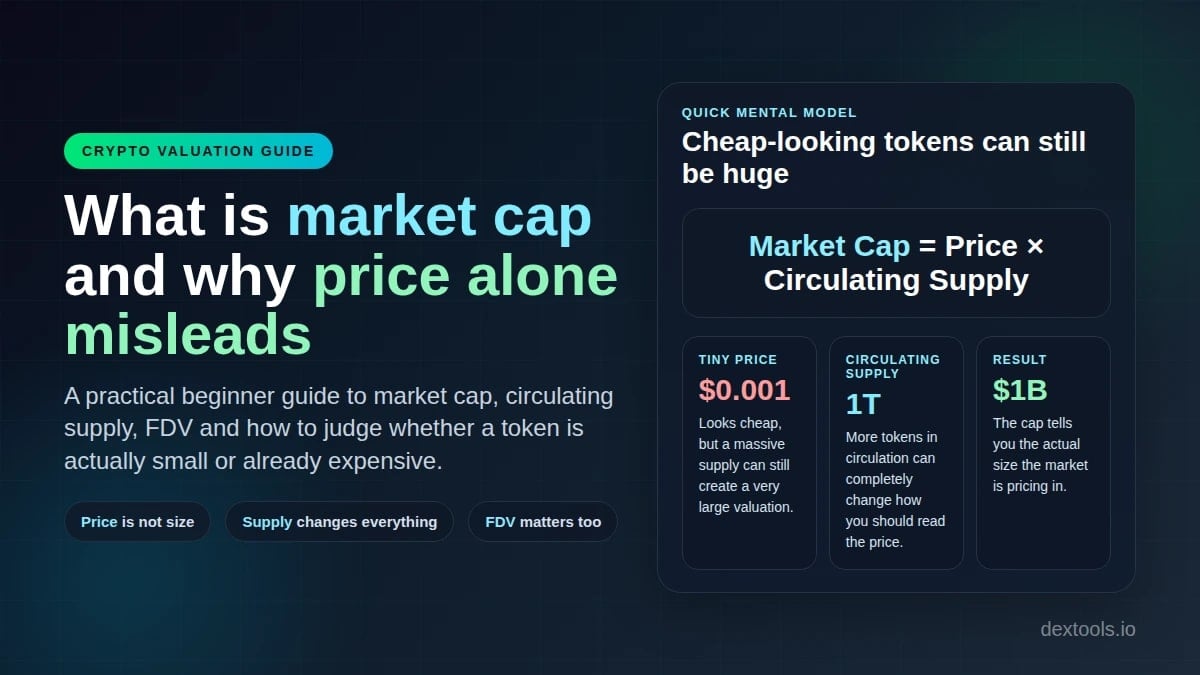
What is market cap in crypto? Learn how it is calculated, why price alone misleads, and how to compare market cap, volume, liquidity, FDV, and risk.
Market cap and scarcity models are not the same thing. If you want the Bitcoin-specific valuation angle, read Stock-to-Flow Bitcoin Model.
Market cap is one of the first numbers most crypto traders see, and also one of the most misunderstood. Beginners often focus on token price because it feels intuitive. A coin priced at one cent looks cheap. A coin priced at one hundred dollars looks expensive. In crypto, that logic breaks constantly because price by itself tells you almost nothing about size.
This guide fixes that. If you understand market cap properly, you stop judging assets by sticker price and start comparing them by valuation, supply, and actual room to grow. That does not make research easy, but it does remove one of the most common beginner mistakes.
Quick answer
- Market cap is the total value of a cryptocurrency based on its current price multiplied by circulating supply.
- It matters more than token price alone because a cheap-looking coin can still already be very large if the supply is huge.
- To judge valuation properly, you also need to compare market cap with FDV, circulating supply, unlocks, and liquidity.
What market cap actually means
In crypto, market cap is short for market capitalization. It is the live value of a cryptocurrency based on what the market is paying for each token today and how many tokens are currently circulating. That makes it a much better starting point than price when you want to compare one asset with another.
Think of it as a rough size label. It is not perfect, because the market can misprice anything in the short term, but it is still far more useful than staring at a token price without context. This is especially true in altcoins and memecoins where supply design can make small prices look deceptively attractive.
How market cap is calculated
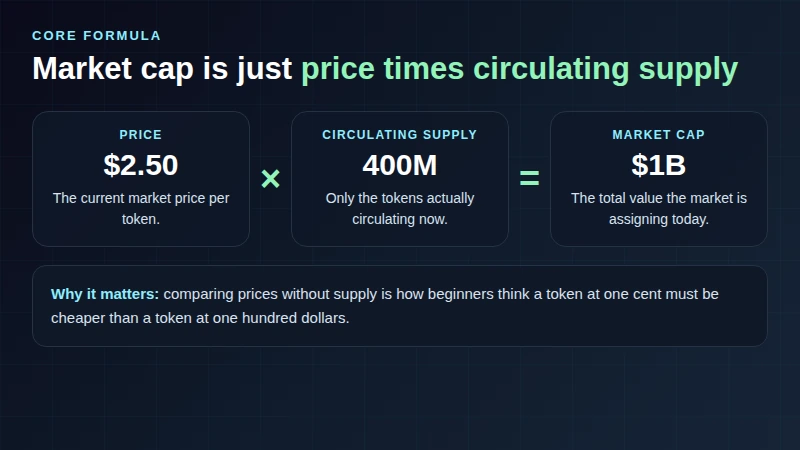
The formula is simple: price multiplied by circulating supply. If a token trades at $2.50 and 400 million tokens are circulating, the market cap is $1 billion.
The important phrase here is circulating supply, not max supply. Circulating supply means the coins or tokens that are actually in the market now. If the project has a huge amount of locked supply that is still waiting to unlock, market cap by itself can still understate future dilution risk.
Why price alone is misleading
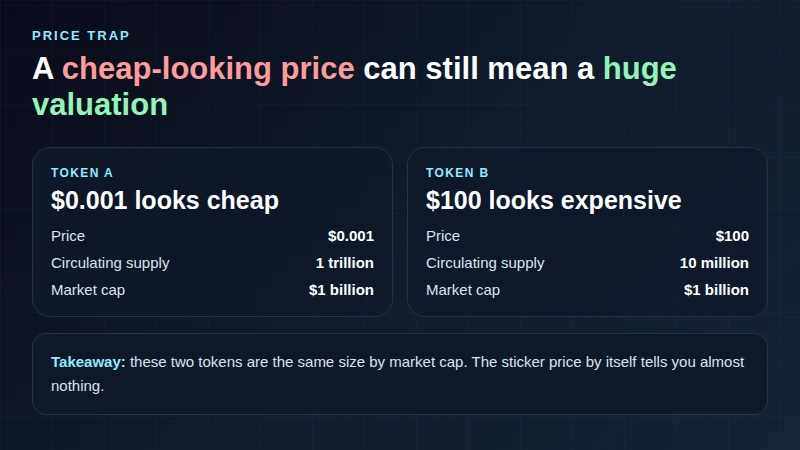
This is where many retail traders get trapped. A token at $0.001 feels early. A token at $100 feels expensive. But if the cheap-looking token has a massive supply, it may already be valued at hundreds of millions or even billions. Meanwhile, a higher-priced token with much smaller supply can actually be the same size or smaller.
Common beginner mistake
This is why experienced traders ask questions like: what is the market cap, what is the circulating supply, how large is the FDV gap, and what similar projects are trading at? That mindset is much more useful than saying a token is cheap just because the number on screen is small.
Market cap vs volume and liquidity
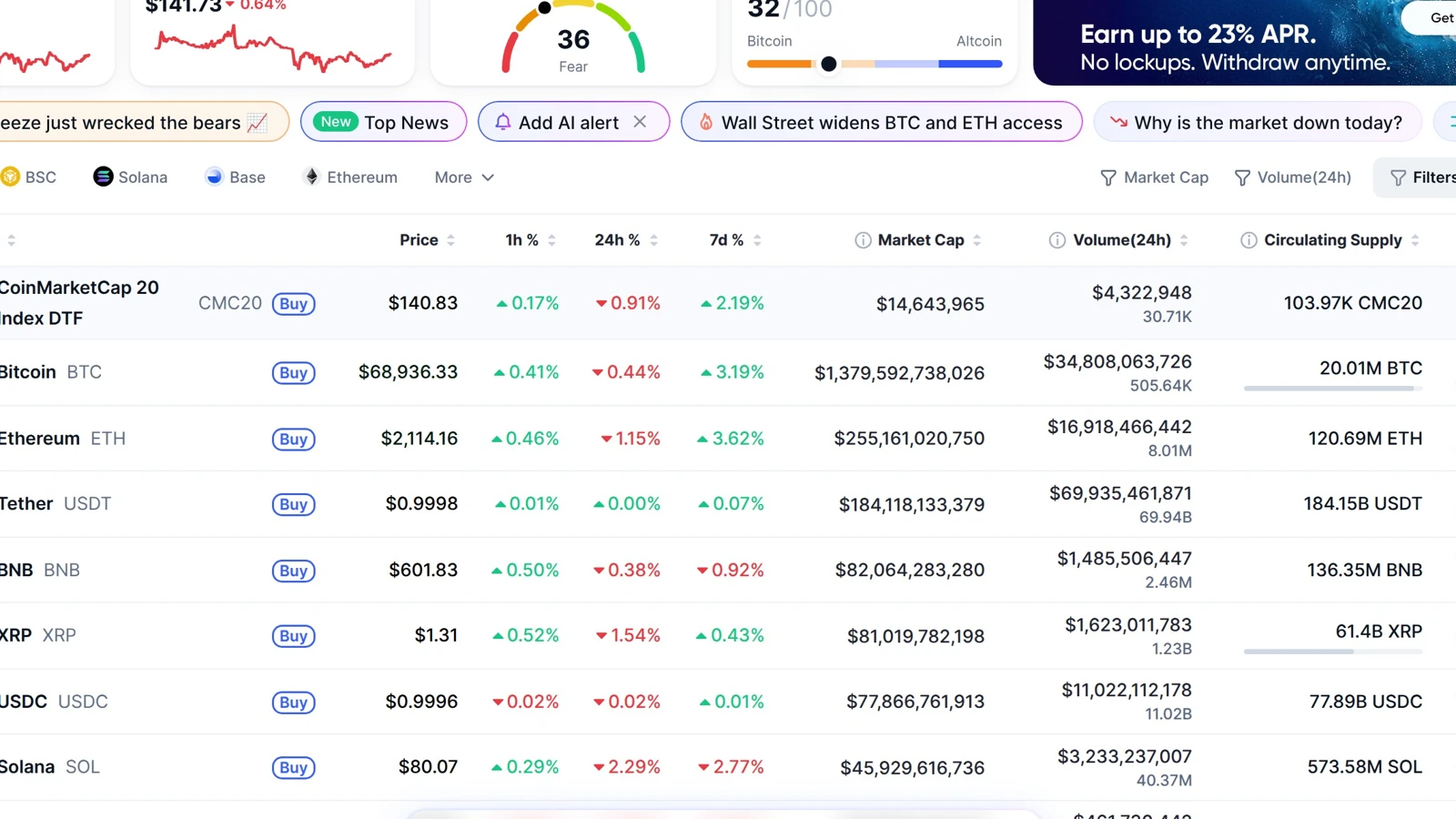
This is another place where beginners get tricked. Market cap is not the same thing as trading activity. A token can show a large market cap and still trade on weak daily volume. It can also trade on thin liquidity where a relatively small amount of buying or selling moves price harder than expected.
Practical read
Market cap vs FDV
Market cap tells you the size today. FDV, or fully diluted valuation, tells you what the valuation would be if the full token supply were already circulating at the current price. That makes FDV an important second lens, especially for newer projects with large unlock schedules ahead.
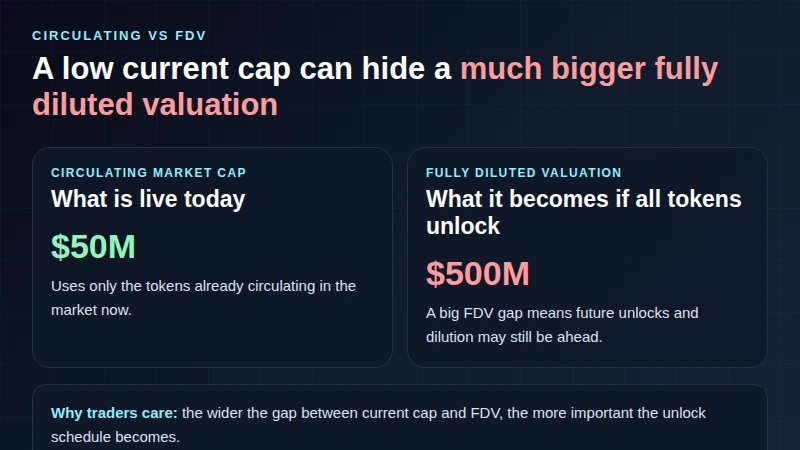
If a token shows a $50 million market cap but a $500 million FDV, that gap matters. It does not automatically mean the project is bad, but it does mean future supply could become a real headwind. This is where tokenomics, vesting schedules, and emissions become critical. If you want the deeper framework behind that, read our tokenomics guide.
Cap buckets and risk
Market cap is also useful because it helps you frame risk. The biggest assets usually have deeper liquidity and stronger market structure, but lower explosive upside. Smaller caps can move much faster, but they usually come with higher narrative risk, thinner liquidity, and a much higher chance of failure.
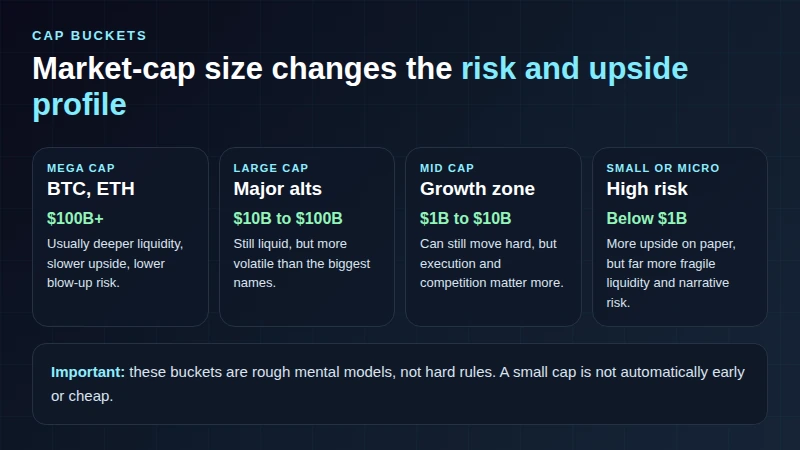
These buckets are only rough mental models, not strict rules. A small cap is not automatically early, and a large cap is not automatically safe. Still, they are helpful for setting expectations. Doubling from a tiny valuation is more plausible than doubling from a multi-hundred-billion-dollar base, but tiny caps also blow up more often.
How to use market cap in research
Good use of market cap is not about finding one magical number. It is about putting the number in context. A token's market cap means much more when you compare it with peers, study supply dynamics, and look at whether the project is actually earning attention or usage.
This is also where broader research helps. If you are comparing several tokens in the same sector, use a consistent framework. Compare market cap, FDV, revenue if it exists, product traction, and whether the narrative still has room. For practical workflow, our DYOR guide is a good companion piece.
Common mistakes when using market cap
- Using price instead of market cap: this is the classic beginner error.
- Ignoring FDV: a low current cap can hide a much larger diluted valuation.
- Ignoring liquidity: a token can look small and exciting but still be very hard to trade cleanly.
- Comparing unrelated sectors: a meme token, an exchange token, and a DeFi protocol should not be judged with the same simple story.
- Assuming low cap equals bargain: sometimes low cap just means low quality.
The cleanest way to think about market cap is this: it is a starting point, not the full thesis. It tells you how large the market currently says the project is. It does not tell you whether that valuation is justified, sustainable, or about to get diluted.
Frequently Asked Questions
What is market cap in crypto?
Market cap is the current token price multiplied by the circulating supply. It estimates the live size the market is assigning to that asset.
Why is market cap more useful than price alone?
Because price ignores supply. A token that looks cheap per coin can already be very large and hard to re-rate if supply is huge.
What is the difference between market cap and FDV?
Market cap uses circulating supply. FDV uses max supply. A big gap between them can signal future dilution risk from unlocks or emissions.
Does a low market cap mean a token is cheap?
No. A low market cap can offer more upside on paper, but it can also mean weaker liquidity, weaker product-market fit, or fragile narrative support.
What should I check besides market cap?
Check FDV, unlock schedules, circulating supply, liquidity, sector comparisons, and whether the project has real traction or only hype.