Market Cap vs Liquidity: Which Matters More?
— By Whatsertrade in Tutorials

Market cap vs liquidity explained: learn which crypto metric matters most for safe trading and how to assess tokens for hidden exit and slippage risks.
Many crypto traders check market cap before buying a token. Market cap can help estimate the size of a project and compare it with other tokens. But market cap alone does not tell you whether you can enter or exit safely.
Liquidity is often more important for actual trading. A token can show a high market cap but still have very little liquidity. This means the price can move sharply with small trades, and selling may become difficult when market conditions change.
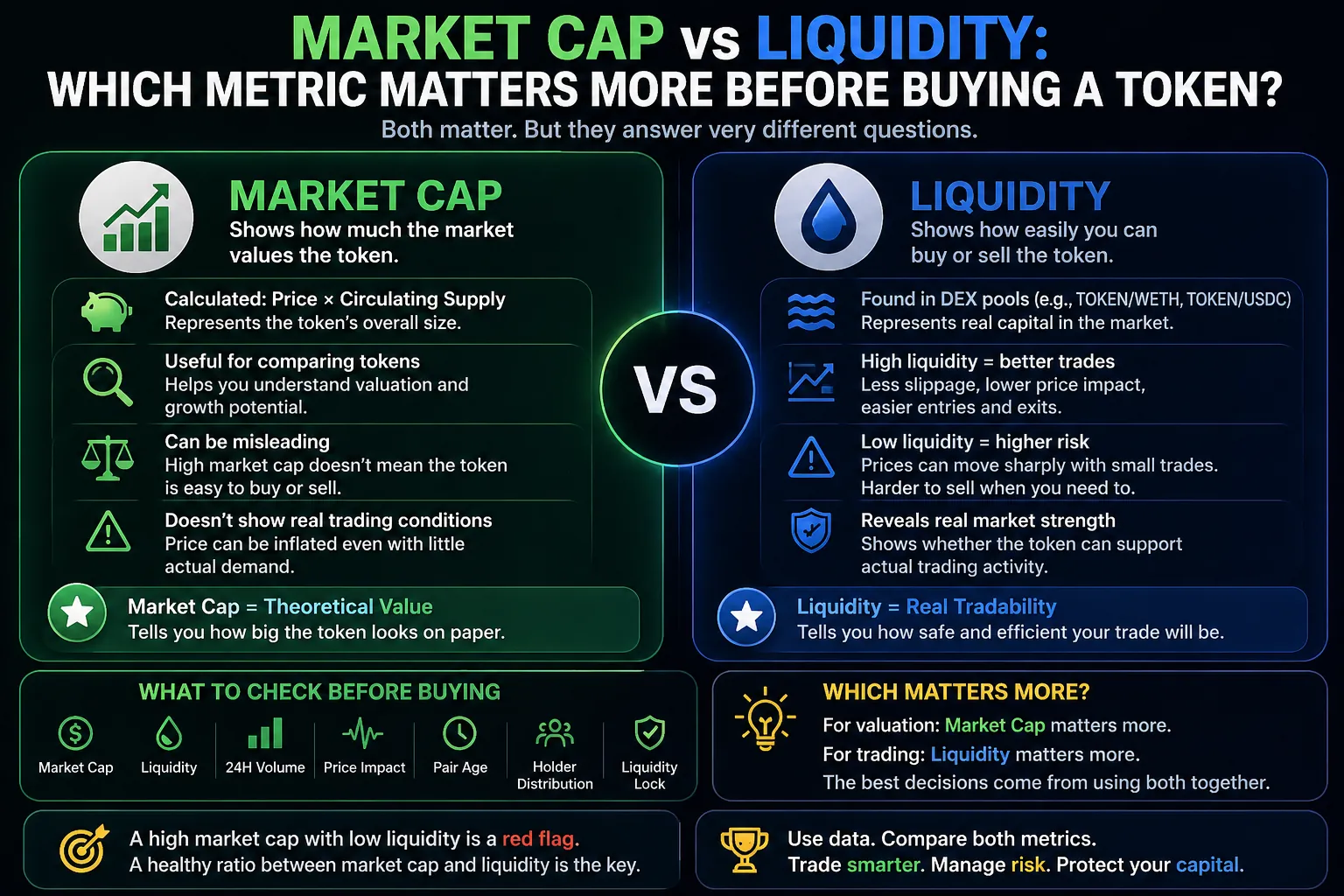
To make better decisions, traders need to understand both metrics. Market cap tells you how the market values the token. Liquidity tells you how tradable that value really is.
This guide explains market cap vs liquidity, why both matter, how they can mislead traders, and how to use DEXTools to compare them before buying a token.
What Is Market Cap in Crypto?
Market cap is the estimated total value of a token's circulating supply. It is usually calculated by multiplying the token price by the circulating supply.
Market cap helps traders understand how large a token is compared with other tokens. A token with a low market cap may have more room for growth, but it can also carry more risk. A token with a high market cap may be more established, but it may have less upside in percentage terms.
Market cap is useful, but it is not the same as liquidity. A token can have a large market cap without enough liquidity to support real trading.
What Is Liquidity in Crypto?
Liquidity refers to the amount of capital available in a trading pool. In DeFi, liquidity usually sits inside a decentralized exchange pool, such as TOKEN/WETH or TOKEN/USDC.
Liquidity determines how easily traders can buy or sell without moving the price too much.
High liquidity usually means:
- Lower price impact
- Better trade execution
- Easier entries and exits
- More stable price movement
- Less slippage
Low liquidity usually means:
- Higher price impact
- Worse execution
- More volatile candles
- Difficult exits
- Higher manipulation risk
For active traders, liquidity is one of the most important safety checks.
Market Cap Shows Size, Liquidity Shows Tradability
Market cap and liquidity answer different questions.
Market cap asks: how much is the token theoretically worth?
Liquidity asks: how easy is it to trade at that value?
A token can have a market cap of millions of dollars but only a small amount of liquidity. In that case, the market cap may look impressive, but the token may be hard to sell without crashing the price.
This is why traders should not judge a token only by market cap. A token's value is only useful if there is enough liquidity to support real buying and selling.
Why Market Cap Can Mislead Traders
Market cap can mislead traders because it is based on the last traded price and circulating supply. It does not mean that all tokens could be sold at that price.
For example, if a small buy pushes a low liquidity token to a higher price, the market cap may rise sharply. But that does not mean there is real demand at that valuation.
Market cap can look attractive when:
- The token price is rising quickly
- Supply numbers are unclear
- Liquidity is thin
- A small trade moves the chart
- The token has artificial volume
- Traders focus only on upside comparisons
A low market cap can suggest opportunity, but it can also signal early stage risk, low liquidity, weak demand, or poor market structure.
Why Liquidity Can Reveal Hidden Risk
Liquidity shows whether traders can actually move in and out of the token. It is especially important in DeFi because many tokens rely on one or two main pools.
Low liquidity can create serious problems. You may enter easily with a small buy, but when you try to sell, your trade may suffer large slippage. If several traders sell at the same time, the price can collapse quickly.
Liquidity can reveal:
A token with healthy liquidity is not automatically safe, but it is usually more tradable than a token with a large market cap and a shallow pool.
The Market Cap to Liquidity Ratio
One useful way to compare market cap and liquidity is to look at the relationship between them.
If market cap is very high but liquidity is very low, the token may be fragile. This means the displayed valuation may not be supported by enough capital in the pool.
For example, a token with a 50 million dollar market cap and only 100,000 dollars in liquidity may be much riskier than it looks. A few large sells could create heavy downside.
A healthier setup usually has enough liquidity to support the level of market activity. There is no perfect ratio, but extreme gaps between market cap and liquidity deserve caution.
When Market Cap Matters More
Market cap matters when you are comparing relative size, upside potential, and valuation.
It can help you ask:
- Is this token already large?
- How does it compare with similar tokens?
- Is the upside realistic?
- Has the token already expanded too much?
- Is the market cap supported by a real narrative?
- Does the valuation match the project's stage?
Market cap is useful for big picture analysis. It helps you avoid thinking a token is cheap just because its price per token is low.
When Liquidity Matters More
Liquidity matters more when you are making an actual trade.
It helps you ask:
- Can I enter without major price impact?
- Can I exit if the trade goes wrong?
- Is the pool deep enough for my position size?
- Are whales able to move the market easily?
- Is the chart vulnerable to sharp dumps?
- Is liquidity stable or leaving?
For execution and risk management, liquidity is often more important than market cap.
High Market Cap, Low Liquidity
This is one of the most dangerous combinations.
A token with high market cap and low liquidity may look successful, but the price can be fragile. If demand slows or a large holder sells, the pool may not have enough depth to absorb the pressure.
Warning signs include:
- Large valuation with shallow liquidity
- Huge price impact on moderate trades
- Low number of active buyers
- Large holders controlling supply
- Thin transaction flow
- Sudden vertical price moves
- Weak support after pumps
This setup can attract late buyers who focus on market cap but ignore exit risk.
Low Market Cap, High Liquidity
A token with low market cap and relatively strong liquidity can be more interesting, but it still needs research.
This setup may suggest that the token is more tradable and has better market depth relative to its size. However, liquidity alone does not guarantee demand.
Check whether:
- Volume is organic
- Holders are growing
- The contract is safe
- Liquidity is locked or stable
- The project has real activity
- The token is not abandoned
- The market cap reflects actual interest
Low market cap with strong liquidity can be attractive, but only when the rest of the data supports the trade.
How to Use DEXTools to Compare Market Cap and Liquidity
DEXTools can help traders review both market cap and liquidity before entering a position.
Check:
- Market cap
- Liquidity
- Volume
- Pair age
- Price impact
- Recent transactions
- Buy and sell pressure
- Holder behavior
- Liquidity changes
- Price structure
Do not look at one metric in isolation. A strong setup usually has a reasonable relationship between valuation, liquidity, volume, and demand.
Practical Checklist Before Buying
Before buying a token, ask:
- What is the market cap?
- Is the market cap realistic compared with similar tokens?
- How much liquidity is in the main pool?
- Is liquidity deep enough for my trade size?
- What is the price impact?
- Is volume supported by real liquidity?
- Are large holders selling?
- Is liquidity stable or decreasing?
- Can I exit without destroying my own price?
- Am I buying because the valuation is attractive or because the trade is actually liquid?
Which Metric Matters More?
For valuation, market cap matters more.
For trading, liquidity matters more.
The best analysis uses both. Market cap helps you understand the token's size and potential upside. Liquidity helps you understand whether you can safely enter and exit.
If you are forced to prioritize one before clicking buy, liquidity should usually come first. A good valuation means little if the pool cannot support your trade.
Final Thoughts
Market cap and liquidity are both essential, but they are not interchangeable.
Market cap shows the theoretical value of a token. Liquidity shows how tradable that value is. Many traders get trapped because they focus on market cap while ignoring liquidity, slippage, and price impact.
Before buying a token, use DEXTools to compare market cap, liquidity, volume, transactions, and price behavior. A token may look cheap, early, or undervalued, but if liquidity is weak, the trade may be much riskier than it appears.
FAQ
Is market cap more important than liquidity?
Market cap is important for valuation, but liquidity is often more important for trading because it affects entry, exit, slippage, and price impact.
Can a token have a high market cap and low liquidity?
Yes. This can happen when the price rises in a thin pool or when supply is large but tradable liquidity is limited.
Why is low liquidity risky?
Low liquidity can cause high price impact, poor execution, sharp dumps, and difficult exits.
What is a good market cap to liquidity ratio?
There is no perfect ratio, but extreme gaps between high market cap and low liquidity are a warning sign.
How can DEXTools help with market cap and liquidity analysis?
DEXTools can help you review market cap, liquidity, volume, transactions, price impact, pair age, and market behavior before trading.
How to Bridge Crypto Between Chains: Complete Cross-Chain Tutorial 2026 How to Use 1inch: Complete DEX Aggregator Swap Tutorial (2026) How to Use OKX Web3 Wallet: Multi-Chain DeFi Hub Guide (2026)Related Guides
- Meme Coin Position Size Calculator: Profit, Risk and Market Cap Scenarios (2026)
- Stablecoin Market Cap vs On-Chain Liquidity Guide
- What Is XRP Market Cap? Complete 2026 Guide
- What Is Market Cap in Crypto? Complete Beginner Guide (2026)
- FDV vs Market Cap in Crypto: How to Read Unlock Risk Before You Buy (2026)
- Fake Market Cap vs Real Exit Liquidity
Frequently Asked Questions
What is the difference between market cap and liquidity?
Market cap is the total value of a token's circulating supply, while liquidity is how much capital is available in the pool to actually buy and sell it. A token can have a large market cap but very little liquidity, making it hard to trade safely.
Which matters more, market cap or liquidity?
For trading safety, liquidity often matters more because it determines whether you can enter and exit without heavy slippage. Market cap describes size on paper, but low liquidity can trap you regardless of how large that number looks.
Why is low liquidity risky?
With low liquidity, even modest trades can move the price sharply, leading to high slippage and difficulty selling without taking a loss. Thin pools also make it easier for large holders to manipulate price or for liquidity to be pulled.
How do I assess a token's tradability?
Check the depth of its liquidity pool relative to its market cap, along with consistent trading volume, before assuming you can exit easily. Comparing these factors helps you spot hidden exit and slippage risks early.