Protocol Revenue vs TVL: DeFi Demand Explained
— By Whatsertrade in Tutorials

Protocol revenue vs TVL explained: learn how these DeFi metrics reveal real user demand and economic activity, and why one can mislead you.
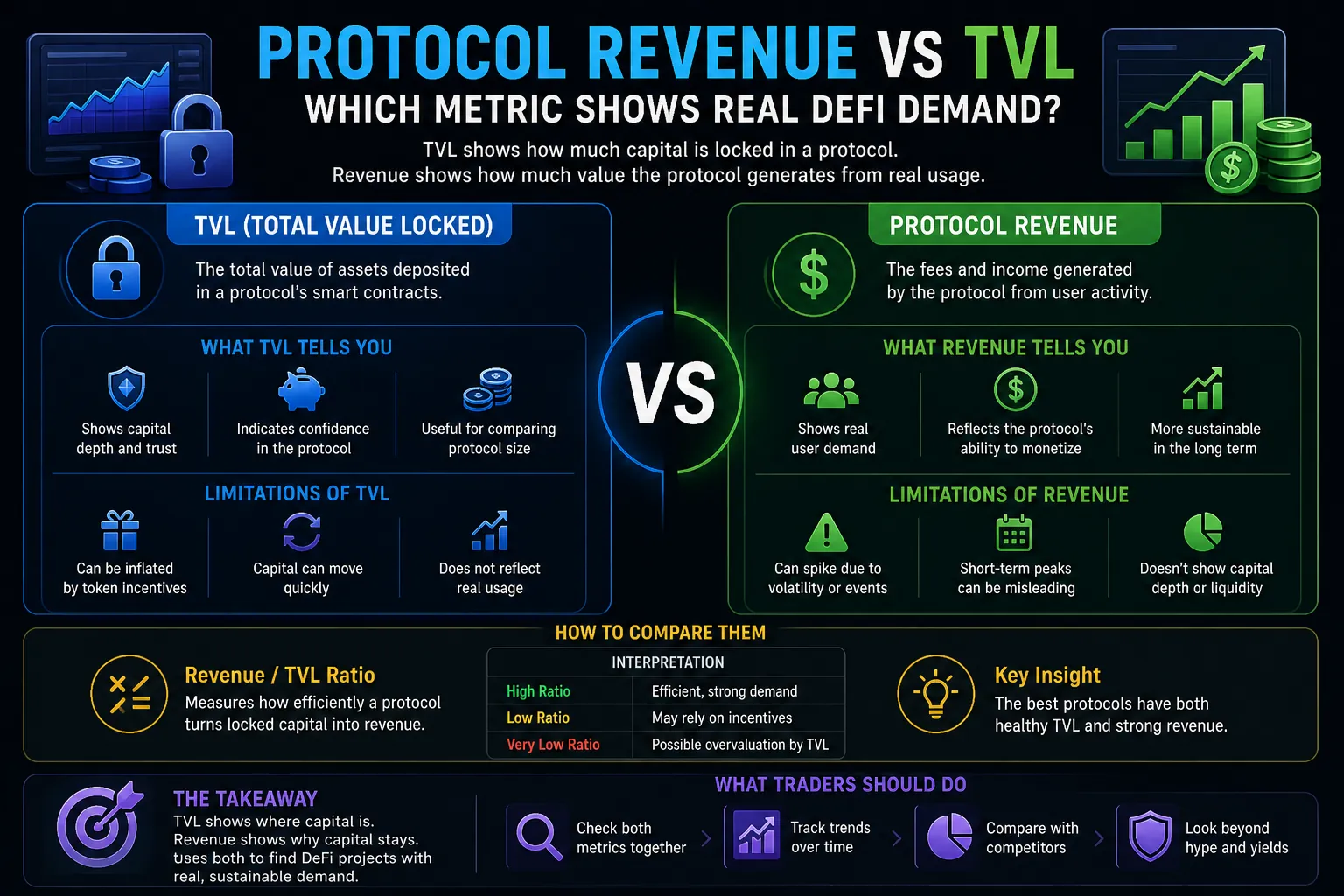
Total value locked, commonly called TVL, has become one of the most popular metrics in DeFi. It shows how much capital is deposited inside a protocol. But TVL does not always tell the full story.
Protocol revenue is another important metric. It can show whether users are actually paying to use a product. When traders compare protocol revenue vs TVL, they can get a clearer picture of real demand.
Key Takeaways
- What Is TVL in DeFi?
- What Is Protocol Revenue?
- Protocol Revenue vs TVL: The Key Difference
- When TVL Can Be Misleading
- When Revenue Can Be Misleading
- Which Metric Is Better for DeFi Traders?
Both metrics are useful, but they answer different questions.
What Is TVL in DeFi?
TVL measures the value of assets locked in a DeFi protocol. This may include liquidity pools, lending markets, staking contracts, vaults or other smart contract systems.
A high TVL can suggest that users trust a protocol with significant capital. It may also show that the protocol has strong incentives, attractive yields or deep liquidity.
However, TVL can be temporary. Capital can move quickly in DeFi, especially when rewards change.
What Is Protocol Revenue?
Protocol revenue measures the value captured by a protocol from real usage. This may come from trading fees, borrowing fees, liquidation fees, performance fees or other product based revenue streams.
Revenue can be a stronger signal of demand because it shows that users are paying to interact with the protocol.
A protocol with revenue has users who are doing more than depositing funds. They are creating economic activity.
Protocol Revenue vs TVL: The Key Difference
TVL shows deposited capital. Revenue shows monetized usage.
A protocol can have high TVL but low revenue if users are mainly there for incentives. A protocol can have lower TVL but strong revenue if users actively trade, borrow or pay fees.
This is why comparing both metrics can reveal whether a DeFi project is capital heavy, usage heavy or incentive dependent.
When TVL Can Be Misleading
TVL can become misleading when it is driven by temporary rewards. If users deposit funds only to earn token incentives, they may leave as soon as rewards decline.
This creates mercenary liquidity. It looks strong while incentives are active, but it may disappear quickly.
TVL can also rise because token prices increase. If the assets locked in a protocol go up in price, TVL may grow even without new user deposits.
That means TVL growth does not always equal user growth.
When Revenue Can Be Misleading
Revenue can also be misunderstood. A short term spike in fees may come from temporary volatility, a liquidation event or one unusual market period.
High revenue in one week does not always mean long term demand. Traders should look for consistency.
The best signal is not only high revenue, but durable revenue that continues across different market conditions.
Which Metric Is Better for DeFi Traders?
Neither metric is always better. TVL and revenue should be used together.
TVL helps traders understand capital depth and trust. Revenue helps traders understand real usage and economic demand.
A protocol with high TVL and low revenue may be overvalued if users are not generating meaningful activity. A protocol with lower TVL and strong revenue may be more efficient because it generates more value per dollar locked.
Revenue to TVL: A Useful Comparison
One useful approach is to compare revenue with TVL. This can help traders understand how efficiently a protocol turns locked capital into economic activity.
If two protocols have similar TVL, but one generates much more revenue, the higher revenue protocol may have stronger user demand.
If a protocol has huge TVL but very little revenue, traders should ask whether the market is valuing deposits more than actual usage.
How This Applies to Token Analysis
For token traders, protocol metrics can help explain whether price action is supported by fundamentals. If a token is pumping while protocol revenue is flat and TVL is falling, the move may be mostly speculative.
If price rises alongside growing revenue, stable liquidity and stronger market activity, the rally may have more support.
DEXTools can help traders analyze the trading side of this equation by reviewing live token activity, liquidity, volume and price behavior.
TVL and protocol revenue are both useful DeFi metrics, but they should not be treated as the same thing. TVL measures capital. Revenue measures paid usage.
A strong DeFi project should ideally show both trust and demand. Traders who compare protocol revenue vs TVL can better understand whether a token is supported by real usage or only by temporary capital.
How to Bridge Crypto Between Chains: Complete Cross-Chain Tutorial 2026 How to Use 1inch: Complete DEX Aggregator Swap Tutorial (2026) How to Use OKX Web3 Wallet: Multi-Chain DeFi Hub Guide (2026)Related Guides
- How to Use DefiLlama: Track TVL, Stablecoins and Protocol Revenue (2026)
- Gross Revenue vs Net Revenue: Decoding Crypto
- Fake Volume vs Real Demand: How to Spot Artificial Momentum in DeFi Trading
- Deposit Growth vs Borrow Growth in DeFi: Guide
- Borrower Diversity vs Whale Borrowing: How Concentrated Loan Demand Creates DeFi Risk
Frequently Asked Questions
What is the difference between protocol revenue and TVL?
TVL (total value locked) measures the assets deposited in a protocol, while protocol revenue measures the fees the protocol actually earns from usage. TVL shows how much capital is parked, whereas revenue shows whether that capital is generating real economic activity.
Why can TVL be misleading in DeFi?
TVL can be inflated by incentives, double counting, or recycled deposits chasing rewards, so a high number does not always mean genuine demand. Capital can flow out as quickly as it arrived once incentives stop, which is why revenue is often a more durable signal.
Does high protocol revenue mean a token is a good investment?
Revenue is a useful sign of real usage, but it does not automatically translate into value for token holders unless the tokenomics direct fees back to them. You still need to consider sustainability, competition, and how the protocol shares its earnings.
How do I use protocol revenue and TVL together?
Comparing the two helps you judge capital efficiency, since a protocol earning meaningful revenue on lower TVL may be using its capital more productively. Looking at both over time also reveals whether demand is growing organically or only reacting to temporary incentives.