How to Evaluate Yield Farms in Crypto: APY Quality, Risks and Red Flags (2026)
— By Tony Rabbit in Tutorials
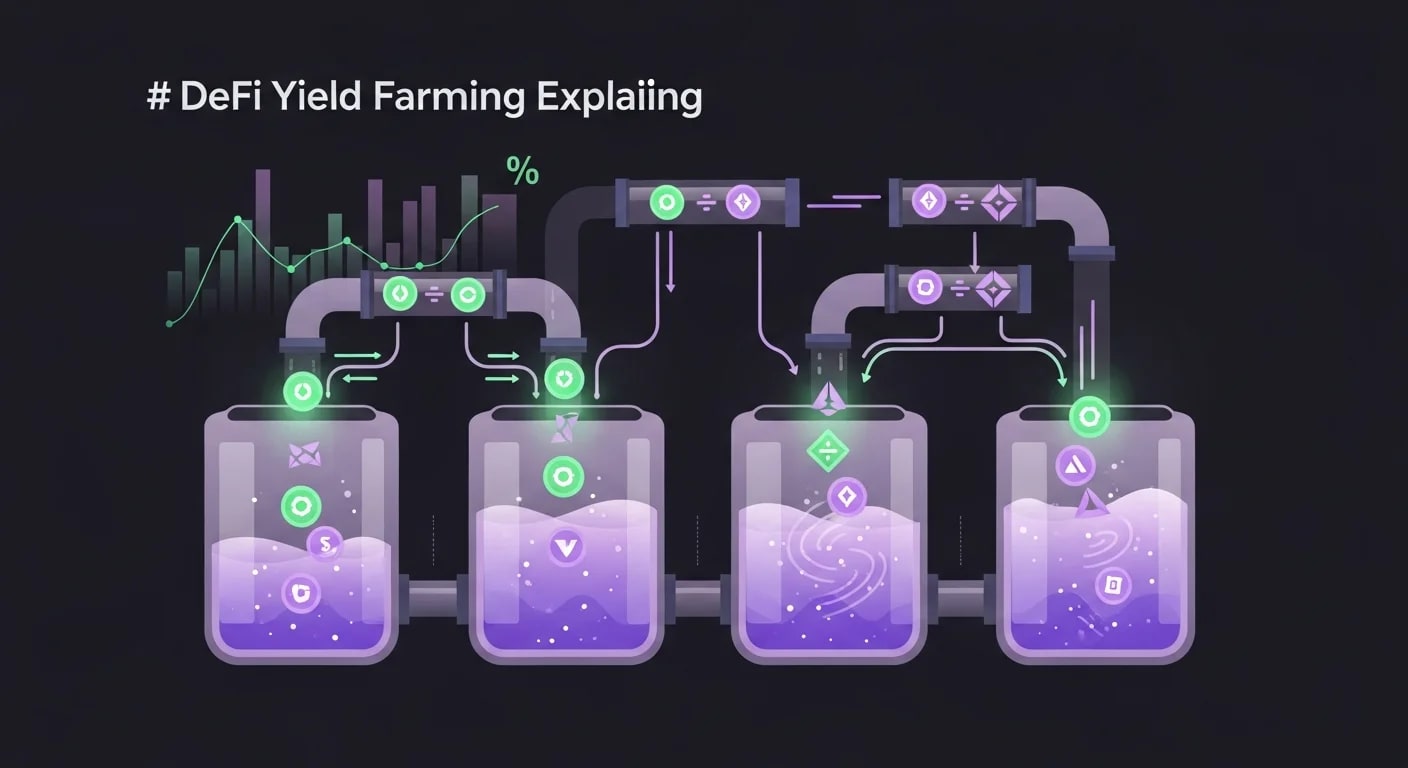
Learn how to evaluate yield farms in crypto by checking APY quality, incentive sustainability, token emissions, smart-contract risk, and the red flags that trap beginners.
Intent check: This page focuses on farm evaluation, APY quality, and red flags before depositing capital. If you want the broader strategy overview first, read Yield Farming Strategies, APY Quality and Risk Management (2026).
Yield farming is one of those phrases that sounds harmless until you read the fine print. The headline says you can earn double-digit APYs by parking tokens inside a DeFi protocol. The reality is that yield farming pays users to take on a stack of risks that most beginners do not yet know how to read. The yields are real. The risks are also real, and they are the part most tutorials skip.
Quick answer: Yield farming in crypto means earning rewards by supplying assets to a DeFi protocol, usually as liquidity, lending collateral, or staked tokens. The rewards come from trading fees, borrower interest, and freshly emitted protocol tokens. The yields can look huge, but they are compensation for impermanent loss, smart contract risk, token inflation, and depeg or insolvency events.
- Yield is paid for taking risk. A high APY is rarely free money. It is usually compensation for risks the protocol cannot remove.
- Most yields combine fees plus emissions. Trading fees and lending interest are sustainable. Token emissions are not, and they create selling pressure.
- Liquidity providers face impermanent loss. Pool math can quietly underperform a simple hold even when the APY headline looks great.
- Smart contract risk is permanent. Audits help, but exploits keep happening, and a hacked farm can lose 100 percent of deposits.
- Reading the source of yield matters more than chasing it. A small, transparent yield from real fees usually beats a giant emissions-driven number.
What yield farming is and where it came from
Yield farming is the practice of putting crypto assets to work inside a DeFi protocol in return for a yield. That yield can come from several sources, but the basic shape is the same. The user deposits a token or pair of tokens, the protocol uses those assets for some economic function, and the user is paid for participating. The phrase exploded into common use during the 2020 DeFi summer, when Compound and similar projects began emitting governance tokens to liquidity providers, and APY screenshots started flooding crypto Twitter.
The category never really left. Even after market cycles, halvings, and a long string of exploits, yield farming stayed central to DeFi because the underlying machinery is genuinely useful. Lenders need to be matched with borrowers. Decentralized exchanges need liquidity to function. Stablecoin issuers need depth on key pairs. Yield farming is how protocols pay users to keep that machinery running.
Liquidity provision is the most common form
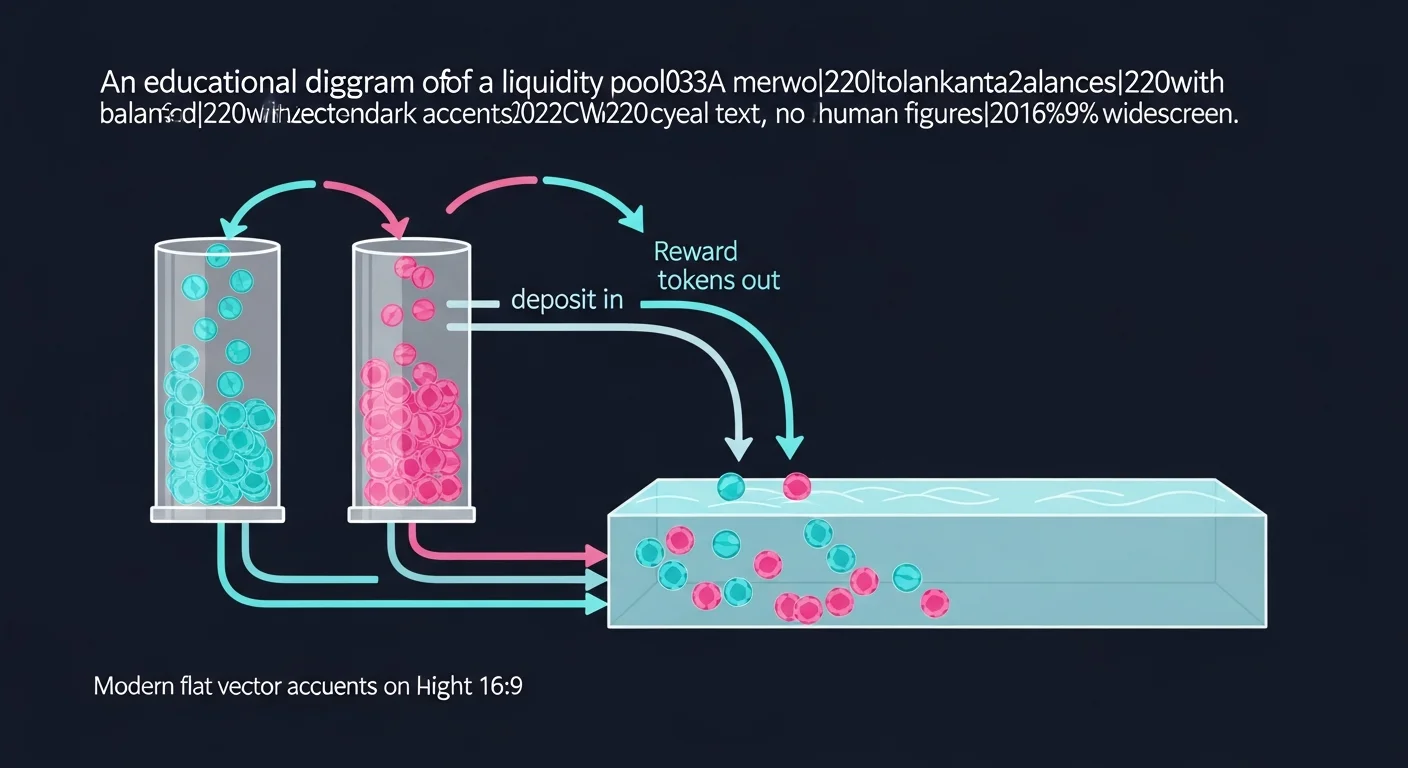
The most common form of yield farming is providing liquidity to an automated market maker (AMM). The user deposits two tokens in equal value into a pool and receives an LP token that represents their share of that pool. Every time someone swaps through the pool, a small fee is added to the reserves, which slowly increases the value backing the LP token. The user can also be paid in additional reward tokens emitted by the protocol on top of those fees.
The math behind that pool is what creates impermanent loss, and it is also why yield farming is more complex than the headline number suggests. The AMM rebalances automatically as prices move, which means the LP can end up holding more of the underperforming asset and less of the outperforming one compared with a simple hold.
Lending farms and stablecoin farms
Lending farms are usually simpler. A user supplies a single token to a protocol like Aave or Compound, the protocol lends it to borrowers, and the supplier earns interest plus possible reward tokens. Stablecoin farms operate the same way, except both supply and borrow sides are denominated in stablecoins. These farms tend to have lower headline yields than AMM farms, but they avoid impermanent loss because there is no two-token pool involved.
Stablecoin farms still carry their own risks. The stablecoins themselves can depeg. The protocol can be exploited. Borrower demand can dry up. Anyone telling you that a stablecoin farm is "risk-free yield" is selling you something rather than explaining the situation.
Where the yield actually comes from
The single most important question in yield farming is where the yield is being paid from. There are only a few real sources, and the difference between them tells you whether the farm is sustainable or already on a countdown.
Trading fees
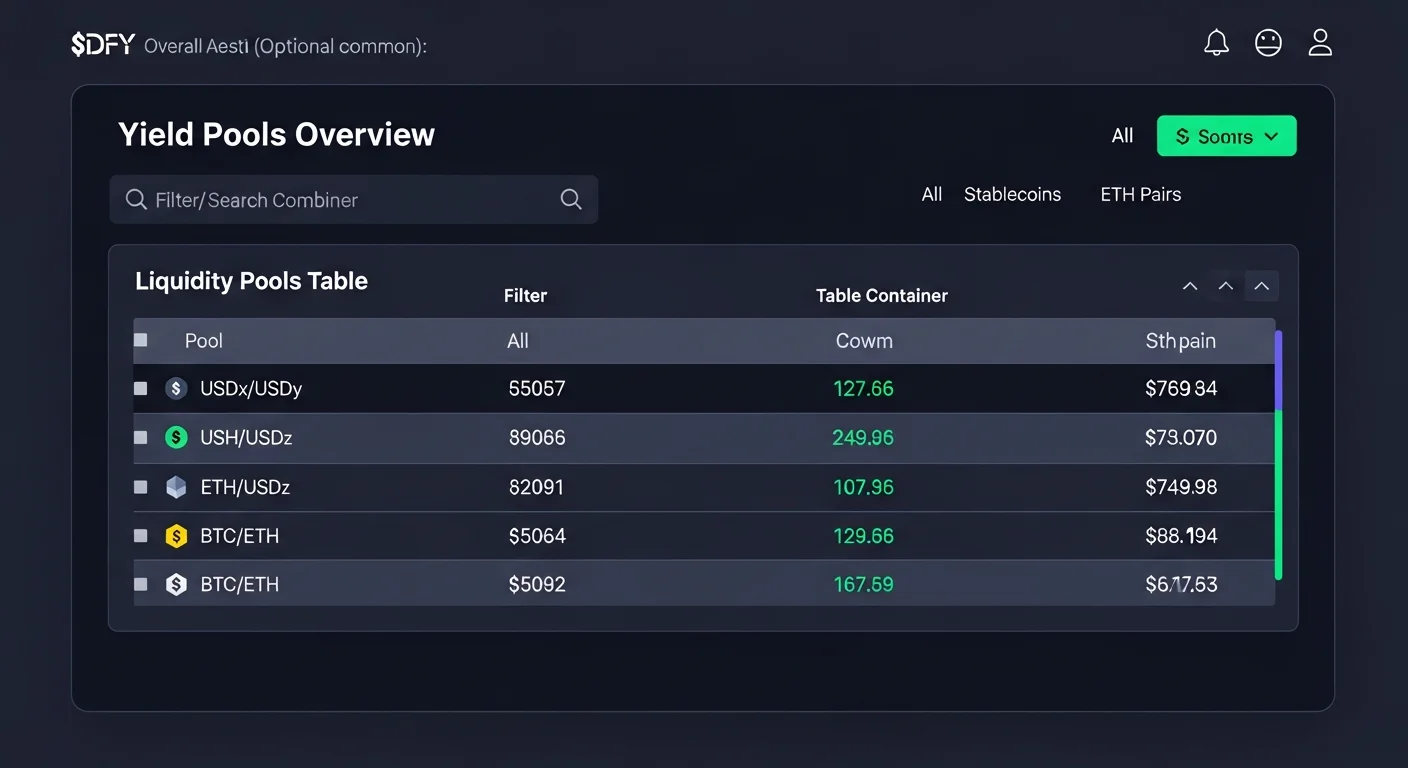
Trading fees are the cleanest source of yield. When traders swap through a pool, the pool collects a small fee that is distributed among the LPs. Pools with consistent volume can generate meaningful base yields purely from these fees. Pools with no volume earn almost nothing, no matter how high the headline APY is on a dashboard. If a farm is paying serious yield purely from fees, that is usually a healthy sign.
Borrower interest
On lending platforms, suppliers earn interest from borrowers. The rate adjusts based on utilization. When more of the supplied capital is borrowed, both the borrow rate and the supply rate climb. When utilization drops, both fall. A lending farm with consistent borrow demand is a sustainable structure. A lending farm with no borrowers is just a cold token-printing machine.
Token emissions and incentives
Most large headline APYs are inflated by token emissions. The protocol prints its own governance or reward token and pays it out to farmers, on top of the underlying fees and interest. Emissions can be a smart growth tool, because they bootstrap liquidity that would otherwise not exist. Emissions can also be a slow drain on holders, because the new tokens have to be sold somewhere and that selling pressure usually shows up on the chart.
The right way to read an emissions APY is to ask two questions. First, will those reward tokens still have value in twelve months, or will the price be cut in half by sell pressure? Second, is the underlying base yield from real fees still attractive without the emissions? If both answers point the wrong way, the headline number is mostly an illusion.
The real risks of yield farming
Every yield is paid for a reason. Understanding the risks is the entire game.
Impermanent loss
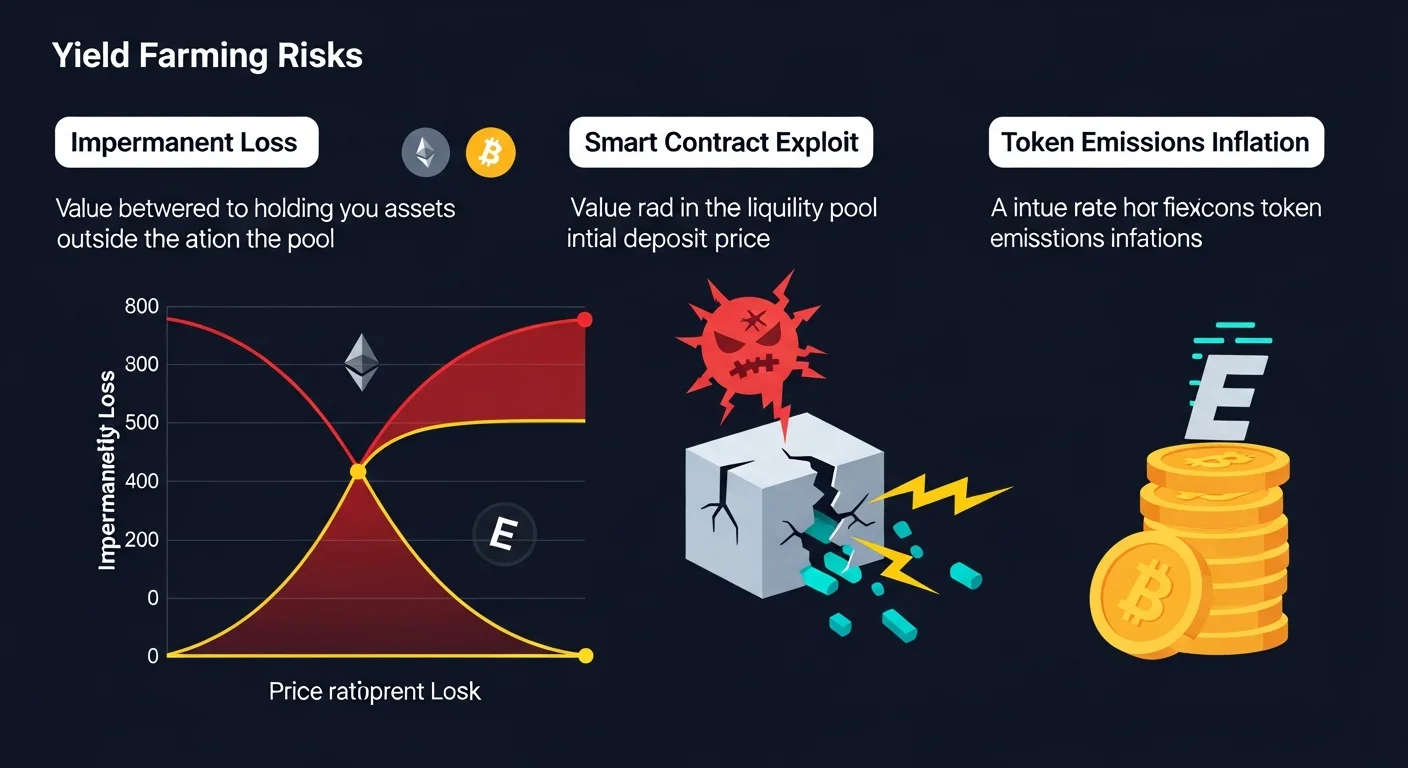
Impermanent loss is the most quietly destructive risk for AMM liquidity providers. It happens when the prices of the two pooled assets diverge. The pool rebalances automatically, leaving the LP with a worse outcome than simply holding both tokens outside the pool. The "impermanent" label is misleading, because the loss only stays impermanent if prices return to the original ratio. In most real-world farming, they do not, and the loss is locked in when the LP withdraws.
Beginner farmers often see a high APY, ignore impermanent loss, and end up with a worse total return than a passive holder. The math is unforgiving on volatile pairs. A pair like ETH-MEME might pay 200 percent APY in tokens and still lose to a simple ETH hold once the meme coin drops 70 percent.
Smart contract and admin risk
Every yield farm runs on smart contracts. Those contracts can have bugs. They can be exploited. The team behind the protocol can have admin keys that allow them to upgrade or pause the contract, and those keys can be compromised or used maliciously. Audits help, but they do not guarantee anything. Multiple audited protocols have been drained.
The defense is layered. Use protocols with long track records. Read whether admin keys are renounced or controlled by a multisig. Avoid putting an outsized portion of your portfolio in any single contract. The day a contract is exploited, the only thing that matters is how much you had inside.
Token inflation and unlock schedules
Reward tokens have to come from somewhere, and most of the time they come from inflationary schedules baked into the protocol. If the unlock cliff is steep and the emissions are aggressive, the price of the reward token tends to bleed even when the protocol itself is doing well. Farmers who reinvest emissions back into the same token often find that the headline yield was theoretical.
Depeg, oracle, and liquidation risk
Stablecoin farms add depeg risk. Lending farms add liquidation risk if you borrow against your supply. Cross-chain farms add bridge risk. None of these risks invalidate yield farming, but they all need to be priced into the trade. The right APY on the right protocol can still lose money if a depeg, exploit, or liquidation cascade hits at the wrong moment.
How to evaluate a yield farm before depositing
The same evaluation framework works on small farms, blue chip farms, and incentive-stacked farms. The questions are simple. The honest answers are what most farmers skip.
Is the yield from real activity or pure emissions?
Read the protocol dashboards or block explorer data and check whether the pool actually has volume, borrow demand, or any other source of organic income. If the entire APY collapses without emissions, the farm is a token-distribution program more than an income product.
Who controls the contracts?
Look at the admin model. Are upgrades behind a timelock? Is there a multisig with reasonable signers? Are admin keys renounced? A protocol with full mutability and a single key holder is not the same risk profile as a protocol with timelocked, multisig-controlled upgrades.
How big is the pool, and how concentrated are the holders?
Tiny farms with one large LP can be exit liquidity if that LP withdraws. Large farms with thousands of LPs are far harder to drain in a single rage-quit. Look at the LP token distribution and at how much of the reward token is held by the team or early investors.
Have the contracts been audited, and by whom?
Audits do not guarantee safety, but unaudited contracts running with millions in TVL are a red flag. A real audit by a reputable firm at least raises the floor on basic mistakes. Read the actual audit if it is published, not just the badge on the homepage.
Common yield farming strategies in 2026
Yield farming has matured a lot since DeFi summer. The strategies that survived are the ones with cleaner risk management.
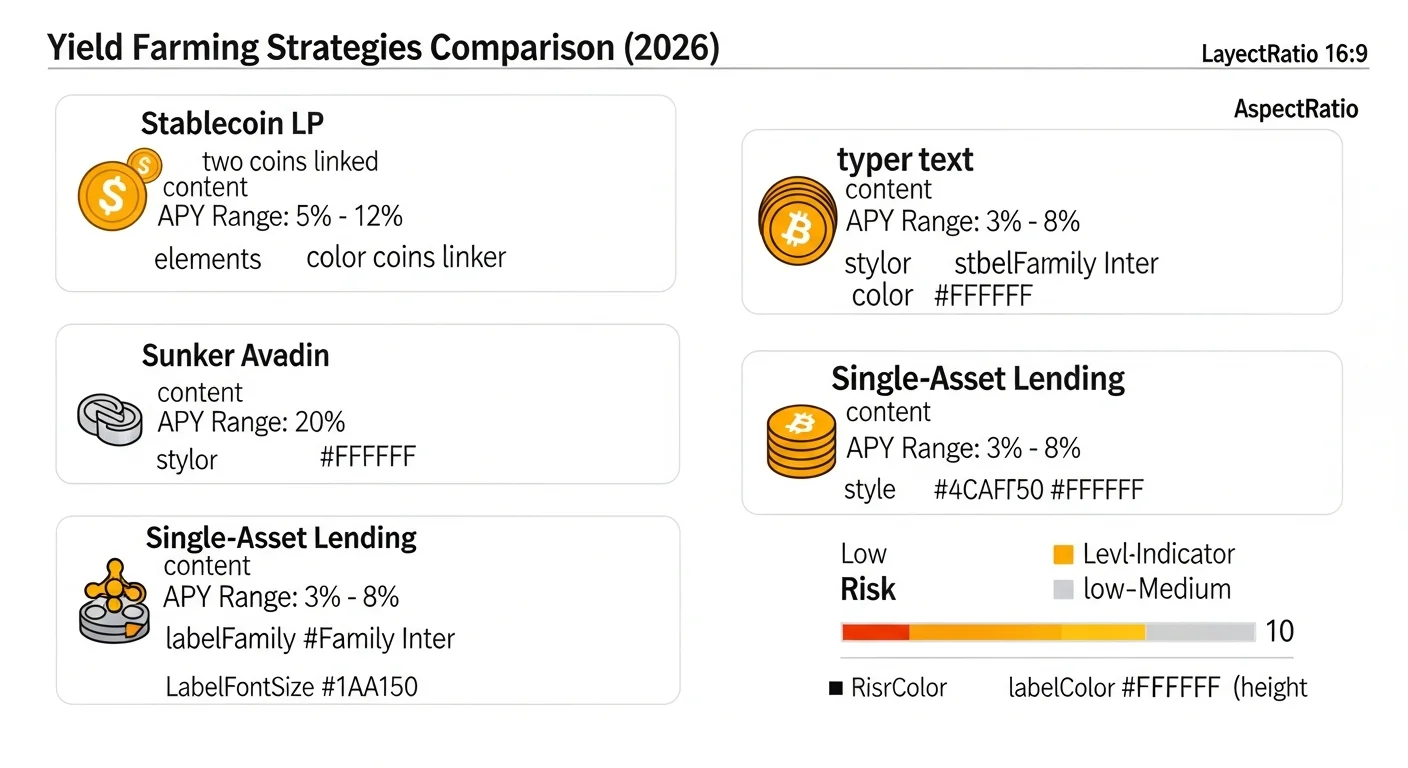
- Stablecoin LP farming on blue chip DEXs. Lower headline APYs, less impermanent loss exposure on near-pegged pairs, and more predictable behavior across cycles.
- Single-asset lending on top-tier money markets. Supply ETH, BTC variants, or major stables, accept lower base yields, and avoid pool math entirely.
- Concentrated liquidity provision. Higher capital efficiency on supported DEXs, with the tradeoff of needing active range management and a clearer view of impermanent loss.
- Liquid staking and restaking integrations. Earn base staking yield and stack additional yield via liquid-staking tokens used as collateral, with extra smart contract layers as a tradeoff.
- Curated risk-tier strategies via vaults. Aggregator vaults bundle multiple farms with risk parameters, taking convenience in exchange for an additional smart contract layer.
None of these strategies are passive. Every one of them requires periodic monitoring, especially when token unlocks, governance changes, or audits drop.
Practical workflow for DEXTools and DeFi users
The same discipline that works for trading also works for farming. Filter pairs, evaluate the source of yield, and only then size the position.
- Use DEXTools to verify the pool is real and liquid. Check holders, volume, and any obvious red flags before clicking deposit.
- Read the source of yield. Separate fees and interest from emissions, and price emissions accordingly.
- Right-size the position. One contract should never carry a portfolio-ending share of your capital.
- Monitor unlocks and governance. Token unlocks and parameter changes can flip the expected yield in days.
If you also want to dive into related topics, hand readers to impermanent loss, liquid staking, or protocol-owned liquidity instead of forcing every concept into this article.
Yield farming vs staking in one short comparison
| Approach | Usually stronger for | Main caution |
|---|---|---|
| Yield farming | Higher headline APY, exposure to fees and emissions | Impermanent loss and smart contract risk |
| Staking | Simpler exposure, network-level rewards, less pool math | Lockups, slashing, and validator-level risk |
Frequently asked questions
What is yield farming in crypto?
Yield farming is the practice of supplying tokens to a DeFi protocol in return for a yield, usually as a liquidity provider, lender, or staker. Rewards come from trading fees, borrower interest, and freshly emitted protocol tokens.
Is yield farming safe?
It is never fully safe. Yield is compensation for impermanent loss, smart contract risk, token inflation, and depeg or insolvency events. Safer farming usually means lower APYs and stricter protocol selection.
What is the difference between yield farming and staking?
Yield farming usually involves liquidity pools and exposure to AMM math. Staking usually involves locking tokens to secure a network or service. Yield farming tends to have higher headline APY and more risk surface.
How much can you earn yield farming?
It depends on the protocol, asset pair, and market regime. Stablecoin farms often pay single digits, blue-chip pairs vary widely, and emissions-driven farms can advertise high triple-digit numbers that rarely survive the next quarter.
Do I need a lot of capital to yield farm?
No. Most DeFi protocols accept small deposits, but on Ethereum mainnet, gas costs can eat into very small positions. Layer 2 networks and other low-fee chains have made small-scale farming far more viable.
Final takeaway: Yield farming is a real category with real returns, but the headline APY is almost never the trade. Read the source of yield, price the risks honestly, and treat every farm as an active position rather than a passive savings account.
Disclaimer: This guide is for educational purposes only and does not constitute investment, financial, legal, or trading advice. DeFi yields can disappear, and protocols can be exploited or fail.
Related Guides
- Yield Farming Strategies, APY Quality and Risk Management (2026)
- When Not to Trade: 12 Red Flags Every DeFi Trader Should Know
- Wash Trading Red Flags on Exchanges and DEXs (2026)
- What Is an Admin Wallet in Crypto? Red Flags
- What Is a Top Holder in Crypto? Concentration, Supply Risk, and Red Flags
Frequently Asked Questions
What is yield farming in crypto?
Yield farming is the practice of providing assets to DeFi protocols, such as liquidity pools or lending markets, to earn rewards. Returns can come from fees, interest, or token incentives.
What does APY mean in yield farming?
APY, or annual percentage yield, estimates the yearly return on your deposit including the effect of compounding. Advertised APYs can change quickly and may rely on token incentives that do not last.
What are the risks of yield farming?
Risks include smart contract bugs, impermanent loss, falling token prices, and incentives that dry up over time. Very high advertised yields often signal correspondingly high risk.
How can I tell if a yield farm is sustainable?
Look at where the yield comes from, since returns based on real fees or interest tend to last longer than those funded only by heavy token emissions. Checking token inflation and the protocol's track record helps spot unsustainable farms.