What Is Spot Trading in Crypto? Guide Explained 2026
— By Tony Rabbit in Tutorials

Spot trading in crypto explained: learn how buying the asset directly works on a CEX or DEX, and how ownership, execution, and slippage affect entries.
Spot trading is the most direct way to trade crypto, and that simplicity is exactly why it matters. You buy or sell the asset itself, your balance changes when the trade fills, and there is no liquidation engine attached to the position. For most people entering the market, that is a feature, not a limitation.
Intent check: This guide focuses on direct asset buying and selling without leverage. If you are comparing spot against leveraged derivatives, read Spot vs Futures in Crypto. If you want the derivatives side by itself, read What Is Futures Trading in Crypto?
Quick answer: spot trading in crypto means buying or selling the actual asset for immediate settlement at the current market price or at a limit price you choose. In practice that can happen on a centralized exchange order book or through a decentralized swap route, but the core idea stays the same: you are trading the asset itself, not a derivative contract.
- Spot means direct ownership. If you buy ETH on spot, you end up holding ETH after the trade settles.
- Execution still matters. Spread, slippage, liquidity, and fees can change the real entry price more than beginners expect.
- Spot is simpler than futures, not risk free. You can still get bad fills, buy weak tokens, or mishandle custody after the trade.
- CEX spot and DEX spot feel different. One usually uses an order book and exchange balance, the other often uses wallet-based swaps and routing logic.
- Good spot trading starts before the click. DEXTools helps you decide whether a token and pair deserve capital at all.
What spot trading means in crypto
Spot trading means buying or selling the actual token at the current market price, or at a limit price you set, with settlement happening right away in practical terms. If you buy BTC spot, you end up with BTC. If you sell SOL spot, your SOL balance decreases and your quote balance increases. There is no separate derivatives contract sitting between you and the asset.
That direct ownership is why spot remains the cleanest market structure for most beginners. The job is simple: build exposure, reduce exposure, or rotate between assets without adding funding, liquidation, or leverage mechanics that can distort the decision.
Why direct ownership changes the risk profile
In spot markets, the asset can still fall hard, but you do not usually face forced liquidation unless you separately borrowed against the position. The trade can be wrong, but the platform is not automatically closing you because volatility spiked through a margin threshold.
That does not make spot easy money. It means the main risks shift. Instead of worrying about liquidation, spot traders worry more about entry quality, token quality, custody, contract risk, and whether they are buying into a liquid market or a trap.
Base asset, quote asset, and what settlement means
Every spot market pairs one asset against another. In BTC/USDT, BTC is the base asset and USDT is the quote asset. Buying the pair means spending USDT to receive BTC. Selling the pair means giving up BTC to receive USDT. On a DEX the same logic applies even if the interface feels different. You may swap USDC for a token in one click, but under the hood you are still exchanging one asset for another.
Settlement in crypto spot is usually fast enough that users think of it as immediate. On a CEX, your account balance updates when the order fills. On a DEX, the wallet receives the output asset once the transaction is confirmed on-chain. The mechanics differ, but the end state is the same: you own the resulting asset.
Spot trading on a CEX vs a DEX
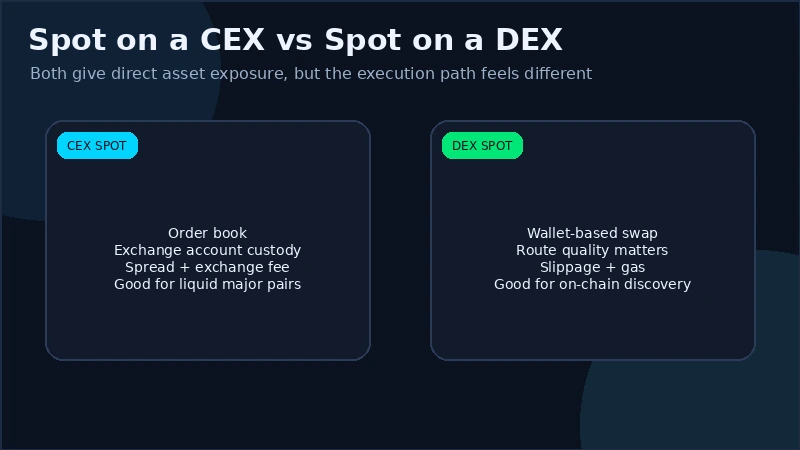
Many beginners hear spot trading and picture a centralized exchange order book. That is only part of the picture. Spot exposure can come from two very different execution environments, and the experience changes depending on which one you use.
How spot feels on a centralized exchange
On a centralized exchange, spot trading usually happens through an order book. You place a market or limit order, the matching engine finds the other side, and your exchange balance updates. The important variables are spread, visible depth, order type, maker or taker fees, and whether the book is liquid enough for your size.
CEX spot is often faster and cleaner for large liquid pairs because the order book is deep and the interface is built for order control. It is also simpler for beginners who want limit orders, stop orders, and a familiar trading panel without managing wallet approvals or gas.
How spot feels on a decentralized exchange
On a DEX, spot exposure often comes through a swap router or automated market maker rather than a traditional order book. You connect a wallet, approve the token if needed, choose the route, and sign the transaction. Instead of looking mainly at bid and ask depth, you care more about route quality, pool liquidity, slippage tolerance, gas costs, and contract safety.
DEX spot is powerful because it gives access to on-chain assets earlier and keeps the user closer to self-custody. It also creates extra responsibility. The wrong contract address, a loose slippage setting, or a thin pool can make a simple buy far worse than the chart implied.
Which environment is better for what
A CEX is often better when you want deep liquidity, classic order control, and a cleaner experience on majors. A DEX is often better when the asset trades on-chain first, when self-custody matters, or when you want access to token-specific ecosystems. Neither is automatically better in every case. The key is to understand that both are still spot, even though the execution mechanics feel different.
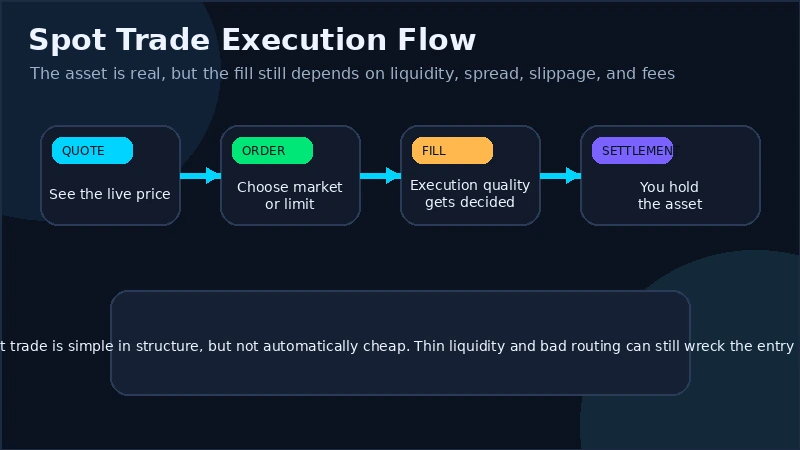
How a spot trade works from quote to final balance
A spot trade starts with a quote, becomes an order, and ends with the asset balance changing. That sounds simple, but the quality of the outcome depends on how you execute.
Market orders, limit orders, and partial fills
A market order prioritizes speed. It fills immediately against the best available liquidity. A limit order prioritizes price. It only fills at your chosen price or better, and it may fill in stages if the market does not have enough size sitting at that level.
That difference matters more than many beginners expect. A market order on a deep BTC pair may be perfectly reasonable. A market order on a thinner alt pair can walk up the book and leave you with an average fill that is noticeably worse than the last printed price. On a DEX, the same idea shows up as price impact inside the route. There may not be a visible order book, but thin liquidity can still push your effective fill far away from the quote.
Spread, slippage, and fees
Most new traders focus on the headline price and ignore the real execution stack. On a CEX, the spread is the gap between the best bid and best ask. On a DEX, route quality and pool depth often matter even more. In both cases, slippage is the distance between the expected price and the actual fill.
Fees also stack. A CEX trade may include maker or taker fees. A DEX trade may include pool fees, router fees, and gas costs. None of that means spot is unattractive. It just means that the cleanest spot trade is usually the one entered in a liquid market with sensible size and clear expectations.
A practical execution example
Imagine you want to deploy $2,000 into a liquid SOL market on a major exchange. The spread is tight, the book is deep, and a market order may slip only slightly. Now imagine the same $2,000 going into a much smaller on-chain token with shallow liquidity. On a DEX, that same order size might create obvious price impact, trigger more slippage than you expected, and make your average entry meaningfully worse. The trade idea did not change. The market quality did.
This is why skilled spot traders talk about execution as part of risk, not as a minor detail. A mediocre asset bought well can still be managed. A strong thesis bought badly starts the position with unnecessary damage.
Practical execution habits that improve spot entries
Better spot trading often comes from a few boring habits repeated consistently.
When a market order is fine, and when it is lazy
A market order is fine when the pair is liquid, the size is modest relative to depth, and getting in immediately matters more than saving a small amount on price. It becomes lazy when the pair is thin, the market is moving fast, or the order size is large enough to move the price against you.
If you cannot describe why speed matters on this trade, it is worth asking whether a limit order would serve you better.
When limit orders make more sense
Limit orders are useful when you already know the level you want, when the market is liquid enough to revisit your price, or when you are trying to avoid paying up in a noisy environment. They also teach discipline. A limit order forces you to think about entry quality instead of chasing candles.
On DEXs, not every venue offers classic limit-order functionality. When that matters, route readers toward tools such as Jupiter for spot swaps and limit orders instead of overloading this article with platform-specific detail.
DEX-specific checks before you swap
Before a DEX swap, confirm the contract address, review the route, check pool liquidity, and make sure the slippage setting is not so loose that a poor pool can take advantage of you. Also look at gas costs and wallet approvals. Approving the wrong token or interacting with the wrong contract is a very different kind of mistake from a bad chart entry, but it can be just as expensive.
CEX-specific checks before you buy
Before a CEX spot order, look at visible depth, recent volatility, and whether you are paying maker or taker fees unnecessarily. If the pair is thin or moving fast, consider breaking the order into smaller pieces. If the plan needs automated protection, understand whether the venue offers stop orders and how they behave. Readers who want the deeper mechanics can continue to what an order book means in crypto and stop-limit vs stop-market orders.
When spot trading makes the most sense
Spot trading is usually the right tool when you want direct exposure without leverage. That covers more use cases than many people realize: building a long-term position, buying dips into support, swing trading clean structures, rotating between sectors, and learning how markets behave without the added pressure of liquidation.
Building a position over time
If your goal is accumulation, spot is usually the cleanest route. You can scale in gradually, move assets into self-custody if desired, and let the thesis play out without funding costs or liquidation thresholds changing the experience.
Swing trading with understandable risk
Spot is not only for investors. Many swing traders prefer spot because the structure is clean. If the trade is wrong, they exit. If it works, they can trim or hold. The market may still move fast, but the product itself is not adding extra fragility.
Learning market structure before adding complexity
For beginners, spot is the clearest place to learn support, resistance, volume, order quality, and emotional discipline. A lot of traders think they need leverage to become serious. In reality, they often need cleaner execution first.
Risks beginners still face on spot
Spot is simpler than futures, but it is not automatically safe. The most common problems come from weak markets and weak process.
- Thin liquidity and bad fills: a low-liquidity pair can turn a reasonable idea into a poor entry through spread and slippage alone.
- Custody and network mistakes: sending funds on the wrong chain, approving bad contracts, or storing assets poorly can erase the benefit of a good trade.
- Buying bad tokens well: a neat chart does not solve insider concentration, fake volume, or contract risk.
- Confusing direct ownership with low risk: owning the asset does not protect you from violent drawdowns if the asset itself is weak.
This is why DEXTools matters even for plain spot trading. It helps expose structural problems before they become your position.
Practical DEXTools workflow before entering a spot trade
For spot traders, the biggest edge often comes before execution. Use DEXTools to decide whether the market deserves capital at all.
- Check pair age, liquidity, volume, and recent trades. You want to know whether the market is deep enough for your size and whether activity looks organic.
- Verify the contract and route. Make sure the token address is correct, the pool is the intended one, and the route is not quietly exposing you to a weak pair.
- Review slippage expectations. If a small order already implies obvious price impact, rethink the setup or reduce size. Readers who need the deeper mechanics can continue to how slippage works on a DEX.
- Check supporting context. Holder concentration, unusual wallet behavior, and suspicious recent trades often matter more than the candle you are staring at.
- Only then place the order. Good spot trading often looks boring because the research work happened before the trade went live.
Spot vs futures in one quick decision block
This page should own the direct spot-trading intent, so keep the comparison short and hand broader comparison traffic to the dedicated spot vs futures guide.
| Question | Spot is usually the better choice if... | Futures is usually the better choice if... |
|---|---|---|
| Do you want direct ownership? | Yes, you want the actual asset after the trade. | No, price exposure is enough. |
| Do you need leverage or shorting? | No, you can trade without them. | Yes, the setup depends on them. |
| Do you want to move the asset on-chain later? | Yes, custody and transferability matter. | No, synthetic exposure is the priority. |
| Are you still learning execution basics? | Yes, spot is usually the cleaner starting point. | Only if you already understand derivatives risk. |
Frequently asked questions
Do you own the coin when you make a spot trade?
Yes. In spot trading you buy or sell the actual asset rather than a derivative contract, so the resulting balance is the asset itself.
Is spot trading safer than futures trading?
Usually yes, because spot does not include liquidation mechanics or leverage by default. It still carries market risk, execution risk, custody risk, and token-specific risk.
Can you short crypto with spot trading?
Not in the same clean way that futures allow. Spot is mainly about buying and selling owned assets, while direct short exposure is usually a derivatives function.
What is the difference between a spot trade and a DEX swap?
A DEX swap is one path to spot exposure. The settlement method differs from an order book, but the end result is still that you receive the actual asset.
What is the best order type for beginner spot traders?
It depends on urgency and liquidity, but many beginners benefit from learning limit-order discipline before defaulting to market orders in thin or fast-moving markets.
Final takeaway: spot trading in crypto is simple in the right way. You buy or sell the asset itself, keep the risk structure understandable, and focus on research and execution quality instead of derivatives complexity. For most traders, especially newer ones, that is not a compromise. It is an advantage.
Disclaimer: This draft is for educational purposes only and does not constitute investment, financial, legal, or trading advice. Crypto spot markets still carry price, execution, custody, and smart-contract risk.
Related Guides
- KuCoin Beginner Guide: Spot, Earn and Trading Bot
- How to Use Kraken Pro: Spot, Futures, Staking and Fees (2026)
- Fake Volume vs Real Demand: How to Spot Artificial Momentum in DeFi Trading
- Bybit Beginner Guide: Spot, Copy Trading, and Earn
- What Is a Pump and Dump Scheme in Crypto: How to Spot and Avoid Scams (2026)
Frequently Asked Questions
What is spot trading in crypto?
Spot trading is buying or selling a cryptocurrency for immediate settlement, where you directly own the asset after the trade. Unlike derivatives, you are trading the actual token rather than a contract based on its price.
How is spot trading different from futures or margin trading?
In spot trading you own the asset outright and there is no borrowing or leverage by default, while futures and margin trading involve contracts and borrowed funds. Spot trading carries no liquidation risk from leverage, though prices can still move against you.
What is slippage in spot trading?
Slippage is the difference between the price you expect and the price you actually get when your order fills. It happens when liquidity is thin or prices move quickly, and it tends to be larger for big orders in shallow markets.
Can I spot trade on both centralized and decentralized exchanges?
Yes, spot trading is available on centralized exchanges where the platform matches orders, and on decentralized exchanges where trades settle through smart contracts. Each has different tradeoffs in custody, fees, and execution.