What Is Tokenomics: Complete Guide to Token Economics (2026)
— By Tony Rabbit in Tutorials

Tokenomics explained. How to analyze supply, distribution, vesting schedules, demand drivers, and spot red flags before investing in any token.
Intent check: This page is the broader definition-first explainer for token economics. If you want the due-diligence framework for evaluating supply, emissions, and unlock risk, read How to Evaluate Tokenomics.
Tokenomics is the single most important factor separating crypto projects that deliver lasting value from those that collapse within months. Understanding token economics is not optional for serious investors or builders. It is the foundation of every valuation model, every governance decision, and every staking reward you will ever encounter in decentralized finance.
In this comprehensive guide, we break down every aspect of tokenomics in 2026: from supply mechanics and distribution schedules to demand drivers, burn mechanisms, and real-world case studies. Whether you are evaluating your first altcoin or designing a protocol from scratch, this article gives you the analytical framework to make informed decisions backed by data.
Tokenomics, short for token economics, refers to the complete set of rules, incentives, and mechanisms that govern a cryptocurrency token's creation, distribution, supply, demand, and utility within its ecosystem. Think of it as the monetary policy of a decentralized network, but with every rule encoded transparently on the blockchain for anyone to verify.
What Is Tokenomics and Why Does It Matter?
At its core, tokenomics answers one question: why should this token have value, and how is that value sustained over time? Unlike traditional equities where value derives from revenue, earnings, and assets, crypto tokens derive value from a carefully designed interplay of supply constraints, utility demand, governance rights, and network effects.
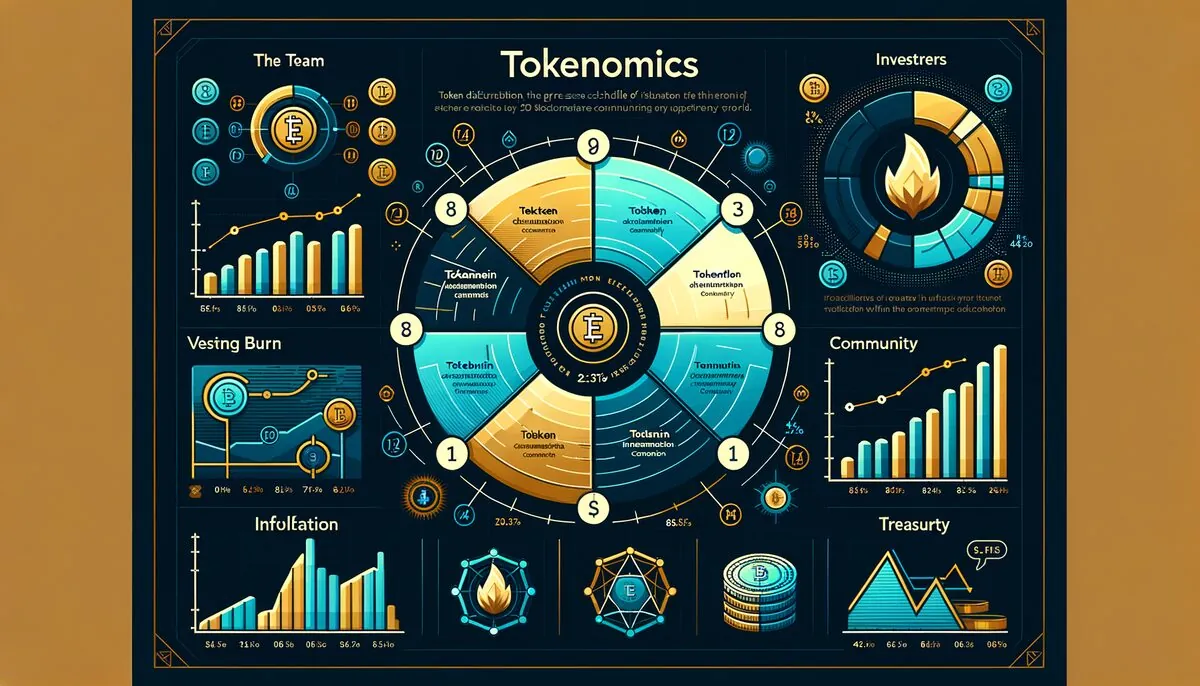
In 2026, tokenomics has matured significantly. The era of launching tokens with vague whitepapers and no clear economic model is over. Institutional investors, DAOs, and retail participants alike demand rigorous tokenomic design before allocating capital. Projects that ignore these fundamentals consistently underperform or fail outright.
The importance of tokenomics extends beyond price speculation. Well-designed token economics create alignment between all stakeholders: developers are incentivized to build, users are incentivized to participate, and holders are incentivized to govern responsibly. Poor tokenomics creates misaligned incentives where insiders profit at the expense of the community.
For a broader understanding of the decentralized ecosystem, see our complete guide to DeFi, which covers how tokenomics fits into the larger decentralized finance landscape.
Token Supply: Maximum, Circulating, and Total Supply Explained
Token supply is the most fundamental pillar of tokenomics. There are three distinct supply metrics every investor must understand, and confusing them is one of the most common mistakes in crypto analysis.
Maximum Supply (Hard Cap)
Maximum supply represents the absolute upper limit of tokens that can ever exist. Bitcoin's maximum supply of 21 million coins is the most famous example. Once all 21 million BTC are mined (projected around 2140), no new Bitcoin can ever be created. This hard cap is enforced by the protocol's consensus rules and cannot be changed without a network fork supported by the overwhelming majority of participants.
Not all tokens have a maximum supply. Ethereum, for example, has no hard cap on ETH issuance. Instead, it uses a dynamic model where new ETH is minted as validator rewards while existing ETH is burned through the EIP-1559 base fee mechanism. In periods of high network activity, more ETH is burned than minted, making the supply deflationary. During quieter periods, the supply experiences mild inflation.
Circulating Supply
Circulating supply is the number of tokens currently available in the open market and in the hands of the general public. This excludes tokens that are locked in vesting contracts, held in project treasuries with governance restrictions, staked in long-term lockups, or permanently burned. Circulating supply is the most relevant metric for calculating market capitalization because it represents the tokens actually available for trading.
A common pitfall is evaluating a token's price without considering the ratio of circulating supply to total supply. A token with only 10% of its supply in circulation may appear cheap by market cap, but when the remaining 90% unlocks over time, the resulting sell pressure can devastate the price. This is known as the fully diluted valuation (FDV) problem.
Total Supply
Total supply represents all tokens that have been created minus any tokens that have been permanently burned. The difference between total supply and circulating supply consists of tokens that exist but are not freely tradable, such as those in vesting contracts, team lockups, or ecosystem reserve funds. Understanding the gap between circulating and total supply tells you how much potential dilution exists.
Token Distribution: Who Gets What and Why It Matters
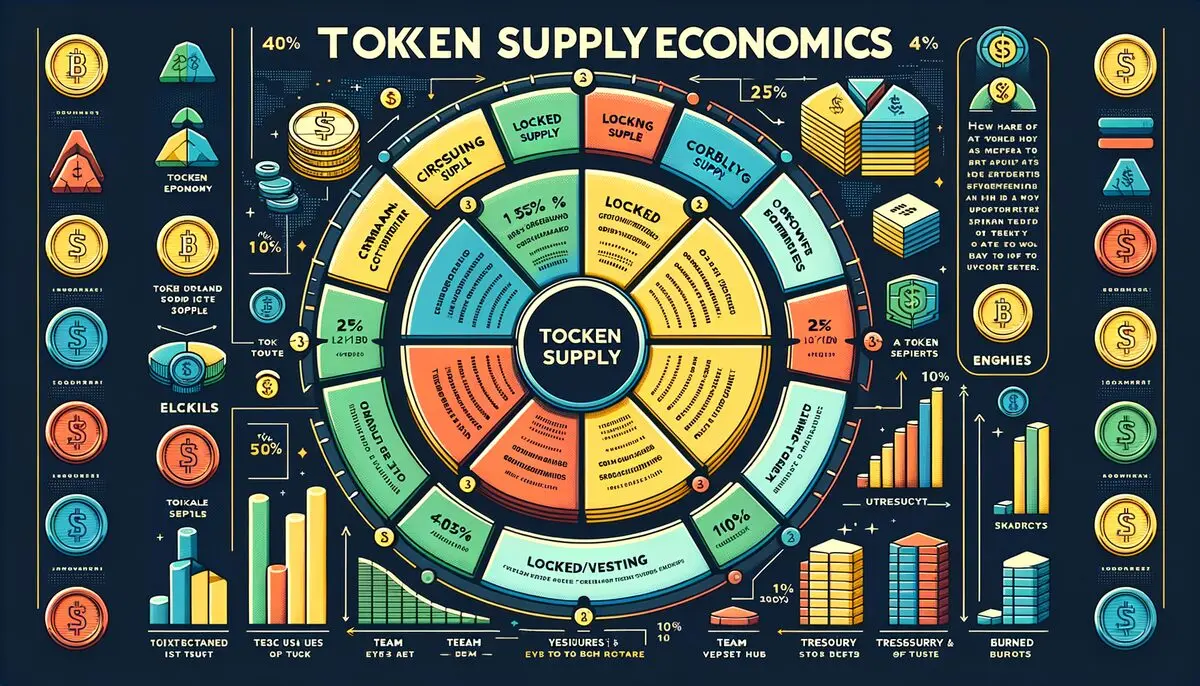
Token distribution defines how the initial and ongoing supply of tokens is allocated among different stakeholder groups. This is arguably the most revealing aspect of a project's tokenomics because it shows where the true incentives lie.
A typical token distribution in 2026 includes several key categories: the core team and founders (usually 15-20%), early investors and venture capital (10-20%), the community and ecosystem fund (25-40%), liquidity provision (5-10%), advisors (2-5%), and public sale participants (10-20%). The exact percentages vary significantly by project, and the details matter enormously.
Projects that allocate more than 50% of tokens to insiders (team plus investors) raise immediate red flags. When insiders control the majority of the supply, they effectively control governance votes, can create significant sell pressure during unlocks, and may prioritize short-term profits over long-term protocol development.
The best-designed distributions in 2026 prioritize community ownership. Protocols like Optimism, Arbitrum, and newer Layer 2 networks have allocated 40% or more to community incentives, retroactive public goods funding, and ecosystem growth, ensuring that the people who actually use and build on the network hold meaningful governance power.
Fair launches, where no tokens are pre-allocated to insiders, remain the gold standard for decentralization. Bitcoin is the ultimate example: every BTC in existence was earned through mining, with no pre-mine, no venture allocation, and no team reserve. While few modern projects achieve this level of fairness, it remains the benchmark against which all distributions are measured.
Vesting Schedules and Token Unlock Timelines
Vesting schedules determine when locked tokens become available to their holders. They are the primary mechanism preventing insiders from dumping their allocations immediately after a token launch. Understanding vesting is critical because major unlock events routinely cause 10-30% price drops as newly liquid tokens hit the market.
Cliff and Linear Vesting
The most common vesting structure combines a cliff period with linear vesting. A typical arrangement for team tokens might include a 12-month cliff (no tokens released during the first year) followed by 36 months of linear vesting (tokens released in equal monthly installments). This means team members receive nothing for the first year, then 1/36th of their allocation each month for the next three years.
Investor vesting is usually shorter, often with a 6-month cliff and 18-24 months of linear release. This reflects the different risk profiles: early investors took financial risk and expect faster liquidity, while team members are expected to demonstrate long-term commitment through longer lockups.
How Unlocks Impact Price
Major token unlock events are among the most predictable catalysts in crypto markets. When a large percentage of circulating supply suddenly becomes liquid, the selling pressure typically outweighs organic demand. Savvy investors track unlock schedules using tools like Token Unlocks and CryptoRank to anticipate these events weeks or months in advance.
The magnitude of the price impact depends on several factors: the size of the unlock relative to circulating supply, the type of holder receiving tokens (teams tend to sell more slowly than VCs), current market conditions, and whether the unlock was widely anticipated. Surprise unlocks or accelerated vesting trigger the sharpest declines.
Smart protocols in 2026 have adopted more gradual release mechanisms, including continuous streaming vesting (where tokens accrue by the second rather than in monthly chunks) and milestone-based vesting (where tokens only unlock when specific development or adoption goals are met). These innovations reduce the cliff-unlock sell pressure problem that plagued earlier token designs.
Demand Drivers: Utility, Governance, and Staking
While supply mechanics determine how many tokens exist, demand drivers determine why anyone would want to hold them. A token with perfect supply dynamics but no genuine demand will still trend toward zero. The strongest tokenomic models create multiple, reinforcing sources of demand.
Utility Demand
Utility demand arises when a token is required to access or use a product or service. Ethereum's ETH is needed to pay gas fees for every transaction and smart contract execution on the network. Chainlink's LINK is used to pay oracle node operators for delivering off-chain data to smart contracts. Filecoin's FIL is required to purchase decentralized storage space.
The strongest utility tokens create a direct, unavoidable link between network usage and token demand. Every time someone deploys a smart contract on Ethereum, they must acquire and spend ETH. This creates organic, sustainable buy pressure that scales with network adoption.
Weak utility tokens suffer from what is called the velocity problem. If users only hold the token for the brief moment needed to complete a transaction, high velocity means constant sell pressure despite high usage. The best models address this by requiring tokens to be locked or staked for extended periods to access premium features.
Governance Demand
Governance tokens grant holders the right to vote on protocol parameters, treasury spending, upgrade proposals, and strategic direction. In protocols with significant treasuries (Uniswap's treasury exceeded $3 billion at peak), governance rights represent meaningful economic control.
Effective governance models require tokens to be locked for voting (vote-escrowed models like Curve's veCRV), creating natural demand and reducing circulating supply. The longer you lock, the more voting power you receive, aligning governance influence with long-term commitment.
Staking Demand
Staking creates demand by offering yield to holders who lock their tokens to secure the network or provide protocol services. Ethereum's proof-of-stake mechanism requires validators to stake 32 ETH, removing those tokens from circulation and creating a yield-driven incentive to hold rather than sell.
As of 2026, approximately 28% of all ETH is staked, representing a massive reduction in effective circulating supply. Solana has an even higher staking ratio near 65%, and Cosmos ecosystem chains routinely see 60-70% staking participation. High staking ratios reduce sell pressure and create stability, but excessively high staking can harm liquidity and make the token difficult to use for its intended utility purposes.
Inflation vs. Deflation in Token Economics
The inflation-deflation spectrum is one of the most debated topics in tokenomics. Neither pure inflation nor pure deflation is inherently superior. The optimal approach depends on the network's stage of development, its security requirements, and the behavior it aims to incentivize.
Inflationary Token Models
Inflationary tokens continuously mint new supply, typically to fund network security (validator/miner rewards), ecosystem development, or liquidity incentives. Polkadot's DOT has a target inflation rate of approximately 10% annually, used to reward stakers who secure the network. Cosmos Hub's ATOM adjusts its inflation rate between 7% and 20% depending on the staking ratio, incentivizing more staking when participation is low.
Inflation is not inherently negative. If the new supply is directed toward productive uses that grow the network's value faster than the dilution, holders still benefit in real terms. The key question is whether inflation rewards are creating genuine value or simply redistributing it.
Deflationary Token Models
Deflationary models reduce token supply over time, creating scarcity pressure that can support price appreciation. Bitcoin is disinflationary (its inflation rate decreases with each halving until reaching zero around 2140). Ethereum became variably deflationary after the Merge, with net supply declining during periods of high network activity.
Pure deflation can create problems if it discourages spending and usage. If users expect their tokens to be worth more tomorrow, they may refuse to spend them today, reducing network activity and undermining the utility that gave the token value in the first place. This is the crypto version of the deflationary spiral concern from traditional economics.
Token Burns: Mechanisms, Impact, and Real Examples
Token burning is the permanent removal of tokens from circulation by sending them to an unrecoverable address (a burn address with no known private key). Burns reduce total supply and, all else being equal, increase the scarcity and potential value of remaining tokens. However, not all burns are created equal.
Protocol-Level Burns
The most impactful burns are built directly into the protocol's transaction processing. Ethereum's EIP-1559 burns the base fee of every transaction, removing ETH proportional to network usage. Since its implementation, over 4.5 million ETH has been burned (worth tens of billions of dollars at various price points). This creates a direct feedback loop: more network usage means more ETH burned, which means more scarcity, which supports higher prices, which attracts more users and developers.
BNB (Binance Coin) uses quarterly auto-burns based on the token's price and the number of blocks produced on BNB Chain. Binance committed to burning BNB until the total supply reaches 100 million (from an initial 200 million). As of 2026, approximately 50 million BNB has been burned through this program, representing about 25% of the original supply.
Buyback-and-Burn Models
Some protocols use revenue to buy tokens on the open market and then burn them, functioning similarly to stock buybacks in traditional finance. Maker (MKR) burns tokens purchased with surplus revenue from its lending protocol. This approach directly links protocol profitability to token scarcity, creating a value accrual mechanism that rewards holders proportionally.
The effectiveness of buyback-and-burn depends on whether the protocol generates genuine revenue. Projects that burn tokens funded by inflationary emissions (minting new tokens to burn old ones) are engaged in circular economics that create no real value. Always verify that burns are funded by external revenue, not internal inflation.
One-Time and Event-Based Burns
Some projects conduct one-time burns of treasury tokens to signal commitment to reduced supply. While these can be positive signals, they are less meaningful than ongoing burn mechanisms because they do not create continuous deflationary pressure. A single large burn generates a temporary price spike but does not change the fundamental supply dynamics going forward.
How to Analyze Tokenomics: A Complete Checklist
Evaluating tokenomics requires a systematic approach. Below is a comprehensive checklist that covers every critical dimension. Use this framework before investing in any token to ensure you understand the full economic picture.
Supply Analysis
- Maximum supply: Is there a hard cap? If not, what controls issuance?
- Current circulating supply: What percentage of total supply is currently liquid?
- Circulating-to-total ratio: A ratio below 40% signals significant future dilution risk
- Fully diluted valuation (FDV): Is FDV reasonable relative to the project's maturity?
- Emission schedule: How quickly will new tokens enter circulation?
- Burn mechanisms: Are there protocol-level burns tied to usage?
Distribution Analysis
- Insider allocation: What percentage goes to team, advisors, and VCs combined?
- Community allocation: Is 30%+ reserved for community incentives and ecosystem growth?
- Treasury governance: Who controls the treasury, and what are the spending guardrails?
- Concentration risk: Do the top 10 wallets hold more than 50% of circulating supply?
Vesting and Unlock Analysis
- Cliff periods: Are they long enough to ensure commitment (12+ months for team)?
- Unlock schedule: Are unlocks gradual (monthly) or large cliff-based releases?
- Upcoming unlocks: What is the next major unlock event, and how large is it?
- VC unlock timing: When do early investors get full liquidity?
Demand Analysis
- Utility: Is the token required to use the protocol, or is it optional?
- Governance: Does holding the token grant meaningful decision-making power?
- Staking yield: Is the yield sustainable or funded by inflation?
- Revenue accrual: Does the token capture protocol revenue through burns or dividends?
- Network effects: Does increased adoption create more demand for the token?
For beginners still building foundational knowledge, our cryptocurrency beginners guide provides essential context for understanding these concepts.
Tokenomics Red Flags: Warning Signs to Watch For
Experience in crypto markets reveals consistent patterns in projects that fail. These red flags should prompt extreme caution or outright avoidance when evaluating a token's economics.
1. Excessive Insider Allocation (50%+ to team and VCs). When more than half the supply is controlled by insiders, the community is effectively a minority stakeholder. History shows that such projects routinely experience sustained sell pressure as insiders liquidate positions. Look for projects where community allocation exceeds insider allocation.
2. Short or Non-Existent Vesting Periods. If team tokens have less than a 6-month cliff or investor tokens are fully liquid at launch, insiders have no structural reason to stay committed. The lack of lockups signals a potential cash-grab mentality. Reputable projects lock team tokens for 2-4 years with meaningful cliff periods.
3. Unrealistically High Staking Yields. APYs above 100% are almost always funded by inflationary emissions, meaning you are earning yield in nominal terms while your holdings are being diluted in real terms. If a protocol cannot explain where yield comes from with a clear revenue model, the yield is likely unsustainable.
4. No Clear Utility Beyond Speculation. Tokens that exist solely as speculative instruments with no protocol utility, governance function, or revenue accrual mechanism are structurally dependent on new buyers entering at higher prices. This is the definition of a greater-fool dynamic and almost always ends badly.
5. Opaque Treasury Management. If the project treasury is controlled by a small multisig with no public spending reports, there is no way to verify that funds are being used productively. Transparent treasuries with on-chain governance approval for spending are the standard in 2026.
6. Concentrated Whale Holdings. When a small number of wallets control the majority of circulating supply, those whales can manipulate price through coordinated buying or selling. Check on-chain distribution data using blockchain explorers before investing.
7. Frequent Tokenomics Changes. Projects that repeatedly modify supply caps, emission rates, or distribution allocations demonstrate a lack of foundational planning. While some flexibility is reasonable, constant changes undermine trust and make long-term valuation impossible.
8. Missing or Vague Documentation. If a project cannot clearly explain its tokenomics in a whitepaper, docs portal, or dedicated tokenomics page, that opacity is intentional. Well-designed tokenomics are meant to be understood by stakeholders, not hidden from them.
Case Studies: Tokenomics of BTC, ETH, SOL, and UNI
Analyzing real-world tokenomics across different protocol types illustrates how these principles work in practice. Each of the following projects takes a fundamentally different approach, and understanding why helps inform better investment decisions.
Bitcoin (BTC): The Gold Standard of Scarcity
Bitcoin's tokenomics are the simplest and most battle-tested in all of crypto. Maximum supply: 21 million BTC. As of 2026, approximately 19.8 million BTC have been mined, with the remaining 1.2 million to be released through block rewards that halve every 210,000 blocks (roughly every four years). The most recent halving occurred in April 2024, reducing the block reward from 6.25 to 3.125 BTC.
Bitcoin's distribution was entirely fair launch with no pre-mine. Satoshi Nakamoto is estimated to hold around 1 million BTC from early mining, but these coins have never moved. The absence of insider allocation, venture capital involvement, or foundation treasuries makes Bitcoin unique among major cryptocurrencies.
Bitcoin's demand drivers are primarily store-of-value narrative, institutional adoption, and its role as a hedge against monetary debasement. It has no smart contract utility, no governance mechanism, and no staking yield. Its value proposition rests entirely on scarcity, decentralization, and network security.
Ethereum (ETH): Dynamic Supply with Utility Dominance
Ethereum has no maximum supply cap, but its supply dynamics changed dramatically with the transition to proof-of-stake (September 2022) and EIP-1559 (August 2021). Post-Merge, ETH issuance dropped by approximately 90%, while the base fee burn mechanism removes ETH proportional to network activity.
The result is a dynamically adjusting supply. During high-activity periods (NFT mints, DeFi surges, major launches), ETH supply contracts. During quiet periods, mild inflation continues. Since the Merge through 2026, Ethereum's net supply has decreased by over 400,000 ETH, representing a negative annual inflation rate of around 0.3%.
ETH's demand drivers are multifaceted: gas fee payments (utility), validator staking (28%+ staked for 3.5-4% APY), collateral in DeFi protocols (ETH is the primary collateral asset), and Layer 2 settlement (all major rollups settle to Ethereum mainnet). This diversity of demand sources makes ETH one of the most robust tokenomic models in crypto.
Solana (SOL): High-Throughput Chain Economics
Solana initially distributed SOL through a combination of seed sale (16%), founding sale (13%), validator sale (5%), strategic sale (2%), team allocation (12.5%), foundation (10%), and community reserve (39%). This distribution was somewhat insider-heavy but included a substantial community allocation.
SOL has no maximum supply and operates with a disinflationary model. Initial inflation started at 8% annually and decreases by 15% each year until reaching a long-term rate of 1.5%. With approximately 65% of SOL staked, the effective dilution for stakers is minimal, as staking rewards offset inflation for participants.
Solana introduced a partial fee burn mechanism in 2024, where 50% of transaction fees are burned and 50% go to validators. This creates a usage-based deflationary component that becomes more significant as Solana's transaction volume grows. With Solana processing hundreds of millions of transactions daily in 2026, the burn impact has become material.
Uniswap (UNI): Governance Token of the Largest DEX
UNI was launched via one of crypto's most famous airdrops in September 2020, distributing 150 million UNI (15% of total supply) to historical users of the protocol. Total supply is capped at 1 billion UNI, distributed as follows: community (60%), team (21.5%), investors (18%), and advisors (0.5%).
UNI's tokenomics have been both praised and criticized. On the positive side, the generous community allocation and retroactive airdrop set a new standard for community ownership. On the negative side, UNI has historically lacked a direct value accrual mechanism, functioning purely as a governance token with no claim on protocol revenues.
In 2024, Uniswap governance approved a fee switch mechanism that directs a portion of trading fees to UNI stakers, transforming UNI from a pure governance token into a revenue-sharing asset. This change significantly improved UNI's tokenomic fundamentals by creating a direct link between protocol usage and token holder returns. The move demonstrated how governance power can be used to retroactively improve tokenomics.
The Future of Tokenomics: Trends Shaping 2026 and Beyond
Tokenomics as a discipline continues to evolve rapidly. Several emerging trends are reshaping how protocols design and implement token economics, driven by regulatory developments, technological advances, and lessons learned from past failures.
Real Yield Over Inflationary Rewards
The DeFi summer of 2020-2021 taught the market that unsustainable inflationary yields always collapse. In 2026, the market strongly favors protocols that generate real yield from genuine economic activity: trading fees, lending interest, MEV capture, and service payments. Real yield is denominated in stablecoins or major assets, not in the protocol's own inflationary token.
Protocols like GMX, Aave, and Lido have led this shift by distributing actual revenue to token stakers. This model attracts more patient, value-oriented capital compared to the mercenary liquidity that chased unsustainable APYs in earlier cycles.
Regulatory-Aware Token Design
With increasing regulatory clarity in the United States, European Union, and Asia, token designers must now consider securities law compliance from day one. The trend toward revenue-sharing tokens has created tension with securities regulations, leading to innovations like the fee switch governance vote model (where the community decides whether to activate revenue sharing) and geographic restrictions on certain token features.
Progressive decentralization, where a project starts with more centralized control and gradually transfers power to the community over a defined timeline, has become the standard approach for regulatory compliance. This model acknowledges that day-one full decentralization is impractical for most projects while providing a credible path toward community ownership.
AI-Optimized Token Economics
Machine learning models are increasingly used to simulate and optimize tokenomic parameters before launch. Projects use agent-based modeling to test how different supply schedules, fee structures, and incentive mechanisms perform under various market conditions. This reduces the need for post-launch parameter changes and creates more resilient economic models from day one.
Cross-Chain and Multi-Token Architectures
The expansion of multi-chain ecosystems has led to more complex tokenomic designs where a single protocol may have different tokens serving different functions across multiple blockchains. Layer 2 tokens, restaking tokens, and liquid staking derivatives have created layered tokenomic structures that require new analytical frameworks to evaluate properly.
Protocols are experimenting with token bridging mechanisms, cross-chain burn and mint models, and unified governance across multiple deployments. These innovations add complexity but also create new opportunities for value capture and stakeholder alignment.

Keep exploring
Frequently Asked Questions About Tokenomics
What is tokenomics in simple terms?
Tokenomics is the study of how a cryptocurrency token works economically. It covers everything about a token's creation, distribution, supply, demand, and utility. Think of it as the rules that determine how many tokens exist, who gets them, what they are used for, and what makes them valuable. Just as traditional economics studies how money works in an economy, tokenomics studies how tokens work in a blockchain ecosystem.
Why is tokenomics important for crypto investors?
Tokenomics is the most reliable predictor of a token's long-term price performance. Tokens with poor economics (excessive inflation, heavy insider allocation, no utility) consistently underperform regardless of the project's technology or marketing. Understanding tokenomics helps you identify which tokens have structural tailwinds (decreasing supply, growing demand, strong utility) and which have structural headwinds (constant dilution, insider dumping, no real use case).
What is the difference between circulating supply and total supply?
Circulating supply is the number of tokens currently available for trading in the open market. Total supply is all tokens that have been created minus any that have been burned. The difference between them consists of tokens that exist but are locked in vesting contracts, staking protocols, team lockups, or treasury reserves. Circulating supply is used to calculate market cap, while total supply helps you understand potential future dilution.
What is fully diluted valuation (FDV) and why does it matter?
Fully diluted valuation is the theoretical market cap if all tokens that will ever exist were in circulation at the current price. It is calculated as maximum supply multiplied by current price. FDV matters because it shows the true scale of a project's valuation, including all future dilution. A token may appear to have a reasonable market cap of $500 million, but if only 10% of tokens are circulating, the FDV is actually $5 billion, which may be unjustifiably high for the project's maturity.
Are deflationary tokens always better investments?
No. Deflationary mechanics reduce supply, which can support price, but they do not guarantee good performance. A deflationary token with no utility, no users, and no real demand will still lose value. The best tokenomics combine some deflationary pressure (through burns or supply caps) with genuine, growing demand (through utility, governance, and revenue sharing). Context matters: a growing network may benefit from mild inflation to fund security and development.
How do token burns affect price?
Token burns reduce total and circulating supply, increasing the scarcity of remaining tokens. If demand remains constant or grows while supply decreases, basic economic principles suggest the price per token should increase. However, the impact depends on the scale of the burn relative to total supply and the source of burned tokens. Protocol-level burns tied to network usage (like Ethereum's EIP-1559) are more impactful than one-time treasury burns because they create ongoing deflationary pressure that scales with adoption.
What is a token vesting schedule?
A vesting schedule is a timeline that controls when locked tokens become available to their holders. It typically applies to team members, investors, and advisors who receive token allocations at or before launch. A common structure is a 12-month cliff (no tokens released for the first year) followed by 24-36 months of linear vesting (tokens released in equal monthly portions). Vesting prevents insiders from selling immediately after launch and aligns their incentives with the project's long-term success.
What makes a good tokenomics model?
Strong tokenomics share several characteristics: a clear, hard supply cap or well-designed dynamic supply; fair distribution with community allocation exceeding insider allocation; long vesting periods for team and investors (2-4 years); genuine utility that creates organic demand; transparent governance with on-chain treasury management; sustainable yield from real revenue rather than inflationary emissions; and burn mechanisms that tie token scarcity to protocol usage. No single model is perfect for every project, but the best designs create alignment between all stakeholders.
How do staking rewards affect tokenomics?
Staking rewards reduce effective circulating supply by incentivizing holders to lock their tokens, which decreases sell pressure and supports price stability. However, staking rewards funded by inflationary emissions dilute non-stakers. The net effect depends on the staking ratio and the source of rewards. In protocols where staking yields come from real transaction fees or protocol revenue, rewards create a genuine value distribution mechanism. When yields come purely from new token minting, they represent a wealth transfer from non-stakers to stakers rather than real value creation.
Where can I research a project's tokenomics?
Start with the project's official documentation, whitepaper, and tokenomics page. Verify claims using on-chain data from blockchain explorers like Etherscan, Solscan, or similar tools. Track vesting and unlock schedules through Token Unlocks and CryptoRank. Analyze holder distribution using Nansen, Arkham, or Dune Analytics dashboards. Check CoinGecko or CoinMarketCap for supply metrics and market data. Compare findings across multiple independent sources to ensure accuracy, as official documentation sometimes contains outdated or misleading information.
Can tokenomics change after a token launches?
Yes, but the process and implications vary significantly. In governance-controlled protocols, token holders can vote to modify parameters like fee structures, emission rates, and treasury allocations. Some changes require smart contract upgrades, while others are adjustable through governance parameters. Bitcoin's tokenomics, by contrast, are virtually immutable because any change would require consensus from the overwhelming majority of miners, nodes, and users. Projects that frequently change core tokenomic parameters should be viewed with caution, as it suggests the original design was not well thought out.
What is the velocity problem in tokenomics?
The velocity problem occurs when users hold a token only for the brief moment needed to complete a transaction, immediately selling it afterward. High velocity means constant sell pressure despite high usage volume. This undermines the assumption that more usage equals higher token value. Solutions include staking requirements for protocol access, vote-escrow locking mechanisms, fee discounts for long-term holders, and utility features that require token lockups. Reducing velocity is essential for creating sustainable token value accrual.
Frequently Asked Questions
What is tokenomics?
Tokenomics refers to the economics of a cryptocurrency or token. It encompasses all factors influencing a token's value and how it operates within its ecosystem.
Why is tokenomics important?
Understanding tokenomics is crucial for evaluating a cryptocurrency project's long-term viability and potential. It provides insight into the supply, demand, and utility of a token.
What are the key components of tokenomics?
Key components typically include supply mechanisms (e.g., total supply, circulating supply, inflation/deflation), distribution methods, utility, and incentive structures.
How does supply affect tokenomics?
The supply of a token, including its maximum cap, emission schedule, and burning mechanisms, directly impacts its scarcity and potential value. Limited supply often contributes to higher demand.
What is the role of utility in tokenomics?
Utility defines the practical uses and functions of a token within its ecosystem. A token with strong utility tends to have higher demand and intrinsic value.
Related Guides
- Liquidity Pool Economics: Fees, Slippage and Impermanent Loss
- How to Evaluate Tokenomics: Supply, Emissions and Unlock Risk Guide (2026)
- What is PEPE? Origins, Tokenomics and Risks
- What is FLOKI memecoin? Tokenomics and Roadmap Explained
- TON Tokenomics: Toncoin Supply, Distribution and Inflation Explained (2026)