What Is a Fork Choice Rule? How Blockchains Resolve Competing Chains
— By Whatsertrade in Tutorials

Learn what a fork choice rule is, how blockchains resolve competing histories, and why this matters for consensus, reorgs, and network security.
This page explains what a fork choice rule is in consensus systems. It is about chain selection logic, not governance forks or token splits.
A fork choice rule is the mechanism that determines which version of a blockchain is considered valid when multiple competing chains exist.
In decentralized networks, it is possible for different nodes to temporarily disagree about the state of the blockchain. A fork choice rule ensures that all participants eventually converge on a single version of the truth. Without it, the network would not be able to maintain consistency.
Understanding Forks
Why Forks Happen
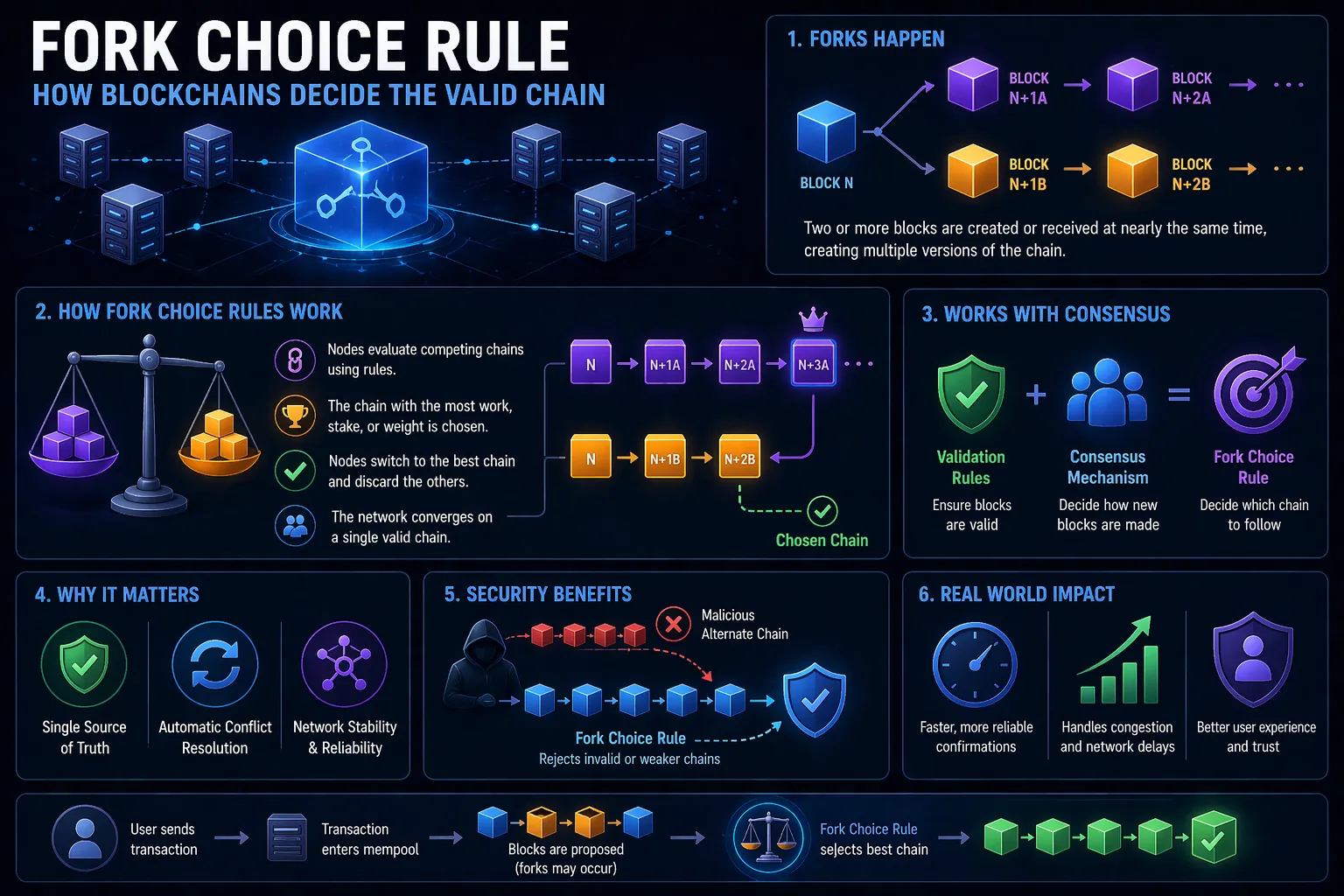
Forks occur when two or more blocks are produced at nearly the same time or when nodes receive information in a different order. This creates multiple versions of the blockchain, each with its own sequence of blocks. Forks can be temporary, lasting only a few seconds, or they can persist longer depending on the situation.
How Fork Choice Rules Work
The fork choice rule defines how nodes decide which chain to follow. In many systems, this is based on the idea of the longest chain, or the chain with the most accumulated work or stake. For example, if one version of the chain becomes longer than another, nodes will switch to that version and abandon the shorter one. This process ensures that the network eventually agrees on a single chain.
Consensus and Security
Fork Choice and Consensus
Fork choice rules are a core part of consensus mechanisms. They work alongside block production and validation rules to ensure that the network remains consistent. While consensus determines how blocks are created and validated, the fork choice rule decides which blocks are accepted as part of the main chain.
Why They Matter
Fork choice rules are essential for maintaining trust in a blockchain. They ensure that there is a single source of truth, conflicts are resolved automatically, and the network remains stable despite temporary disagreements. Without a clear fork choice rule, different nodes could follow different chains indefinitely, breaking the system.
Role in Security
Fork choice rules also play a crucial role in security. If an attacker tries to create an alternative chain, the fork choice rule determines whether that chain will be accepted or rejected. A strong fork choice rule makes it difficult for malicious actors to manipulate the network.
Real World Implications
For most users, fork choice rules operate in the background. However, they influence important aspects of the user experience, including transaction confirmation reliability, reorganization behavior, and network stability during congestion. Understanding fork choice rules helps users better understand why transactions may sometimes behave unpredictably.
A fork choice rule is a fundamental part of how blockchains maintain consensus. It determines which chain is valid when forks occur and ensures that all participants eventually agree on a single version of history. For anyone interacting with crypto, understanding this concept provides a deeper appreciation of how decentralized systems stay consistent and secure in a dynamic environment.
How to Bridge Crypto Between Chains: Complete Cross-Chain Tutorial 2026 How to Use 1inch: Complete DEX Aggregator Swap Tutorial (2026) How to Use OKX Web3 Wallet: Multi-Chain DeFi Hub Guide (2026)Frequently Asked Questions
What is a fork choice rule?
A fork choice rule is an algorithm that a blockchain client uses to determine the canonical, or correct, chain among multiple competing chains. It helps resolve situations where different versions of the blockchain exist simultaneously.
Why are fork choice rules necessary?
They are essential for maintaining consensus and security in decentralized blockchain networks. Without them, nodes would not agree on the correct history of transactions, leading to network instability and potential double-spending.
How do fork choice rules typically work?
Most fork choice rules operate by selecting the chain that has accumulated the most 'work' or 'difficulty' according to the network's consensus mechanism. This often translates to the longest chain or the chain with the most valid blocks.
What is the 'longest chain rule'?
The longest chain rule is a common type of fork choice rule where the chain with the greatest number of blocks is considered the valid one. It assumes that the chain with more blocks represents the most effort from miners or validators.
Are there different types of fork choice rules?
Yes, while the longest chain rule is prevalent in Proof of Work systems, Proof of Stake blockchains often use more complex rules. These can involve factors like validator stake weight, block proposer selection, and finality gadgets.
Related Guides
- What Is Aerodrome Finance? Base DEX & Velodrome Fork Guide 2026
- WETH vs USDC Pair: Which Trading Pool Is Better?
- Does the Wash Sale Rule Apply to Crypto? (2026)
- What Is SushiSwap (SUSHI)? The Multichain DEX on 40+ Chains Explained (2026 Guide)
- Top 5 Whale Tracking Tools in 2026: Large Wallet Monitoring Across Chains