WETH vs USDC Pair: Which Trading Pool Is Better?
— By Whatsertrade in Tutorials

Compare a WETH vs USDC pair and learn which trading pool may offer better liquidity, lower slippage, cleaner pricing, and safer execution.
This guide compares a WETH pair vs USDC pair for trade execution. It is about choosing the better pool, not about ETH versus dollar directional price exposure.
When a token trades on a decentralized exchange, it may have more than one liquidity pool. One pool might be paired with WETH, while another might be paired with USDC. At first, both pools may look like they offer access to the same token. In practice, the pool you choose can affect your entry price, slippage, price impact, execution quality, and exit risk.
This is especially important for new tokens, memecoins, low liquidity assets, and tokens that trade across multiple DEXs or chains. A trader who buys through the wrong pool may pay more than expected, suffer higher slippage, or struggle to exit later.
This guide explains how to compare a WETH pair vs a USDC pair before trading. You will learn what each pair means, when one may be better than the other, and how to use DEXTools to review liquidity, volume, price impact, transaction flow, and market structure.
What Is a WETH Pair?
A WETH pair is a liquidity pool where a token trades against wrapped Ether. For example, a token may trade in a TOKEN/WETH pair.
WETH is commonly used in Ethereum based DeFi because it allows ETH to interact with smart contracts as an ERC-20 token. Many early token launches use WETH pairs because ETH is one of the most liquid assets in DeFi.
A WETH pair can be useful because many traders already hold ETH or WETH, and many DEX routes use WETH as a core trading asset. However, WETH itself changes in price against the dollar. That means the quoted value of the token is affected by both the token's own price movement and the movement of ETH.
What Is a USDC Pair?
A USDC pair is a liquidity pool where a token trades against USDC. For example, a token may trade in a TOKEN/USDC pair.
USDC is a stablecoin, so traders often use it to measure token value more directly in dollar terms. A USDC pair can make it easier to understand entry price, position size, profit, loss, and market cap calculations.
USDC pairs can be especially useful when traders want less exposure to ETH volatility while entering or exiting a token.
Main Difference Between WETH and USDC Pairs
The main difference is the quote asset. In a WETH pair, the token is priced against WETH. In a USDC pair, the token is priced against USDC.
This matters because WETH moves with ETH market conditions, while USDC is designed to stay near one dollar. If ETH moves sharply while you are trading through a WETH pair, the dollar value of your trade may shift even if the token itself has not changed much against WETH.
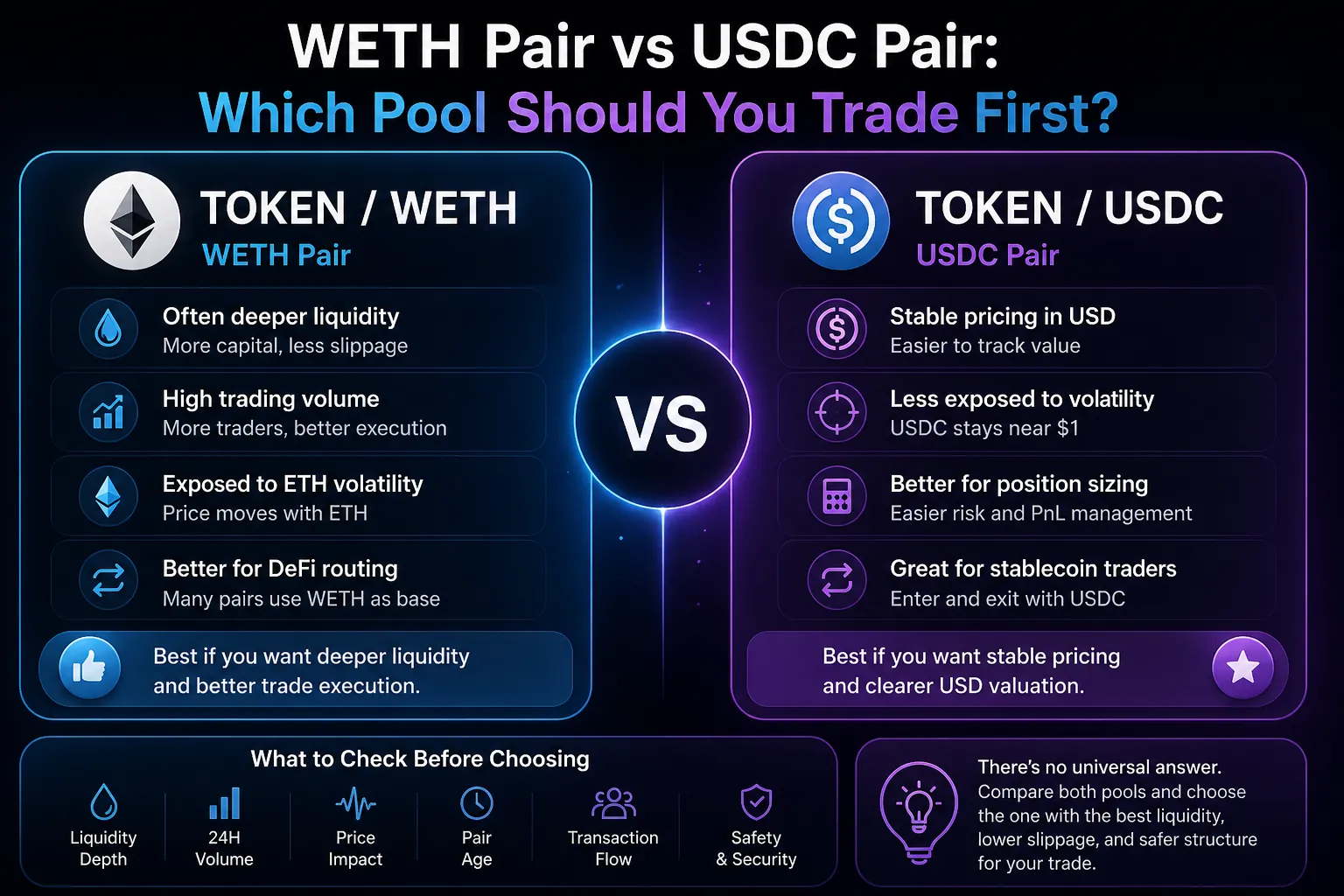
A USDC pair gives a cleaner dollar based view. A WETH pair may offer deeper liquidity and better routing, depending on the token.
Why the Pair You Choose Matters
Choosing the wrong pool can create hidden costs. Two pools for the same token can have different liquidity depth, volume, price impact, spread, and trader behavior.
Before trading, compare:
- Liquidity
- 24 hour volume
- Recent transactions
- Pair age
- Price impact
- Slippage
- Buy and sell flow
- DEX routing
- Token holder behavior
- Chain and contract address
A token can look cheap in one pool and expensive in another if liquidity is thin or arbitrage has not balanced prices yet.
When a WETH Pair May Be Better
A WETH pair may be better when it has deeper liquidity, stronger volume, and more active trading.
Many tokens launch first with WETH liquidity. If most traders are using the WETH pair, that pool may offer better execution and lower price impact. This can be especially true for Ethereum based tokens where WETH is the main trading route.
A WETH pair may be preferred when:
- It has much higher liquidity than the USDC pair
- Most trading volume happens there
- The token launched with WETH liquidity
- Price impact is lower
- Transaction flow is more active
- The pair is older and more established
- Arbitrage keeps the price aligned with other pools
However, deeper liquidity does not automatically mean safer trading. You still need to check whether liquidity is stable, whether large sellers are active, and whether the token contract is legitimate.
When a USDC Pair May Be Better
A USDC pair may be better when you want clearer dollar pricing and less exposure to ETH volatility.
If you are managing risk in dollar terms, USDC pairs can be easier to analyze. You can see more directly how much you are paying and what your position is worth without mentally converting from WETH.
A USDC pair may be preferred when:
- It has enough liquidity for your trade size
- Price impact is lower than the WETH pair
- You want stablecoin based entry and exit
- You are avoiding ETH volatility
- The USDC pool has cleaner transaction flow
- The token has stronger activity in stablecoin pairs
- You are comparing market cap and liquidity in dollar terms
The risk is that some USDC pools are secondary pools with lower liquidity. If the USDC pair is thin, it may produce worse execution than the WETH pair.
Compare Liquidity First
Liquidity should be your first check. A pool with more liquidity can usually support larger trades with less price impact.
On DEXTools, compare the liquidity of the WETH pair and the USDC pair. Do not only check the total number. Ask whether the liquidity is deep enough for your trade size.
For example, a small trade may work fine in either pool. A larger trade may move the price heavily in the thinner pool. This is where price impact becomes important.
A good rule is simple: the best pool is often the one that gives you the cleanest execution, not the one with the quote asset you prefer.
Compare Volume and Activity
Volume tells you where traders are actually active. If the WETH pair has most of the volume and the USDC pair has almost none, the WETH pair may be the main market.
However, volume should be reviewed carefully. High volume can come from real demand, bots, arbitrage, or wash trading.
Look at:
- How often trades happen
- Whether buys and sells are balanced
- Whether one wallet dominates volume
- Whether trades are organic or repetitive
- Whether volume is growing or fading
- Whether liquidity supports the volume
A pool with high volume and low liquidity can be risky. A pool with moderate volume and stable liquidity may offer better execution.
Compare Price Impact
Price impact is one of the most important differences between pools. It shows how much your trade may move the price.
If a pool has low liquidity, even a small trade can create large price impact. This means you may enter at a worse price than expected and lose value immediately.
Before trading, simulate the transaction in your DEX interface and compare price impact between the WETH pair and the USDC pair.
The better pool is often the one with lower price impact for your actual trade size.
Watch for Price Differences Between Pools
Sometimes the WETH pair and USDC pair show slightly different prices for the same token. This can happen when liquidity is uneven or arbitrage has not fully balanced the pools.
Small differences are normal. Large differences are a warning sign.
Large price gaps may indicate:
- Thin liquidity
- Slow arbitrage
- A stale pool
- Manipulated trading
- Wrong contract
- Fake or cloned token
- Poor routing
If prices are very different, slow down and verify the contract, chain, and pair details before trading.
Check Pair Age
Pair age matters because newer pools may have less trading history. If the WETH pair has existed for months and the USDC pair was created today, the WETH pair may be more reliable. But if the token recently migrated liquidity from WETH to USDC, the newer pair may be the official active one.
Use pair age together with official project announcements, liquidity, and transaction flow. Do not assume older always means better.
Check the Contract Address
Before choosing any pair, confirm that both pools use the same official token contract. Fake tokens can copy names, tickers, and logos.
This is especially important when a token has multiple pools. A scam pool may use a fake token contract paired with WETH or USDC to look legitimate.
Always verify:
- Token contract address
- Chain
- Official links
- Pair address
- DEX
- Project announcements
The quote asset does not matter if the token contract is wrong.
Practical Checklist Before Choosing a Pool
Before trading, ask:
- Which pool has more liquidity?
- Which pool has lower price impact for my trade size?
- Which pool has healthier volume?
- Which pool has more organic transaction flow?
- Are both pools using the same official token contract?
- Is one pool much older or newer?
- Does one pool show suspicious price differences?
- Is liquidity stable or leaving?
- Which quote asset fits my risk plan, WETH or USDC?
- Can I exit through the same pool without major slippage?
Final Thoughts
The choice between a WETH pair and a USDC pair is not just a preference. It can affect execution, risk, price impact, and exit quality.
A WETH pair may offer deeper liquidity and stronger routing. A USDC pair may offer clearer dollar based pricing and reduce ETH volatility exposure. The better choice depends on the actual market data.
Use DEXTools to compare liquidity, volume, transactions, pair age, and price behavior before trading. Do not choose a pool because it looks familiar. Choose the pool that gives you the cleanest, safest, and most liquid path for your trade.
Is a WETH pair better than a USDC pair?
Not always. A WETH pair may have deeper liquidity, but a USDC pair may offer clearer dollar pricing. The better pool depends on liquidity, volume, price impact, and transaction activity.
Why do tokens have multiple pools?
Tokens can have multiple pools because traders provide liquidity against different assets, such as WETH, USDC, USDT, or native chain tokens.
Should I always trade the pool with the most liquidity?
Usually, higher liquidity helps reduce price impact, but you should also check volume, contract address, transaction flow, and whether the pool is official.
Can WETH price movement affect my trade?
Yes. If you trade through a WETH pair, the dollar value of the token can be affected by ETH price movement.
How can DEXTools help compare pools?
DEXTools can help you compare liquidity, volume, price action, pair age, transaction activity, and market behavior across different pools for the same token.
How to Bridge Crypto Between Chains: Complete Cross-Chain Tutorial 2026 How to Use 1inch: Complete DEX Aggregator Swap Tutorial (2026) How to Use OKX Web3 Wallet: Multi-Chain DeFi Hub Guide (2026)Frequently Asked Questions
What is WETH?
WETH, or Wrapped Ether, is an ERC-20 token that represents Ether (ETH) on the Ethereum blockchain. It allows ETH to be used in decentralized finance (DeFi) protocols that require ERC-20 compatibility.
What is USDC?
USDC is a stablecoin pegged to the US dollar, meaning one USDC is intended to always be redeemable for one US dollar. It is a popular choice for traders seeking stability and liquidity in the crypto market.
How do WETH and USDC differ?
WETH is a wrapped version of a volatile cryptocurrency (ETH), while USDC is a stablecoin designed to maintain a stable value against the US dollar. Their primary functions and risk profiles are distinct.
What are the benefits of trading WETH?
Trading WETH allows participation in DeFi protocols and provides exposure to the price movements of Ethereum. It offers potential for capital appreciation but also carries price volatility risk.
What are the benefits of trading USDC?
Trading USDC offers stability and reduces exposure to crypto market volatility, making it suitable for hedging or as a safe haven asset. It provides predictable value for transactions and liquidity provision.
Related Guides
- PancakeSwap Infinity CLAMM vs LBAMM: Which Pool Type Is Better for LPs in 2026?
- Pair Explorer Data Trend Reversals: A Pro Trading Guide
- What Is a Fork Choice Rule? How Blockchains Resolve Competing Chains
- How Wrapped ETH Works in DeFi: WETH Guide for 2026
- ETH vs WETH in 2026: Differences, Uses and Tradeoffs