What Is a Governance Token in Crypto? Beginner Guide
— By Whatsertrade in Tutorials

Governance tokens explained: learn how they differ from utility tokens, what holders actually vote on, and how to assess governance risk before buying.
A governance token is a crypto token that gives holders voting power over protocol decisions such as upgrades, treasury use, emissions, fee changes, or incentive design. It is easiest to think of it as a coordination tool for a crypto network, not as automatic equity in a company. In DeFi and on-chain communities, governance tokens help decide how rules evolve after a product launches.
This is why governance tokens matter in evergreen search. Beginners see them on DEXTools all the time, but many still confuse them with utility tokens, reward tokens, or equity-like ownership. Those are not interchangeable concepts. A governance token can influence a protocol without guaranteeing cash flows, legal ownership, or full decentralization.
Quick answer
- A governance token gives holders voting power over protocol decisions, proposals, treasury policy, or upgrades.
- Governance tokens are not automatically the same as equity, dividends, or legal ownership in a company.
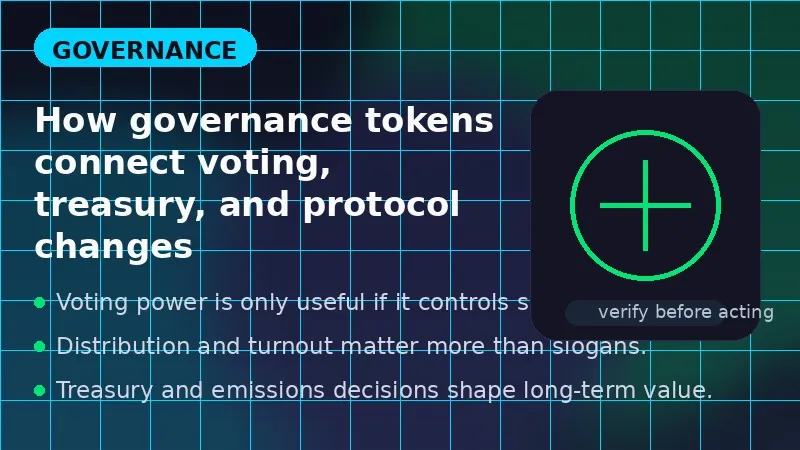
- Good governance analysis looks at voting power, token distribution, treasury control, emissions, and turnout, not just hype.
- Before buying, check tokenomics, circulating supply, unlock schedules, and whether governance actually affects real protocol decisions.
What a Governance Token Actually Is
A governance token is a token designed to let holders participate in decisions about how a protocol or on-chain community changes over time. That can include voting on treasury spending, parameter changes, reward emissions, new listings, protocol upgrades, incentives, or the composition of a DAO. The specific powers vary, but the broad idea is consistent: governance tokens turn a user base into a decision-making body.
That does not mean every governance token is equally meaningful. Some projects market governance aggressively even when the real control is narrow, off-chain, or dominated by insiders. So the real analytical question is not only “does this token have voting?” but “what does that vote actually control, and who can realistically influence it?”
Governance Token vs Utility Token
Governance and utility often overlap, but they are not the same. A utility token typically powers access, discounts, collateral functions, staking, or in-product actions. A governance token focuses on voting rights and protocol coordination. Sometimes one token covers both roles, and that can be efficient. It can also create confusion, especially when investors assume “governance” automatically means durable demand or legal ownership.
If you already understand tokenomics, then governance tokens are easier to assess. You want to know how the token is distributed, how new supply enters circulation, and whether governance rights are concentrated among the team, treasury, or whales.
How governance tokens differ from nearby token types
What Governance Holders Usually Vote On
The details depend on the protocol, but votes often cover treasury grants, fee switches, staking emissions, collateral parameters, incentive programs, and technical upgrades. In mature protocols, governance can shape the competitive direction of the network. In weaker projects, governance is mostly cosmetic and used for marketing optics.
The most common governance subjects
Why Governance Matters to Valuation and Risk
Governance affects more than ideology. It can shape token dilution, treasury quality, fee pathways, and protocol resilience. A project with strong usage but weak governance can still disappoint holders if emissions are uncontrolled or insiders dominate voting. On the other hand, a protocol with healthy participation and disciplined treasury management can protect long-term value better than one driven only by hype.
That is where broader supply context matters too. Articles like What Is FDV in Crypto? and Circulating Supply vs Total Supply matter because governance tokens are often sensitive to future dilution and unlock schedules. Governance rights mean less if new supply can overwhelm the existing holder base.
Governance Red Flags Beginners Miss
The main governance red flags
A practical governance-token checklist before buying
- Read what the token actually controls, not just the label attached to it.
- Check tokenomics, circulating supply, and future dilution paths.
- Look at proposal history and turnout, not only marketing claims.
- Assess whether governance decisions affect fees, treasury use, or protocol incentives in a real way.
- Use DEXTools to confirm liquidity, market structure, and trading behavior before you take any position.
How DEXTools Helps You Analyze Governance Tokens
DEXTools does not replace governance research, but it is a strong first filter. It helps you verify token contracts, liquidity, holder behavior, and market context before you go deeper into treasury or proposal analysis. That matters because governance tokens can look attractive in abstract theory while trading on weak liquidity or fragile market structure.
A sensible workflow is to start with DEXTools for the market reality, then move into tokenomics, distribution, proposal history, and unlock analysis. If you are also studying launch mechanics, the related guides on launching a crypto token and token vesting give useful context.
Frequently Asked Questions
What is a governance token in crypto?
It is a token that gives holders voting power over protocol decisions such as treasury use, upgrades, fees, or incentive changes.
Is a governance token the same as equity?
No. Governance rights do not automatically mean legal ownership, dividends, or corporate shareholder rights.
Can a token be both utility and governance?
Yes. Some tokens combine both roles, but you should still evaluate governance power and product utility separately.
Why do governance tokens depend on tokenomics?
Because voting power and value can be diluted by emissions, vesting, and unlocks if supply expands aggressively.
How do I check whether a governance token is meaningful?
Look at proposal history, turnout, treasury control, distribution, and whether token-holder votes actually change important protocol outcomes.
Related DEXTools tutorials
Disclaimer: This article is for educational purposes only and does not constitute investment, legal, or financial advice. Governance rights do not guarantee value, and crypto markets can remain highly speculative even when a token has real protocol voting power.
Related Guides
- What Is Snapshot: Complete DAO Governance Voting Guide (2026)
- Lido on Ethereum: stETH, wstETH and Dual Governance Explained (2026)
- What Is Hedera (HBAR)? Hashgraph and Governance Explained
- How Do DAOs Work? Governance, Treasury and Voting Explained (2026)
- TRON Super Representatives: How Voting and Governance Work (2026)