Oracle Manipulation in DeFi: Price Feed Exploitation
— By Whatsertrade in Analysis
Discover how oracle manipulation in DeFi affects price feeds, leading to potential losses for protocols and users. Learn why reliable data is crucial.
Understanding Oracle Manipulation and Exploits
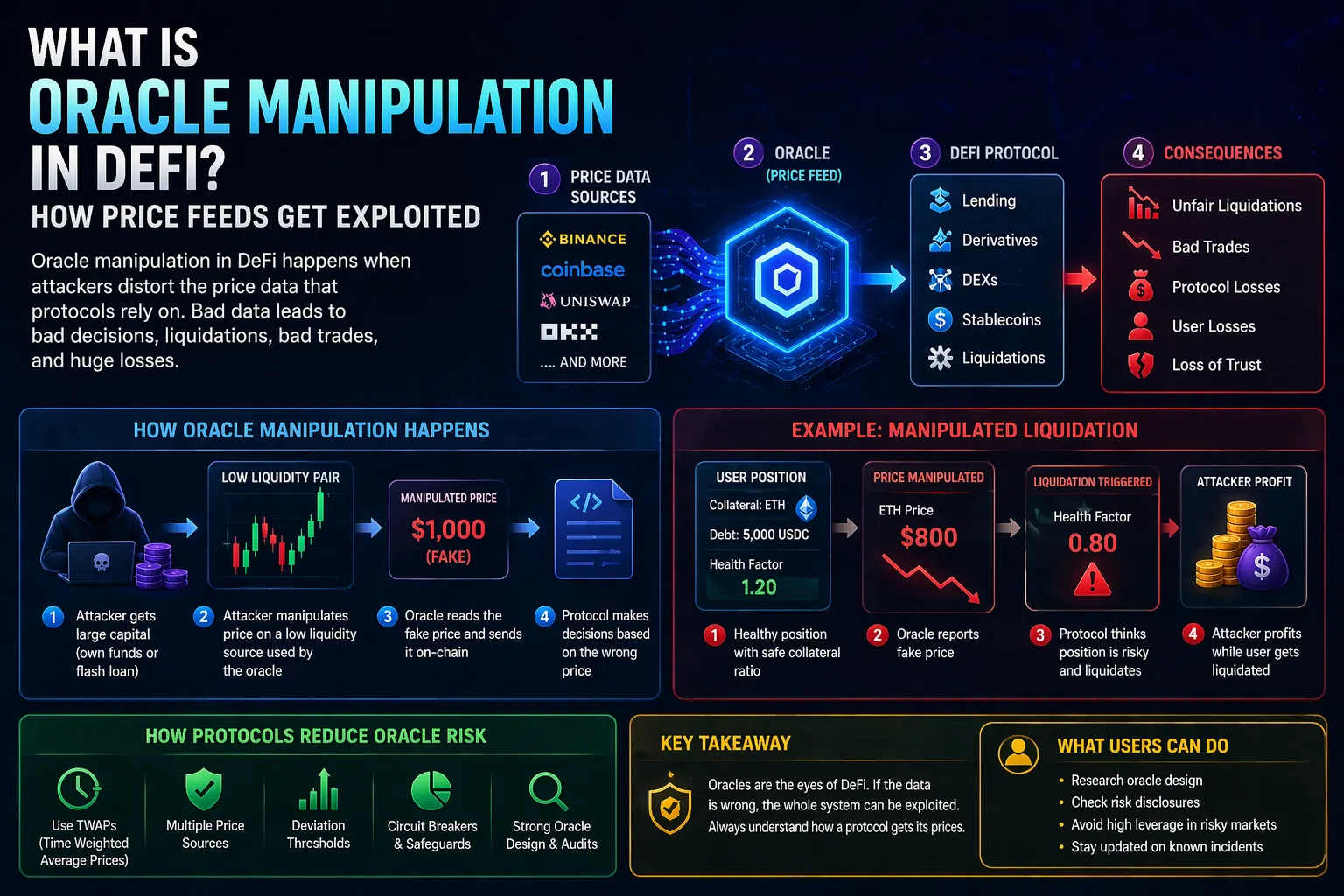
Oracle manipulation in DeFi happens when attackers distort the price data that a decentralized protocol relies on. Since many DeFi apps use external price feeds to determine collateral value, liquidation levels, trade execution, or borrowing power, inaccurate data can cause serious losses.
In simple terms, if a DeFi protocol reads a wrong price, it can make the wrong decision. That is why oracle manipulation in DeFi is one of the most significant risks for traders, liquidity providers, and protocol users.
Role of Oracles in DeFi Systems
A blockchain cannot automatically know the real-world price of an asset. It needs an external data source to provide that information. This is where oracles come into play.
Oracles feed market prices and other off-chain data into smart contracts. Lending protocols utilize them to assess collateral. Perpetual trading platforms use them to calculate positions. Stablecoin systems may use them to help maintain price stability.
Without reliable price feeds, many DeFi products would not function. Thus, the oracle becomes a critical point of trust.
Methods of Oracle Manipulation
Oracle manipulation often occurs when an attacker influences the price source a protocol depends on. This generally involves low liquidity markets, thin trading pairs, or poorly structured pricing mechanisms.
For instance, if a protocol relies on a small decentralized exchange pool for price data, an attacker may temporarily push the price up or down with a large trade or borrowed capital. If the oracle reads that manipulated price, the smart contract reacts as if it were genuine.
This can enable the attacker to borrow excessively, trigger liquidations unfairly, or exploit pricing gaps for profit.
Risks and Implications
Oracle manipulation is dangerous because it can disrupt a protocol even if the code itself is flawless. The contract might operate as intended, but it acts on false information.
This makes oracle attacks notably powerful. Instead of attacking the code directly, the attacker targets the assumptions behind the code.
For users, the consequences can include sudden liquidations, poor swaps, distorted collateral values, or eroded trust in the protocol.
Targets of Oracle Exploitation
Lending platforms are common targets because they heavily depend on accurate collateral prices. If the collateral price is inflated, an attacker might borrow more than allowed. If the price drops, other users may be unfairly liquidated.
Derivatives protocols can also suffer if manipulated prices alter entry, exit, or settlement conditions.
Any DeFi app that relies on market data is potentially vulnerable if its oracle model is weak.
Mitigating Oracle Risks
Protocols strive to minimize oracle manipulation by employing robust pricing methods. These may involve time-weighted average prices, multiple market sources, deeper liquidity references, and protections against abrupt price spikes.
The goal is to make it more challenging for attackers to influence the price sufficiently to exploit the system.
Yet, no oracle design is perfect. The more a protocol grows in complexity, the greater the need for dependable price data.
User Vigilance and Oracle Awareness
Users should scrutinize how a protocol sources its prices. A DeFi platform that relies on weak, illiquid, or overly narrow data sources risks higher oracle vulnerability.
If a protocol offers unusually high leverage, rapid liquidations, or relies on niche tokens with thin liquidity, the risks might be more pronounced.
Understanding oracle manipulation in DeFi is crucial not just for developers but for anyone using lending, trading, or leveraged products on-chain.
Oracle manipulation in DeFi serves as a reminder that good code isn't sufficient. Smart contracts are reliant on the data they trust. If the price feed is compromised, the protocol can make costly mistakes even when everything else appears secure.
Traders and investors should consider oracle risk as part of their due diligence. In DeFi, incorrect data can be just as dangerous as faulty code.
How to Bridge Crypto Between Chains: Complete Cross-Chain Tutorial 2026 How to Use 1inch: Complete DEX Aggregator Swap Tutorial (2026) How to Use OKX Web3 Wallet: Multi-Chain DeFi Hub Guide (2026)