What Is a State Channel? Off-Chain Transactions Explained
— By Whatsertrade in Tutorials
Learn what a state channel is, how off-chain transactions work, and how state channels compare with rollups and other blockchain scaling solutions.
This guide explains what a state channel is and when off-chain channels make sense. If you want newer shared execution infrastructure, see our Layer 2 sequencer guides.
Key Takeaways
- How a State Channel Works
- Advantages of State Channels
- Limitations of State Channels
- Use Cases for State Channels
- State Channels vs Other Scaling Solutions
- Final Thoughts
Blockchains are secure but limited in throughput. Every transaction that is recorded on chain requires network resources and incurs fees.
State channels solve this by moving repeated interactions off chain. This allows users to transact instantly and cheaply without overloading the network.
They are especially useful in scenarios where the same participants interact multiple times.
How a State Channel Works
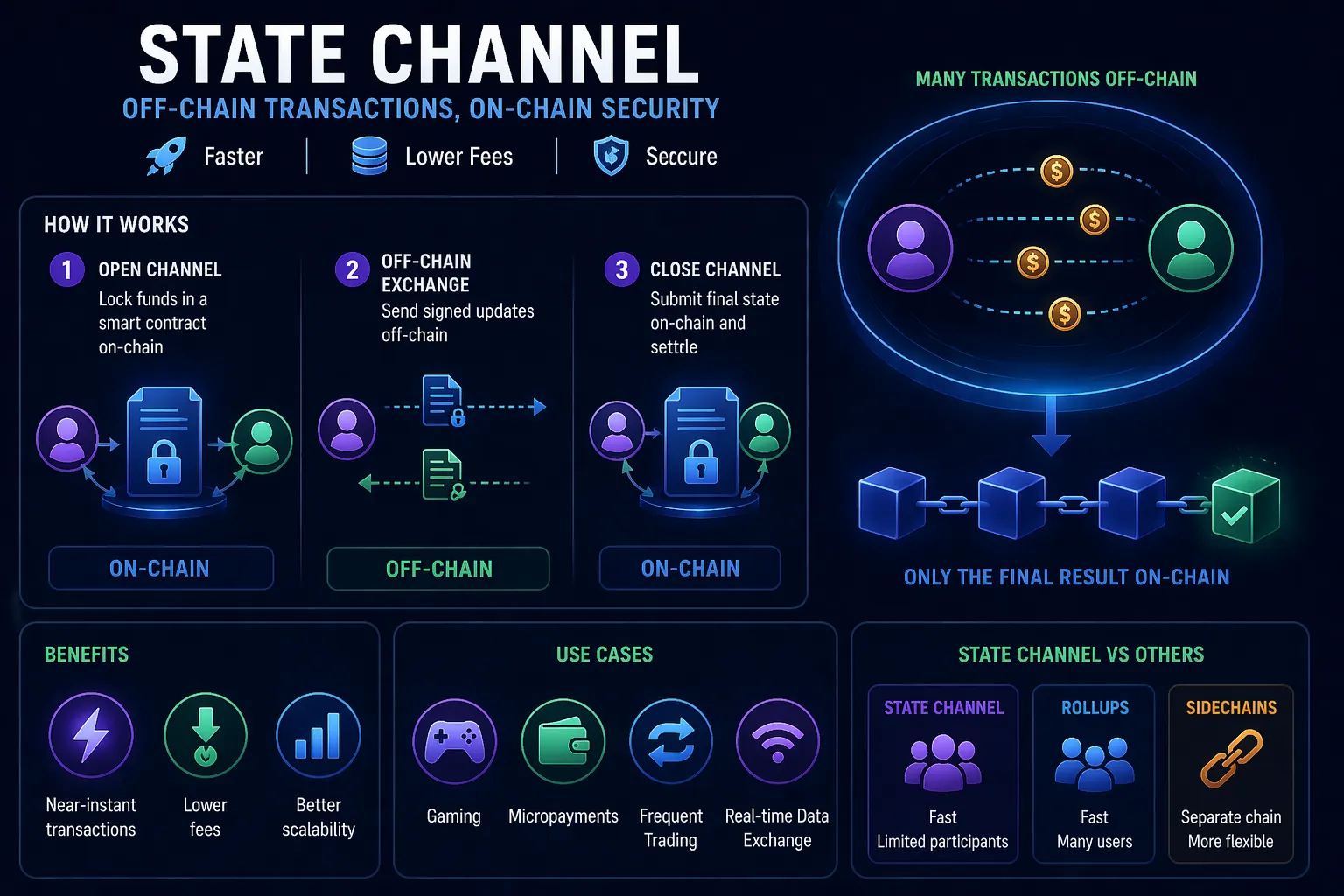
A state channel typically follows three steps.
First, participants open a channel by locking funds into a smart contract on the blockchain.
Second, they exchange signed messages off chain that represent changes in balances or states. These updates are not immediately recorded on the blockchain.
Third, when the interaction ends, the final state is submitted to the blockchain, and the contract distributes funds accordingly.
This process allows many interactions to happen without requiring multiple on chain transactions.
Advantages of State Channels
State channels offer several key benefits.
They enable near instant transactions because updates do not need to wait for block confirmations.
They reduce fees since only the opening and closing transactions are recorded on chain.
They improve scalability by reducing the number of transactions the network needs to process.
These advantages make state channels attractive for certain use cases.
Limitations of State Channels
Despite their benefits, state channels have limitations.
Participants must remain online to monitor the channel and ensure that no invalid state is submitted.
Channels are typically limited to a fixed group of participants, which makes them less flexible for open systems.
They also require upfront setup, including locking funds in a contract.
These limitations have led to the development of alternative scaling solutions such as rollups.
Use Cases for State Channels
State channels are well suited for applications that involve repeated interactions between the same parties.
Examples include:
Micropayments
Gaming interactions
Frequent trading between specific participants
Real time data exchange
In these scenarios, the efficiency gains can be significant.
State Channels vs Other Scaling Solutions
State channels are one of several approaches to scaling blockchains.
Compared to rollups, state channels offer faster interactions but less flexibility. Rollups can support many users without requiring direct coordination between them.
Compared to sidechains, state channels do not require a separate chain. They operate directly on top of the main blockchain.
Each solution has its own trade offs depending on the use case.
Final Thoughts
A state channel is a powerful way to move transactions off chain while maintaining the security of the underlying blockchain. By recording only the final outcome, state channels reduce fees, improve speed, and increase scalability.
Although they are not suitable for every use case, they remain an important part of the blockchain scaling landscape. Understanding how state channels work helps users better evaluate different approaches to scaling and choose the right tools for their needs.
How to Bridge Crypto Between Chains: Complete Cross-Chain Tutorial 2026 How to Use 1inch: Complete DEX Aggregator Swap Tutorial (2026) How to Use OKX Web3 Wallet: Multi-Chain DeFi Hub Guide (2026)Frequently Asked Questions
What is a state channel?
A state channel is a layer-2 scaling solution for blockchains that allows parties to conduct multiple transactions off-chain without involving the main blockchain for each one.
How do state channels work?
Participants lock funds into a smart contract on the main chain, then exchange signed transactions directly between themselves off-chain. Only the initial setup and final settlement are recorded on the main blockchain.
What are the benefits of using state channels?
State channels offer increased transaction speed, lower transaction fees, and improved privacy compared to on-chain transactions, as most interactions occur off-chain.
What types of transactions are suitable for state channels?
State channels are ideal for frequent, repeated interactions between a fixed set of parties, such as micropayments, gaming, or recurring service payments.
What is the main difference between state channels and sidechains?
State channels are typically point-to-point connections between a few participants for specific interactions, while sidechains are separate, independent blockchains with their own consensus mechanisms that can support a wider range of applications and users.
Related Guides
- What is Ark? Bitcoin Off-Chain Scaling Explained
- Top 5 Crypto Privacy Tools in 2026: Protecting Your On-Chain Anonymity
- How to Use BscScan: Track BNB Chain Transactions, Tokens and Contracts (2026)
- What Is wagmi: React Hooks, Wallet Connectors and EVM State (2026)
- What Is the Keltner Channel in Crypto Trading? 2026 Guide