Uniswap v4 Explained: Hooks & the Modular Revolution
Uniswap v4 explained: how hooks, singleton pools and lower gas change DeFi. A 2026 guide to what's new and why it matters for traders and LPs.
Uniswap v4: The End of Simple Pools
In the decentralized finance ecosystem of March 2026, the way we understand asset exchange has changed drastically. What we once knew as static and rigid liquidity pools has given way to modular and highly programmable environments. The arrival of Uniswap v4 has marked a turning point, pushing traditional Automated Market Makers (AMMs) toward an era where customization is the norm rather than the exception. This article explores how the introduction of hooks and the singleton architecture has redefined capital efficiency and the user experience.
The Transition from Traditional AMMs to Modularity
- For years, AMMs like Uniswap v2 and v3 operated under a logic of individual contracts. Every time a new trading pair was created, a new smart contract was deployed on the blockchain. While this model was revolutionary at the time, it presented significant limitations in terms of gas costs and lack of flexibility. If a developer wanted to add a new feature, such as a limit order or a dynamic fee, they had to create an entirely new protocol from scratch.
- Uniswap v4 breaks with this tradition by implementing a singleton architecture. Instead of having thousands of separate contracts for each pool, all pool states are held within a single smart contract. This consolidation drastically reduces the gas cost for swaps that involve multiple hops, as it is no longer necessary to transfer tokens between different contracts during the execution process. In the high activity environment of 2026, this efficiency is the baseline for any competitive exchange.
The Power of Hooks: Customization Without Limits
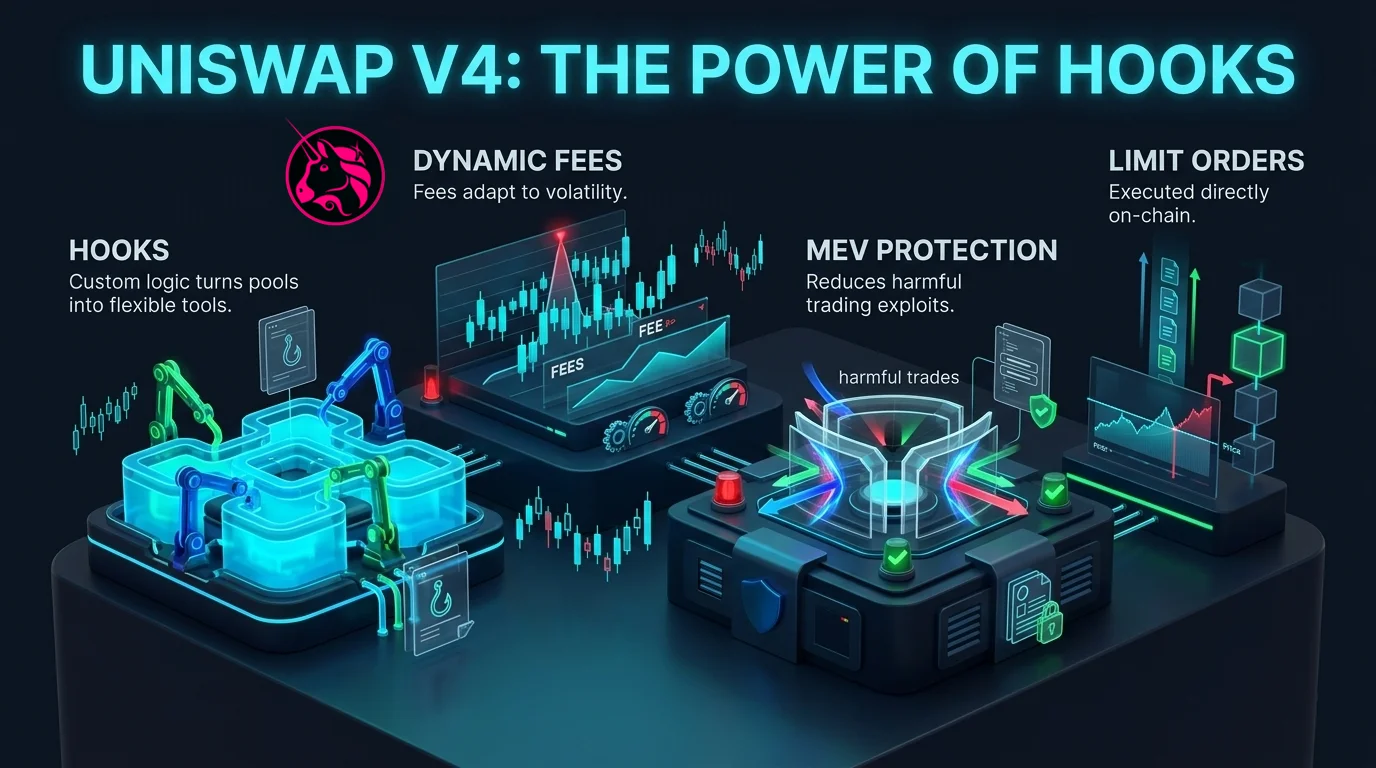
- The true innovation of Uniswap v4 lies in its hooks. These are external contracts that execute custom logic at specific points in the lifecycle of a liquidity pool. Developers can program actions to occur before or after a swap, or before and after a liquidity position is modified. This capability transforms a simple exchange pool into a complex and adaptive financial instrument.
- Unlike previous versions, where the rules of the game were set in stone, hooks allow each pool to have its own personality. We can imagine a pool that adjusts its fees based on real time market volatility or one that only allows participation from users who have met certain identity verification requirements. This means that Uniswap is no longer just a protocol, but a platform upon which others can build specialized financial services.
Example One: Dynamic Fees and Volatility Management
- A practical example of using hooks is the creation of pools with dynamic fees. In traditional AMMs, liquidity providers often suffer during periods of high volatility due to impermanent loss. With a dynamic fee hook, the pool can automatically increase the cost of the swap when volatility rises, better compensating liquidity providers for the risk assumed.
- In March 2026, many of the largest stablecoin pools use hooks to monitor prices from external oracles and adjust execution rates. This ensures that price slippage is minimal during normal market conditions but protects the integrity of the pool when decoupling events or high financial stress occur. The ability to react to the market in real time is a significant advantage over the old, fixed fee models.
Example Two: Native Protection Against MEV
- Miner Extractable Value, or MEV, has long been an invisible tax on DeFi users. Traditional AMMs are vulnerable to sandwich attacks and toxic arbitrage that extract value from everyday users. Uniswap v4 allows for the implementation of hooks designed specifically to internalize or mitigate this MEV.
- For example, a hook can be programmed to auction the right to perform the first swap of a block, directing those profits back to the liquidity pool or to the users instead of to the validators. Other hooks implement price smoothing schemes that make it much more expensive for bots to manipulate the price before a large transaction, returning control and profitability to legitimate market participants.
Example Three: Integrated Limit Orders and TWAMMs
- Traditionally, limit orders on DEXs required complex external infrastructure or third party intervention. With Uniswap v4 hooks, it is possible to execute limit orders directly on chain in a native way. A hook can monitor the price within the pool and execute a buy or sell order at the exact moment the target is reached.
- Additionally, the implementation of Time Weighted Average Market Makers, or TWAMMs, has become common. This allows large investors to execute massive orders by breaking them into thousands of small operations spread over time, all managed by a hook. This reduces price impact and makes Uniswap’s liquidity attractive to institutions that previously preferred centralized markets for their large moves.
Flash Accounting and Storage Efficiency
- Another crucial technical advancement in v4 is the use of flash accounting, supported by the Ethereum improvement proposal EIP 1153 regarding transient storage. In older versions, every operation within a transaction had to be settled immediately, which consumed a lot of gas in storage writes. With flash accounting, the system only verifies the net balance at the end of the transaction.
- This means a user can perform a series of complex swaps through ten different pools and the contract will only move the final necessary tokens upon finishing the entire process. In the fast paced world of 2026, where Layer 2 networks are often congested, this efficiency is what allows Uniswap to maintain its dominance against competitors who still use old and expensive accounting models.
Comparison: Why Traditional AMMs are Fading
- When we compare Uniswap v4 with v2 or v3 models, the difference is clear. Traditional models are static. If you want to add an oracle, you have to pay extra gas in every transaction to update it. If you want concentrated liquidity, you have to manually manage the ranges. v4 automates and optimizes all of this through the hook layer.
- Traditional AMMs are now considered general purpose infrastructures that cannot compete with the specialized pools of v4. While an old AMM treats all tokens the same way, v4 allows a governance token to have different trading rules than a stablecoin or a tokenized real world asset. This adaptability has caused liquidity to migrate massively toward protocols that offer these competitive advantages.
Disclaimer: This article is for informational purposes only and does not constitute investment advice, financial advice, trading advice, or any other kind of advice. DEXTools does not recommend buying, selling, or holding any cryptocurrency or token. Users should conduct their own research and consult with a qualified financial advisor before making any investment decisions. Cryptocurrency investments are volatile and high-risk. DEXTools is not responsible for any losses incurred.
Related Guides
- What Is Uniswap V4 (Hooks): Complete Customizable AMM Guide (2026)
- What Is Uniswap? AMM, Liquidity Pools, Fees and UNI Token Explained (2026)
- What is Unichain? Uniswap's L2 Rollup Complete Guide 2026
- What Is a Modular Blockchain: Celestia and the New Stack (2026)
- What is Mantle? Modular L2 Beginner Guide (2026)
Frequently Asked Questions
What is Uniswap v4?
Uniswap v4 is the latest version of the decentralized exchange protocol that introduces modular and programmable environments, allowing for greater customization and efficiency in asset exchanges.
How does Uniswap v4 improve gas efficiency?
Uniswap v4 utilizes a singleton architecture, consolidating all pool states into a single smart contract, which significantly reduces gas costs for swaps that involve multiple hops.
What are hooks in Uniswap v4?
Hooks are external contracts that enable developers to execute custom logic at specific points in a liquidity pool's lifecycle, allowing for enhanced customization and adaptability of financial instruments.
How do dynamic fees work in Uniswap v4?
Dynamic fees in Uniswap v4 can automatically adjust based on market volatility, helping to compensate liquidity providers during high-risk periods and minimizing impermanent loss.
What measures does Uniswap v4 take against MEV?
Uniswap v4 implements hooks designed to mitigate Miner Extractable Value (MEV) by allowing auctioning of the first swap rights and employing price smoothing schemes to protect users from manipulation.