The Ethereum Ecosystem in 2026: Complete Guide to L1, L2 and DeFi

Full map of the Ethereum ecosystem in 2026: Pectra and Fusaka upgrades, top L2 rollups, restaking, LRTs, RWAs, BUIDL and ETF flows.
The Ethereum ecosystem in 2026 is no longer a single blockchain. It is a sprawling, multi-layered economy that settles trillions of dollars in stablecoin transfers, secures hundreds of billions in restaked capital, and hosts the majority of the world's onchain financial activity. With roughly 33 million ETH staked (more than 27% of total supply), Layer 2 fees down over 90% since the Dencun upgrade, and BlackRock's BUIDL fund alongside Franklin Templeton's BENJI pulling tokenized treasuries onchain, Ethereum has crossed the threshold from experimental network to global settlement infrastructure.
This guide is your full map. We will walk through Ethereum Layer 1 mechanics after the Pectra and upcoming Fusaka upgrades, decode the Layer 2 landscape (Arbitrum, Base, Optimism, zkSync, Linea, Scroll, Starknet), explain the emerging Layer 3 stack, break down the top dApps by total value locked, and unpack the restaking and liquid restaking token (LRT) economy that EigenLayer kicked off. By the end, you will understand how the entire Ethereum ecosystem fits together and where the real opportunities live in 2026.
If you are coming from a competitor blockchain, you will also find a head to head comparison with Solana and Sui near the bottom. Ethereum is not the fastest chain, and it does not pretend to be. What it offers is liquidity, security, and an institutional moat that no other smart contract network has matched. Let us dig in.
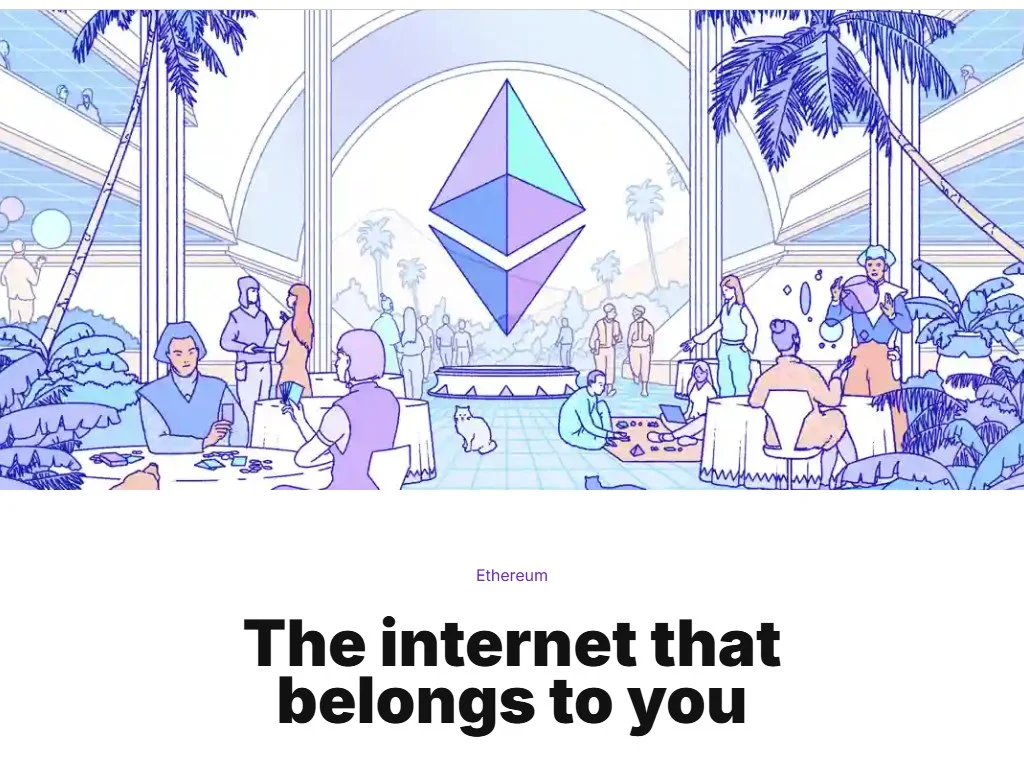
What Is the Ethereum Ecosystem?
The Ethereum ecosystem is the network of protocols, applications, rollups, validators, wallets, and capital that runs on or settles to the Ethereum blockchain. At its core sits Ethereum Layer 1, a Proof of Stake network secured by around 900,000 validators staking roughly 33 million ETH. On top of that base layer, dozens of Layer 2 rollups bundle transactions, and a growing number of Layer 3 application chains specialize even further. The result is a tiered architecture that anchors security at the bottom and pushes throughput to the top.
What makes this an ecosystem rather than just a chain is composability. Smart contracts on Ethereum and most of its rollups can call each other atomically, so a single transaction can route through a decentralized exchange, deposit into a lending protocol, mint a liquid staking token, and post collateral elsewhere, all in one block. Capital, liquidity, and developer tooling flow between these layers, creating network effects that compound. For a refresher on the base asset itself, see our complete beginner guide to Ethereum.
Ethereum Layer 1 in 2026: Pectra, Fusaka and Beyond
Layer 1 Ethereum is the settlement engine. It no longer tries to process every retail swap or NFT mint. Instead, it does what only it can do: provide credibly neutral consensus, data availability for rollups, and the final word on state. The 2025 Pectra upgrade and the 2026 Fusaka upgrade have reshaped what L1 looks like under the hood.
Proof of Stake and the Validator Set
Ethereum runs on Proof of Stake, where validators stake 32 ETH to participate in consensus. As of 2026, the network secures over 33 million ETH, worth more than $200 billion at current prices. Validators propose and attest to blocks. Misbehavior triggers slashing, where a portion of stake is destroyed. This economic security is what underwrites everything built on top of Ethereum, including the rollups that settle billions in daily volume.
Pectra (the merged Prague + Electra hard fork that activated in 2025) raised the effective stake ceiling per validator from 32 ETH to 2,048 ETH. This consolidation reduced operational overhead for large stakers and trimmed the active validator count without reducing the amount of ETH securing the network. It also introduced execution layer triggered exits, smoother withdrawals, and the foundations for smart account behavior at the protocol level through EIP-7702.
The Pectra Upgrade: What Changed
Lets large stakers consolidate validators, cutting infra costs without reducing securing capital.
Standard wallets can temporarily act as smart contracts, unlocking account abstraction features for everyone.
Target blob count raised from 3 to 6 per block, doubling rollup data availability capacity.
Validators can be exited from the execution layer, simplifying liquid staking unwinds and recovery flows.
The Fusaka Upgrade: PeerDAS and 2026 Scaling
Fusaka, the 2026 hard fork combining Fulu (consensus) and Osaka (execution), pushes Ethereum into its data sharding era through PeerDAS (Peer Data Availability Sampling). With PeerDAS, validators no longer need to download every blob. They sample small pieces and statistically verify that the full data is available across the network. The practical result is a multi-fold increase in the number of blobs Ethereum can handle per slot, which directly translates into cheaper rollup transactions for end users.
Fusaka also raises the block gas limit, refines the EVM with additional opcodes that make zero knowledge proving cheaper, and ships changes that prepare the network for full Verkle trees and stateless clients. The roadmap from Vitalik Buterin's "Surge, Verge, Purge, Splurge" framework continues to march forward, with the destination being a Layer 1 that can support tens of millions of L2 users at single digit cent fees.
The Layer 2 Ecosystem: Where Most Activity Happens
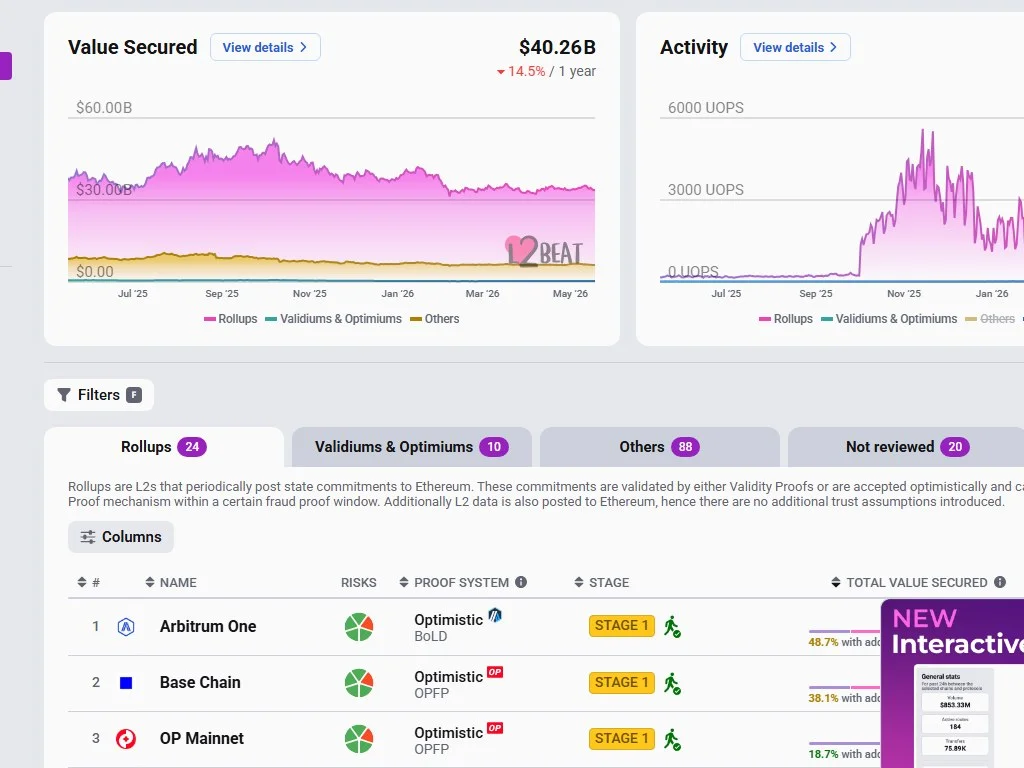
If you opened MetaMask in 2020 and tried to swap $50 of tokens, you might have paid $30 in gas. In 2026, that same swap on Base or Arbitrum costs a fraction of a cent. The reason is Layer 2 rollups, which inherit Ethereum's security while moving execution offchain. Since the Dencun upgrade introduced blob transactions in March 2024, L2 fees have collapsed by more than 90%, and the total value locked across rollups has grown into the tens of billions.
Rollups split into two main families. Optimistic rollups (Arbitrum, Optimism, Base) assume transactions are valid and rely on fraud proofs during a challenge window. ZK rollups (zkSync Era, Linea, Scroll, Starknet, Polygon zkEVM) generate cryptographic proofs of correct execution that Ethereum verifies directly. Both inherit L1 security, but their tradeoffs around withdrawal speed, proving cost, and EVM equivalence are different.
Optimistic Rollups: Arbitrum, Optimism, Base
Arbitrum One is the largest L2 by TVL. It runs Arbitrum Nitro, a highly optimized fork of Geth, and has deep DeFi liquidity through GMX, Camelot, Pendle and Aave V3. Arbitrum's Stylus upgrade also lets developers write contracts in Rust, C and C++, expanding the developer pool beyond pure Solidity.
Optimism pioneered the OP Stack, the modular framework that powers an entire ecosystem of chains called the Superchain. Optimism Mainnet itself hosts protocols like Velodrome and Synthetix. Beyond Mainnet, dozens of chains share security and bridging through Optimism's shared sequencer roadmap.
Base, built by Coinbase on the OP Stack, became the breakout rollup of 2024 and held its lead through 2025 and 2026. Base benefits from direct fiat onramps via Coinbase, the SocialFi explosion led by Farcaster and friend tech style apps, and a heavy concentration of memecoin and consumer activity. Aerodrome, the native DEX, regularly tops daily DEX volume rankings.
ZK Rollups: zkSync, Linea, Scroll, Starknet
zkSync Era by Matter Labs uses its own zkEVM and has shipped ZK Stack, similar in spirit to the OP Stack but for zero knowledge chains. It powers chains like Cronos zkEVM and various enterprise deployments.
Linea, built by ConsenSys, integrates tightly with MetaMask, Infura and the broader Ethereum tooling stack. It is fully EVM equivalent, meaning Solidity contracts deploy unchanged.
Scroll is the most bytecode level EVM equivalent ZK rollup, aiming for full L1 compatibility. It is popular with developers who want their contracts to behave identically across L1 and L2.
Starknet, built by StarkWare, uses its own Cairo language and STARK proofs. It trades EVM compatibility for performance, and after the v0.13 series and Stwo prover upgrades, throughput and proving cost both improved dramatically.
L2 Comparison Table
Layer 3 and the Appchain Era
Layer 3 chains sit on top of Layer 2 rollups and inherit their security recursively. The thesis is simple: if your application is so high throughput or so customized that even a shared L2 is a bottleneck, deploy a dedicated chain that settles to that L2 and only pays for the data it actually uses. In 2026, the L3 ecosystem is real, with rollup-as-a-service providers turning chain deployment into a one click experience.
Conduit is the leading rollup-as-a-service platform on the OP Stack and Arbitrum Orbit. Teams can launch a production grade chain in days with managed sequencers, monitoring and bridging baked in. AltLayer offers restaked rollups using EigenLayer security, plus flash layers (ephemeral rollups for events). Caldera and Gelato round out the RaaS field. The result is a Cambrian explosion of appchains for games, perpetual exchanges and consumer apps that demand control over fee markets and sequencer policy.
Top dApps by Total Value Locked
The Ethereum ecosystem hosts the largest concentration of decentralized applications anywhere in crypto. The top protocols by TVL in 2026 reflect a maturation toward yield bearing assets, real world assets, and staking infrastructure rather than pure speculation. For a primer on the broader sector, see our guide to decentralized finance.
stETH is the dominant LST and the most integrated yield bearing collateral in DeFi. Lido alone secures roughly 9 million staked ETH.
Pioneer of restaking. Lets ETH and LSTs secure additional services (AVSs) for extra yield, with billions in deposits.
Multi chain money market with billions in supplies. GHO stablecoin and Aave V3 are deeply integrated across L2s.
Issuer of DAI and USDS. Backed by a mix of crypto collateral and tokenized real world assets.
The reference AMM. Uniswap V4 hooks unlocked programmable pool logic and pushed daily volume to record highs.
Tokenizes future yield, lets users trade fixed and variable rate exposure on LSTs, LRTs and stablecoins.
If you want a deeper dive into specific protocols mentioned above, our tutorials on Uniswap V4 hooks and Rocket Pool and rETH are good next reads. For routing across DEX liquidity, the 1inch DEX aggregator is the go to.
Liquid Staking and the LRT Economy
Liquid staking solved a basic Ethereum problem: when you stake 32 ETH directly, that capital is locked and illiquid. Liquid staking protocols pool ETH from users, run validators, and issue a tradable receipt token that accrues staking yield. You earn rewards and you can still deploy the receipt as collateral, swap it, or LP it.
The big three liquid staking tokens are stETH from Lido, rETH from Rocket Pool, and cbETH from Coinbase. stETH dominates by market share, rETH is favored by decentralization purists because Rocket Pool has a lower node operator bond requirement, and cbETH benefits from Coinbase's regulatory clarity and exchange listings.
Restaking and Liquid Restaking Tokens
EigenLayer added a second layer to the staking stack. Instead of just staking ETH to secure Ethereum, you can restake it (or your LSTs) to also secure Actively Validated Services (AVSs). AVSs are protocols that need their own consensus or trust assumptions, like data availability layers, oracles, bridges, or coprocessors. Restakers earn additional yield in exchange for accepting additional slashing conditions if the AVSs they support misbehave.
On top of EigenLayer sit the Liquid Restaking Token (LRT) protocols. ether.fi (eETH, weETH), Renzo (ezETH), Kelp DAO (rsETH), and Puffer (pufETH) each let you deposit ETH or LSTs, automatically restake through EigenLayer, and receive a liquid receipt. As of 2026, the AVS economy hosts dozens of services including EigenDA (data availability), Lagrange (state proofs), AltLayer (restaked rollups), and Witness Chain (proof of location).
Lock 32 ETH, run a validator, earn base yield around 3 to 4%.
Deposit any amount, receive stETH/rETH/cbETH, stay liquid.
Deposit ETH or LST into EigenLayer, secure AVSs for extra yield.
Hold eETH, ezETH, rsETH or pufETH for liquid restaked exposure.
DeFi Categories: DEXs, Lending, Derivatives, RWA
Decentralized finance on Ethereum splits into four major categories. Each has matured into a multi billion dollar segment with its own leaders and design space.
Decentralized exchanges include AMMs like Uniswap V4 (with hooks), Curve (stablecoin focused), Balancer (weighted pools), and Aerodrome on Base. Order book DEXs include dYdX and Hyperliquid (though Hyperliquid runs its own L1). Aggregators like 1inch, Matcha and CoW Swap route across all of them. If you trade onchain, understanding market makers and how liquidity is sourced matters.
Lending and borrowing protocols include Aave V3 (multi chain), Compound (the original money market), Morpho (peer to peer optimization on top of Aave/Compound), and Spark (the Sky/Maker subDAO). Lending is where most stablecoin and ETH yield comes from in the conservative end of DeFi.
Derivatives on Ethereum cover perpetuals (GMX, Hyperliquid via its bridge, Vertex), options (Lyra, Premia, Aevo), and structured products (Ribbon). Perpetuals on L2s have closed the gap with centralized exchanges on fees, and some products like Pendle even let you trade fixed versus variable yield exposure.
Real World Assets are the institutional bridge into Ethereum. BlackRock BUIDL, the largest tokenized US Treasury fund, lives natively on Ethereum and several L2s. Franklin Templeton's BENJI is also onchain. Ondo Finance issues OUSG and USDY, treasury backed yield bearing stablecoins. The total tokenized RWA market on Ethereum surpassed $15 billion in 2026 and continues to grow. Our guides to RWA tokenization and Ondo Finance treasuries cover this in depth, as does our deep dive on tokenized treasuries.
Stablecoins on Ethereum
Stablecoins are the killer app of Ethereum. The network settles more stablecoin volume than any other chain. USDT (Tether) is the largest by supply, though much of it lives on Tron. USDC (Circle) is the regulated favorite for institutions. DAI and USDS are issued by the Sky ecosystem (formerly MakerDAO). USDe from Ethena offers a delta hedged synthetic dollar with yield. FDUSD, PYUSD (PayPal) and a growing fleet of bank issued stablecoins continue to expand.
For traders, understanding the stablecoin you hold matters. Some are fully backed by treasuries (USDC, BUIDL, BENJI), some are crypto collateralized (DAI), some are algorithmic or hybrid (USDe, USDS). Our complete USDT and stablecoin guide breaks down each design.
NFTs, SocialFi and Onchain Gaming
The NFT market reshaped itself between 2022 and 2026. Profile picture collections lost their speculative premium, but utility NFTs and onchain media stayed strong. Markets like Blur, OpenSea Pro and Magic Eden moved liquidity from passive auctions toward order book style trading. ERC 6551 token bound accounts gave NFTs their own wallets, enabling new gameplay and identity patterns.
SocialFi exploded on Base with Farcaster, a decentralized social protocol whose Frames primitive turned posts into interactive mini apps. Lens Protocol migrated to its own Lens Chain. Friend.tech popularized the keys / social token model before fading. The pattern that survived is composable social graphs: you own your followers and content, apps plug into the protocol.
Onchain gaming pivoted toward Layer 3s and dedicated rollups. Games like Pirate Nation, Parallel, Realms and Treasure DAO built on Arbitrum Orbit chains or ZK Stack chains where they could tune fees and execution. The thesis is that high frequency game state belongs on a sovereign appchain, with the valuable assets bridging back to Ethereum or its L2s for liquidity.
Identity and Wallets
The Ethereum identity layer matured around ENS (Ethereum Name Service). What started as human readable wallet addresses (vitalik.eth) grew into a full identity layer with subdomains, profile records, and cross chain resolution. Most major wallets, exchanges and dApps now resolve ENS by default. Coinbase's cb.id and Base's basename system extended the model to subdomains for millions of users.
Wallet choice is more diverse than ever. MetaMask remains the default for most users, with built in Snaps for extending functionality. Rabby is preferred by power users for its multi chain UX and transaction simulation. Safe (formerly Gnosis Safe) is the standard for multi sig treasury management, securing tens of billions in DAO and institutional funds. Smart account wallets like Argent, Coinbase Smart Wallet and Zerion brought passkeys, social recovery and gas sponsorship to mainstream users.
Institutional Adoption: ETFs, BUIDL and Corporate Treasuries
The institutional story for Ethereum changed permanently in 2024 when spot ETH ETFs launched in the US. By 2026, BlackRock's ETHA grew into one of the largest crypto ETPs in the world with assets under management north of $35 billion. Fidelity's FETH, Bitwise's ETHW and others rounded out a multi billion dollar category. Several issuers later added staking to their products, channeling institutional capital directly into the validator set.
Tokenization brought the other half of the institutional flow. BlackRock BUIDL, launched on Ethereum in 2024, became the largest tokenized treasury product. Franklin Templeton BENJI, WisdomTree and several private bank pilots followed. Total tokenized assets on Ethereum surpassed $15 billion in 2026, with treasuries leading and private credit, money market funds, and tokenized equities filling out the rest.
Corporate treasuries also began holding ETH directly, in part for staking yield, in part as a strategic reserve asset alongside Bitcoin. Some publicly listed companies adopted ETH yield strategies through liquid staking and restaking, mirroring the playbook MicroStrategy popularized with BTC. For trading mechanics around ETH, our guides on whether to buy ETH and how to sell Ethereum effectively cover the basics, and the XRP ETF analysis gives useful context on how spot ETFs reshape liquidity.
Developer Tooling and Grants
Ethereum's developer experience is one of its strongest moats. Foundry (from Paradigm) became the dominant smart contract development framework, replacing Truffle and competing with Hardhat for general use. Foundry's speed, fuzzing capabilities and native Solidity scripting changed how teams build. Hardhat remains popular for teams that want a Node.js plugin ecosystem.
Tenderly provides production grade transaction simulation, debugging and monitoring. Etherscan remains the default block explorer, with Blockscout running open source alternatives across most L2s. The Solidity compiler continues to evolve, with Vyper offering a Python like alternative for security focused projects. For users worried about wallet hygiene around contract approvals, our Permit2 guide and transaction simulation overview are essential reading.
Grants and ecosystem funding are massive. The Ethereum Foundation distributes millions per year through its grants program. Optimism RetroPGF (Retroactive Public Goods Funding) rewards builders who created lasting value. Gitcoin runs quadratic funding rounds. Arbitrum DAO and the OP Collective direct hundreds of millions in token grants toward ecosystem growth.
Ethereum vs Solana vs Sui: Ecosystem Comparison
Ethereum is not the only smart contract platform with a real ecosystem. Solana and Sui both grew significantly, and each makes different tradeoffs. Here is an honest comparison.
The short version: Ethereum trades raw speed for credible neutrality, the deepest liquidity, and the most institutional plumbing. Solana trades modularity for a single chain UX that feels closer to a centralized exchange. Sui's Move based architecture is technically elegant but the network is still building out applications and capital. For an L1 designed around sharding, see our NEAR Protocol guide.
Step by Step: Getting Started in the Ethereum Ecosystem
If you are new to Ethereum or returning after a long break, here is a clean path to get productive. None of these steps require coding skills.
Risks, Tradeoffs and Honest Limitations
Ethereum is not perfect. Understanding the tradeoffs is part of using the ecosystem intelligently.
Fragmentation across L2s. Liquidity and users are split across dozens of rollups. Bridging is faster than it used to be, but cross L2 UX is still not as seamless as a single chain experience. Initiatives like the Superchain, ZK Stack interop, and chain abstraction wallets are addressing this, but full intent based UX is still a work in progress.
Centralized sequencers. Most L2 rollups still run a single sequencer operated by their core team. If that sequencer censors or goes down, users can usually force withdrawals back to L1, but day to day UX assumes the sequencer is honest and online. Decentralized sequencer roadmaps exist for nearly every major rollup, but the work is slow.
Smart contract risk. Every dApp adds a layer of code that can have bugs. Flash loan exploits, governance attacks, and oracle manipulation continue to drain protocols. Sticking with battle tested protocols and using tooling that surfaces issues like nonce errors helps, but the risk is never zero.
Restaking systemic risk. EigenLayer concentrated billions in ETH securing dozens of AVSs. If an AVS gets slashed badly, the contagion could ripple through LRTs and the lending markets that hold them as collateral. The category is young.
Regulatory uncertainty. Securities classification, staking regulation, stablecoin rules and DeFi reporting requirements continue to evolve, country by country. Builders and users need to track this actively.
Trading on Ethereum: Tools and Best Practices
For active traders, Ethereum and its L2s offer the deepest onchain liquidity in crypto. Some practical pointers:
Use a serious analytics tool. DEXTools, GeckoTerminal and Dexscreener let you watch new pairs, liquidity, holder distribution and trading patterns in real time. Pair that with techniques like backtesting and VWAP analysis to refine entries.
Understand market microstructure. Know what a long versus short position means in perpetuals, how liquidation zones cluster around price, and how to detect fake volume in newly listed tokens. Use a reliable oracle by understanding how pull based oracles like Pyth price assets.
Mind your gas. On L1, set max fee carefully. On L2, gas is mostly negligible, but bridging back to L1 still costs real money. Use aggregators (Bungee, Across, LI.FI) to find the cheapest route across rollups.
Where the Ethereum Ecosystem Goes Next
Looking past 2026, four trends are worth watching. Native account abstraction through EIP-7702 and Pectra means smart account features (gas sponsorship, batching, passkeys, social recovery) will reach hundreds of millions of users. PeerDAS and full Danksharding from Fusaka onward will keep pushing L2 fees lower and throughput higher. Restaking and AVS proliferation will turn Ethereum into the security layer for an entire economy of services beyond just settlement. Tokenized real world assets will continue migrating onchain, with bank issued stablecoins, money market funds, and equities arriving in size.
The big picture: Ethereum in 2026 is no longer a single product, it is an entire economy. Layer 1 settles, Layer 2 executes, Layer 3 specializes, restaking secures, and capital flows freely through composable smart contracts. Whether you are a developer, a trader, a treasurer, or just curious, understanding this stack is the foundation for everything else in onchain finance.
Frequently Asked Questions
Q Q Q What is the Ethereum ecosystem in 2026?
The Ethereum ecosystem is the network of protocols, applications, rollups and capital that runs on or settles to Ethereum. In 2026 it spans Layer 1 (secured by around 33 million staked ETH), dozens of Layer 2 rollups like Arbitrum, Base and zkSync, an emerging Layer 3 appchain economy, and a deep stack of DeFi, NFT, RWA and SocialFi applications.
Q Q Q How much ETH is staked and what does it earn?
Roughly 33 million ETH (more than 27% of the supply) is staked in 2026, worth over $200 billion. Solo stakers and liquid staking participants earn around 3 to 4% APR from base issuance plus priority fees, with restakers and LRT holders typically capturing additional yield from AVS rewards.
Q Q Q What did the Pectra upgrade actually change?
Pectra raised the per validator stake ceiling to 2,048 ETH (EIP-7251), introduced smart account behavior for normal wallets via EIP-7702, doubled blob throughput (EIP-7691), and added execution layer triggered validator exits (EIP-7002). The net effect: better staking economics, more rollup capacity, and account abstraction features for ordinary users.
Q Q Q What is Fusaka and when does it activate?
Fusaka is the 2026 Ethereum hard fork combining Fulu (consensus) and Osaka (execution). Its headline feature is PeerDAS, which lets validators sample blob data instead of downloading all of it. The result is a major increase in rollup data capacity and cheaper L2 fees, alongside EVM and Verkle related improvements.
Q Q Q Which Layer 2 should I use?
For deep DeFi liquidity choose Arbitrum. For Coinbase onramps and consumer or SocialFi apps choose Base. For the Superchain ecosystem choose Optimism. For zero knowledge proofs and faster final withdrawals consider zkSync Era, Linea or Scroll. Starknet is best for high throughput novel applications written in Cairo.
Q Q Q What is the difference between an LST and an LRT?
A Liquid Staking Token (LST) like stETH or rETH represents ETH staked to secure Ethereum, earning base staking yield. A Liquid Restaking Token (LRT) like eETH or ezETH represents ETH or LSTs that have been restaked through EigenLayer to also secure Actively Validated Services, earning additional yield in exchange for additional slashing risk.
Q Q Q How is institutional money entering Ethereum?
Three main paths: spot ETH ETFs like BlackRock ETHA (over $35 billion AUM in 2026), tokenized real world assets like BlackRock BUIDL and Franklin Templeton BENJI issued natively on Ethereum, and direct corporate treasury allocations to ETH, often paired with liquid staking for yield.
Q Q Q Is Ethereum still expensive to use?
Not in 2026. Mainnet L1 fees rise during congestion, but most user activity happens on Layer 2 rollups, where typical swaps and transfers cost under a cent. Since the Dencun upgrade in 2024, L2 fees have collapsed by more than 90%, and Fusaka in 2026 pushes them lower still.
Q Q Q What are the top dApps by TVL on Ethereum?
The leaders in 2026 are Lido (liquid staking), EigenLayer (restaking), Aave (lending), Sky / Maker (CDP and RWA), Uniswap (DEX) and Pendle (yield tokenization). LRT protocols like ether.fi, Renzo and Kelp DAO have also climbed into the top ranks since EigenLayer launched.
Q Q Q How does Ethereum compare to Solana and Sui?
Ethereum offers the deepest liquidity, most institutional rails and broadest developer tooling, but uses a modular L1 plus L2 architecture that fragments UX. Solana is a monolithic fast L1 with strong consumer apps. Sui uses an object based parallel design with the Move language but has a smaller ecosystem. Ethereum still leads on stablecoin supply, TVL and tokenized RWA.
Q Q Q What are the main risks of using the Ethereum ecosystem?
Key risks include L2 fragmentation (split liquidity, complex bridging), centralized rollup sequencers, smart contract bugs and exploits, restaking systemic risk if AVSs misbehave, evolving regulation around staking and stablecoins, and standard self custody pitfalls like phishing, address poisoning, and unsafe contract approvals.
Q Q Q Which wallet should I use for Ethereum and its L2s?
MetaMask remains the default for broad dApp compatibility. Rabby is preferred by power users for multi chain UX and transaction simulation. Safe is the standard for multi sig and treasury management. For mainstream users, smart account wallets like Coinbase Smart Wallet, Argent and Zerion offer passkeys, social recovery, and gas sponsorship.
Conclusion: Navigating the Ethereum Economy
The Ethereum ecosystem in 2026 is the most complete onchain economy ever built. Layer 1 is the bedrock, Layer 2 is where users actually live, Layer 3 is where specialized apps grow, restaking is the new security primitive, and tokenized real world assets are the institutional bridge. Stablecoins flow through it all. Tens of millions of users interact with the system every week, often without realizing how many layers of cryptography and economics sit between their click and the final block.
For traders and builders, the practical takeaway is to pick the right layer for the right job. Use an L2 for daily activity, anchor serious capital in audited blue chip protocols, treat restaking and LRTs as their own asset class, and keep your security hygiene tight. The opportunities are bigger than ever, but the surface area for mistakes is bigger too.
Ready to explore? The DEXTools dashboard for Ethereum hot pairs is the fastest way to see what is moving across the ecosystem in real time, with live charts, holder analytics and pair level data across L1 and L2. Use it alongside this guide to navigate the Ethereum economy with confidence.
Disclaimer: This article is for informational purposes only and does not constitute investment advice, financial advice, trading advice, or any other kind of advice. DEXTools does not recommend buying, selling, or holding any cryptocurrency or token. Users should conduct their own research and consult with a qualified financial advisor before making any investment decisions. Cryptocurrency investments are volatile and high risk. DEXTools is not responsible for any losses incurred.
Related Guides
- What is ETH? A Comprehensive Ethereum chain 2026 Guide
- How Wrapped ETH Works in DeFi: WETH Guide for 2026
- The Open League (TOL): TON Ecosystem Program Guide
- What Is MyShell (SHELL)? The Decentralized AI Agent Ecosystem Explained in 2026
- What Is Milady (CULT)? Remilia NFT + Cult Coin Ecosystem Guide 2026