Airdrop Claim Rate vs Retention Explained
— By Whatsertrade in Tutorials

Airdrop claim rate vs post-launch retention explained: learn which metric better signals real community interest and demand in a crypto project.
Airdrops are among the most popular methods by which crypto projects distribute tokens to attract users. A successful airdrop can garner attention, reward early participants, and build a large holder base. In terms of determining token community engagement, comparing airdrop claim rates to post-launch retention offers insights.
Key Takeaways
- Understanding Airdrop Claim Rate
- Relevant Insights for Token Traders
- Evaluating Airdrop Quality
- Utilizing DEXTools for Insight
- Related Guides
- Frequently Asked Questions
However, a high airdrop claim rate does not always signify strong community demand.
Many users claim tokens simply because they are free. The true test occurs post-launch: do users remain, participate, and support the ecosystem, or do they sell and quickly exit?
By comparing airdrop claim rates with post-launch retention, traders can discern whether a project possesses an authentic community or merely attracts temporary reward seekers.
Understanding Airdrop Claim Rate
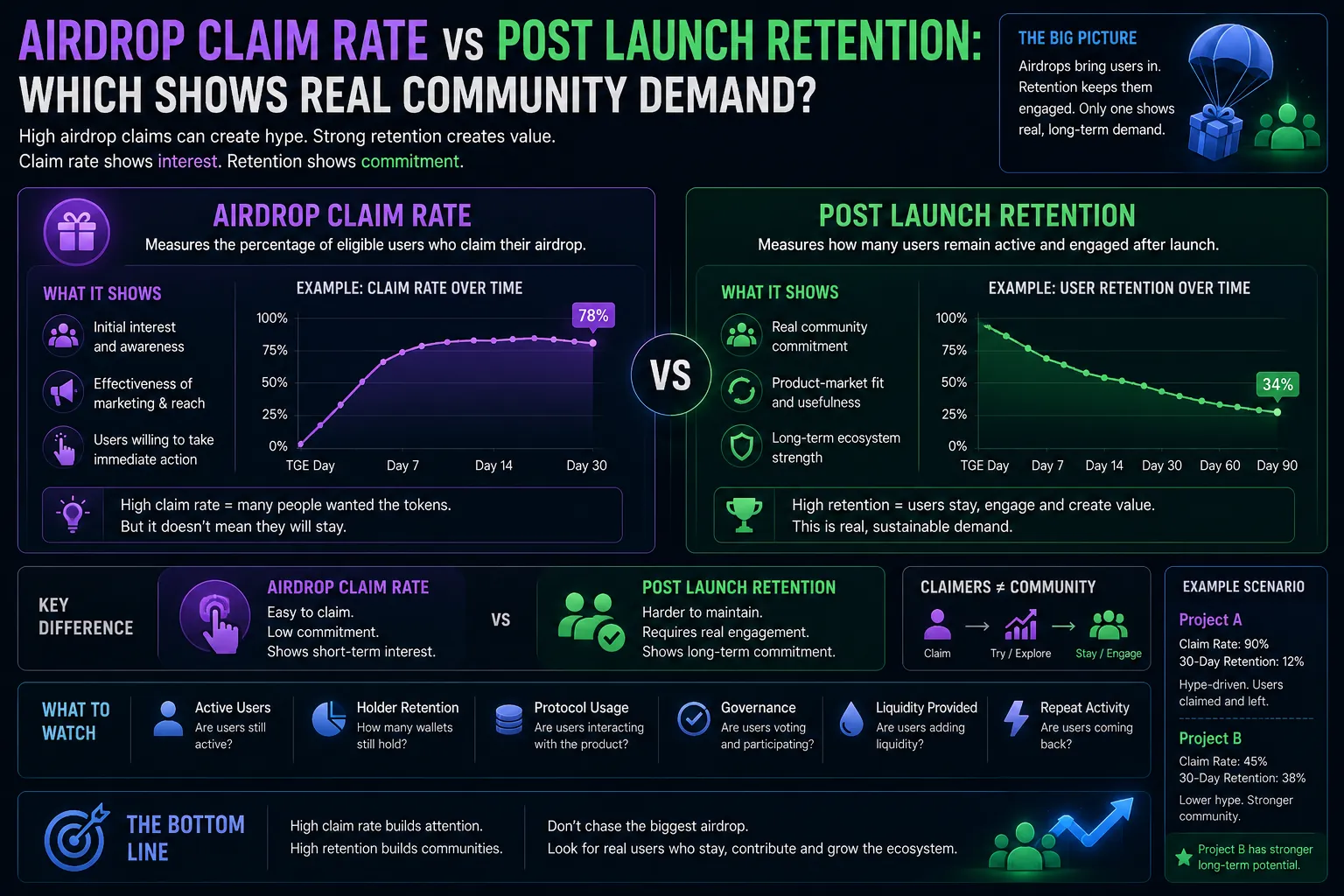
Airdrop claim rate refers to the percentage of eligible users who claim their tokens.
For instance, if 1 million wallets are eligible and 800,000 make claims, the claim rate is 80 percent.
A high claim rate can suggest considerable awareness and interest, indicating that users noticed the distribution and acted on it.
However, claiming tokens involves minimal commitment and does not demonstrate enduring demand.
Defining Post Launch Retention
Post-launch retention measures how many users stay active following token distribution.
This includes holding tokens, staking, voting, providing liquidity, using the product, trading responsibly, or participating in the ecosystem.
Retention serves as a stronger signal because it reflects user actions after receiving the reward.
A project with high retention likely has substantial community strength.
Key Differences: Airdrop Claim Rate vs Retention
The core difference is between initial attention and sustained commitment.
Claim rate indicates the number of users interested in the reward.
Retention reveals how many users maintain interest after receiving said reward.
A high claim rate can generate short-term excitement; strong retention creates long-term ecosystem value.
For traders, retention generally offers a more significant signal.
Why Claim Rate May Mislead
Airdrop claim rates might appear impressive as users often have a financial incentive to claim free tokens.
Some users may claim simply to sell immediately, while others might use multiple wallets to maximize their rewards.
Such actions can inflate the appearance of community interest.
Thus, a large number of claimants does not necessarily equate to a loyal user base.
The Importance of Retention
Retention gauges whether users continue engaging post-incentive.
If users persist with protocol usage, participation in governance, or provision of liquidity, the airdrop may have created lasting interest.
Conversely, if users vanish quickly, the airdrop likely attracted reward seekers rather than genuine participants.
Retention separates fleeting attention from sustainable adoption.
Indicators of Weak Retention
Weak retention becomes evident when numerous users sell immediately post-claim.
Other signs include decreasing active wallets, declining protocol usage, minimal governance participation, and reduced liquidity.
A quiet community post-airdrop suggests a misjudgment in real demand.
This can exert pressure on the token's value.
Indicators of Strong Retention
Robust retention could include continuous product use, stable or rising liquidity, active governance involvement, healthy holder distribution, and ongoing community participation.
If users remain active beyond the distribution of rewards, the project likely has stronger fundamentals.
Airdrops are most effective when they convert users into long-term participants.
Relevant Insights for Token Traders
Airdrops can incite volatility, with tokens potentially surging on anticipation before falling as claimants sell off.
Therefore, traders should remain cautious in assuming a large airdrop signifies robust token release.
The critical question is whether users remain engaged after launch.
A token with moderate claim excitement but robust retention might be healthier than one with significant claim activity followed by rapid sales.
Evaluating Airdrop Quality
Key questions for traders:
What percentage of eligible wallets made claims?
How many claimants promptly sold their tokens?
What is the ratio of current token holders?
Is post-launch protocol usage on the rise?
Are users engaging in staking or voting?
Is liquidity remaining consistent?
Are active wallets declining or climbing?
Are incentives attracting genuine users or mere reward farmers?
These inquiries assist traders in determining authentic community demand.
Utilizing DEXTools for Insight
DEXTools provides traders with tools to monitor token behavior post-airdrop. Observing price trends, liquidity, volume, and transaction flow can indicate if claimants are aggressively selling or if the market is absorbing supply efficiently.
Traders should tread carefully if liquidity weakens and selling pressure builds after airdrop claims.
Conversely, if the token stabilizes with healthy volume and active participation, it may indicate robust retention.
Overall, both claim rates and post-launch retention highlight different aspects of user interaction.
While claim rates demonstrate initial user interest in free tokens, retention points to sustained user engagement post-reception.
For traders, examining post-launch retention is frequently a superior indicator of genuine community demand.
Airdrops might spark initial attention, but sustained retention is what truly builds value.
How to Bridge Crypto Between Chains: Complete Cross-Chain Tutorial 2026 How to Use 1inch: Complete DEX Aggregator Swap Tutorial (2026) How to Use OKX Web3 Wallet: Multi-Chain DeFi Hub Guide (2026)Related Guides
- What Is a Crypto Airdrop: How to Find and Claim Safely (2026)
- Token Transfer Velocity vs Holder Retention: What Shows Real Conviction?
- Retention Cohorts vs Daily Active Wallets: Why Crypto User Quality Matters
- Post-Trade Review Using DEXTools: How to Learn From Failed Crypto Trades
- Post-Quantum Blockchain: Are Current Cryptos at Risk?
Frequently Asked Questions
What is an airdrop claim rate?
An airdrop claim rate is the share of eligible recipients who actually claim the tokens they were allocated. A low claim rate can mean limited awareness or interest, while a high rate shows many recipients found it worth the effort to claim.
What is post-launch retention for an airdrop?
Post-launch retention measures how many recipients keep holding or continue using the project after they claim their tokens, rather than selling right away. It reflects whether the airdrop attracted lasting users instead of one-time claimers.
Which is a better signal, claim rate or retention?
Claim rate shows initial interest, but retention is usually the stronger signal of genuine demand because it reveals whether recipients stay engaged. A project can have a high claim rate yet poor retention if most people sell immediately.
Why do many airdrop recipients sell quickly?
Some recipients only join to capture free tokens and have no longer-term interest in the project, a behavior often called airdrop farming. This can create selling pressure shortly after launch and is why retention often matters more than the headline claim rate.