Post-Trade Review Using DEXTools: How to Learn From Failed Crypto Trades
— By Whatsertrade in Tutorials

Every trader has losing trades. The difference between random traders and improving traders is what they do after the loss.Many DeFi traders move from one token
Every trader has losing trades. The difference between random traders and improving traders is what they do after the loss.
Many DeFi traders move from one token to the next without reviewing what happened. They blame the market, the team, the whales or bad timing. Sometimes those factors matter, but they are not enough.
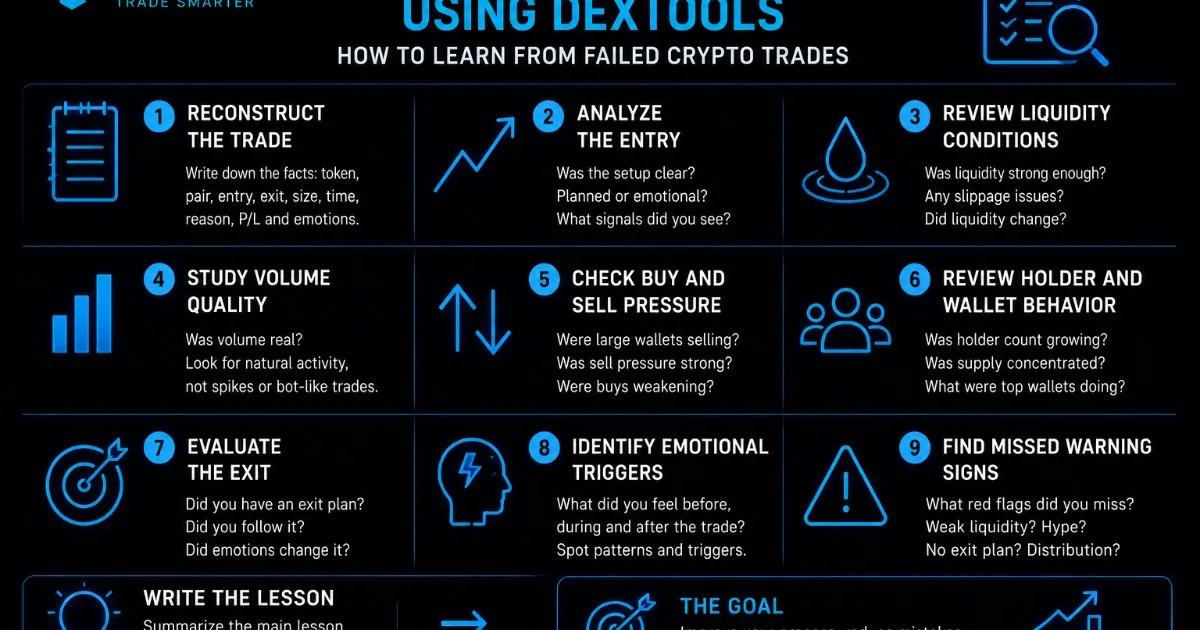
A post-trade review helps traders turn mistakes into data.
Instead of asking, “Why did I lose money?”, ask:
What did I miss?
Was my entry planned or emotional?
Did liquidity support the trade?
Was volume real?
Did I ignore sell pressure?
Did I have an exit plan?
Would I take the same trade again?
This process can help traders improve decision-making and avoid repeating the same mistakes.
Why Post-Trade Reviews Matter
A losing trade is not always a bad trade. A winning trade is not always a good trade.
You can follow a solid plan and still lose because markets are uncertain. You can also make a poor decision and win because price temporarily moves in your favor.
Post-trade review separates outcome from process.
The goal is not to punish yourself. The goal is to understand whether your decision-making was clear, disciplined and repeatable.
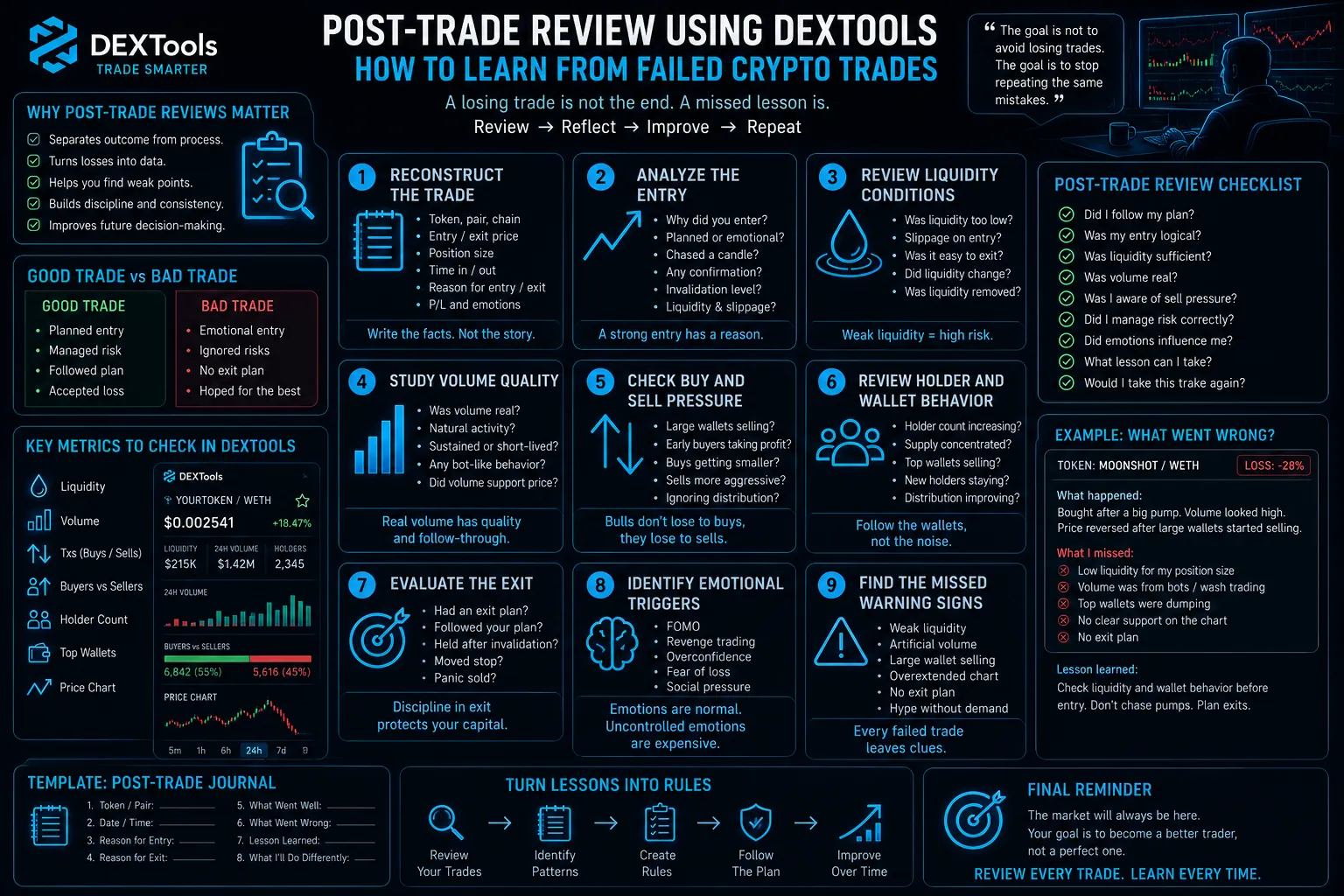
Step 1: Reconstruct the Trade
Start by writing down the basic facts.
Include:
Token name
Pair
Chain
Entry price
Exit price
Position size
Time of entry
Time of exit
Reason for entry
Reason for exit
Profit or loss
Emotional state before entry
Do not rely on memory alone. After a trade, emotions can distort the story. Write the facts first.
Step 2: Analyze the Entry
The entry is where many mistakes begin.
Ask:
Why did I enter?
Was the setup clear?
Did I chase a green candle?
Did I enter because the token was trending?
Did I wait for confirmation?
Was there a defined invalidation level?
Did I understand liquidity and slippage?
A strong entry has a reason. A weak entry has an impulse.
If your reason was “it looked like it was going higher,” that may not be enough. Try to identify the actual signals you used.
For example:
Healthy liquidity
Increasing holders
Diverse buyers
Clean chart structure
Pullback into support
Strong volume with follow-through
Reduced sell pressure
If none of these were present, the trade may have been driven by emotion.
Step 3: Review Liquidity Conditions
Liquidity can make or break a DeFi trade.
After a failed trade, check whether liquidity was strong enough at the time of entry.
Ask:
Was liquidity too low?
Did slippage affect my entry?
Could I exit easily?
Did liquidity change during the trade?
Was liquidity removed or reduced?
Did volume look too large compared to liquidity?
Many traders focus on price but ignore execution. A chart can look attractive while liquidity makes the trade dangerous.
If liquidity was weak, your mistake may not have been the idea. It may have been position sizing or execution.
Step 4: Study Volume Quality
Next, review volume.
High volume may have influenced your decision, but was it real demand?
Look for:
Varied transaction sizes
Sustained activity
Natural buy and sell rhythm
Volume that supports price movement
Follow-through after spikes
Be cautious if the trade showed:
Repeated transaction sizes
Sudden volume bursts
High volume with no price progress
Activity that disappeared quickly
Bot-like microtransactions
A failed trade often reveals that the volume looked strong at first but lacked quality.
Step 5: Check Buy and Sell Pressure
A token can have many buys and still fail if sell pressure is stronger.
Review the transaction flow before and after your entry.
Ask:
Were large wallets selling?
Were early buyers taking profit?
Were buys getting smaller?
Were sells becoming more aggressive?
Was price struggling despite many buys?
Did I ignore distribution?
This is especially important when trading trending tokens. New buyers may enter while earlier participants exit.
If you bought into distribution, your post-trade review should mark that clearly.
Step 6: Review Holder and Wallet Behavior
Holder behavior can provide important context.
Ask:
Was holder count increasing?
Was supply too concentrated?
Were top wallets selling?
Did new holders stay or leave quickly?
Did wallet distribution improve or worsen?
If a few wallets controlled too much supply, the trade may have carried more risk than you recognized.
If holders increased but price fell, you may need to analyze whether new buyers were absorbing sells from larger wallets.
Step 7: Evaluate the Exit
Many traders review entries but ignore exits.
Ask:
Did I have an exit plan before entering?
Did I exit according to plan?
Did I hold after invalidation?
Did I move my stop mentally?
Did I take profit when the setup became extended?
Did I panic sell at the bottom?
Did I let a small loss become a large loss?
A failed trade can still be a good trade if you exited correctly. A bad exit often comes from not defining risk in advance.
Step 8: Identify Emotional Triggers
DeFi trading is fast and emotional. Your emotional state matters.
Common emotional triggers include:
Fear of missing out
Revenge trading
Overconfidence after a win
Desperation after a loss
Pressure from social media
Fear of being late
Refusal to accept invalidation
Write down what you felt before, during and after the trade.
The goal is not to remove emotion completely. The goal is to recognize when emotion is making decisions for you.
Step 9: Find the Missed Warning Signs
Every failed trade has clues. Some are visible before entry. Others become clearer afterward.
Look for missed red flags:
Weak liquidity
High slippage
Artificial volume
No clear support
Overextended chart
Large wallet selling
Poor holder distribution
No exit plan
Social hype without on-chain demand
Entering during maximum attention
Choose the top three warning signs you ignored. These become part of your future checklist.
Step 10: Write the Lesson
End every review with one clear lesson.
Examples:
“I will not enter a trending token without checking liquidity first.”
“I will not buy vertical candles without a pullback or invalidation level.”
“I will reduce position size in low-liquidity pairs.”
“I will not enter if large wallets are selling into the move.”
“I will wait 10 minutes before buying from social hype.”
One lesson is better than a long list you will forget.
Post-Trade Review Template
Use this template after every significant trade:
Trade:
Entry:
Exit:
Result:
Why I entered:
What I saw on the chart:
What liquidity looked like:
What volume looked like:
What buyers were doing:
What sellers were doing:
What holders were doing:
What I felt before entry:
What I ignored:
What I did well:
What I did poorly:
Main lesson:
Rule for next time:
Final Thoughts
A failed trade is only wasted if you refuse to study it.
Post-trade review helps traders improve their process, reduce emotional decisions and build better habits. In DeFi, where markets move fast and information changes quickly, having a review system is a major advantage.
Do not only search for the next opportunity. Study the last decision.
The best traders are not perfect. They are honest with their data.
FAQ
What is a post-trade review in crypto?
A post-trade review is the process of analyzing a completed trade to understand the entry, exit, risk, market conditions and decision-making process.
Why should DeFi traders review failed trades?
Reviewing failed trades helps identify repeated mistakes, emotional triggers, missed red flags and areas for improvement.
What should I include in a crypto trading journal?
Include entry, exit, position size, reason for trade, liquidity, volume, holder behavior, emotional state, result and lesson learned.
Is every losing trade a bad trade?
No. A losing trade can still be good if it followed a clear plan. A winning trade can still be bad if it was based on poor process.
How can I improve after a failed crypto trade?
Review the trade objectively, identify missed warning signs, write one lesson and create a rule to avoid repeating the mistake.
When Not to Trade: 12 Red Flags Every DeFi Trader Should Know How to Check Buy and Sell Tax Before Buying a Token (2026) Red Flags Every Crypto Trader Must Know Fake Volume vs Real Demand: How to Spot Artificial Momentum in DeFi TradingBeyond the P&L: Unpacking the Psychological Fallout
While the quantitative analysis of a failed trade is crucial, the post-trade review remains incomplete without a honest examination of the psychological impact. Crypto trading, with its inherent volatility and constant stream of information, can amplify cognitive biases and emotional responses. Ignoring these aspects means missing a significant piece of the learning puzzle, potentially leading to a repetition of the same emotionally driven errors.
The initial sting of a loss often triggers a cascade of emotions: frustration, regret, anger, or even self-doubt. These feelings, if not acknowledged and processed, can cloud judgment and influence subsequent trading decisions. A truly effective post-trade review extends beyond simply identifying what went wrong with the entry or exit, delving into the mental state that underpinned those decisions.
Reframing Emotional Responses
- Identify the specific emotions felt during and immediately after the loss. Were you chasing a pump, feeling FOMO, or succumbing to FUD?
- Trace the emotional trigger. What news, chart pattern, or social media sentiment initiated the cascade of feelings?
- Objectively separate the emotion from the trading decision. Could a logical, rules-based decision have been made despite the emotional pull?
- Develop a pre-trade emotional checklist. Before entering a trade, assess your mental state for common pitfalls like overconfidence or desperation.
- Practice emotional detachment. View each trade as an independent event, rather than a reflection of your overall trading prowess or personal worth.
Related Guides
- How to Review Crypto Trade Mistakes with DEXTools
- The Hidden Cost of a Round Trip Trade: Slippage, Gas, Failed Transactions and Fees
- DEXTools Trading Simulator Tutorial 2026: Paper Trade
- How to Trade Manually on DEXTools: A Complete Strategy Guide
- DEXTools Beginner Tutorial: Setup, Navigation and First Trade Checks (2026)
Frequently Asked Questions
Why is a post-trade review important for crypto traders?
A post-trade review helps traders learn from both winning and losing trades. It allows them to identify patterns, improve their strategies, and avoid repeating costly mistakes, leading to more consistent performance over time. This process transforms random trading into a more disciplined and analytical approach.
How can DEXTools assist in reviewing past crypto trades?
DEXTools provides comprehensive on-chain data and charting tools that are invaluable for post-trade analysis. Traders can use it to re-examine price action, volume, liquidity changes, and key on-chain metrics around their trade entry and exit points. This helps in understanding the market context and the impact of their decisions.
What key metrics should I focus on when reviewing a failed trade using DEXTools?
When reviewing a failed trade, focus on metrics like entry/exit price accuracy relative to local highs/lows, trading volume at key decision points, liquidity depth, and any significant whale movements or large transactions. Also, check for unusual price spikes or drops that might indicate manipulation or sudden market shifts. Analyzing these can reveal flaws in your initial trade thesis or execution.
Beyond DEXTools, what other steps are crucial for learning from failed trades?
Beyond DEXTools, maintaining a detailed trading journal is crucial. Document your trade thesis, emotional state, and reasons for entry/exit. After reviewing the data in DEXTools, compare it with your journal entries to identify discrepancies between your perception and market reality. This holistic approach helps in refining both your analytical skills and emotional discipline.