How Do DAOs Work? Governance, Treasury and Voting Explained (2026)
— By Tony Rabbit in Tutorials
Learn how DAOs actually work, from governance tokens and proposals to treasury management, voting mechanics, and common coordination problems.
For the complete, up-to-date guide, read our full guide here.
Top results for what is a DAO focus on definition, governance, purpose, and how DAOs work in practice. This guide is optimized around that core explanatory intent, not around setting up a DAO from scratch.
Imagine an organization with no CEO, no boardroom, no headquarters, and no human signing the checks. Instead, decisions are made by thousands of token holders around the world, voting on proposals that are automatically executed by code the moment they pass. Money sitting in the treasury can only move if the rules say so. That is not science fiction. That is a DAO, and in 2026 there are thousands of them collectively managing tens of billions of dollars in on-chain assets.
A DAO, short for Decentralized Autonomous Organization, is one of the most ambitious experiments to come out of the crypto space. It tries to answer a question that has haunted economists, lawyers, and revolutionaries for centuries: can a group of strangers coordinate at scale without a central authority telling them what to do? The blockchain version of the answer combines smart contracts, governance tokens, online forums, and treasury wallets into a single coordination engine that anyone in the world can join with a wallet and an internet connection.
The promise is huge. DAOs aim to make organizations more transparent, more democratic, and more resistant to censorship. The reality is messier. Some DAOs run multi-billion dollar protocols smoothly. Others have been hacked, captured by whales, or paralyzed by voter apathy. In this complete guide you will learn what a DAO is, how it works under the hood, the main types you will encounter, famous examples like MakerDAO and Uniswap, the legal status of DAOs in 2026, the real risks, and how to join one yourself.
What Is a DAO?
A Decentralized Autonomous Organization is an entity whose rules are encoded in smart contracts on a blockchain, whose decisions are made collectively by its members through on-chain or off-chain voting, and whose treasury is controlled by those same rules rather than by any single person or company. The "decentralized" part means no central authority. The "autonomous" part means the organization runs itself according to its code. The "organization" part means it exists to coordinate humans toward a shared goal, whether that is running a DeFi protocol, investing in startups, funding public goods, or simply hanging out together as a culture club.
In a traditional company, ownership is represented by shares, voting is done at annual meetings, and the CEO has discretionary power to execute decisions. In a DAO, ownership is represented by a governance token, voting happens continuously online, and execution is automatic once a proposal hits the threshold required by the smart contract. There is no CEO who can override a vote. There is no bank that can freeze the treasury. The whole thing runs on rails of code.
The very first DAO worth that name was simply called "The DAO," launched on Ethereum in April 2016. It raised over $150 million in ETH from more than 11,000 contributors, making it one of the largest crowdfunding events in history at the time. The plan was to function as a decentralized venture fund, where token holders would vote on which projects to back. Two months later, an attacker discovered a recursive call bug in The DAO's smart contract and began draining ETH at a rate that threatened to wipe out roughly one third of all ETH in circulation. The Ethereum community made the controversial decision to hard fork the chain to reverse the hack. That split created the two chains we know today: Ethereum, where the rollback was applied, and Ethereum Classic, where the original chain continued untouched.
The TheDAO disaster could have killed the entire concept of DAOs. Instead, it taught the industry a brutal but valuable lesson: smart contracts must be audited rigorously, governance can be a security surface, and "code is law" hits a wall the moment ordinary users lose their savings. Every DAO built afterward inherited those lessons. By 2026 the DAO ecosystem has matured into a serious infrastructure layer for crypto, with battle-tested frameworks, professional governance delegates, formal legal wrappers in multiple jurisdictions, and treasuries that rival mid-sized hedge funds.
How Does a DAO Work?
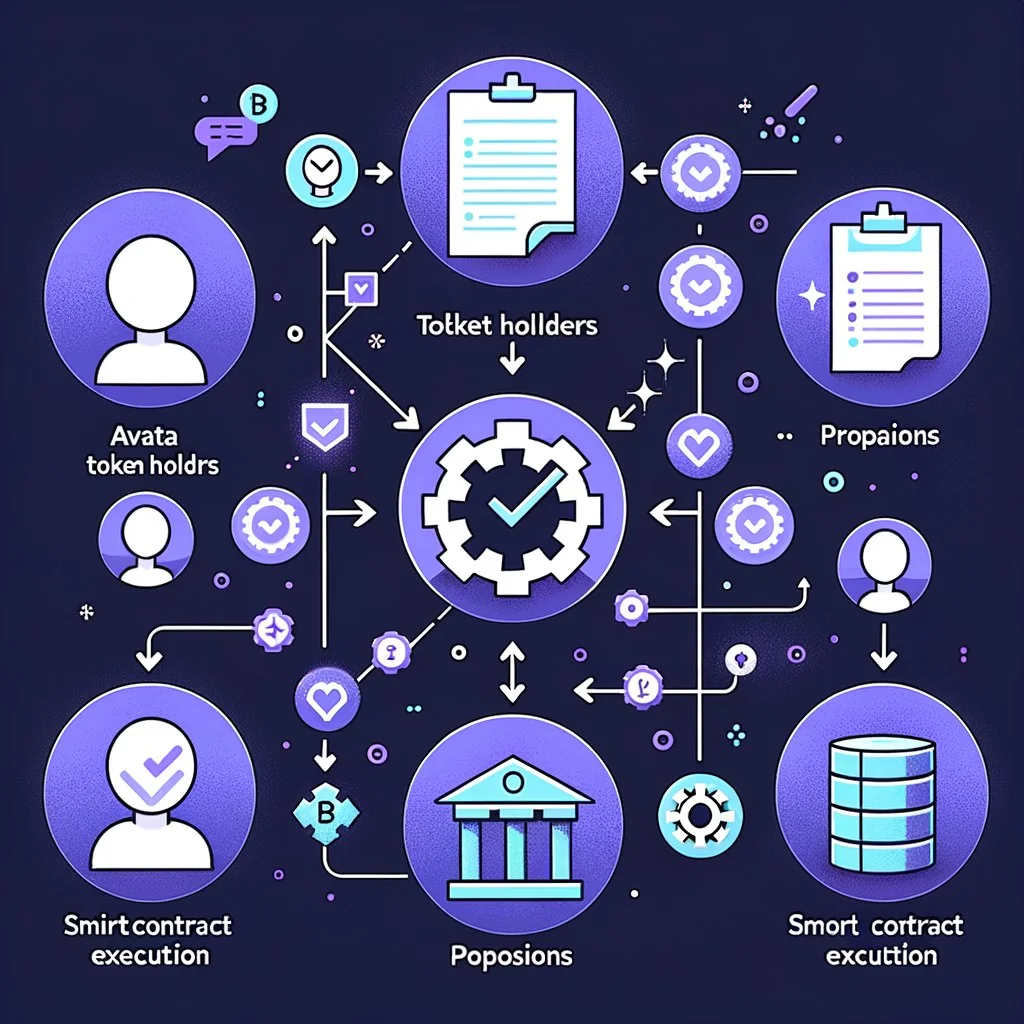
At its core, a DAO is a feedback loop between humans and smart contracts. Humans hold governance tokens that grant them voting power. They discuss ideas in forums, draft proposals, and signal opinions. When a formal vote is opened, token holders cast their ballots, usually weighted by how many tokens they hold or delegate. If the proposal reaches the quorum and approval thresholds defined by the protocol, a smart contract automatically executes the action: sending funds, upgrading code, changing a parameter, or anything else encoded into the system.
Compare this to a traditional company. A shareholder may technically own part of the firm, but they cannot directly move money from the corporate bank account. They have to elect a board, which hires executives, who instruct employees, who finally execute decisions. In a DAO, the gap between vote and execution can be as short as a few seconds after the timelock expires. Money moves because the code says it can move. The on-chain audit trail is permanent, public, and verifiable by anyone with a block explorer.
Most DAOs follow the same broad workflow. First, a member or working group identifies a need. Second, they draft a proposal and publish it on a forum (often Discourse) to gather feedback. Third, they run a temperature check on Snapshot, the off-chain signaling tool, to see whether the community supports the idea before spending resources on a full on-chain vote. Fourth, if the temperature check passes, they submit a binding on-chain proposal, usually through a governance interface like Tally or the protocol's own portal. Fifth, token holders vote during a window that typically lasts three to seven days. Sixth, if the vote succeeds, a timelock contract holds the action for a safety period (often 48 hours) so the community can react if something looks wrong. Finally, the proposal is executed automatically, and the change is live on chain.
The Core Components of a DAO
Despite the diversity of DAOs in the wild, almost all of them share a stack of five core components. Understanding these pieces is the fastest way to read any DAO and figure out how it actually works under the hood.
1. The Smart Contract. This is the constitution. It encodes the rules of the DAO: who can vote, how proposals are submitted, the quorum required, the voting period, who can execute, and what actions are possible. On Ethereum, the most common base contract is OpenZeppelin Governor, which became the de facto standard after Compound popularized it. The smart contract is the only thing that can authorize the treasury to move funds, so it functions as the legal core of the organization in a way that no PDF bylaws can match.
2. The Treasury. Every DAO has at least one address that holds its assets. This can be a single smart contract, a multisig wallet, or both. Larger DAOs often hold hundreds of millions of dollars in stablecoins, native tokens, and partner protocol tokens. The treasury is controlled by the governance smart contract or by a trusted multisig of community members. Either way, no one can unilaterally withdraw. Funds move only when authorized by the rules.
3. The Governance Token. Voting power in most DAOs is tied to ownership of a specific ERC-20 token. This is where tokenomics design becomes critical. How many tokens exist, how they are distributed, who got them at launch, and how new tokens are minted all determine whether the DAO is genuinely decentralized or quietly controlled by a handful of insiders. Some DAOs use non-transferable "soulbound" tokens or reputation systems to avoid pure plutocracy.
4. The Forum. Before anything reaches an on-chain vote, ideas need to be discussed. Most DAOs run a public Discourse forum where members post proposals, debate trade-offs, and refine the language. Off-chain signaling on Snapshot then lets the community gauge support before spending on-chain gas. Snapshot uses cryptographic signatures, not transactions, so voting is free and accessible to anyone with a wallet.
5. The Multisig. Even the most decentralized DAOs typically maintain at least one Gnosis Safe (now branded Safe) multisig that holds operational funds or acts as a guardian on critical functions. A multisig requires N out of M signers to approve any transaction, which adds a layer of human review for actions that are too sensitive or too frequent to put through full token-holder voting. Grant payouts and contributor salaries are commonly run through multisigs.
Types of DAOs
Not all DAOs are doing the same thing. The category determines the kind of treasury, the membership model, the legal wrapper, and the governance cadence. These four buckets cover the vast majority of DAOs you will encounter in 2026.
Govern a specific DeFi or infrastructure protocol. Decide on fees, parameters, integrations, and treasury allocations.
Examples: MakerDAO, Uniswap, Aave, Compound, Lido
Pool capital from members to invest in early-stage crypto projects, NFTs, or real-world assets. Function like decentralized venture funds.
Examples: MetaCartel Ventures, The LAO, Flamingo DAO
Distribute funds to public goods, open source contributors, and ecosystem builders. Run by reviewers who vote on funding rounds.
Examples: Gitcoin, Optimism RetroPGF, Arbitrum Grants
Token-gated communities organized around shared culture, art collecting, or member access. Treasury usually holds NFTs and social capital.
Examples: Friends With Benefits (FWB), PleasrDAO, Nouns, Bored Ape DAO
The lines between categories are blurry. A grant DAO can hold venture investments. A protocol DAO might run a social arm. Nouns DAO, for example, is technically a social DAO that operates as a perpetual grant funding machine for projects built around the Nouns brand. What matters is identifying the primary goal of the DAO before you participate, because the goal determines whether your tokens are voting on smart contract upgrades, allocating budget to artists, or selecting the next portfolio company.
Famous DAOs You Should Know in 2026
If you are getting into DAOs, a handful of names dominate the conversation. They are the case studies, the benchmarks, and the source of most governance research published in the space.
MakerDAO. MakerDAO is arguably the most important DAO in DeFi, responsible for the DAI stablecoin that has held a dollar peg since 2017. Its governance token is MKR, and the DAO oversees risk parameters, collateral types, stability fees, and now the multi-year Endgame restructuring that breaks Maker into specialized SubDAOs focused on real-world assets, decentralization, and product expansion. MakerDAO routinely manages billions of dollars in collateral and is the longest continuously running DAO with a serious treasury.
Uniswap DAO. Uniswap is the largest decentralized exchange in crypto, and its DAO controls a treasury of UNI tokens worth billions. The DAO has voted on fee switches, deployments to new chains, and the famous "fee distribution" debate over whether to direct protocol revenue back to token holders. Uniswap governance is a textbook example of how slow and conservative a mature DAO becomes once the stakes are high.
Aave DAO. The DAO behind the Aave lending protocol, where users borrow, lend, and execute flash loans. Aave governance decides on new asset listings, risk parameters, the GHO stablecoin, and cross-chain deployments. The community uses a sophisticated stakeholder model that combines AAVE token voting with delegated representation.
ENS DAO. The DAO that governs the Ethereum Name Service, the protocol behind ENS domains like vitalik.eth. ENS DAO controls a multi-hundred-million dollar treasury accumulated from registration fees and is widely respected for its transparent working group structure. ENS uses delegated voting heavily, and many of the most active governance delegates in crypto cut their teeth on ENS proposals.
Optimism Collective and Citizens House. The Optimism Collective splits governance into two houses. The Token House votes with the OP token on protocol upgrades and grants. The Citizens House, made up of identity-verified humans (one person, one vote), runs the Retroactive Public Goods Funding rounds that have distributed tens of millions of dollars to ecosystem builders. It is one of the most ambitious experiments in bicameral on-chain governance.
Arbitrum DAO. The DAO that governs Arbitrum, one of the largest Ethereum Layer 2 networks. Arbitrum DAO famously launched with a controversial initial proposal that the community rejected, forcing a course correction and setting a precedent that even powerful foundations cannot ram changes through without legitimate consent. The DAO now runs multi-million dollar grant programs and sets the technical roadmap for Arbitrum One and Nova.
ConstitutionDAO. A retrospective example worth knowing. In November 2021, ConstitutionDAO raised over $40 million in ETH in a single week to bid on an original copy of the U.S. Constitution at Sotheby's auction. They lost the bid to a billionaire by a narrow margin, and the DAO returned funds to contributors. The episode is studied as both a demonstration of how fast DAOs can mobilize capital and a reminder of how brittle their structures are when the original mission ends.
How to Join a DAO
Joining a DAO in 2026 is mostly a matter of choosing the DAO, acquiring its membership token, and showing up in the governance forum. The steps below cover the path for a typical token-based DAO. Pure social DAOs with closed membership work a bit differently.
1. Pick a DAO whose mission you care about. Treasury size and token price are interesting, but participation pays off most when you actually care about what the DAO does. If you use a protocol every day, joining its DAO often makes sense. If you are passionate about public goods, a grants DAO is a better fit.
2. Acquire the governance token. Most governance tokens are ERC-20 tokens you can buy on any major decentralized exchange. Connect a wallet, choose the token, and swap. Some DAOs use NFTs for membership (Nouns, FWB) which you buy on NFT marketplaces. Be aware of the underlying consensus mechanism of the chain you are using, since gas costs and confirmation times will affect your experience.
3. Join the forum and Discord. Find the official Discourse forum and Discord or community chat. This is where the real conversations happen, long before formal votes. Read the recent proposals. Look at which delegates are active. Get a sense of the personalities and the political fault lines. Every DAO has them.
4. Self-delegate or pick a delegate. In most modern DAOs, your tokens do not vote unless you actively delegate them, either to yourself or to a trusted community member. Delegation is a one-time on-chain transaction. If you want to vote personally, delegate to your own address. If you do not have time to follow every proposal, pick a public delegate whose voting record and statements align with your values. Tally and Boardroom are the standard platforms for browsing delegates.
5. Vote on Snapshot or Tally. Once you are delegated, you can vote on any active proposal. Snapshot votes are signed with your wallet for free. Tally and the protocol's own portal handle on-chain binding votes, which cost a small amount of gas. The first time you cast a real vote on a multi-million dollar treasury allocation, you understand why people get excited about this technology.
DAO Governance Models
Not all DAOs vote the same way. The voting model is one of the most important design choices in a DAO because it determines how power is distributed and how resistant the system is to capture. Here are the major models in use in 2026.
Token-weighted voting is the default. One token equals one vote. This is simple, transparent, and easy to implement, but it favors whales by definition. Anyone holding 5 percent of the supply can singlehandedly outvote thousands of small holders. Most major protocol DAOs use this model with quorum and timelock safeguards.
Quadratic voting tries to soften plutocracy by making each additional vote cost more. Casting one vote costs one credit. Casting two votes costs four credits. Three costs nine. The square root of voting power means small holders punch above their weight, but the model is vulnerable to Sybil attacks where one person splits funds across many wallets. Gitcoin pioneered quadratic funding for grant allocations, with mixed but generally positive results.
Conviction voting weights votes by how long they have been cast. A vote that has been parked on a proposal for 30 days carries more weight than one cast yesterday. The idea is to reward long-term commitment and discourage short-term flash mobs. 1Hive and a few other DAOs use conviction voting for ongoing treasury allocation rather than discrete yes-or-no proposals.
Optimistic governance assumes proposals will pass unless someone challenges them. A proposal goes through a short objection window, and if no one with sufficient voting power objects, it executes automatically. This dramatically reduces voter fatigue for routine operations and is increasingly popular for delegated operating committees within larger DAOs. Optimism and Arbitrum both use variants of optimistic governance for grant councils.
Futarchy is the most exotic model: govern by prediction markets. Instead of voting yes or no, members trade tokens on the predicted outcomes of each option. Whichever option the market believes will produce the best result wins. Futarchy has been more theoretical than practical, but Robin Hanson's original idea continues to inspire experiments at the edges of DAO design.
Risks and Challenges of DAOs
DAOs are not magic. They face structural challenges that traditional companies do not have, and after a decade of experimentation the failure modes are well documented. Anyone participating in a DAO should understand the following risks clearly.
- Whale dominance: Token-weighted voting means a handful of large holders can dictate outcomes. Cartels of VCs and exchanges often coordinate informally.
- Low voter turnout: Most DAOs see 5 to 15 percent of tokens voting on any given proposal. Apathy means small organized groups can carry decisions affecting everyone.
- Flash loan governance attacks: Attackers borrow huge token amounts for one transaction and use them to pass malicious proposals. Beanstalk lost $182M this way in 2022.
- Legal uncertainty: Without a legal wrapper, members may be treated as a general partnership with unlimited personal liability under common law.
- Plutocracy and capture: Even with safeguards, DAOs tend to evolve toward rule by the wealthy, especially as tokens become tradable financial assets.
The flash loan attack vector deserves special attention because it intersects two parts of the DeFi stack. If a DAO uses simple token-balance voting based on the current block, an attacker can borrow tokens in a flash loan, vote, drain the treasury, and repay the loan all within one transaction. Modern DAOs defend against this with snapshot-based voting that records balances at a block before the proposal was created, plus timelocks that delay execution by 48 hours or more so the community can react. Always check whether a DAO you join uses these defenses before holding tokens through governance events.
Low voter turnout is a quieter but more pervasive problem. The Tally and Boardroom dashboards consistently show that even on critical proposals affecting nine-figure treasuries, participation often hovers between 5 and 20 percent of circulating supply. This is partly why delegation has become so important. Active delegates aggregate the voting power of tens of thousands of holders who simply do not have time to track every proposal. The downside is that a small number of delegates can effectively control outcomes, recreating a soft oligarchy under the surface of an apparently decentralized system.
Traditional Company vs DAO
Sometimes the easiest way to grasp a DAO is to compare it side by side with the legal entity it is trying to replace. The contrast is sharper than it sounds.
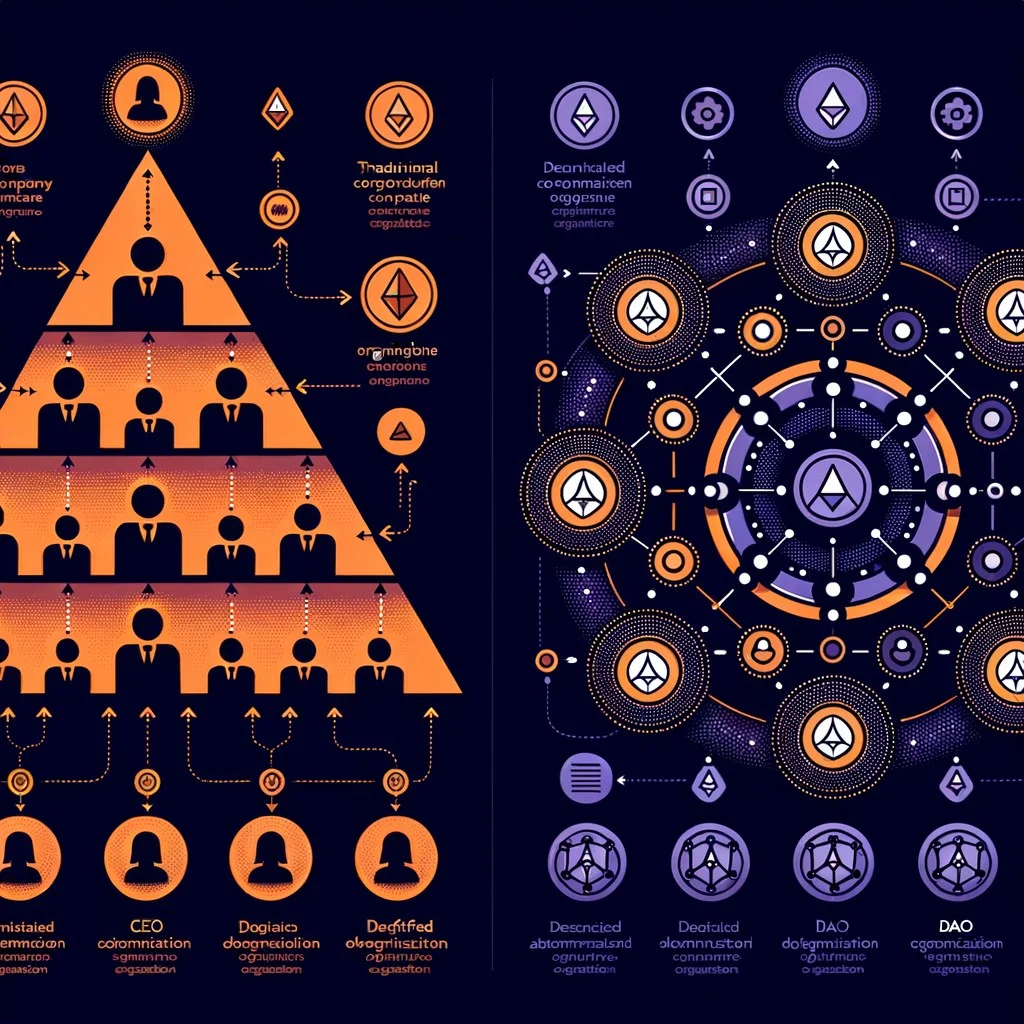
- Hierarchical: CEO > Board > Executives > Staff
- Ownership represented by shares in a registry
- Decisions made privately, often quarterly
- Treasury controlled by signatories at a bank
- Operates within a specific legal jurisdiction
- Joining requires hiring, accreditation, or stock purchase
- Flat: token holders, delegates, contributors
- Ownership represented by tokens in wallets
- Decisions made publicly, continuously, on chain
- Treasury controlled by smart contract code
- Operates globally, sometimes wrapped in an LLC or foundation
- Joining is permissionless: buy the token, show up
The honest answer is that neither model is universally better. Traditional companies are slow and opaque, but they can pivot fast when the CEO decides to. DAOs are transparent and global, but their decision making can stall for months on simple matters. The interesting question in 2026 is no longer "DAO or company" but how to combine them: legal wrappers that give DAOs limited liability, executive subcommittees that move quickly under DAO oversight, and hybrid structures that take the best of both.
Legal Status of DAOs
For years, DAOs lived in a legal gray zone. Members often did not realize that without an explicit legal wrapper, courts could classify their organization as a general partnership, leaving every participant personally liable for the DAO's debts and actions. That risk has driven the rise of formal DAO legal structures in friendly jurisdictions.
Wyoming DAO LLC. In 2021, Wyoming became the first U.S. state to pass a law (the DAO Supplement to the LLC Act) explicitly recognizing DAOs as a type of LLC. A Wyoming DAO LLC must reference its smart contract in its articles of organization and can be either algorithmically managed or member-managed. American CryptoFed DAO was the first registered. The wrapper provides limited liability protection while preserving on-chain governance.
Marshall Islands DAO. The Republic of the Marshall Islands has emerged as one of the most popular jurisdictions for DAOs that want a non-U.S. base. Their 2022 DAO Act recognizes DAOs as nonprofit LLCs with full legal personality and limited liability. Notable examples include MIDAO Directory Services and several DeFi protocols that registered there to formalize their structures.
Cayman Islands Foundations. Many large protocol DAOs use Cayman foundation companies as a legal sponsor, with the foundation acting as a steward of the DAO's brand, contracts with service providers, and any legal interactions in the real world. The foundation has no shareholders and is bound by its purpose, which is to serve the DAO. MakerDAO, Lido, and Aave have at various times worked through Cayman foundations.
European Union and MiCA. The EU's Markets in Crypto-Assets (MiCA) regulation, fully in force since 2024, does not address DAOs directly but does affect them indirectly through stablecoin and crypto-asset service provider rules. Several EU member states have begun consultations on dedicated DAO legislation, though no harmonized framework exists yet. France's PACTE law and Liechtenstein's Token Act provide partial coverage.
The pattern is clear. Pure code-is-law DAOs without any legal layer still exist, but most serious DAOs in 2026 have adopted some form of legal wrapper for the parts of their work that touch the offline world: hiring contributors, signing service agreements, paying taxes on treasury income, and limiting liability for participants. This hybrid model is now the dominant approach, and any DAO managing more than a few million dollars in treasury without a wrapper is generally considered to be taking on unnecessary risk.
DAO Tools You Should Know
The DAO toolchain has matured into a coherent stack. If you are going to participate in or build a DAO, these are the platforms you will use repeatedly.
Snapshot is the off-chain voting platform that almost every DAO uses for signaling and most non-binding governance. Votes are signed with your wallet but not posted on chain, so they cost no gas. Snapshot supports custom voting strategies, including token-weighted, quadratic, and delegated models.
Tally is the leading interface for on-chain governance. Tally aggregates proposals, delegates, voting history, and treasury data across hundreds of DAOs, presenting it in a usable dashboard. It is the closest thing the DAO ecosystem has to a Bloomberg terminal for governance.
Aragon is one of the original DAO frameworks, providing modular smart contracts and a no-code interface for launching DAOs. Aragon OSx, their latest stack, lets builders compose DAOs from plugins (voting modules, treasury modules, permissions). Aragon is widely used for new DAO launches.
DAOhaus is the platform built around the Moloch framework, originally designed for grant DAOs. DAOhaus emphasizes simplicity and the "ragequit" feature that lets members exit a DAO with their pro-rata share of the treasury at any time. It remains popular for smaller and mid-sized DAOs.
Safe (formerly Gnosis Safe) is the standard multisig wallet used by virtually every DAO with significant treasury operations. Safe supports custom modules, integrations with Snapshot, and complex permission systems. If a DAO holds real money, there is almost always a Safe involved somewhere in the architecture.
Karma tracks the activity and performance of governance delegates across major DAOs. If you are choosing who to delegate your tokens to, Karma's profiles show voting history, forum posts, and discipline scores. It is one of the more important accountability tools to emerge in the DAO ecosystem.
Boardroom is an alternative governance dashboard with strong emphasis on cross-DAO analytics and treasury tracking. Many delegates use both Tally and Boardroom in parallel.
The Future of DAOs
DAOs in 2026 look very different from the early experiments of 2016. The trajectory points toward more modularity, more legal sophistication, and the integration of AI agents into governance workflows.
Modular DAO frameworks are the biggest architectural shift. Aragon OSx, Tally Sub-DAOs, and the SubDAO model pioneered by MakerDAO Endgame all break monolithic governance into smaller specialized units. A protocol DAO might spin up a SubDAO to focus on real-world asset management, another for grants, another for security response. Each SubDAO has its own scope, budget, and voting rules, while remaining accountable to the parent. This solves the scaling problem that plagued the first generation of DAOs, where every decision had to go through the same slow vote.
AI agents are starting to appear inside DAO workflows as well. The current generation handles narrow but useful tasks: summarizing forum threads, monitoring on-chain treasury movements, flagging suspicious proposals, and drafting initial proposal language for human review. The more ambitious vision, where autonomous AI agents act as full-fledged DAO contributors with their own delegated voting power and budget, is being prototyped but remains controversial. Many DAO veterans correctly point out that handing voting weight to an AI raises governance security questions that the community has not yet solved.
DAO treasury management has also become professionalized. Specialized service providers run treasury diversification, hedging, and yield strategies on behalf of DAOs, often using yield farming and DeFi-native instruments. Karpatkey, Avantgarde, Llama, and Steakhouse Financial are the most active names. They produce regular treasury reports that hold up to professional finance standards, a far cry from the spreadsheets that early DAOs maintained by hand.
The most interesting question for the next decade is whether DAOs remain a niche tool inside crypto or become a general purpose coordination layer for any group of people who want to manage resources together without a central authority. Cities, fan clubs, scientific research groups, and even small businesses are experimenting with DAO structures. Whether these experiments scale beyond crypto-native users will depend on user experience improvements, regulatory clarity, and the ability of governance models to resist capture over long time horizons.
Frequently Asked Questions
What is a DAO in simple terms?
A DAO is an internet-native organization where the rules are written in smart contract code on a blockchain, members vote with governance tokens, and the treasury moves automatically when a vote passes. There is no CEO, no central office, and no bank. The code enforces the constitution.
What does DAO stand for?
DAO stands for Decentralized Autonomous Organization. Decentralized means no central authority controls it. Autonomous means it runs on code that executes automatically. Organization means it exists to coordinate a group of people toward a shared goal.
How do I join a DAO?
For most DAOs, you join by acquiring the governance token on a decentralized exchange, joining the forum and Discord, delegating your tokens to yourself or a trusted delegate, and voting on Snapshot or Tally. Some DAOs use NFTs for membership instead of fungible tokens, in which case you buy the NFT on a marketplace.
Are DAOs legal?
Yes, DAOs themselves are legal. Several jurisdictions including Wyoming, the Marshall Islands, and the Cayman Islands have laws explicitly recognizing DAOs as registered legal entities. Without a legal wrapper, however, members may be exposed to personal liability as a general partnership under common law. Most serious DAOs in 2026 use a formal wrapper.
What was the first DAO?
The first major DAO was simply called "The DAO," launched on Ethereum in April 2016. It raised over $150 million in ETH before being hacked through a recursive call vulnerability that drained roughly one third of its funds. The incident led to the Ethereum hard fork that split the network into Ethereum and Ethereum Classic.
Can a DAO own real-world assets?
Yes, when a DAO has a legal wrapper such as a Wyoming DAO LLC, Marshall Islands DAO, or Cayman foundation, it can hold real-world assets including bank accounts, real estate, intellectual property, and even tokenized treasuries. MakerDAO famously holds billions in U.S. Treasury bills through its real-world asset partners.
What is the difference between a DAO and a DeFi protocol?
A DeFi protocol is the application itself (a lending market, a decentralized exchange, a stablecoin issuer). A DAO is the governance organization that controls the protocol. MakerDAO is a DAO that governs the Maker protocol. Uniswap DAO is a DAO that governs the Uniswap protocol. Many DeFi protocols are owned by DAOs, but a DAO can also exist without a DeFi protocol underneath, for example a grant DAO or a social DAO.
Can DAOs be hacked?
Yes. DAOs can be attacked through smart contract bugs (as TheDAO was in 2016), flash loan governance attacks (as Beanstalk was in 2022), social engineering of multisig signers, and oracle manipulation. Modern DAOs defend with audits, timelocks, snapshot-based voting, and diverse signer sets, but the risk is never zero.
Do DAO members get paid?
Active contributors and delegates often receive compensation through the DAO treasury, paid in stablecoins or governance tokens. Compensation is typically approved by vote, transparent on chain, and tracked through multisigs or streaming payment tools like Sablier. Passive token holders do not get paid simply for holding tokens unless the DAO has explicitly approved a fee distribution or buyback program.
What is a SubDAO?
A SubDAO is a smaller DAO that operates with delegated authority and budget from a larger parent DAO. SubDAOs handle specific domains (grants, security, real-world assets) with their own governance while remaining accountable to the parent. MakerDAO popularized the model through its Endgame restructuring, and the pattern is now widely adopted by large protocols looking to scale governance without bottlenecking every decision.
Conclusion
DAOs are not the polished, frictionless coordination machines that the original 2016 manifestos promised. They are messy, political, sometimes slow, occasionally captured by whales, and frequently hijacked by their most engaged participants. But they are also one of the most consequential organizational experiments of the internet era. For the first time in history, anyone in the world can join an organization that manages billions of dollars, participate in its governance, and verify every decision on a public ledger. That capability did not exist a decade ago in any form.
If you are entering the DAO space in 2026, the playbook is straightforward. Start with a protocol you actually use. Acquire a small amount of its governance token. Read the forum. Pick a delegate or self-delegate. Vote on a real proposal. Watch the treasury react. Once you have done that on one DAO, you understand the model well enough to evaluate any other DAO you encounter. The mechanics are nearly identical across the ecosystem; the personalities, missions, and risks differ.
Whether DAOs eventually replace the corporation, coexist with it as a parallel structure, or remain a niche tool for crypto-native communities depends on the next generation of governance design, regulatory clarity, and user experience improvements. What is already certain is that the idea of a self-governing, code-enforced, globally accessible organization is here to stay, and the smartest move you can make is to learn how it actually works before forming an opinion on whether it should.
Related Guides
- What Is a DAO: Complete Guide to Decentralized Autonomous Organizations (2026)
- What Is Snapshot: Complete DAO Governance Voting Guide (2026)
- Governance Quorum vs Whale Voting: How DAO Control Risk Affects Tokenholders
- TRON Super Representatives: How Voting and Governance Work (2026)
- How AI Agents Are Revolutionizing DeFi and Finance
- DAO