Post-Quantum Blockchain: Are Current Cryptos at Risk?
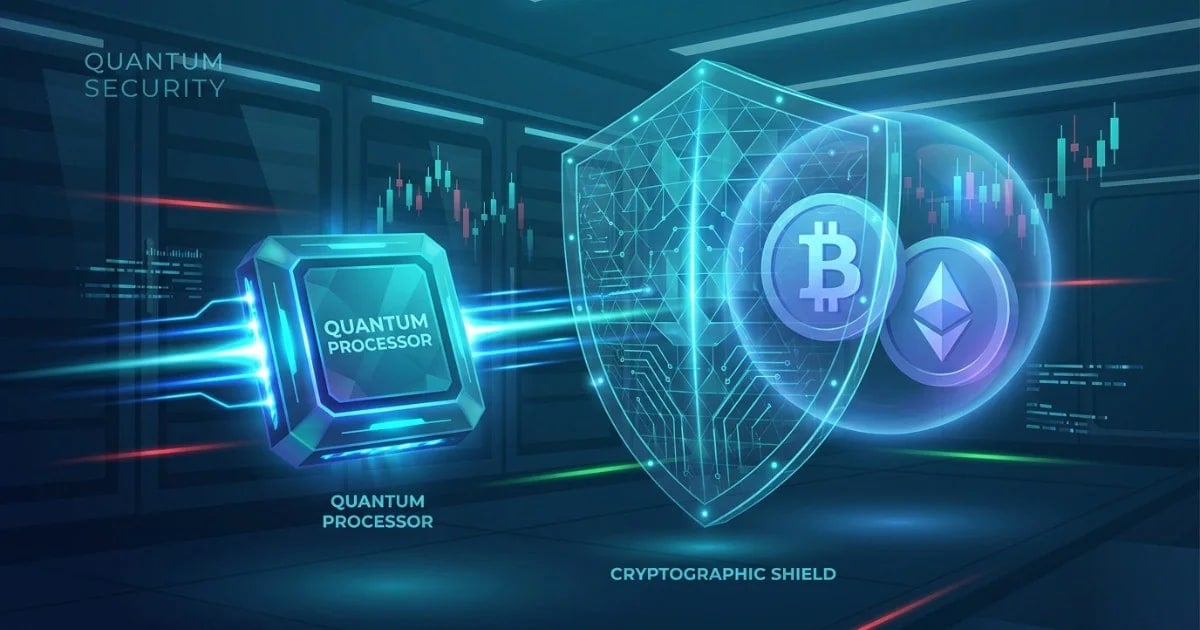
Quantum computing is moving faster than expected. We analyze the 2026 risk to Bitcoin and Ethereum, the HNDL threat, and the rise of Post-Quantum Cryptography.
The Race Toward a Post-Quantum blockchain Future
- Quantum blockchain is rapidly emerging as a key concept as, by May 4, 2026, the conversation around quantum computing has shifted from academic theory to a baseline engineering priority for the blockchain industry. While a "cryptographically relevant quantum computer" (CRQC) capable of breaking the entire market does not yet exist in the public domain, the timeline for its arrival has been significantly compressed.
- Recent disclosures in March and April 2026 from Google Quantum AI and a Caltech-Berkeley collaboration suggest that Shor’s algorithm could be implemented with as few as 10,000-20,000 atomic qubits or roughly 500,000 physical superconducting qubits. These estimates have moved the "Quantum Apocalypse" window forward, pushing researchers and developers to explore quantum blockchain-ready security models, with most experts now projecting a viable threat to Elliptic Curve Cryptography (ECC) as early as 2028-2030.
- For the average holder, the question is no longer "if," but "how" current networks are migrating to Post-Quantum Cryptography (PQC) to survive the coming shift.
The Core Vulnerability: ECDSA vs. SHA-256
To understand the risks associated with quantum blockchain, we must distinguish between the two primary cryptographic pillars of a blockchain: digital signatures and hashing.
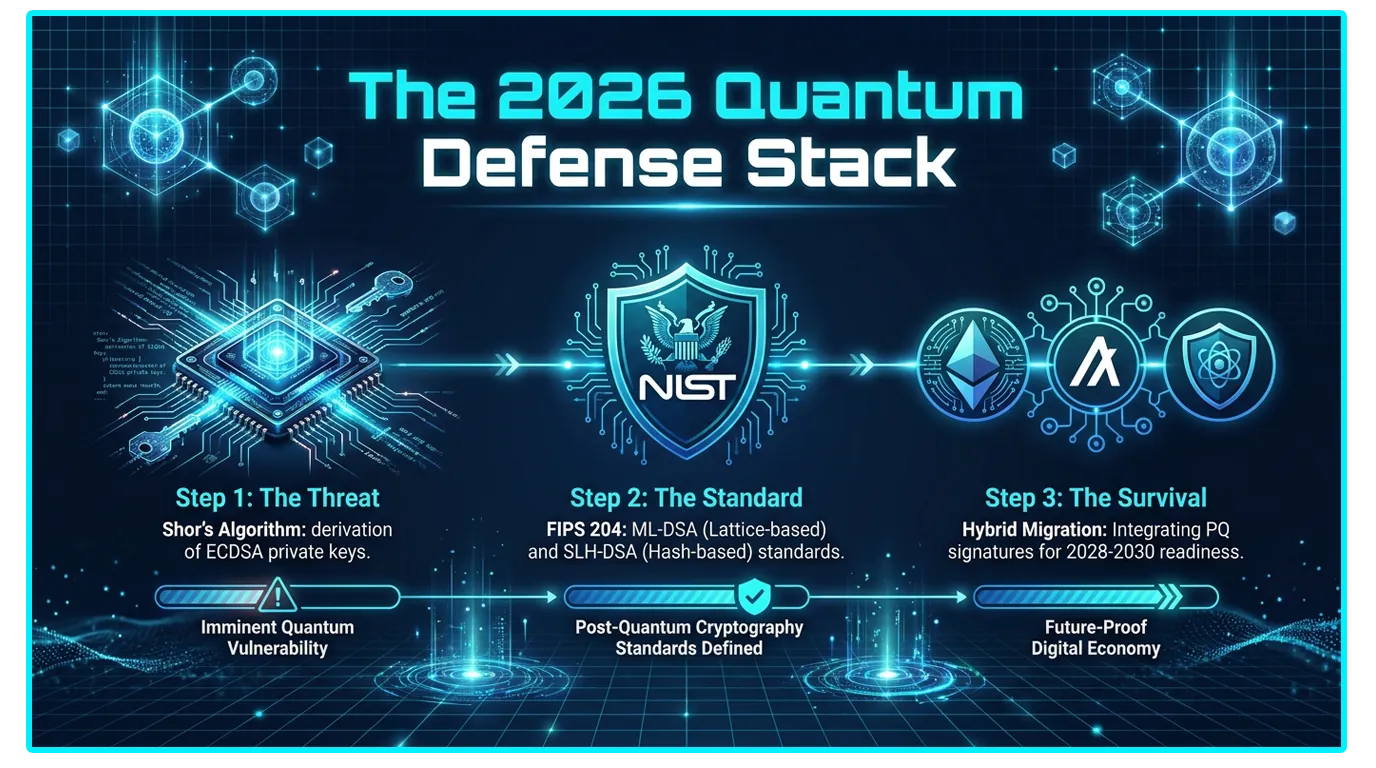
Digital Signatures (High Risk): Most blockchains, including Bitcoin and Ethereum, use the Elliptic Curve Digital Signature Algorithm (ECDSA). This algorithm is highly vulnerable to $Shor's\ Algorithm$. A quantum computer could potentially derive a private key from its public key in minutes, allowing it to spend funds from any address that has previously revealed its public key (e.g., any address that has sent a transaction).
Hashing (Low Risk): The SHA-256 algorithm used in Bitcoin mining is resistant to Shor's algorithm but susceptible to Grover's Algorithm. However, Grover’s only provides a quadratic speedup. To counter this, networks simply need to increase hash complexity or move to larger hash outputs (e.g., SHA-512), which is considered a manageable upgrade.
The "Harvest Now, Decrypt Later" (HNDL) Threat
- In May 2026, the most immediate concern for institutional players is HNDL. This strategy involves malicious actors or nation-states capturing and storing encrypted blockchain data today, with the intent to decrypt it once a CRQC becomes available.
- While HNDL is more concerning for private messaging and state secrets, it poses a long-term risk for "cold" blockchain addresses. If your public key is already visible on the ledger, the clock is effectively ticking on how long that data remains secure in an archived state.
Current State of Mitigation: The 2026 Leaders
The industry is currently in a "migration phase." Following the finalization of NIST’s post-quantum standards (FIPS 203, 204, and 205) in August 2024, several major networks have begun live implementations.
1. Ethereum: The Glamsterdam Upgrade
Ethereum’s Glamsterdam upgrade (H1 2026) has positioned post-quantum security as a central pillar of the network's safety strategy. The Ethereum Foundation’s PQ team is currently testing lattice-based signatures and hash-based signatures (like SPHINCS+) for future integration into the base layer. The focus is on "crypto-agility": the ability for the network to swap out cryptographic components without a hard fork.
2. Algorand: The Falcon Standard
In April 2026, the Coinbase Quantum Advisory Board named Algorand as one of the most "quantum blockchain" prepared Layer-1. Algorand successfully deployed its first live post-quantum transaction using Falcon-1024 signatures on its mainnet in late 2025. By utilizing lattice-based cryptography, Algorand has moved ahead of its peers in live, production-ready PQ tech.
3. QRL: The Native PQ Specialist
The Quantum Resistant Ledger (QRL) remains the benchmark for "native" quantum resistance. It utilizes the eXtended Merkle Signature Scheme (XMSS), a hash-based signature scheme that was standardized by NIST specifically for its resistance to Shor's algorithm. Because QRL was built from the ground up with this intent, it avoids the complex migration issues facing older, larger networks.
Comparative Schematic: Prototypical Blockchain Models
Traders and developers in 2026 use a three-tier model to evaluate the "Quantum-Safety" of their portfolios.
| Feature | Model A (Classic/Legacy) | Model B (Transitional) | Model C (Native PQ) |
| Examples | Bitcoin, Early Ethereum | Ethereum (Glamsterdam), Algorand | QRL (Quantum Resistant Ledger) |
| Cryptography | ECDSA (Secp256k1) | Hybrid (ECDSA + Falcon/Dilithium) | XMSS / SPHINCS+ |
| Threat Level | Extremely High (2028+) | Moderate (Migration in progress) | Low (Verified PQ) |
| Upgrade Path | Soft/Hard Fork required | Native "Agility" Hooks | No upgrade needed |
Verification and Market Forensics via DEXTools
In 2026, the "Post-Quantum" label has become a marketing buzzword, often used by scammers to launch "Quantum-Safe" tokens that are nothing more than standard honeypots. DEXTools remains the essential verification layer for distinguishing between technical reality and hype.
To monitor the DeFi market in an agile and secure way in real-time and trade Quantum-Ready assets with the help of the best crypto tools, you can access DEXTools here.Disclaimer: This article is for informational purposes only and does not constitute investment advice, financial advice, trading advice, or any other kind of advice. DEXTools does not recommend buying, selling, or holding any cryptocurrency or token. Users should conduct their own research and consult with a qualified financial advisor before making any investment decisions. Cryptocurrency investments are volatile and high-risk. DEXTools is not responsible for any losses incurred.
Related Guides
- Crypto DCA Calculator: Model Recurring Buys and Current Value (2026)
- Post-Trade Review Using DEXTools: How to Learn From Failed Crypto Trades
- Avoid Buying Old Token Contracts Post-Migration
- Airdrop Claim Rate vs Retention Explained
- What is VeChain (VET)? Supply Chain Blockchain Explained
Frequently Asked Questions
What is the risk of current cryptocurrencies from quantum computing?
Current cryptocurrencies, particularly those using Elliptic Curve Digital Signature Algorithm (ECDSA), are at risk from quantum computing due to vulnerabilities that could allow a quantum computer to derive private keys from public keys.
What is the 'Harvest Now, Decrypt Later' (HNDL) threat?
The HNDL threat involves malicious actors capturing and storing encrypted blockchain data today with the intent to decrypt it once a cryptographically relevant quantum computer becomes available, posing a long-term risk for blockchain addresses.
How are blockchains preparing for post-quantum security?
Blockchains like Ethereum and Algorand are implementing post-quantum cryptography strategies, such as testing lattice-based signatures and deploying quantum-resistant transactions to enhance their security against future quantum threats.
What cryptographic algorithms are vulnerable to quantum attacks?
The Elliptic Curve Digital Signature Algorithm (ECDSA) is highly vulnerable to quantum attacks, particularly Shor's algorithm, while SHA-256 used in Bitcoin mining is resistant but can be affected by Grover's algorithm.
What is the timeline for quantum computers affecting cryptocurrencies?
Experts project that a viable threat to cryptocurrencies using ECDSA could emerge as early as 2028-2030, prompting the need for migration to post-quantum cryptography.