What Is Staking in Crypto? How It Works, Rewards, Risks and Best Practices (2026)
— By Tony Rabbit in Tutorials
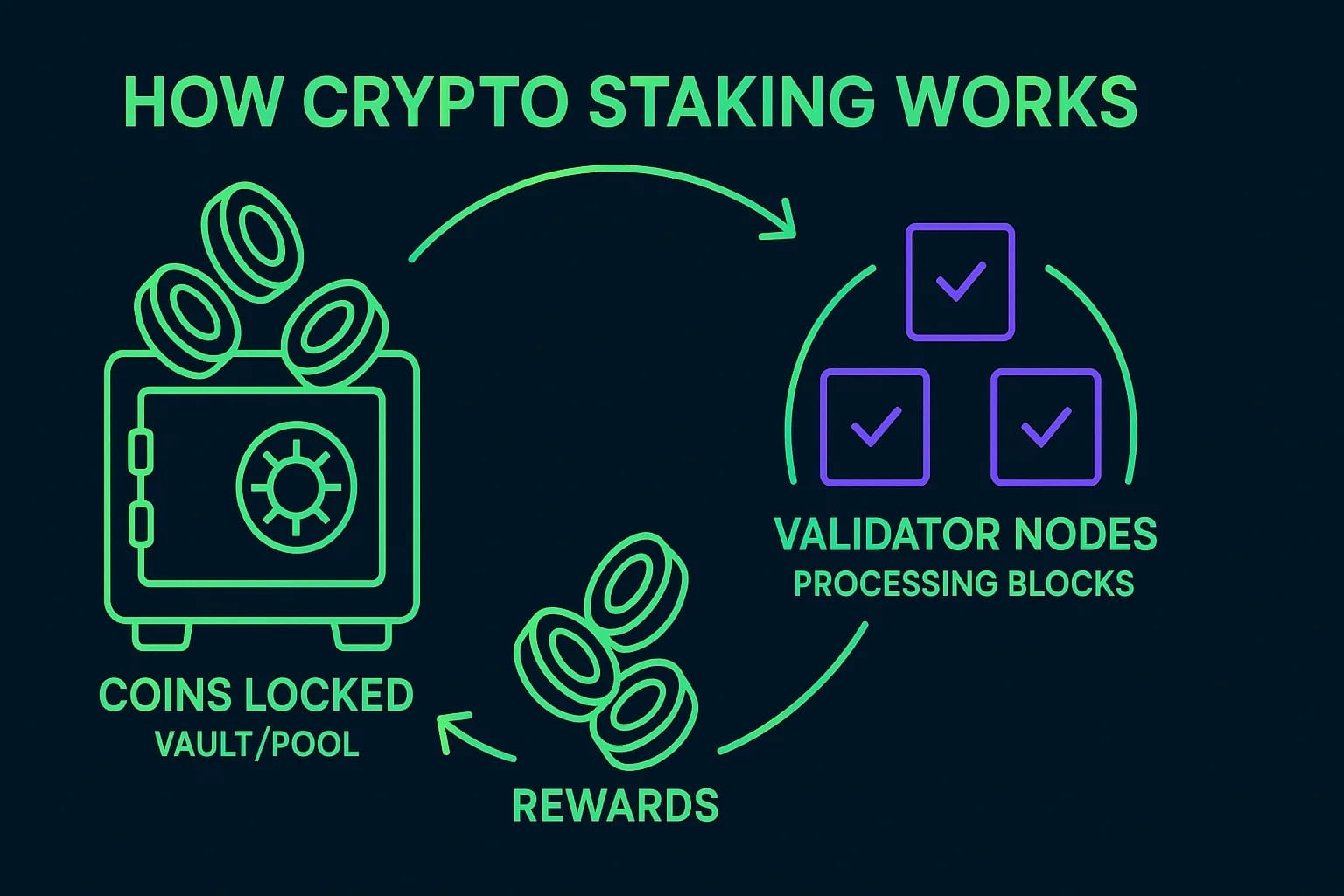
What is staking in crypto? Learn how staking works, compare native vs liquid staking, understand the biggest risks, and start earning safely in 2026.
Staking Explained: Earn Passive Income From Your Crypto

Staking is the process of locking up your cryptocurrency to help secure a blockchain network and earn rewards in return. Think of it like earning interest on a savings account - except instead of a bank, you're supporting a decentralized network, and the yields are typically much higher.
In 2026, staking has become one of the most popular ways to earn passive income in crypto. Major blockchains like Ethereum, Solana, Cardano, and many others offer staking rewards. This guide explains everything you need to know.
How Does Crypto Staking Work?
The 5-Step Process
- You lock (stake) your tokens - Your crypto is committed to the network as collateral
- Validators are selected - The network randomly selects validators to verify the next block. The more tokens staked, the higher the chance of being selected
- Blocks are validated - Selected validators verify transactions and add them to the blockchain
- Rewards are distributed - Validators (and their delegators) earn newly minted tokens and transaction fees
- Bad actors are punished - If a validator tries to cheat, they lose part of their staked tokens (slashing)
Proof of Stake vs Proof of Work
| Feature | Proof of Work (Bitcoin) | Proof of Stake (ETH, SOL) |
|---|---|---|
| Security method | Computing power | Locked tokens (stake) |
| Energy usage | ⚡ Very high | 🌱 Very low |
| Hardware needed | Specialized mining rigs | Standard computer or none |
| Earn rewards by | Mining blocks | Staking tokens |
| Penalty for cheating | Wasted electricity | 🔪 Slashing (lose tokens) |
| Accessibility | Requires investment in hardware | Anyone with tokens can participate |
Staking Rewards: How Much Can You Earn?
| Cryptocurrency | Staking APY | Unstaking Period | Min. Stake |
|---|---|---|---|
| Ethereum (ETH) | 3.5% - 5% | Variable (usually days) | 32 ETH (solo) or any (liquid) |
| Solana (SOL) | 6% - 8% | ~2-3 days | Any amount |
| Cardano (ADA) | 3% - 5% | None (liquid) | Any amount |
| Polkadot (DOT) | 10% - 14% | 28 days | 250 DOT |
| Cosmos (ATOM) | 15% - 20% | 21 days | Any amount |
| Avalanche (AVAX) | 7% - 9% | 14 days | 25 AVAX |
Types of Staking
Get stETH/mSOL back. Earn rewards and use in DeFi. Lido, Marinade, Jito.
Easiest option. Coinbase, Binance handle setup. 10-25% commission.
Risks of Staking
If your validator misbehaves (double-signing, excessive downtime), the network may slash a portion of staked tokens. Choose reputable validators with high uptime records.
Most networks require a waiting period before you can access staked tokens. If the price crashes during this time, you're stuck.
If you stake a token earning 8% APY but the token drops 50%, you've lost money despite earning rewards. Staking does not protect you from price depreciation. Always evaluate the token's market cap and fundamentals before staking.
Step-by-Step: How to Start Staking
Option A: Staking Solana (Beginner-Friendly)
Option B: Staking Ethereum (Liquid Staking)
Staking vs Other Passive Income Strategies
| Strategy | Typical APY | Risk Level | Complexity |
|---|---|---|---|
| 🔐 Native Staking | 3% - 15% | 🟢 Low-Medium | Easy |
| 💧 Liquid Staking | 3% - 10% | 🟡 Medium | Easy |
| 🌾 Yield Farming | 5% - 50%+ | 🔴 High | Advanced |
| 🏦 Lending (Aave) | 1% - 8% | 🟡 Medium | Easy |
How to Choose the Right Staking Method for Your Situation
One thing many ranking pages gloss over is that staking is not a single product. There are several ways to do it, and the best option depends on how much control, liquidity, and convenience you need. If you are staking long term bags that you do not plan to use, native staking is usually the cleanest path. If you want to earn yield while still using your position in DeFi, liquid staking is often the better fit. If you only care about simplicity, exchange staking is the easiest, but it also comes with custody risk and less transparency.
A good beginner framework is simple. Ask yourself three questions before you click stake. First, do you want to keep the asset liquid? Second, are you comfortable trusting a protocol or an exchange? Third, would a multi-day unlock period stress you out during a market selloff? If the answer to that last question is yes, then the unstaking window matters more than the headline APY.
| Method | Best For | Main Advantage | Main Tradeoff |
|---|---|---|---|
| Native staking | Long term holders | Direct validator exposure and fewer moving parts | Funds can be locked during unstaking |
| Liquid staking | DeFi users | You keep a liquid receipt token like stETH or mSOL | Extra smart contract and depeg risk |
| Exchange staking | Absolute beginners | Fast setup inside Binance or Coinbase | You do not control the coins while they are on the exchange |
| Restaking and higher-yield products | Advanced users | Potentially higher return stack | Usually higher complexity and more risk layers |
How to Evaluate a Validator or Staking Protocol Before You Commit
Choosing where to stake matters almost as much as deciding to stake in the first place. A validator with weak uptime, poor decentralization practices, or an aggressive commission structure can quietly reduce your real return. The same idea applies to liquid staking protocols. A famous brand name does not remove smart contract risk, governance risk, or liquidity risk.
For native staking, start with validator uptime, historical performance, commission, total delegated stake, and reputation in the community. A validator with 99.9% uptime and a reasonable commission is usually better than a flashy option promising the highest headline return. If one validator already controls too much of the network stake, splitting stake elsewhere can improve decentralization while still keeping your risk low.
- Check validator uptime and commission
- Confirm whether funds are subject to slashing
- Review the unstaking period before you deposit
- For liquid staking, confirm the protocol is audited and widely integrated
- Look at where the liquid staking token trades and whether it has ever depegged
- Never chase APY without understanding where the yield comes from
If you want a practical ETH example, compare native Ethereum staking with a liquid staking route like Lido. On Solana, compare native delegation inside Solflare or Phantom with a liquid staking route that keeps capital movable.
Common Staking Mistakes Beginners Make
The biggest beginner mistake is treating APY as if it were guaranteed profit. It is not. Your staking rewards are paid in the same token you are holding, so if that token falls hard, your portfolio can still end lower even after earning yield. A second mistake is ignoring liquidity. Many users only discover the unstaking timer when they want to exit during volatility, which is exactly when that lockup hurts most.
Another common mistake is staking from a wallet or platform you do not fully understand. If you are using exchange staking, learn the rules for withdrawals, reward schedules, and geographic restrictions. If you are using DeFi, understand whether you are doing native staking, liquid staking, or something more complex like yield looping or restaking. Those are not interchangeable. Finally, do not overconcentrate. Staking a single volatile altcoin is not the same as earning a stable savings yield. The asset itself still drives most of the risk.
- Chasing the highest APY instead of the best risk-adjusted setup
- Ignoring unlock windows until the market turns against you
- Confusing liquid staking with risk-free liquidity
- Leaving too much on an exchange just because staking is easier there
- Staking assets you do not actually want to hold for months
Staking Taxes and Liquidity Planning
Taxes are another area where many top-level explainers stay too vague. In many jurisdictions, staking rewards may be taxable when received, when sold, or both, depending on local rules. The exact treatment varies, so you should keep records of reward dates, amounts, and the token price at the time of receipt. That matters even more if you are frequently moving rewards into DeFi strategies like yield farming or depositing them into protocols like Aave.
A simple rule works well here: never stake 100% of a position if you may need liquidity soon. Keep a liquid buffer for gas, emergency exits, and tax obligations. That makes your staking plan much more durable during market stress. Staking works best when it is part of a broader portfolio plan, not when it is used as a desperate attempt to force yield out of a weak token.
When Staking Does Not Make Sense
Staking is often presented as an automatic yes, but there are situations where the better move is to stay liquid. If you expect to trade the position actively, if you are using the asset as emergency collateral, or if the token itself has weak fundamentals, the extra yield may not justify the loss of flexibility. This is especially true for smaller cap assets where price volatility can swamp any reward rate.
It also may not make sense to stake if the process forces you into extra protocol layers you do not fully understand. For example, if a user only wants safe ETH exposure, moving into a complex multi-step yield stack can create more operational risk than value. In those cases, simple self-custody or a smaller native staking position is usually the better answer.
Beginner Staking Checklist Before You Press Confirm
- Confirm you actually want to hold the asset through the entire unstaking period
- Decide whether you need liquidity before choosing native or liquid staking
- Keep a gas buffer outside the staking position
- Record entry date, amount, and reward receipts for taxes
- Review whether self-custody or exchange convenience matters more for this specific position
- Start with one major network first before adding more protocols
For most beginners, a measured first step on Ethereum or Solana is more than enough. You do not need five staking dashboards, three liquid staking tokens, and a yield loop to build a solid process. The winning setup is the one you can explain clearly, monitor easily, and exit safely when needed.
Native vs Liquid Staking: A Practical Decision Rule
If you are still undecided between native and liquid staking, use a simple rule. Choose native staking when your priority is simplicity, direct validator exposure, and lower protocol risk. Choose liquid staking when you know you want to keep the position usable elsewhere and you are comfortable monitoring depeg risk and protocol updates. This is not about which method is universally better. It is about which tradeoff profile matches your portfolio.
For example, a long term SOL holder might prefer direct delegation in a wallet and accept the short unlock window. An active ETH user who wants to keep deploying capital in DeFi may prefer a liquid staking token instead. The key is deciding first, then staking with intention rather than defaulting into whatever the exchange or app puts in front of you.
What to Monitor After You Start Staking
Staking is not fully passive once the deposit is made. You should periodically review validator uptime, reward consistency, governance changes, and whether the original reason for holding the token still applies. If a liquid staking token loses depth or trades below fair value, that also deserves attention. A five-minute monthly review is usually enough to catch the important things before they become expensive.
As a final rule, staking should follow conviction, not create it. If you would not hold the asset without rewards, staking alone is usually not a strong enough reason to own it.
That mindset keeps the process simple: choose the asset carefully, choose the staking method carefully, and only then compare APY.
Key Takeaways
- Staking is locking crypto to secure a PoS network and earning rewards in return (typically 3-15% APY)
- Proof of Stake replaced Proof of Work for most modern blockchains - it's more energy-efficient and lets you participate
- Liquid staking (Lido, Marinade) lets you earn rewards without locking up your tokens
- The biggest risk is price depreciation - 8% APY doesn't help if the token drops 50%
- Compare unstaking periods before committing - they range from instant (Cardano) to 28 days (Polkadot)
- Start with native staking on Solana or liquid staking on Ethereum for the best beginner experience
- Always DYOR and check the token's fundamentals before staking
Disclaimer: This guide is for educational purposes only. Staking involves risks including slashing, lock-up periods, and price volatility. Always do your own research before staking any cryptocurrency.
Related Guides
- What Is Ethereum Staking? How It Works, Rewards and Risks (2026)
- Ethereum Staking Rewards, Risks and Unstaking Rules (2026)
- What Is Airdrop Farming in Crypto? Strategy, Risks and Best Practices (2026)
- How to Farm on PancakeSwap: Liquidity, CAKE Rewards and LP Risks (2026)
- TON Staking Calculator: Estimate Toncoin Rewards Live (2026)
Frequently Asked Questions
What is staking in cryptocurrency?
Staking is the process of locking up your cryptocurrency to help validate transactions on a Proof of Stake blockchain. In return, you earn rewards similar to interest, typically ranging from 3% to 15% APY depending on the network.
Is crypto staking safe?
Staking on major networks like Ethereum and Solana is generally considered safe, but it carries risks including slashing (penalty for validator misbehavior), lock-up periods where you cannot sell, and the risk that the token price drops during staking.
How much can you earn from staking crypto?
Staking rewards vary by network. Ethereum offers 3-5% APY, Solana 6-8%, Cardano 3-5%, Polkadot 10-14%, and Cosmos 15-20%. Higher APY often comes with higher inflation or risk.
Can you lose money staking crypto?
Yes. The biggest risk is token price depreciation - if you earn 8% APY but the token drops 50%, you have a net loss. Other risks include slashing, smart contract bugs, and being unable to sell during the unstaking period.
What is the difference between staking and mining?
Mining (Proof of Work) requires expensive hardware and electricity to solve mathematical puzzles. Staking (Proof of Stake) requires locking up tokens as collateral. Staking uses 99.9% less energy and is accessible to anyone with tokens.
What is liquid staking?
Liquid staking lets you stake tokens and receive a derivative token (like stETH or mSOL) in return. This derivative earns staking rewards while remaining tradeable, so you do not have to choose between staking rewards and liquidity.