How Long Does It Take to Unstake Solana?

Learn how the Solana unstaking process works, how long it takes for SOL holders to regain access to their funds, and what to consider for effective capital management.
Full Guide for SOL Holders
- As we move through March 2026, the Solana ecosystem has matured into a cornerstone of the decentralized finance world. With the full implementation of the Firedancer validator client and the explosion of the restaking economy, staking remains the primary way for SOL holders to secure the network while earning a yield.
- However, one question remains paramount for every investor: how long does it take to get your money back? Whether you are a long-term staker or a newcomer exploring the high speeds of the Solana Virtual Machine, understanding the exit liquidity timeline is essential for effective capital management.
The Core Concept: Understanding the Solana Epoch
- To understand the unstaking timeline, you must first understand the Solana epoch. Unlike many other blockchains that use a fixed number of minutes or hours to define cycles, Solana operates on a system of slots. An epoch is a period of approximately 432,000 slots. In the current network environment of 2026, where block times are consistently optimized, an epoch typically lasts between two and three days.
- The epoch is the heartbeat of the network. It dictates when validator rewards are distributed and when changes to the staking pool take effect. When you initiate an unstaking request, you are essentially telling the network that you wish to move your SOL from an active state to a deactivating state. This change can only be finalized at the boundary of the next epoch.
Native Unstaking: The Standard Three-Step Process to Unstake Solana
Native staking, which involves delegating your SOL directly to a validator through a wallet like Phantom or Solflare, follows a strict protocol-level timeline. This process is divided into three distinct phases if you want to unstake Solana efficiently.
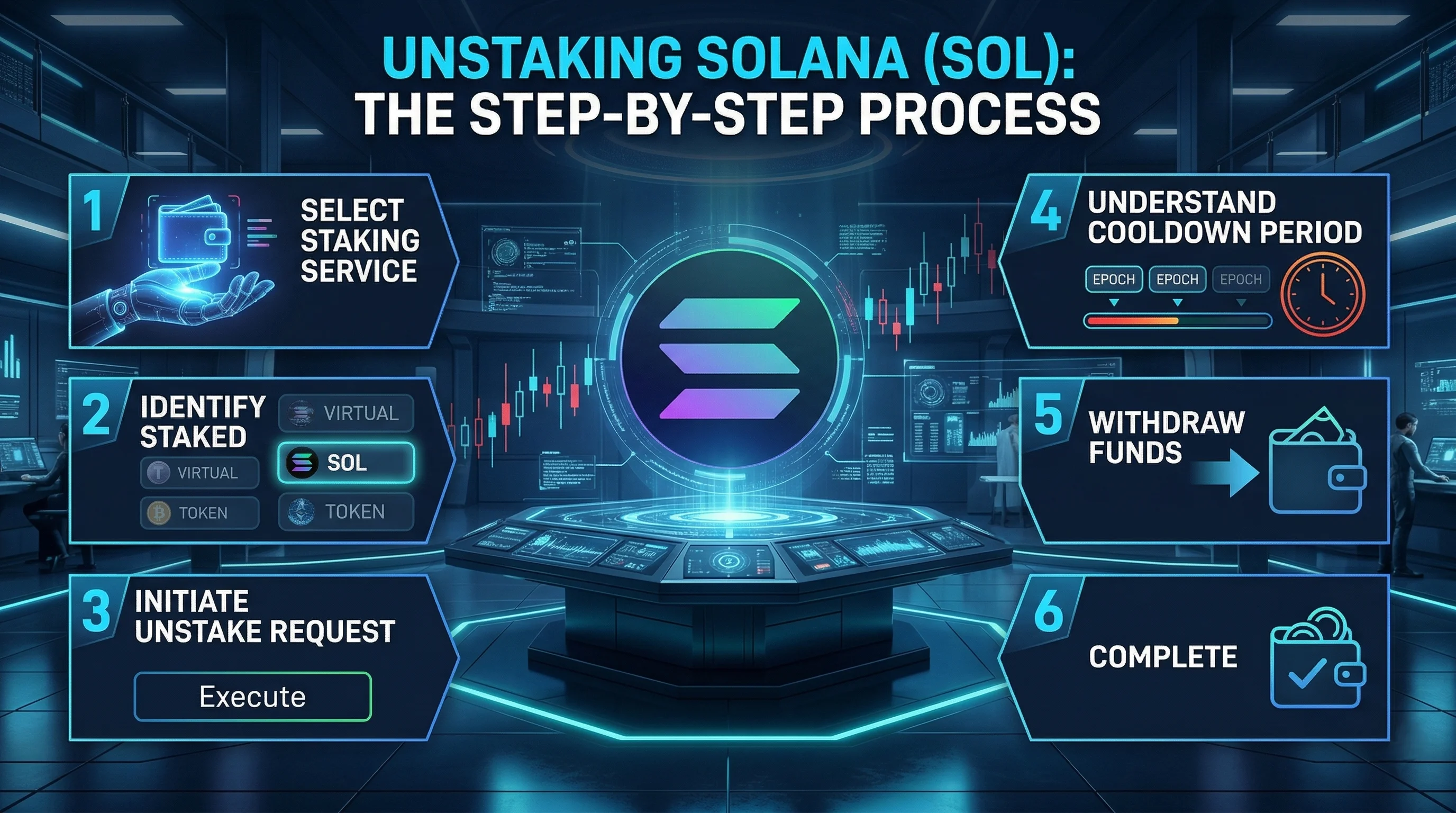
Phase One: Deactivation
The moment you click the unstake Solana button in your wallet, your stake enters the deactivating state. At this point, your SOL is still technically locked in the stake account, but it has stopped earning rewards for the upcoming epoch. You cannot move these tokens yet. They are in a warm-down period that ensures the network remains stable by preventing massive, instantaneous shifts in the total amount of secured capital.
Phase Two: The Waiting Period
This is where the epoch duration comes into play. If you deactivate your stake halfway through an epoch, you must wait for the remaining slots to be processed. For example, if an epoch has 48 hours remaining, your SOL will sit in the deactivating state for exactly that amount of time. If you happen to deactivate just ten minutes before the epoch ends, your waiting period will be remarkably short.
Phase Three: Withdrawal
Once the epoch boundary is crossed, your stake account status changes from deactivating to inactive. However, your SOL is not yet in your main wallet balance. You must perform one final manual transaction to withdraw the funds from the stake account into your spending wallet. This transaction is near-instant and costs a negligible gas fee, but it is a step that many users forget, leading them to believe their funds are still locked.
Liquid Staking: The Instant Alternative in 2026
By March 2026, liquid staking has become the dominant method for SOL holders to participate in the network. Protocols such as Jito, Marinade, and Jupiter offer liquid staking tokens, often called LSTs, which represent your staked SOL. Because these tokens are tradable on decentralized exchanges, the time it takes to unstake is effectively reduced to the time it takes to click a swap button.
How Instant Unstaking Works
When you hold a token like JitoSOL or mSOL, you have two ways to exit your position. The first is to use the protocol's official unstake feature, which follows the standard two to three day epoch wait time. The second is to simply swap your LST for native SOL on a decentralized exchange. In 2026, liquidity for these pairs is so deep that most retail users can exit positions of thousands of SOL with almost zero price impact. In this scenario, unstaking Solana takes less than ten seconds.
The Cost of Speed
It is important to note that while liquid staking provides instant access to capital, there is often a small cost. When swapping on a DEX, you might pay a tiny percentage in slippage or exchange fees. If you choose the native unstake route through the liquid staking provider's dashboard, you avoid these fees but must wait for the epoch to end.
The Impact of Restaking on Unstaking Times
- A significant development in 2026 is the rise of restaking protocols like Solayer and Jito's specialized restaking vaults. Restaking allows you to use your staked SOL to secure additional layers, such as oracle networks or AI-compute chains. This adds a layer of complexity to the unstaking timeline.
- When you unstake from a restaking vault, you may be subject to additional cooling-off periods. Some restaking protocols require a longer deactivation phase than the standard Solana epoch to ensure the security of the auxiliary services they support. If you are participating in these advanced yield strategies, always check the specific withdrawal terms, as they can sometimes extend the total wait time to five or even seven days.
Click unstake, wait, then manually withdraw.Must wait for the epoch to end (~36 hours).
Click unstake, wait, then manually withdraw.Instant liquidity via swap (Seconds).
Swap staked tokens for native SOL in one transaction.
Examples of Unstaking Scenarios
To make these timelines clearer, let us look at two different SOL holders trying to access their funds on March 24, 2026.
Example A: The Native Staker
Sarah has 500 SOL staked directly with a high-performance validator. On Monday at 10:00 AM, she decides she wants to sell her SOL. She clicks unstake, and her wallet informs her that the current epoch is only 40 percent complete. Based on current network speeds, she sees that the epoch will end in approximately 36 hours. Sarah must wait until Tuesday night for her SOL to become inactive. Once the epoch transitions, she logs back in, clicks withdraw, and her 500 SOL is finally available in her balance.
Example B: The Liquid Staker
David holds 500 JitoSOL, which he has been using to earn both staking rewards and MEV tips. On Monday at 10:00 AM, he decides he needs liquidity immediately to buy a new NFT. Instead of waiting for the epoch, David goes to a liquidity aggregator. He swaps his 500 JitoSOL for 512 native SOL, the extra reflects the rewards accrued over time, in a single transaction. Within seconds, the native SOL is in his wallet and ready to be spent.
Factors That Can Influence the Timeline
While the epoch is the primary timer, other technical factors in 2026 can influence your experience.
Network Congestion: While the Firedancer upgrade has largely eliminated the massive outages of the past, extreme market volatility can still lead to high demand for block space. This might make the final withdrawal transaction take slightly longer to confirm if you do not use a priority fee.
Validator Health: If the validator you have chosen goes offline or is delinquent, it does not change the unstaking time, but it does mean you will stop earning rewards during the period they are inactive.
Governance Proposals: In rare cases, emergency network upgrades or governance decisions could temporarily pause staking functions, though this has not occurred in the current 2026 landscape.
Managing Your Exit Strategy
The key to a successful experience with Solana staking is planning. If you know you will need your funds by a certain date, always initiate the deactivation process at least four days in advance to account for any epoch variances. Alternatively, maintaining a portion of your portfolio in liquid staking tokens ensures that you are never caught off guard by a sudden need for cash.
In the fast-moving market of 2026, being stuck in a deactivation cycle while prices are shifting can be stressful. By choosing the right staking method and understanding the underlying mechanics of the Solana clock, you can maximize your rewards without sacrificing your financial flexibility.
Key Points to Unstake Solana Properly
Standard Wait Time: Native unstaking takes one full Solana epoch, which is generally between two and three days.
The Epoch Mechanism: Unstaking only becomes effective at the boundary between epochs, not the moment you request it.
The Manual Step: After the waiting period, you must manually withdraw funds from the stake account to your main wallet.
Liquid Staking Benefits: Tokens like JitoSOL and mSOL allow for instant unstaking via DEX swaps, bypassing the epoch wait.
Restaking Delays: Newer restaking protocols in 2026 may have longer withdrawal windows than standard native staking.
No Rewards During Warm-down: Once you start the deactivation process, you stop earning staking rewards for that SOL.
If you are looking to trade your SOL or manage your liquid staking positions with the highest level of security and real-time data, I invite you to explore the Solana ecosystem here through the DEXTools dashboard. It provides the most comprehensive tools for monitoring price action and liquidity, ensuring you can trade safely and efficiently in the 2026 market.
Disclaimer: This article is for informational purposes only and does not constitute investment advice, financial advice, trading advice, or any other kind of advice. DEXTools does not recommend buying, selling, or holding any cryptocurrency or token. Users should conduct their own research and consult with a qualified financial advisor before making any investment decisions. Cryptocurrency investments are volatile and high-risk. DEXTools is not responsible for any losses incurred.
Related Guides
- Long vs Short in Crypto: Complete Guide with Examples (2026)
- How to Stake and Unstake ETH on Coinbase: cbETH, Exit Paths and Fees (2026)
- Take Profit vs Stop Loss in Crypto: Key Differences, Trigger Logic and Fill Risk (2026)
- Memecoin Trading Strategy: When to Take Profits
- Is Dogecoin A Meme Coin? Let's take a closer look
Frequently Asked Questions
How long does it take to unstake Solana?
Unstaking Solana typically takes between two to three days, depending on the epoch duration, which is approximately 432,000 slots.
What is the process to unstake Solana?
The process to unstake Solana involves three phases: deactivation, a waiting period based on the epoch duration, and finally, a manual withdrawal of funds to your spending wallet.
What happens during the waiting period when unstaking Solana?
During the waiting period, your SOL remains in a deactivating state and stops earning rewards until the current epoch ends.
What is liquid staking in Solana?
Liquid staking allows SOL holders to use tradable tokens that represent their staked SOL, enabling instant access to liquidity through decentralized exchanges.
Can I withdraw my staked SOL immediately after unstaking?
No, after unstaking, you must wait for the epoch to end and then perform a manual transaction to withdraw your SOL to your main wallet.